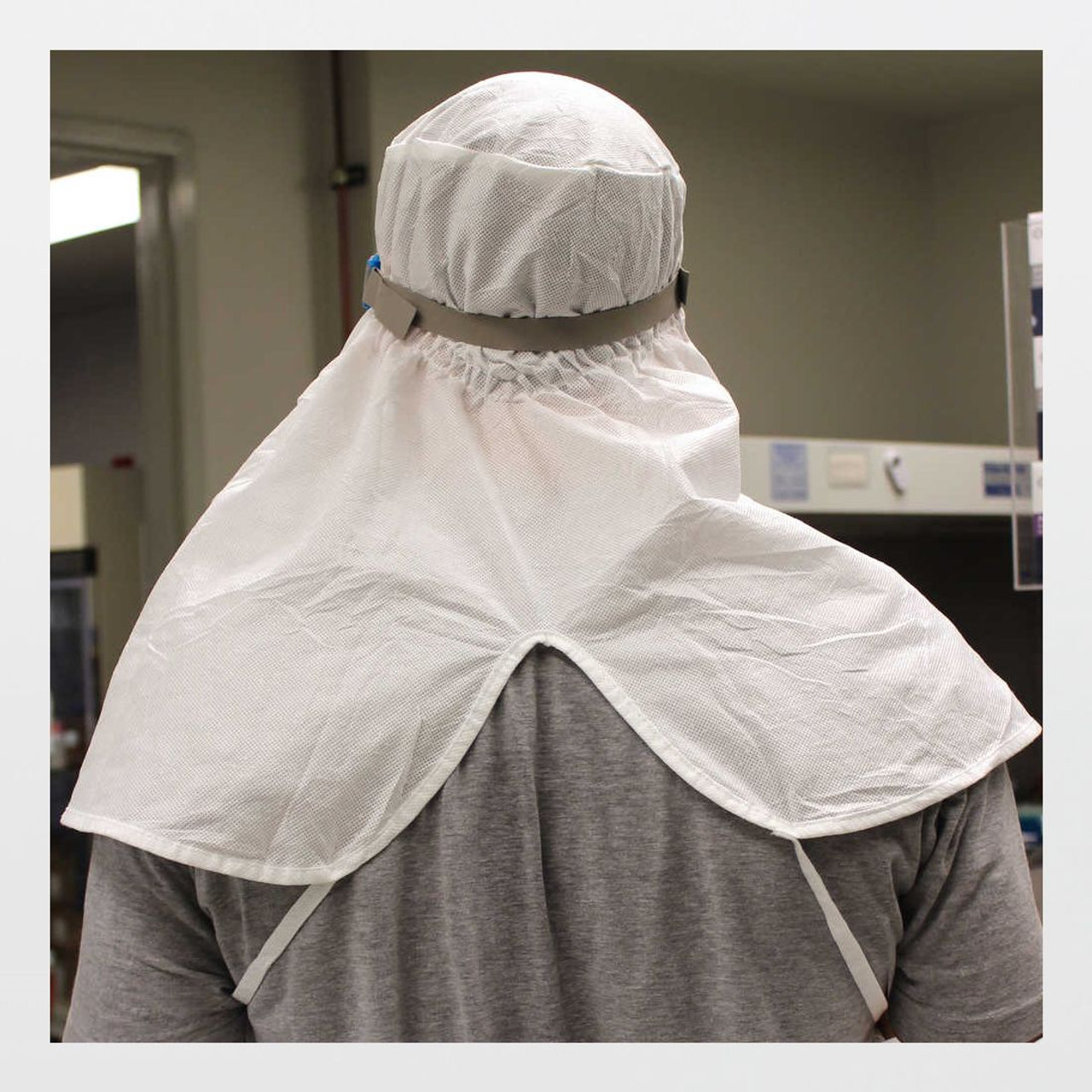
Kimberly-Clark Kimtech Pure A5 Sterile Integrated Hood and Mask

$698.01
(No reviews yet)
SKU:
36072
Availability:
5 - 7 Business Days
Shipping:
Calculated at Checkout
Quantity Option (Case):
75 Hoods
Kimberly-Clark Kimtech PURE® A5 Sterile Integrated Hood and Mask — CLEAN-DON™ Technology, Triple-Bagged Vacuum Packaging, ISO Class 5+ Ready (75/Case)
Sterile (SAL 10-6) Integrated Hood + Mask CLEAN-DON™ Donning System ISO Class 5+ Suitable Triple-Bagged + Vacuum Packed Latex-free / Silicone-free / No BHT 75 Sets / Case

Overview

Kimtech PURE® A5 Sterile Integrated Hood and Mask sets combine head coverage and mask protection into one sterile, cleanroom-ready component to help reduce exposure gaps and simplify aseptic gowning. CLEAN-DON™ technology is designed to streamline donning while reducing unnecessary contact with the garment exterior.

SOSCleanroom standardizes critical-environment PPE around best-in-class manufacturers—including Kimtech™ (Kimberly-Clark Professional) and Ansell—because consistency, documentation, and supply continuity materially affect yield, sterility assurance, and audit confidence.


Why this hood + mask matters in critical environments
  • Fewer interfaces, fewer gaps: Integrated construction helps minimize the hood-to-mask gap risk during movement and task transitions.
  • Aseptic donning support: Folded presentation and a visible internal donning indicator help staff don without grabbing the outside surface.
  • Sterile presentation control: Individually bagged sets with sterility indicator; triple-bagged and vacuum packaged to support staged introduction into controlled areas.
  • Cleanroom-ready materials: Manufactured and packaged under cleanroom conditions; suitable for ISO Class 5 or higher cleanrooms (per published information).
  • Residue risk reduction: Not made with natural rubber latex and stated as silicone-free and BHT-free for programs where residues and sensitizers are tightly controlled.

Typical cleanroom tasks supported
  • ISO-classified aseptic processing support activities where sterile head + mask coverage is required by SOP
  • Sterile staging and material transfers (airlocks, pass-throughs, aseptic set-ups)
  • Cleanroom cleaning and disinfection workflows where face/neck boundary control is needed
  • Pharma, biotech, medical device, and microelectronics operations with documented gowning discipline

Key specifications (published)
SOSCleanroom SKU / code 36072 (Kimtech PURE® A5 Sterile Integrated Hood & Mask)
Cleanroom suitability Suitable for ISO Class 5 or higher cleanrooms (published)
Sterility / method Gamma irradiated; Sterility Assurance Level (SAL) 10-6 (published)
Material 100% polypropylene breathable SMS fabric (published)
Construction Integrated hood/mask; sonically welded together; designed to reduce exposure gaps (published)
Donning support CLEAN-DON™ ties; folded inside-out for aseptic donning; interior indicator line (published)
Packaging Individually bagged with sterility indicator; triple-bagged and vacuum packaged (published)
Residue/sensitizer statements Not made with natural rubber latex; stated silicone-free and BHT-free (published)
Color / case pack White; 75 sets per case

Note: Always verify PPE selection against your site hazard assessment and gowning SOP. A hood/mask combo supports contamination control; it does not replace respiratory protection requirements where respirators are mandated.


Human facial skin is a well-documented source of contamination in controlled environments due to:

  • Continuous shedding of skin squames
  • High microbial bioburden (nose, mouth, chin, beard area)
  • Aerosolization from breathing, talking, coughing, and facial movement

Multiple cleanroom studies attribute >80% of viable airborne contamination to personnel, with the face being one of the highest-risk zones.

Environment / Standard Cleanroom Classification Exposed Facial Skin Required Facial Coverage Notes for SKU Pages
USP <797> Sterile Compounding ISO 5 (PEC) Not permitted Mask covering nose & mouth, hood covering head, face, neck; beard cover if applicable Exposed facial skin is a direct sterility risk; full facial coverage expected
USP <797> Buffer Room ISO 7 Not permitted Hood, mask, beard cover; no exposed skin above gown neckline Personnel are the dominant contamination source
USP <800> Hazardous Drugs ISO 5–7 Not permitted Full facial coverage with sealed interfaces Protects both product and operator
EU GMP Annex 1 (Grade A/B) ISO 5–7 equivalent Not permitted Full head, face, and neck enclosure Exposed skin incompatible with aseptic processing
ISO 14644 (Operations) ISO 5–6 Strongly discouraged / industry expectation: No Mask + hood; minimize exposed skin Risk-based enforcement; exposure difficult to justify
ISO 14644 (Operations) ISO 7 Risk-based; generally discouraged Mask and hair covering recommended Requires documented contamination control rationale
ISO 14644 (Operations) ISO 8 Conditionally permitted Mask recommended depending on task Acceptability depends on proximity to critical areas
USP <795> Non-Sterile Compounding Controlled (non-ISO or ISO 8) Permitted with justification Hair cover; mask recommended Risk assessment and SOP documentation required

Note: Gowning requirements vary by application, facility SOP, and regulatory authority. This chart is provided for general guidance only. Users are responsible for ensuring compliance with current USP chapters, ISO standards, and local regulatory interpretations.


Packaging and sterile presentation

Controlled packaging is part of contamination control. These sets are published as individually bagged (with sterility indicator) and supplied triple-bagged and vacuum packaged, supporting staged introduction and point-of-use sterility maintenance in controlled areas.

Best practice: define where bags are opened (airlock vs. gown room), how outer bags are removed, and how opened inventory is protected from recontamination between shifts.


EU GMP Annex 1 alignment notes (practical)

Annex 1 programs typically treat gowning as part of the facility’s Contamination Control Strategy (CCS). Selection is only one control—outcomes depend on validated donning technique, change triggers, training, and documentation.

  • Boundary control: use a validated sequence that protects the face/neck interface and avoids contact with the exterior.
  • Change strategy: define triggers (tear, wetting, touch of uncontrolled surfaces, leaving the area, time-based changes).
  • Traceability: maintain lot/expiry traceability and control substitutions under change management.

Storage and lifecycle control
  • Store sealed cases in a clean, dry location; protect vacuum packaging from puncture or crushing.
  • Use FIFO and verify sterility indicators and packaging integrity before staging into controlled zones.
  • Discard if any seal is compromised or if SOP-defined change triggers occur during use.

Standards and regulatory references (context)


If you have any questions please email us at Sales@SOSsupply.com or give us a call at (214) 340-8574. OR check out the AI ChatBot powered by SOSCleanroom data libraries - give it a try! THIS IS NEW FOR 2026! © 2026 SOSCleanroom. All rights reserved.
The Technical Vault
Kimtech PURE® A5 Sterile Integrated Hood & Mask
By SOSCleanroom
ISO-first education — Annex 1 aware
CLEAN-DON™ technique Head/face boundary control Aseptic gowning discipline Best-in-class PPE systems
Why integrated hood + mask is a high-value control

In critical environments, the face/neck boundary is a common vulnerability: movement, talking, and task transitions can create micro-gaps where contamination risk increases. An integrated hood/mask is designed to reduce that interface risk and standardize how operators don this portion of the gowning system.

  • Fewer steps: combining hood + mask reduces handling and potential touch points.
  • Reduced gap risk: integrated construction is intended to minimize exposure gaps between components.
  • Process discipline: consistent donning creates repeatable outcomes—important for CCS, deviation prevention, and audit readiness.

ISO-first: how this supports contamination control

ISO 14644 classification is based on airborne particle concentration. People are a primary contamination source, so head/face coverage is used to reduce particle generation and transfer. Even when your room is not formally ISO classified, you can apply the same logic: reduce shedding, reduce transfer, and control contact surfaces at the operator interface.


Annex 1: CCS mindset for gowning components

Annex 1 programs typically document gowning as part of the Contamination Control Strategy (CCS). That means your success is not the SKU alone: it is training, validated donning technique, defined change triggers, and documentation discipline.

  • Validated sequence: define and train a step-by-step gowning method, including how the hood/mask is handled and tied.
  • Glove interface: confirm hood coverage integrates cleanly with collar/coverall and does not interfere with goggles/face shields where required.
  • Change triggers: tears, wetting, contact with uncontrolled surfaces, leaving the area, or time-based changes per SOP.

CLEAN-DON™ technique: practical donning steps (training-style)
  1. Prep first: complete hand hygiene and don required under-layers (hair/beard control, inner gloves) per SOP.
  2. Open correctly: remove only the outermost bag at each stage (airlock/gown room as defined) to prevent pre-use contamination.
  3. Use the interior indicator: grasp the designated internal area (blue-line indicator) to avoid touching the outside surface.
  4. Seat the mask, then the hood: position for full coverage at the cheeks/jawline; ensure hairline and nape are fully covered.
  5. Secure ties: use the pull-down ties to stabilize fit; avoid over-handling or re-adjusting once seated.
  6. Final check: confirm there are no visible gaps, no twisted ties, and that subsequent garments (coverall/collar) do not pull the hood out of position.

Training tip: build a short proficiency check into onboarding (correct grasp point, correct tie method, and what to do after an accidental exterior touch).


Build the complete best-in-class system

The hood/mask is one component of the personnel barrier. For best results, standardize the complete kit (hood/mask, coverall/gown, gloves, boots, sleeves) using manufacturer documentation and site change control. SOSCleanroom emphasizes best-in-class lines (Kimtech and Ansell) so customers can maintain consistent specs and documentation.

Glove pairing (critical) Use sterile cleanroom gloves per SOP (commonly double-glove). Ansell sterile cleanroom gloves are a best-in-class option for programs that require reliable documentation and performance consistency.
Surface wipe discipline For controlled wipe-down and staging, add cleanroom-grade wipers and swabs: Texwipe AlphaWipe® TX1009, Texwipe Vectra® TX1060, Texwipe TX761 Swab.

Documentation (qualification + training)

Best practice: keep these documents in your qualification packet and reference them during change control reviews to prevent substitutions that introduce process drift.


If you have any questions please email us at Sales@SOSsupply.com or give us a call at (214) 340-8574. OR check out the AI ChatBot powered by SOSCleanroom data libraries - give it a try! THIS IS NEW FOR 2026! © 2026 SOSCleanroom. All rights reserved.