The Technical Vault
By SOSCleanroom
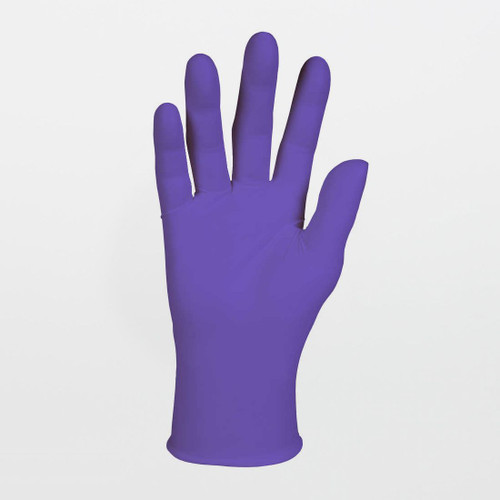
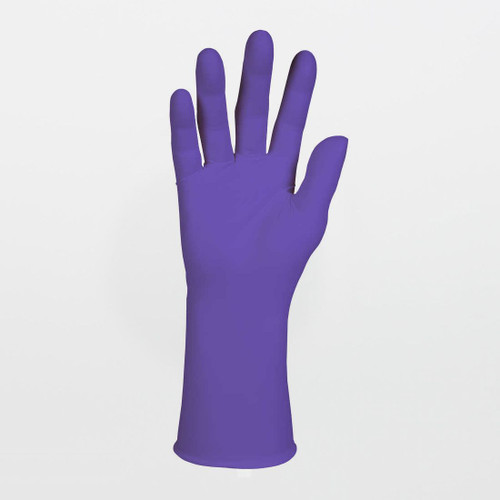
Kimtech Purple Nitrile Exam Gloves (Kimtech 5508x) — 9.5" powder-free nitrile with published AQL 1.5 and ~6.0 mil fingertip gauge for lab and controlled-area work
Nitrile
Non-sterile exam glove
Textured fingertips
Beaded cuff
AQL 1.5 (published)
Chemo cleared (published)
RightCycle eligible (published)
Product family shown. Select your size at checkout (XS–XL).
Where this glove fits best
Kimtech Purple Nitrile is designed as a premium non-sterile exam glove for laboratories and controlled work areas where consistent defect control, dexterity, and quick donning matter. For aseptic processing and ISO-class cleanrooms, use sterile, cleanroom-validated gloves that publish particulate/bioburden controls and sterility assurance.
1) Practical solutions in a critical environment
Gloves are often the highest-frequency consumable a technician touches, which makes them a controllable risk lever: pinholes and micro-tears drive direct exposure risk, while poor donning, wrong sizing, and overextended wear drive cross-contamination. Kimtech Purple Nitrile is positioned for “high-use, high-turn” workflows where teams need a durable, powder-free nitrile with published defect control and predictable tactile response.
The current Kimtech portfolio is now aligned under Ansell following Ansell’s acquisition of Kimberly-Clark’s PPE business. That matters operationally because Ansell is an integrated PPE manufacturer with broad lab and industrial safety brands, and it has explicitly expanded Kimtech and RightCycle in North America and Europe as part of that transition. The intent is continuity of supply and a more standardized technical support model across glove families.
2) What it’s for
- General lab handling: routine wet work, sample handling, and bench tasks where splash exposure is incidental (not primary chemical PPE).
- High-frequency glove changes: dispensing-friendly box design is intended to reduce multiple pulls and dropped gloves.
- Task work that benefits from tactile feel: textured fingertips with an exam-grade nitrile film for dexterity and grip.
- Programs seeking reduced landfill waste: published eligibility for RightCycle glove recycling where permitted by your waste classification.
- Chemotherapy drug handling where a “chemo cleared” exam glove is specified by your program (always validate against your facility’s drug list and internal policy).
3) Why should customers consider this swab
- Published defect control: AQL 1.5 for critical defects is commonly used as an “upgrade point” versus general exam gloves that only meet baseline AQL expectations.
- Gauge built for durability + feel: published fingertip gauge is ~5.9 mil (often described as a 6.0 mil class glove) to balance tear resistance with tactile sensitivity.
- Powder-free nitrile polymer: avoids natural rubber latex and reduces powder-related residue concerns for many labs.
- Box dispensing engineered to reduce waste: SmartPull-style two-opening concept is positioned to cut dropped-glove waste as the box level changes.
- Program alignment: published RightCycle eligibility supports sustainability initiatives when your EHS team classifies used gloves as non-hazardous and acceptable for the program.
4) Materials and construction
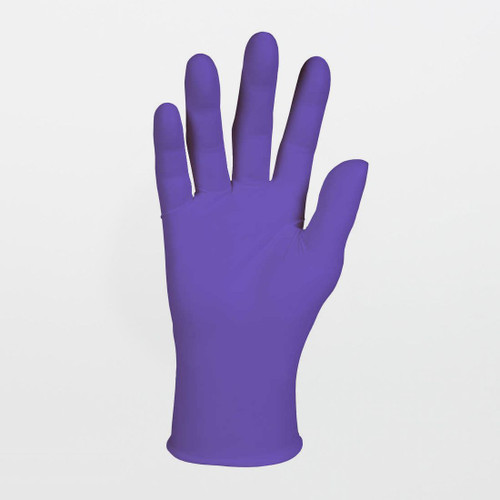
Kimtech Purple Nitrile Exam Gloves are described as purple nitrile, powder-free, non-sterile, ambidextrous gloves with textured fingertips and a beaded cuff. Published construction notes include single chlorination, which is commonly used in nitrile glove manufacturing to support donning and reduce tack.
If your process is residue-sensitive (analytical chemistry, trace work, optical assembly, microelectronics), your practical decision point is whether you need cleanroom-processed/sterile glove controls with published cleanliness metrics. This exam glove family focuses on exam-performance and defect control rather than cleanroom particulate/ionic baselines (not published in the linked technical data sheet).
5) Specifications in context
| Specification |
Published value |
Why it matters on the floor |
| Length |
242 mm (9.5") |
Standard coverage for bench work; reduces cuff roll exposure with a beaded cuff and correct sizing. |
| Gauge (middle finger / palm / cuff) |
0.15 / 0.12 / 0.09 mm (5.9 / 4.7 / 3.5 mil) |
Fingertip gauge drives puncture/tear resistance where technicians pinch and twist most. |
| Tensile strength / elongation |
21 MPa; 550% (before aging) / 500% (after aging) |
Useful for comparing “snappiness” and tear propagation risk when pulling tight over the knuckles. |
| Finish |
Powder-free; textured fingertips; ambidextrous; beaded cuff |
Powder-free reduces powder transfer risk; texture improves grip on wet glass and plastics. |
| Sizes / codes (non-sterile purple nitrile) |
55080 (XS), 55081 (S), 55082 (M), 55083 (L), 55084 (XL) |
Code discipline supports receiving inspection and prevents size substitutions that drive tears and contamination events. |
SOSCleanroom’s product listing is sold by the case (10 boxes/case), with 100 gloves/box for XS–L and 90 gloves/box for XL. Published palm widths (mm) are 70 (XS), 80 (S), 95 (M), 110 (L), 120 (XL), which is useful for reducing “wrong-size” tear events that masquerade as glove quality issues.
6) Cleanliness metrics
For exam gloves, “cleanliness” is typically expressed through powder status, water-tightness/defect control, and packaging/traceability discipline. The linked technical data sheet does not publish particle counts, ionic extractables, NVR, bioburden, or sterility assurance for this non-sterile family; if your process requires those, specify a cleanroom-processed or sterile cleanroom glove with published contamination controls.
| Metric |
Published value |
Test method / note |
| Powder status |
Powder-free |
Published product description / sell sheet. |
| Critical defects (pinholes) |
AQL 1.5 (published) |
Sell sheet notes ASTM D6319 baseline AQL 2.5 and claims AQL 1.5 for critical defects. |
| Watertightness |
Pass |
ASTM D5151 (noted with 1.0 AQL on the technical data sheet). |
| Sampling procedures |
ISO 2859-1 referenced |
Technical data sheet references ISO 2859-1 for AQL sampling definitions. |
| Manufacturing quality system |
ISO 9001 (published) |
Sell sheet statement. |
7) Packaging, sterility, and traceability
- Sell unit: SOSCleanroom lists this glove as case-only: 10 boxes of 100 gloves (1,000 gloves/case), with XL at 90 gloves/box (900 gloves/case).
- Non-sterile: This is an exam-glove family; do not treat it as a sterile barrier or as a cleanroom sterile glove unless your documentation specifically states otherwise.
- Lot/batch labeling: The technical data sheet states shipping case and inner packaging should be labeled with product name, size, lot/batch, and catalog number.
- Dispensing control: The sell sheet describes a two-opening “SmartPull” dispensing concept intended to reduce waste from multiple pulls and dropped gloves as the box level changes.
8) Best-practice use
Start with the risk question, not the glove color. In GMP and Annex 1-aligned environments, glove choice is part of a contamination control strategy (CCS): define what the glove must prevent (chemical exposure, bioburden transfer, particulate, extractables), then specify the glove family that publishes the right controls.
- Size discipline: Use palm width and fit as a controlled variable. Oversized gloves slip and snag; undersized gloves tear at the thumb crotch and knuckles.
- Donning discipline: Dry hands, pinch at the cuff, and avoid stretching across fingernails. A “fast don” is where most micro-tears start.
- Change frequency: Set a clock (time-based) plus triggers (tear, splash, touching non-controlled surfaces). The safest glove is the one you replace on schedule.
- Alcohol compatibility: If you use IPA for glove wipe-down, verify your glove film does not become tacky or brittle in your dwell times. Repeated wipe-down is not the same as repeated sanitizer exposure.
- Cytotoxic handling: If your chemo program specifies “chemo cleared” gloves, validate against your SOP, drug list, and any required double-gloving / change intervals. If your SOP requires ASTM D6978-type performance evidence, obtain the current documentation for the exact glove code and revision.
- Escalation rule: If you see repeated defects, stop blaming “a bad box.” Check glove size, donning technique, sharp-edge contact points, and chemical swell effects before escalating to supplier investigation.
9) Common failure modes
- Thumb-crotch tearing: most common when gloves are undersized, donned aggressively, or stressed during repetitive pinch/rotate tasks.
- Solvent swell and softening: nitrile performance changes with certain solvents; a glove that “feels fine” can lose tear resistance after exposure.
- False security in non-sterile gloves: using exam gloves in aseptic zones without a validated sterile glove strategy undermines CCS intent.
- Cross-contamination from extended wear: the longer a glove stays on, the more it becomes a transfer tool. Schedule changes like a process control, not a convenience.
10) Closest competitors
In the exam-glove lane, the right comparison is not brand recognition; it is the combination of published AQL, gauge, allergen/powder status, chemo documentation needs, and how the glove behaves after repeated sanitizer and wet work.
- Basic SynGuard Nitrile Examination Gloves (SOSCleanroom): positioned as powder-free, medical-grade nitrile. Use this when you need a general exam glove and your workflow does not require the same published defect-control emphasis.
- TechNiGlove RV400 Series 9.5" Nitrile Gloves (SOSCleanroom): positioned as accelerator-free, powder-free, and low-extractable. Consider this lane when chemical sensitivity/dermatitis or certain residue controls drive your selection more than maximum durability.
If your actual requirement is ISO-class cleanroom work, aseptic compounding, or Annex 1-aligned operations, the better “competitor set” is cleanroom-validated sterile gloves (with published cleanliness/sterility controls) rather than general exam gloves.
11) Program fit
- Best fit: labs, research, and controlled work areas that want a premium non-sterile nitrile exam glove with published AQL and a durability-forward gauge profile.
- Good fit with documentation needs: organizations that want supporting documents (TDS, quick reference guide, chemical resistance guidance) tied to a stable product code set (55080–55084).
- Not the right fit: ISO 5/Grade A aseptic operations or sterile compounding steps that require sterile glove control, validated disinfection practices, and documented sterility assurance for the glove itself.
12) SOP disclaimer
This Technical Vault entry provides practical guidance and suggested controls for customer consideration. It is not a substitute for your written procedures, validation, training, environmental monitoring plan, or regulatory interpretation.
Customers must evaluate glove selection, change frequency, disinfection compatibility, and cytotoxic-handling requirements in the context of their specific process, risk assessment, and applicable standards. Always follow your site SOPs, quality unit requirements, and EHS guidance.
13) Source basis
Product + documentation
- SOSCleanroom product page: https://www.soscleanroom.com/product/kimtech/kimberly-clark-kimtech-purple-nitrile-exam-gloves/
- SOS-hosted Technical Data Sheet (Rev. Dec 2013): https://www.soscleanroom.com/content/Kimberly_Clark_PDF/PURPLE-NITRILE-Exam-Glove-Technical-Data-Sheet.pdf
- SOS-hosted Sell Sheet (P15-5554, 3/15): https://www.soscleanroom.com/content/Kimberly_Clark_PDF/Kimberly-Clark-Purple-Nitrile-Exam-Gloves-Sell%20-Sheet.pdf
- SOS-hosted Exam Gloves Quick Reference Guide (D14-4172, 12/14): https://www.soscleanroom.com/content/Kimberly_Clark_PDF/Exam%20Gloves%20Quick%20Reference%20Guide.pdf
- SOS-hosted Kimtech Scientific Products Catalog (2018 Edition): https://www.soscleanroom.com/content/Kimberly_Clark_PDF/2018%20Scientific%20Catalog.pdf
- SOS-hosted Nitrile Chemical Resistance resource (poster): https://www.soscleanroom.com/content/Kimberly_Clark_PDF/K4556_10_01%20Ntrl_Chem_pstr_v3.pdf
Manufacturer + corporate transition context
- Kimberly-Clark Professional / Kimtech product page (sterile purple nitrile family reference): https://www.kcprofessional.com/en-us/products/scientific-and-research/lab-environment/hand-protection-and-gloves/kimtech-sterile-purple-nitrile-exam-gloves/55091
- Ansell transition / Kimtech and RightCycle portfolio expansion (Business Wire, 2025): https://www.businesswire.com/news/home/20250302096825/en/Ansell-Expands-Portfolio-to-Include-Kimtech-KleenGuard-and-RightCycle-Brands-in-North-America-and-Europe/
Referenced standards bodies (for customer lookup)
- ASTM (test methods referenced on TDS/sell sheet, including D6319, D5151, D412, D573): https://www.astm.org
- ISO (cleanroom classification reference): https://www.iso.org/standard/53394.html
- IEST (controlled environment practices): https://www.iest.org
- FDA (cGMP context and quality expectations): https://www.fda.gov
Source: SOSCleanroom Technical Vault entry for Kimtech Purple Nitrile Exam Gloves (Kimtech 5508x family).
Briefed and approved by the SOSCleanroom (SOS) staff.
If you have any questions please email us at Sales@SOSsupply.com or give us a call at (214)340-8574.
OR check out the AI ChatBot powered by SOSCleanroom data libraries - give it a try! THIS IS NEW FOR 2026!
Last reviewed: January 10, 2026
© 2026 SOSCleanroom.com. All rights reserved.