1) Practical solutions in a critical environment
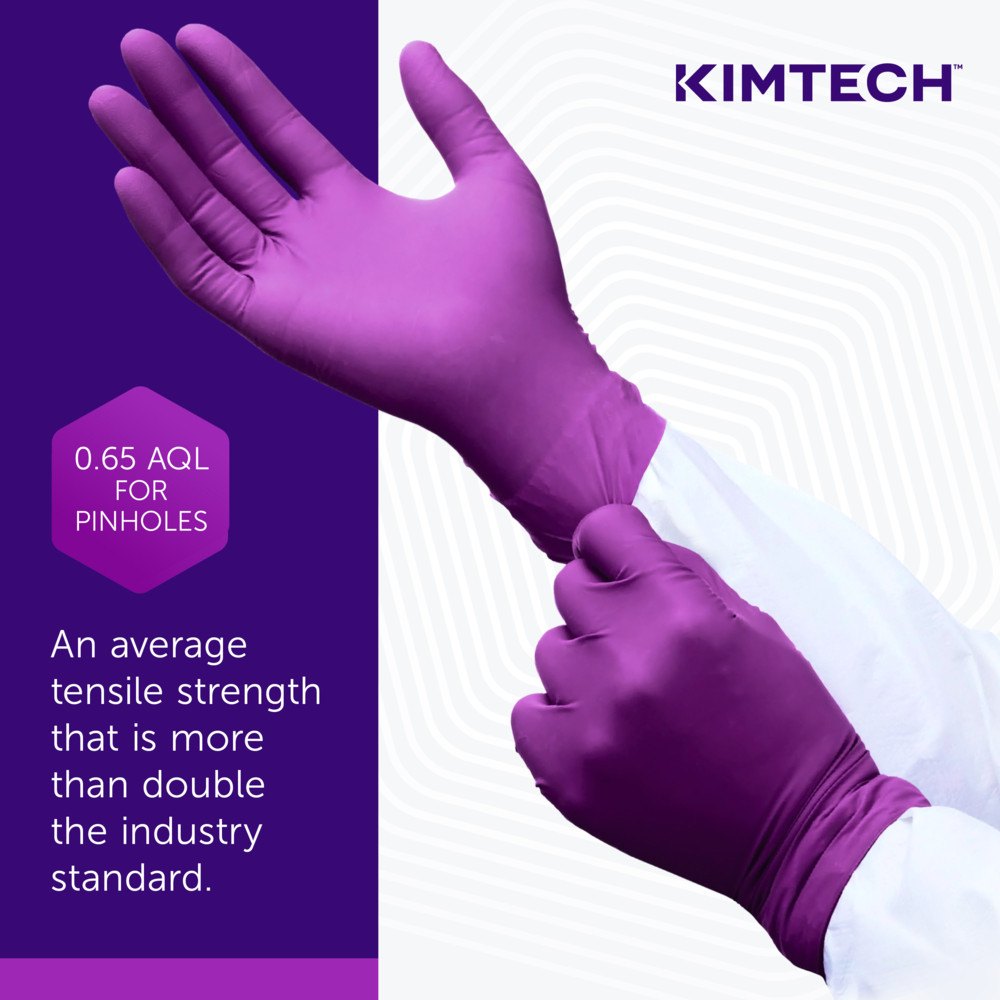
Many customer processes sit in the “controlled-but-not-cleanroom-processed PPE” zone: research labs, non-sterile pharmaceutical compounding support, med device manufacturing support areas, and biotech workflows where the glove must manage chemical splash exposure, bodily fluid contact risk, and operator fatigue over long shifts. Kimtech™ Polaris™ is positioned as a premium nitrile exam glove with a published, strict defect target (AQL 0.65) and a chemistry-minded formulation intended for extended splash protection in demanding work.
Important boundary (exam glove vs. cleanroom glove): Polaris is sold and documented as an exam glove. It is not published as a cleanroom-processed glove with ISO cleanroom particle/ionic/NVR specifications. If your SOP places gloves inside a classified cleanroom, qualify them to your internal contamination control requirements before adoption.
2) What it’s for
Manufacturer and SOSCleanroom positioning aligns Polaris with:
- Laboratory work and life science applications
- Non-sterile pharmaceutical manufacturing support activities
- Medical device manufacturing support areas
- Biotechnology workflows where chemical splash protection and dexterity are both required
- Tasks involving common lab chemicals, bodily fluids, and high-contact tool handling
- Programs that reference USP <800> glove considerations for non-sterile compounding activities (customer must validate fit to their policy and risk assessment)
3) Why should customers consider this glove
- AQL 0.65 (freedom from holes): A published, stringent defect target that exceeds typical exam glove baselines many teams are used to seeing.
- Documented splash/chemical intent: Manufacturer describes an optimized nitrile formulation for extended chemical splash protection, plus broad chemical and cytotoxic/opioid test positioning in published materials.
- Tested-for-use claims that matter in pharmacy and lab workflows: Published testing for chemotherapy drugs, fentanyl, and hormones per ASTM D6978-05.
- Ergonomics signal: US Ergonomics certification is listed in manufacturer documentation and on the SOSCleanroom product page.
- Grip where it counts: Textured fingertips for dry and wet handling.
- Sustainability pathway: Eligible for the RightCycle™ Program (when used in non-hazardous applications per local classification).
4) Materials and construction
Polaris is built from high-grade synthetic nitrile rubber (acrylonitrile-butadiene). Design elements published in the North America Technical Data Sheet include: dark magenta color, ambidextrous build, beaded cuff, and textured fingertips. Global documentation for Polaris/Polaris Xtra also states: powder-free with maximum residual powder content <2.0 mg/glove, not made with natural rubber latex, and silicone not present per SAE AMS 3819C test method results (as published by the manufacturer).
5) Specifications (at-a-glance)
| Parameter |
Published value |
| Brand / sub-brand |
Kimtech™ / Polaris™ |
| Glove type |
Nitrile exam glove (non-sterile) |
| Color |
Dark magenta |
| Cuff |
Beaded cuff |
| Surface |
Textured fingertips |
| Length |
9.5 in / 25 cm (254 mm target length in NA TDS) |
| Target thickness (fingertip / palm / cuff) |
5.91 mil (0.15 mm) / 4.72 mil (0.12 mm) / 3.54 mil (0.09 mm) |
| Freedom from holes |
AQL 0.65 (ISO 2859-1 sampling by attributes, per TDS) |
| Tensile strength (before aging / after aging) |
>14 MPa / >14 MPa |
| Elongation (before aging / after aging) |
>500% / >400% |
| Median force at break (before / after aging) |
>6.0 N / >6.0 N |
| US Ergonomics |
Certified (per manufacturer documentation and SOSCleanroom listing) |
| Country of origin |
Indonesia (per SOSCleanroom listing) |
| Packaging |
10 boxes/case; 100 gloves/box (XL: 90/box) → 1000/case (XL: 900/case) |
| ISO cleanroom class |
Not stated (exam glove; no cleanroom particle/extractables specs published) |
6) Specifications in context
Polaris is most valuable when your glove program needs a defensible combination of barrier integrity and operator usability:
- AQL 0.65 provides a straightforward control point when you are managing pinhole risk in liquid-handling, wipe-down, and frequent-glove-change tasks.
- 0.15 mm fingertip thickness is a practical “work glove” thickness for lab workflows—more robust than ultrathin exam gloves, while still supporting dexterity.
- Published tensile/elongation and aging performance supports training language (“what good looks like”) and helps procurement avoid spec drift during substitutions.
- Documented chemical/chemo/fentanyl test positioning can simplify internal stakeholder alignment (EHS, pharmacy leadership, QA) when building a standardized glove list.
Practical selection note: “tested for use” statements are most useful when you also define change-out triggers (after splash, after known contact, after a set task duration, or after touching high-risk surfaces), and when you train doffing discipline to prevent self-contamination.
7) Cleanliness metrics (what’s published vs. what you should verify)
Because this is an exam glove (not a cleanroom-processed glove), “cleanliness” is best managed through defect control, additive controls, and packaging/traceability—then verified against your facility risk assessment if gloves are used near controlled product contact areas.
| Control |
Published statement |
| Freedom from holes |
AQL 0.65 (ISO 2859-1 sampling by attributes) |
| Biocompatibility |
ISO 10993 listed in manufacturer documentation |
| Powder |
Powder-free; max residual powder content <2.0 mg/glove (global TDS) |
| Latex / silicone |
Not made with natural rubber latex; silicone not present per SAE AMS 3819C method (global TDS) |
| Cleanroom particulate/ionic/NVR metrics |
Not stated |
Regulated environments note (U.S. first): If this glove touches product-contact tooling, aseptic processing zones, or controlled transfer steps, anchor your control strategy in U.S. FDA cGMP/aseptic processing expectations first, then use EU GMP Annex 1 as a secondary benchmark to sharpen contamination control thinking (CCS, material transfer discipline, and documentation) without implying Annex 1 is a U.S. legal requirement.
8) Packaging, documentation, and traceability
Polaris is sold by SOSCleanroom as a case quantity option: 10 boxes of 100 gloves (1,000 gloves/case), with the published exception XL = 90 gloves/box (900 gloves/case). The North America Technical Data Sheet lists the North America product codes:
- 62770 (XS), 62771 (S), 62772 (M), 62773 (L), 62774 (XL)
- Target palm widths (mm): 70 / 80 / 95 / 110 / 120; target length 254 mm
Documentation discipline matters when gloves are part of a validated workflow. Manufacturer documentation publishes test method references (e.g., ASTM D6319, EN 455-2, EN ISO 21420; and ASTM D6978-05 for chemotherapy/fentanyl/hormone testing). Global documentation also references quality system compliance statements for the manufacturing facility (e.g., ISO 9001, ISO 13485, and 21 CFR Part 820 as published).
9) Best-practice use (field-ready guidance)
- Define glove-change moments before you train them. Examples: after any splash event, after direct chemical contact, before touching keyboards/labels, before touching clean packaging, and before re-entering higher-control zones.
- Use task-based change-outs for chemo/drug-handling workflows. Even with “tested for use” positioning, set conservative change-out triggers tied to contact time, splash risk, and the chemical list used at your site.
- Make donning technique part of barrier integrity. Dry hands first, avoid overstretching fingertips, pull from the cuff, and replace both gloves if one tears during donning.
- Grip training prevents incidents. Textured fingertips help, but wet handling still benefits from deliberate torque control on caps, controlled pulls on tubing, and avoiding pinch points.
- Store correctly to protect mechanical performance. Follow the storage guidance in manufacturer documentation (cool, dry, away from direct sunlight/ozone sources).
- RightCycle™ reality check. Only route to recycling when your site classifies the used gloves as non-hazardous and the program accepts the material stream.
Customer SOP disclaimer: SOSCleanroom provides best-practice guidance and suggested templates to support customer training and continuous improvement. Customers are responsible for developing, approving, validating, and maintaining their own SOPs and safety procedures based on their facility, chemicals, products, regulatory obligations, and risk assessments.
10) Common failure modes
- Over-trusting “tested for use” without change-out rules: If you do not define contact-time and event-based change-outs, any glove can become a weak link.
- Cross-zone transfer: Using the same glove for chemical handling and then touching labels, pass-through handles, or clean packaging drives contamination spread.
- Doffing errors: Fast removal, glove snapping, or touching the exterior during doffing is a common exposure mechanism.
- Improper sizing: Too small increases tear risk; too large increases snagging and loss of fine control.
- Unqualified use in classified cleanrooms: Exam gloves without published cleanroom metrics can introduce variability unless the site qualifies them against the CCS and product-risk profile.
11) Closest competitors
The most common cross-shops for Polaris are other premium exam gloves used in labs and industrial settings. Within SOSCleanroom’s catalog, close functional alternatives typically include:
- Kimtech Purple nitrile exam gloves: a widely used nitrile exam option when you want reliable general lab protection and a familiar feel.
- Kimtech Sterling Nitrile-Xtra exam gloves: often compared for thickness/durability preferences and workload style.
- Ansell MICROFLEX® nitrile exam glove options (selected by task): cross-shopped when operators want a different balance of thickness, grip, and cost structure.
12) Program fit (U.S. standards first, then global benchmarks)
In U.S. operations, exam glove selection is typically anchored in an OSHA-aligned PPE program (hazard assessment, training, and documented selection rationale). In pharmacy and life science settings, programs often add USP <800>-informed glove decision-making and change-out discipline for hazardous drugs (customer policy governs). For global alignment and continuous improvement, EU GMP Annex 1 can be used as a secondary benchmark to strengthen contamination control strategy expectations (material transfer discipline, cleaning/hand hygiene consistency, and documentation), without implying it is a U.S. legal requirement.
Texwipe pairing guidance (kept ISO-accurate): Polaris is not published as a cleanroom-processed glove with an ISO cleanroom class. If your workflow requires pairing gloves with cleanroom consumables, match Texwipe low-linting cleanroom wipers, swabs, and validated cleaning chemistries to your specific ISO classification and to the solvent/disinfectant set in your CCS/cleaning validation plan. (Nothing is truly “lint-free,” so focus on low-linting performance that is qualified to your process.) SOSCleanroom is the authorized Master Distributor of ITW Texwipe for the United States market, and for over 35 years, SOS and Texwipe have been close partners.
13) Source basis
SOSCleanroom product page (primary): https://www.soscleanroom.com/product/kimtech/kimtech-polaris-nitrile-exam-gloves/
Manufacturer technical data sheet (North America, 2 pages PDF): https://www.kcprofessional.com/-/media/global/content-hub/documents/204334130_pdf.pdf
Manufacturer overview brochure (2 pages PDF): https://www.kcprofessional.com/en-us/-/media/global/content-hub/documents/202864799_pdf.pdf
Manufacturer global technical data sheet (2023, 2 pages PDF): https://www.contenthubext.kimberly-clark.com/Content/Public/204264707.pdf
U.S. FDA aseptic processing guidance (reference-first for U.S. customers, as applicable): https://www.fda.gov/regulatory-information/search-fda-guidance-documents/sterile-drug-products-produced-aseptic-processing-current-good-manufacturing-practice
ISO cleanroom classification reference (terminology): https://www.iso.org/standard/53394.html
ASTM and IEST organizational references (methods and contamination-control education): https://www.astm.org | https://www.iest.org
EU GMP Annex 1 (secondary/global benchmark): https://health.ec.europa.eu/system/files/2022-08/20220825_gmp-an1_en_0.pdf
SOSCleanroom is the source for this Technical Vault entry.
Briefed and approved by the SOSCleanroom (SOS) staff.
If you have any questions please email us at Sales@SOSsupply.com or give us a call at (214)340-8574.
If you need additional information please try our SOSCleanroom specific AI ChatBot which draws from our extensive cleanroom specific libraries.
Last reviewed: Jan. 11, 2026
© 2026 SOSCleanroom.com