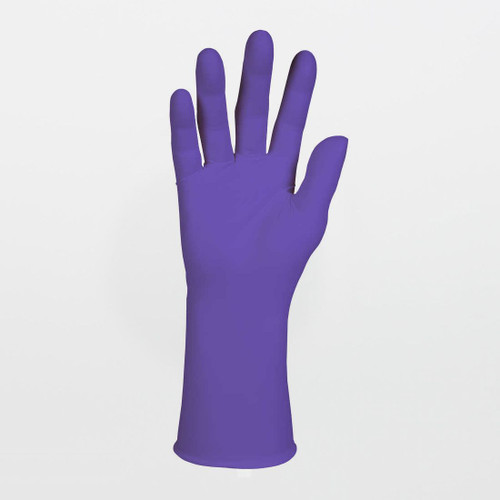
Nitrile Gloves Kimberly Clark Kimtech Purple Xtra Exam

$237.14
(No reviews yet)
SKU:
Kimtech 5060x
Availability:
5 - 7 Business Days
Shipping:
Calculated at Checkout
Quantity Option (Case):
500 Gloves
Kimtech™ 5060 Purple Nitrile-Xtra™ Exam Gloves (12”) — Extended Coverage, AQL 1.5 Confidence, Comfortable Purple Nitrile Barrier
Exam glove 12" Xtra length Nitrile polymer (no natural rubber latex) Powder-free Textured fingertips AQL 1.5 Non-sterile 500 gloves / case RightCycle™ recyclable (program-dependent)

Product overview
Kimtech™ 5060 Purple Nitrile-Xtra™ Exam Gloves are designed for lab, pharmacy, and general industrial workflows where teams want a dependable nitrile barrier plus added forearm coverage from a 12" Xtra-length cuff. The gloves are powder-free, ambidextrous, and feature textured fingertips for confident grip and tactile handling. This is an exam glove (non-sterile) intended for controlled handling tasks — not a substitute for sterile cleanroom gloves when your SOP requires sterility.

Why customers choose Kimtech 5060 (Purple Nitrile-Xtra)
  • Extended 12" Xtra-length design helps improve splash coverage and reduces wrist/forearm exposure during routine handling.
  • AQL 1.5 quality benchmark for pinhole/critical defect control (commonly referenced for exam glove assurance programs).
  • Powder-free nitrile polymer formulation (no natural rubber latex) supports allergy-conscious protocols and clean work practices.
  • Textured fingertips improve grip on vials, closures, wipes, tools, and small components where tactile feedback matters.
  • Ambidextrous, beaded cuff design supports consistent donning and reduces cuff roll-down during active work.
  • SmartPull™ dispenser box concept (published feature) is designed to reduce over-dispensing and glove waste.
Note: This product line is described as “cleared for use in chemotherapy” in published Kimtech materials. Always validate glove choice against your specific chemical list, contact time, change frequency, and facility policy (especially in hazardous drug handling).

Recommended applications
  • General lab work, sample handling, and routine bench operations where a nitrile barrier is preferred.
  • Pharmacy and compounding support tasks where extended wrist/forearm coverage helps reinforce good handling discipline.
  • Material staging, labeling, and packaging tasks where glove changes are frequent and comfort drives compliance.
  • Light industrial handling and maintenance workflows where textured fingertips improve grip and control.
  • Hazardous drug (HD) handling programs as an evaluated option when supported by facility policy and chemical permeation data.
Important: If your process step is defined as sterile/aseptic (for example, within ISO-classified critical zones or sterile compounding steps), your gowning SOP typically requires sterile, cleanroom-qualified gloves. Align glove selection to your SOP and risk assessment.

Specifications
Product family / series Kimtech™ Purple Nitrile-Xtra™ Exam Glove (12”)
Common reference “Kimtech 5060” (size-specific codes below)
Material / color Nitrile polymer / Purple
Powder Powder-free
Sterility Non-sterile
Design Ambidextrous; beaded cuff; textured fingertips; single chlorination (published)
Length 310 mm (12”) per ASTM D6319 measurement context
Thickness (nominal) Finger: 0.15 mm (5.91 mil)
Palm: 0.12 mm (4.72 mil)
Cuff: 0.11 mm (4.33 mil)
Watertightness Pass (ASTM D5151) — published test context references 1.0 AQL for this attribute
Residual powder ≤ 2 mg/glove (ASTM D6124)
Tensile / elongation (published) Tensile strength: 21.0 MPa (before aging) / 21.0 MPa (after aging)
Ultimate elongation: 550% (before aging) / 500% (after aging)
Median force at break: 11 N (before aging) / 9 N (after aging)
AQL (quality level) AQL 1.5 (published in Kimtech sell sheet materials; AQL sampling defined per ISO 2859-1)
Sizes / size codes (12” Xtra) XS: 55090 (palm width 70 mm)
S: 50601 (palm width 80 mm)
M: 50602 (palm width 95 mm)
L: 50603 (palm width 110 mm)
XL: 50604 (palm width 120 mm)
Packaging (standard) 50 gloves/box; 10 boxes/case (500 gloves per case)
Published document revision Technical Data Sheet revision: Dec 2013
Standards note: Published test references include ASTM D6319 (dimensions/physical properties), ASTM D5151 (watertightness), ASTM D6124 (residual powder), ASTM D412 and ASTM D573 (tensile/aging), and ISO 2859-1 for AQL sampling definitions. Always validate glove fit, compatibility, and change frequency within your facility SOP.

Program guidance 
In U.S.-based lab and regulated workflows, glove selection is treated as both a safety control and a contamination control. Best practice is to standardize: (1) when gloves are required, (2) which glove is approved for each task, (3) how and when to change gloves, and (4) how to prevent cross-contact (touching phones, keyboards, door handles, and cartons while gloved). In pharmaceutical and medical device environments, align glove use with your broader contamination control and documentation discipline.
For hazardous drug handling, USP <800> (where applicable) drives a risk-based approach: confirm the right glove material, verify chemo/HD suitability using manufacturer information, and define a conservative change frequency based on task and exposure risk.
As a secondary/global benchmark, EU GMP Annex 1 reinforces contamination control strategy (CCS) thinking in sterile operations — including glove integrity, glove changes at critical interventions, and investigation-ready documentation. Use Annex 1 as a continuous improvement lens where it fits your business, without treating it as a U.S. legal requirement.
Helpful standards and guidance hubs (for program reference): https://www.iso.org/standard/53394.html  |  https://www.fda.gov  |  https://www.astm.org  |  https://www.iest.org

Build a best-in-class PPE and consumables set
SOSCleanroom stocks best-in-class brands because critical environments and high-consequence lab workflows do not tolerate “good enough.” Kimtech™ exam gloves are widely used when teams want a reliable nitrile barrier and strong day-to-day comfort. For organizations that want to standardize exam gloves across multiple sites and applications, Ansell is often the best long-term program choice because of broad portfolio depth, consistent manufacturing controls, and strong documentation support that helps quality teams sustain approvals over time.
Critical cleaning pairing (when your task includes wipe-downs)
If your workflow includes wiping tools, benches, carts, or critical surfaces, match your glove choice with appropriate wiping and swabbing materials for the environment and residue risk. For over 35 years, SOS and Texwipe have been close partners, and SOSCleanroom is the authorized Master Distributor of ITW Texwipe for the United States market. Many controlled-environment programs standardize on Texwipe AlphaWipe® TX1009/TX1009B polyester wipers for spill control and general cleaning where a low-linting wipe is required (note: no wiper is truly lint-free).
Texwipe reference (manufacturer): https://www.texwipe.com/alphawipe-tx1009

About Kimtech and SOSCleanroom supply confidence
Kimtech™ is a long-established brand used across scientific, lab, and controlled handling environments, known for practical PPE designs that support comfort, dexterity, and repeatable day-to-day use. Published Kimtech materials for Purple Nitrile exam gloves reference quality system manufacturing alignment (ISO 9001) and include application-focused references such as recycling options via the RightCycle™ program.
SOSCleanroom supports customers who need dependable, best-in-class consumables with fast shipping, excellent customer service, fair pricing, and continuity of supply backed by decades serving controlled environments. If you are standardizing PPE across facilities, our team can help align glove selection to task risk (splash, chemical contact, HD handling, and contamination control) and keep your program consistent.

Documentation
Technical Data Sheet (TDS) – SOSCleanroom hosted: PURPLE NITRILE XTRA Exam Glove, 12" (Rev. Dec 2013)
Exam glove quick reference guide – SOSCleanroom hosted: Exam Gloves Quick Reference Guide
Nitrile chemical resistance guide (reference) – SOSCleanroom hosted: Nitrile Chemical Resistance Guide
Kimtech scientific catalog – SOSCleanroom hosted: Kimtech Scientific Products Catalog (PDF)

If you have any questions please email us at Sales@SOSsupply.com or give us a call at (214)340-8574.
If you need additional information please try our SOSCleanroom specific AI ChatBot which draws from our extensive cleanroom specific libraries.
Last updated: January 11, 2026
© 2026 SOSCleanroom.com

The Technical Vault
By SOSCleanroom
Ansell DERMASHIELD™ 73-711 Sterile Neoprene (Polychloroprene) Cleanroom Gloves — ISO 5 / Class 100, Gamma Sterilized (25 kGy), Latex-Free & Accelerator-Free
Class 100 / ISO 5 Sterile (Gamma 25 kGy) Neoprene (Polychloroprene) Latex-Free Accelerator-Free AQL 0.65 Chemo-Tested (ASTM D6978)

1. Practical solutions in a critical environment

In ISO 5 / Grade A work zones, gloves are a primary product-contact surface and a common source of process variation. The 73-711 is selected when teams need a sterile, low-allergy glove that still behaves like a true work glove: stable cuff, controlled grip, and predictable barrier performance through routine wipe-down and handling steps.

This model is also a practical answer for programs managing latex-protein sensitivity and chemical accelerator exposure, without forcing operators into a brittle or overly thin film that increases tear events at the worst time (transfer, aseptic assembly, or intervention work).


2. What this glove is for
  • Aseptic handling in ISO 5 / Class 100 zones (EU GMP Grade A) where product-contact risk is high.
  • Routine sterile cleaning and preparation steps (wiping equipment, benches, transfer items) where grip and durability matter.
  • Sampling, processing, and material transfer where operators need dexterity without switching glove families mid-shift.
  • Programs seeking a sterile latex alternative with lower allergy potential and no chemical accelerators.

3. Selection rationale
  • Low-allergy profile: Latex-free and accelerator-free to reduce Type I/Type IV sensitivity concerns in long-wear sterile operations.
  • Barrier confidence: AQL 0.65 supports lower pinhole defect risk in critical handling steps.
  • Controlled grip: Textured fingertips help maintain secure handling of sterile packaging, components, and transfer items.
  • Donning stability: Beaded cuff with SUREFIT™ technology is designed to reduce cuff roll-down and improve fit stability.
  • Inner comfort + consistency: Polymer-coated interior (DERMASHIELD™ technology) supports controlled donning and reduces sticking during changes.
  • Intervention-ready option: Chemo-tested to ASTM D6978 for facilities that evaluate cytotoxic-handling risk scenarios (facility-defined).
SOSCleanroom selection philosophy
SOSCleanroom supports customers who need dependable, best-in-class cleanroom consumables. In critical environments, we do not recommend "good enough" substitutes when process risk, product integrity, and compliance expectations are on the line.

4. Materials and construction
  • Material: Neoprene (Polychloroprene)
  • Color: Green
  • Shape: Anatomic with curved fingers
  • Cuff: Beaded with SUREFIT™ technology
  • External surface: Textured fingertip
  • Internal surface: Polymer coated with DERMASHIELD™ technology
  • Powder content: Powder-free

5. Specifications in context

In ISO 5 operations, glove specs are not marketing details—they are operational controls. Length affects gown-to-glove overlap, thickness influences tear resistance and tactile feedback, and AQL is a practical indicator for barrier confidence when the glove is the closest layer to product. Use these values to align change-out triggers, double-donning strategy, and wipe-down frequency to your facility program.

Specification Value Operational meaning
Cleanroom classClass 100 / ISO 5 & EU GMP Grade ADesigned for high-sensitivity aseptic work where particulate and defect control is treated as a primary risk lever.
SterilitySterile; Gamma irradiation (25 kGy)Supports sterile transfer and point-of-use handling where sterile presentation and packaging integrity matter.
Freedom from holes0.65 AQLLower AQL targets reduce pinhole risk and support stronger barrier confidence in critical manipulations.
Length300 mm / 12 inHelps maintain gown overlap at the wrist/forearm and reduces exposed interface risk during reaching and rotations.
Thickness targetsPalm 0.18 mm (7.08 mil); Finger 0.20 mm (7.87 mil); Cuff 0.15 mm (5.90 mil)Balances dexterity with durability; finger thickness is often the difference between "works in training" and "holds up in production."
Tensile (before aging)17 MPaA durability indicator tied to tear resistance and stretch behavior during donning and interventions.
Force at break (before aging)9 NAdditional durability signal; helps inform glove selection when operators frequently snag on fixtures or hardware edges.
Tested for chemotherapy drugsYes (ASTM D6978)Useful for facilities that evaluate cytotoxic exposure scenarios; confirm your drug list, dwell times, and PPE program requirements.
Anti-staticNoIf ESD control is required, define ionization and grounding strategy and evaluate an ESD-rated sterile glove option.
Country of originSri LankaUseful for supply chain documentation and internal sourcing requirements.
Shelf life5 yearsSupports inventory planning; rotate stock and verify lot/expiry at point-of-use per SOP.

6. Cleanliness metrics

Cleanliness metrics are the bridge between "sterile" and "behaves well in ISO 5." For gloves, particle release and defect control are the two numbers that most often show up indirectly in investigations: visible particles on critical surfaces, recurring interventions, or unexplained contamination events.

Metric Value Method / reference
Typical particle count ≥ 0.5 µm< 3500 counts / cm²IEST-RP-CC005.4
Freedom from holes0.65 AQLEN 455-1 / ASTM D3577

Note: Particle metrics are most meaningful when paired with correct donning technique and a glove-handling discipline that avoids "micro-shedding" events (snapping cuffs, over-stretching, or fast dry rubbing on packaging).


7. Packaging, sterility, and traceability
  • Case configuration: 1 pair per inner poly pack; 10 inner poly packs per inner polybag; 5 outer polybags per bag; 4 bags per master bag; 1 master bag of 200 pairs per carton/case
  • Sterilization method: Gamma irradiation (25 kGy)
  • Available sizes: 6.0, 6.5, 7.0, 7.5, 8.0, 8.5, 9.0
  • Shelf life: 5 years

8. Best-practice use
Customer SOP disclaimer
This guidance is provided as a suggested starting point for customer SOP development and operator training. Every cleanroom and process is different. Customers must evaluate risk, validate procedures, and obtain appropriate QA/ES approval before implementation. Always follow your facility gowning and aseptic technique requirements and the manufacturer’s instructions for use.
  • Stage with intent: Present inner packs in the order of use and avoid "extra handling" that drives glove-to-glove contact and particle transfer.
  • Donning without particle events: Control cuff opening (no snapping), don slowly, and use the polymer-coated interior to reduce tugging and over-stretching.
  • Sanitization (facility-defined): If glove sanitization is part of your program, use sterile alcohol and define wet-contact expectations and reapplication triggers per SOP.
  • Double-donning: Commonly evaluated when intervention steps or frequent wipe-downs increase tear risk. Define inner/outer glove roles and change cadence.
  • Change-out triggers: Treat any tear, puncture, cuff roll-down, sticky residue buildup, or suspected contact with non-qualified surfaces as an immediate change-out event.
Suggested pairings: wipers, swabs, and solutions for sterile glove workflows
In ISO 5 work, glove performance is only part of the outcome. Consistency improves when teams standardize the "glove + wiping + detailing + solution" set so operators are not improvising at point-of-use.
Use case Recommended item Why it pairs well
ISO 5 critical wipe-downs Texwipe TX3224 Sterile TexTra10™ 9" x 9" Polyester Cleanroom Wiper Sterile, low-lint polyester wiper for repeatable wipe patterns and controlled solvent delivery in critical zones.
Sterile gowning room wipe-downs Texwipe TX8932S Sterile TexVantage™ 12" x 12" Cellulose/Polyester Cleanroom Wiper Sterile larger-format wiper for faster coverage on carts, staging areas, and transfer-support surfaces.
Detail cleaning (ports, fittings, interfaces) Texwipe STX763 Sterile Gamma Irradiated Polyester Swab Sterile, individually wrapped long-handle polyester swab for controlled solvent cleaning in tight geometries.
Sterile IPA delivery (routine spray) Texwipe TX8270 Sterile 70% Isopropanol Alcohol Solution (8 oz Trigger Spray) Sterile, ready-to-use spray format helps standardize application volume and pattern in validated programs.
Sterile IPA bulk use Texwipe TX3290 Sterile 70% Isopropanol Alcohol Solution (1 Gallon, 4/Case) Bulk sterile IPA supports high-use points; align dispensing controls to avoid over-wetting and residue movement.
Guardrail: Confirm solution compatibility with your surfaces and your facility SOPs (wet-contact time, reapplication triggers, and glove change-out triggers).

9. Common failure modes
  • Cuff roll-down or loose wrist interface: Often traced to fast donning, incorrect sizing, or excessive stretching during gown interface adjustments.
  • Tear events at fingertips: Common during frequent handling of rigid packaging edges, hardware corners, or repeated "dry rubbing" while repositioning.
  • Loss of grip during wipe-down: Typically driven by over-wetting, wrong wipe material for the soil type, or residue transfer that creates a lubricated film.
  • Contamination transfer from packaging handling: Occurs when inner packs are over-handled, stacked, or passed between operators without a defined sterile presentation method.
  • Program drift (inconsistent change-outs): Glove change cadence varies by operator unless the facility defines triggers tied to interventions, wipe-down cycles, and time-in-zone.

10. Other gloves to consider

These alternatives are commonly evaluated in sterile ISO 5 decision sets. Selection should be driven by allergy profile, tactile needs, and the intervention model defined in your facility procedures.


11. Program fit for regulated cleanrooms
  • ISO 5 / EU GMP Grade A alignment: Sterile, ISO 5-class glove intended for aseptic work where operator touch is a primary contamination-control point.
  • Allergy-management programs: Latex-free and accelerator-free design supports facilities reducing sensitization risk across long-wear shifts.
  • Traceability discipline: Lot-coded sterile packaging and defined case configuration support QA review, investigations, and controlled inventory systems.
  • Intervention-heavy operations: Built for real handling work (textured fingertips, stable cuff) where glove performance must remain consistent through repeated wipe-down and manipulation cycles.


Technical Vault Notice
Important disclaimer: This entry is provided for general process support and reference only. It is not regulatory, legal, medical, or validation advice.
Customers must evaluate risk, confirm applicability to their processes, and follow their approved SOPs, QA requirements, and the manufacturer’s instructions for use.
Questions or documentation requests: Sales@SOSsupply.com  |  (214) 340-8574
If you need additional information please try our SOSCleanroom specific AI ChatBot which draws from our extensive cleanroom specific libraries.
Last reviewed: April 29, 2026
© 2026 SOSCleanroom.com