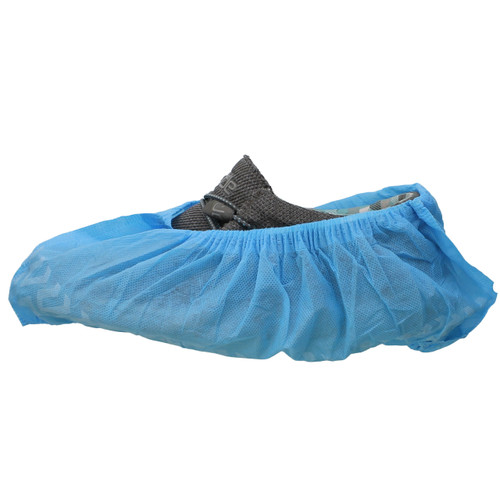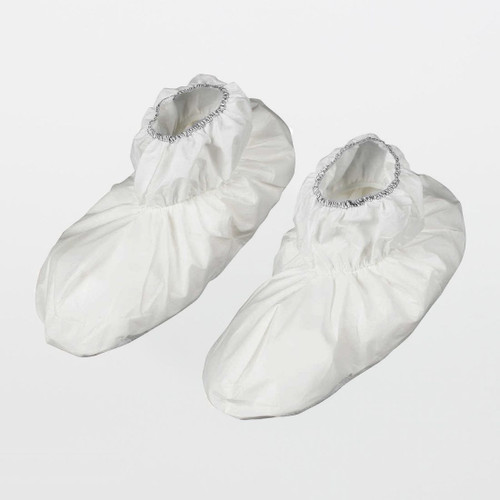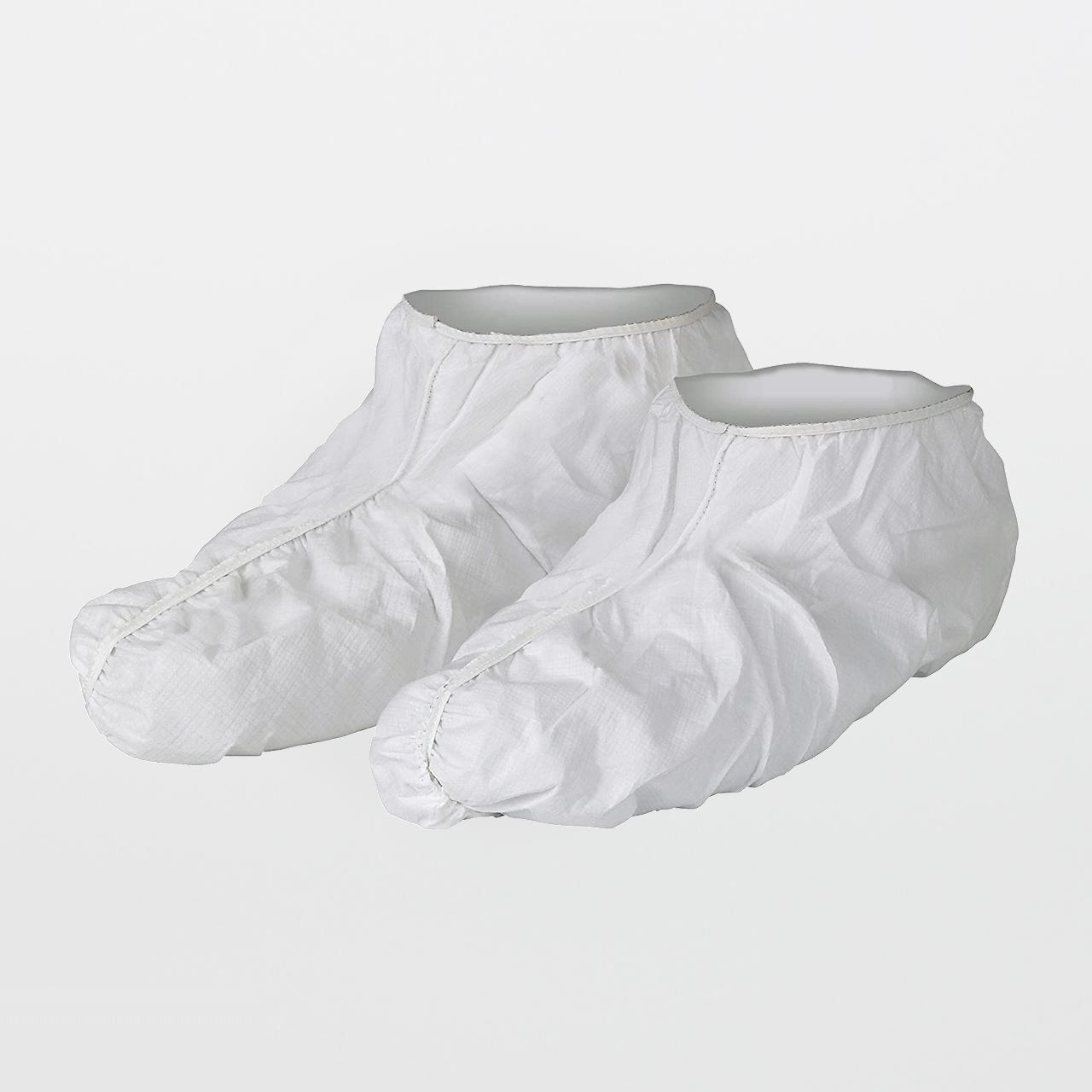
SKU shown: 27000 (A40 shoe covers, universal fit).
Why footwear control matters in contamination control
Footwear is a high-frequency contamination vector: floors collect particles and residues, then shoes transfer them to traffic lanes, gowning areas, and controlled spaces.
Shoe covers are a straightforward control intended to reduce what is carried in on shoes and to add a barrier layer during wet maintenance or liquid handling work.
The best shoe cover in the world will still underperform if gowning flow, donning technique, and entry discipline are weak—so this entry includes donning guidance alongside product attributes.
What this product is used for
- Reducing particulate carry-in from shoes at controlled entry points and change areas.
- Adding a liquid/particle barrier layer during washdown, pressure washing, and wet maintenance activities.
- General industrial contamination control where a microporous barrier is preferred over lightweight visitor covers.
- Supporting traffic control programs (tacky mats, defined lanes, routine wipe-downs) to reduce recontamination.
Why customers consider this product
- Barrier-focused laminate: microporous film laminate construction is published for A40 accessories.
- Footwear coverage features: elastic opening and seamless-sole format supports practical on-shoe coverage.
- ESD/antistatic relevance: static decay performance is published as a pass to NFPA 99 criteria for A40 accessories.
- Operational throughput: 300/case supports high usage rates at entry points and maintenance staging areas.
- Program consistency: published test methods and results help QA teams compare options on more than “feel” and price.
Materials, composition, and build
Manufacturer literature describes A40 accessories as a microporous film laminate platform.
For the shoe cover (27000), the published product attributes include elastic opening, 7" height,
a seamless sole, and universal sizing.
Shoe covers are intended to be worn over standard footwear. Fit, coverage, and donning behavior matter as much as fabric performance—especially at the ankle and sole edges where gaps and snagging can occur.
If your SOP requires higher overlap with coveralls or leggings, consider an ankle-high or overboot format.
Specifications in context
The table below consolidates key attributes for receiving, SOP alignment, and practical use.
Where the manufacturer literature provides test results at the platform/accessory level, those are listed as “published (A40 accessories).”
| Attribute |
27000 (A40 Shoe Covers) |
| SKU / Code |
27000 |
| Material platform |
Microporous film laminate |
| Sizing |
Universal / one size fits all |
| Height |
7" (published) |
| Sole |
Seamless sole / no bottom seam |
| Opening |
Elastic opening / elastic top |
| Seams (published for A40 accessories) |
Serged seams |
| Color |
White |
| Case pack |
300 per case (3 bags of 100) |
| Antistatic (published for A40 accessories) |
NFPA 99 static decay pass (<0.5 sec) |
| Country of origin |
Not stated in the manufacturer source basis listed below |
Performance and cleanliness considerations (published basis)
For shoe covers, “performance” typically means: barrier behavior (liquid splash resistance, particle holdout), low-lint suitability for the environment, and practical durability during walking.
Manufacturer literature for A40 accessories publishes test methods and results at the platform/accessory level; use those values as comparative inputs and qualify for your specific floor chemistry, abrasion, and SOP use time.
| Characteristic |
What it means for use |
Published basis (A40 accessories) |
| Hydrohead |
Indicator of resistance to water penetration (relevant to splash and wet floors). |
AATCC 127-1998 result published. |
| Particle holdout (0.3–0.5 µm) |
Useful comparator for barrier behavior against fine particulate challenges. |
Independent lab result published (platform/accessory basis). |
| Lint (particles >0.5 µm) |
Helps estimate shedding risk; always validate in your airflow/traffic conditions. |
INDA method reference and result published. |
| Static decay |
Relevant where static control and ESD-sensitive environments are considerations. |
NFPA 99 pass (<0.5 sec) published. |
| Chemical / blood penetration references |
Useful comparisons for barrier intent; confirm applicability to your hazards and PPE selection. |
ASTM methods and pass statements are published for the platform/accessory literature. |
Packaging, traceability, and receiving considerations
Receiving teams should verify: correct SKU (27000), correct case quantity (300), packaging integrity, and any site-required documentation.
For programs that require country of origin confirmation or special declarations, treat that as a receiving requirement and request documentation prior to qualification.
Gowning (donning) guidance to minimize contamination
ISO-first approach: align gowning to cleanroom class and operational control
- Start with classification and monitoring: ISO 14644-1 defines particle-based cleanroom classification, and ISO 14644-2 addresses monitoring plans. Your gowning controls should support the class you must maintain.
- Treat gowning as an operations control: ISO 14644 operations guidance (Part 5) is intended to support cleanroom use and operation with contamination-control focus.
- Technique reduces shedding: Don slowly and deliberately, avoid snapping elastics, and avoid contact between the “outside” of the cover and non-controlled surfaces.
- Footwear handling discipline: Put shoe covers on in the gowning area, handle by the opening, and keep the sole from dragging across benches or garments.
- Confirm overlap and fit: Ensure the elastic sits above the shoe collar. If your SOP requires higher overlap with coveralls, choose ankle-high or overboot formats.
European Annex 1 (sterile medicinal products): gowning expectations by grade
- Grades C/D: Annex 1 describes baseline measures such as covering hair (and facial hair where relevant) and wearing protective clothing and shoes/overshoes appropriate to the area.
- Grade B (aseptic background): Annex 1 describes dedicated protective clothing and sterilized elements, including appropriate sterilized footwear or overshoes, with trouser legs tucked inside footwear and attention to garment packing/folding to prevent contamination.
- Practical takeaway: If you operate under Annex 1 Grade A/B expectations, confirm that your footwear/overshoe selection is supplied and documented to the required sterility level—then validate your donning method.
The donning “order of operations” is facility-specific. Many programs control the dirtiest-to-cleanest flow (shoe/boot control early, then garments, then gloves), while others require footwear steps to occur at specific bench transitions.
Follow your SOP and validate the method using your site’s particle/micro monitoring outcomes.
Common failure modes (and how to avoid them)
- Dragging the cover before it is on: handle by the opening and keep the sole off benches/garments.
- Ankle gaps: confirm elastic sits above shoe collar; choose higher coverage options when required.
- Overuse beyond SOP wear time: set change frequency and enforce it (especially after wet-floor exposure).
- Recontamination after donning: avoid stepping off controlled lanes and then re-entering without changing shoe covers.
Closest competitors / alternatives
Closest alternatives are other barrier-focused shoe/overshoe products, including ankle-high shoe covers and overboots used in cleaner or more regulated gowning programs.
Compare: coverage height, sole construction, seam design, packaging, and documentation—then validate in your environment.
- Kimtech A7 ankle-high shoe covers: higher coverage option for overlap requirements.
- Kimtech A8 shoe covers: cleanroom-oriented alternative depending on SOP and area classification.
- Overboots / sterilized overshoes: use when your SOP or regulatory framework requires sterilized footwear components.
Critical environment fit for this product
27000 shoe covers are typically selected for industrial and controlled-entry contamination-control workflows where a breathable barrier laminate is preferred over lightweight visitor covers.
If your environment requires sterile footwear components or higher coverage overlap, select products supplied and documented to that requirement and validate the donning method in your program.
SOSCleanroom note about SOP's
The Technical Vault is written to help customers make informed contamination-control decisions and improve day-to-day handling technique.
It is not your facility’s Standard Operating Procedure (SOP), batch record, or validation protocol.
Customers are responsible for establishing, training, and enforcing SOPs that fit their specific risks, products, equipment, cleanroom classification, and regulatory obligations.
Always confirm material compatibility, cleanliness suitability, sterility requirements, and acceptance criteria using your internal quality system and documented methods.
If you adapt any technique guidance from this entry, treat it as a starting template. Your team should review and approve the final method, then qualify it for your specific surfaces,
footwear types, floor chemistry, cleanliness limits, inspection methods, and risk profile. In short: use these best-practice suggestions to strengthen your SOPs—not to replace them.
Source basis
- SOSCleanroom product page (27000): https://www.soscleanroom.com/product/kimtech/kleenguard-a40-liquid-particle-protection-shoe-covers-27000/
- Manufacturer literature (A40 Accessories data sheet copy): https://exdron.co.il/Exdron-Pdf/kimberly-clark-27000-datasheet.pdf
- ISO 14644-1 (classification context): https://www.iso.org/standard/53394.html
- ISO 14644-2 (monitoring plan context): https://www.iso.org/standard/53393.html
- ISO 14644-5 (operations context): https://www.iso.org/standard/33445.html
- EU GMP Annex 1 (gowning expectations by grade): https://health.ec.europa.eu/system/files/2022-08/2022_annex1ps_sterile_medicinal_products_en.pdf
SOSCleanroom is the source for this Technical Vault entry.
Briefed and approved by the SOSCleanroom (SOS) staff.
If you have any questions please email us at Sales@SOSsupply.com
Last reviewed: Jan. 14, 2026
© 2026 SOSCleanroom