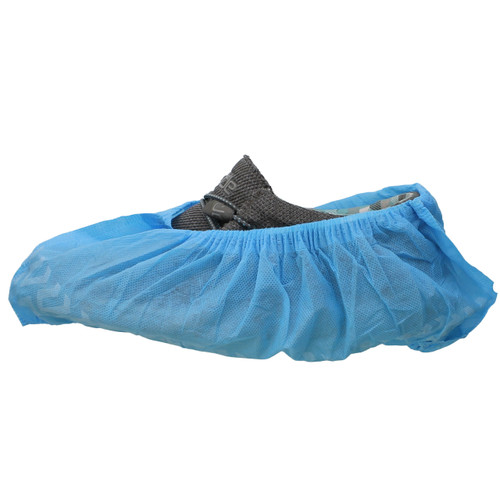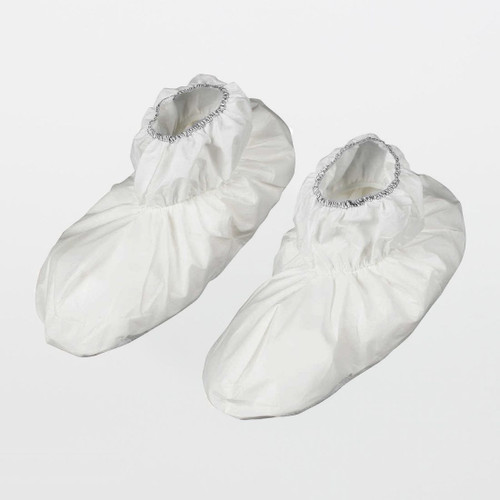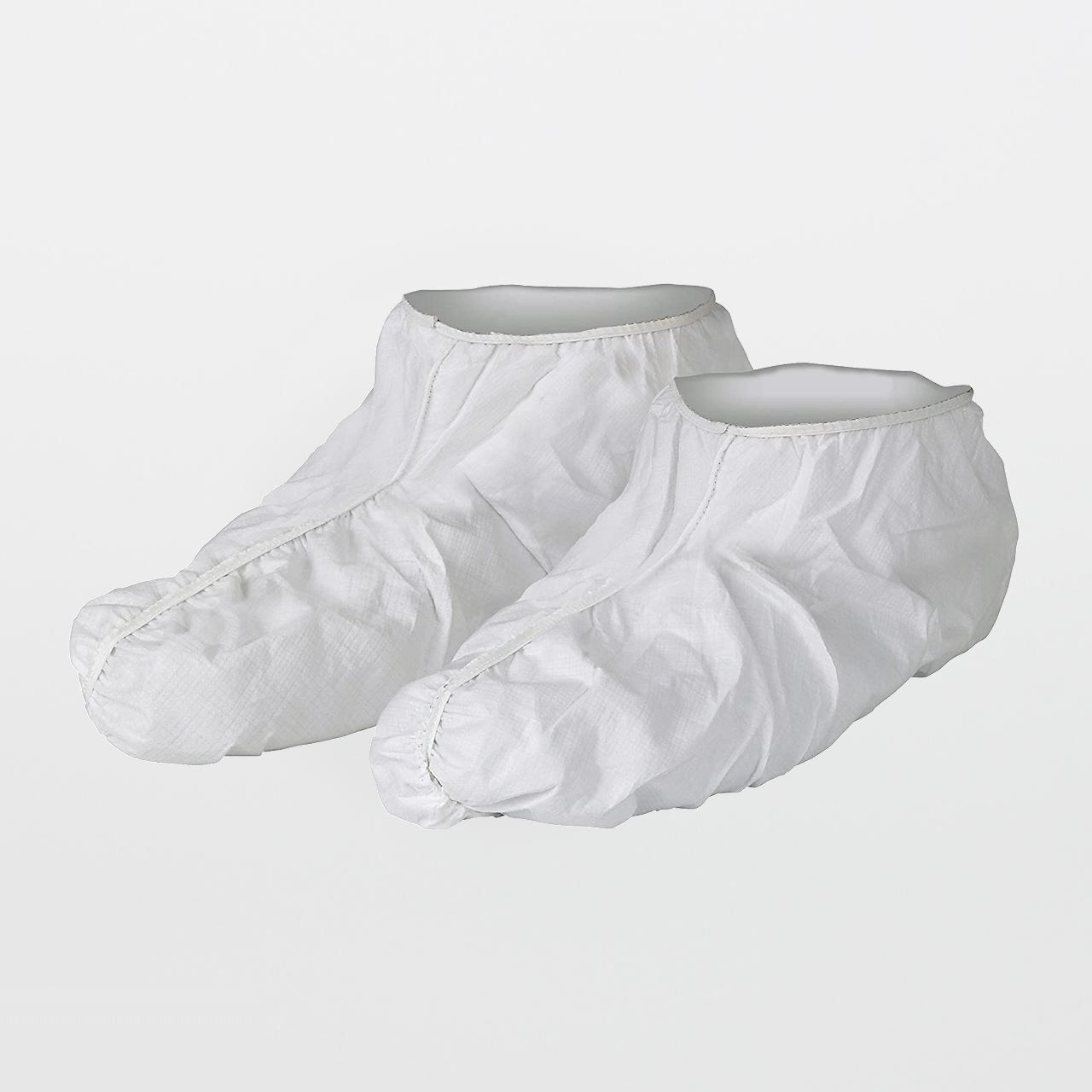
SKU shown: 27000 (A40 shoe covers, universal fit).
Why footwear control matters in contamination control
Footwear is a high-frequency contamination vector: floors collect particles and residues, then shoes transfer them to traffic lanes, gowning areas, and controlled spaces.
Shoe covers are a straightforward control intended to reduce what is carried in on shoes and to add a barrier layer during wet maintenance or liquid handling work.
The best shoe cover will still underperform if gowning flow, donning technique, and entry discipline are weak.
What this product is used for
- Reducing particulate carry-in from shoes at controlled entry points and change areas.
- Adding a liquid/particle barrier layer during washdown, pressure washing, and wet maintenance activities.
- General industrial contamination control where a microporous barrier is preferred over lightweight visitor covers.
- Supporting traffic control programs to reduce recontamination.
Why customers consider this product
- Barrier-focused laminate: microporous film laminate construction published for A40 accessories.
- Footwear coverage features: elastic opening and seamless-sole format.
- ESD/antistatic relevance: static decay published as NFPA 99 pass for A40 accessories.
- Operational throughput: 300/case supports high usage rates at entry points.
- Program consistency: published test methods help QA teams compare options on more than "feel" and price.
Materials, composition, and build
Manufacturer literature describes A40 accessories as a microporous film laminate platform.
For the shoe cover (27000), published attributes include elastic opening, 7" height,
a seamless sole, and universal sizing.
Fit, coverage, and donning behavior matter as much as fabric performance—especially at the ankle and sole edges where gaps and snagging can occur.
If your SOP requires higher overlap with coveralls or leggings, consider an ankle-high or overboot format.
Specifications in context
| Attribute |
27000 (A40 Shoe Covers) |
| SKU / Code | 27000 |
| Material platform | Microporous film laminate |
| Sizing | Universal / one size fits all |
| Height | 7" (published) |
| Sole | Seamless sole / no bottom seam |
| Opening | Elastic opening / elastic top |
| Seams (A40 accessories) | Serged seams |
| Color | White |
| Case pack | 300 per case (3 bags of 100) |
| Antistatic (A40 accessories) | NFPA 99 static decay pass (<0.5 sec) |
Performance and cleanliness considerations
| Characteristic |
What it means for use |
Published basis (A40 accessories) |
| Hydrohead | Indicator of resistance to water penetration (relevant to splash and wet floors). | AATCC 127-1998 result published. |
| Particle holdout (0.3–0.5 µm) | Useful comparator for barrier behavior against fine particulate challenges. | Independent lab result published. |
| Lint (particles >0.5 µm) | Helps estimate shedding risk; validate in your airflow/traffic conditions. | INDA method reference and result published. |
| Static decay | Relevant where ESD-sensitive environments are a consideration. | NFPA 99 pass (<0.5 sec) published. |
| Chemical / blood penetration | Confirm applicability to your hazards and PPE selection. | ASTM methods and pass statements published. |
Packaging, traceability, and receiving
Receiving teams should verify: correct SKU (27000), correct case quantity (300), packaging integrity, and any site-required documentation.
For programs that require country of origin confirmation or special declarations, request documentation prior to qualification.
Gowning (donning) guidance to minimize contamination
ISO-first approach
- Start with classification and monitoring: ISO 14644-1 defines particle-based cleanroom classification; gowning controls should support the class you must maintain.
- Treat gowning as an operations control: ISO 14644-5 provides operations guidance with contamination-control focus.
- Technique reduces shedding: don slowly and deliberately, avoid snapping elastics, and avoid contact between the "outside" of the cover and non-controlled surfaces.
- Footwear handling discipline: put shoe covers on in the gowning area, handle by the opening, and keep the sole from dragging across benches or garments.
- Confirm overlap and fit: ensure the elastic sits above the shoe collar. If your SOP requires higher overlap with coveralls, choose ankle-high or overboot formats.
European Annex 1: gowning expectations by grade
- Grades C/D: Annex 1 describes protective clothing and shoes/overshoes appropriate to the area.
- Grade B: Annex 1 describes sterilized footwear or overshoes, with trouser legs tucked inside footwear.
- Practical takeaway: For Grade A/B, confirm that footwear/overshoe selection is supplied and documented to the required sterility level, then validate donning.
Common failure modes
- Dragging the cover before it is on: handle by the opening and keep the sole off benches/garments.
- Ankle gaps: confirm elastic sits above shoe collar; choose higher coverage options when required.
- Overuse beyond SOP wear time: set change frequency and enforce it.
- Recontamination after donning: avoid stepping off controlled lanes and then re-entering without changing shoe covers.
Closest competitors / alternatives
- Kimtech A7 ankle-high shoe covers: higher coverage option for overlap requirements.
- Kimtech A8 shoe covers: cleanroom-oriented alternative depending on SOP and area classification.
- Overboots / sterilized overshoes: use when your SOP or regulatory framework requires sterile footwear components.
Critical environment fit
27000 shoe covers are typically selected for industrial and controlled-entry contamination-control workflows where a breathable barrier laminate is preferred over lightweight visitor covers.
If your environment requires sterile footwear components or higher coverage overlap, select products supplied and documented to that requirement.
SOSCleanroom note about SOP's
The Technical Vault is written to help customers make informed contamination-control decisions and improve day-to-day handling technique.
It is not your facility's Standard Operating Procedure (SOP), batch record, or validation protocol.
Customers are responsible for establishing, training, and enforcing SOPs that fit their specific risks, products, equipment, cleanroom classification, and regulatory obligations.
Use these best-practice suggestions to strengthen your SOPs—not to replace them.
Source basis
SOSCleanroom is the source for this Technical Vault entry.
Briefed and approved by the SOSCleanroom (SOS) staff.
If you have any questions please email us at Sales@SOSsupply.com
If you need additional information please try our SOSCleanroom specific AI ChatBot which draws from our extensive cleanroom specific libraries.
Last reviewed: April 29, 2026
© 2026 SOSCleanroom