BIOLUX 25W Germicidal Strip Fixture with Lamp

$175.00
(No reviews yet)
SKU:
BIOLUX 25 (40-1110)
Availability:
7 - 10 Business Days
Shipping:
Calculated at Checkout
Quantity Option (Each):
1 Fixture
Product Description
25W UV-C strip fixture for targeted air and surface disinfection in controlled spaces.
SOSCleanroom
Overview

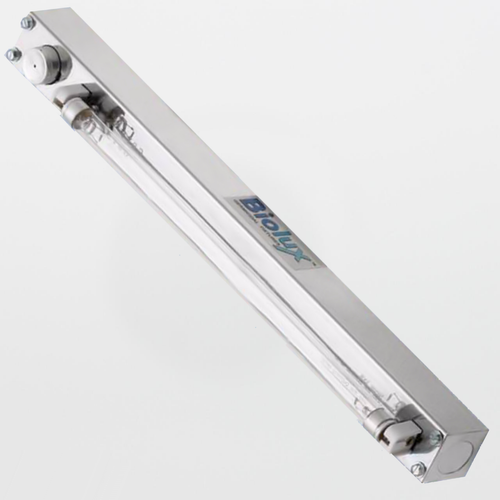
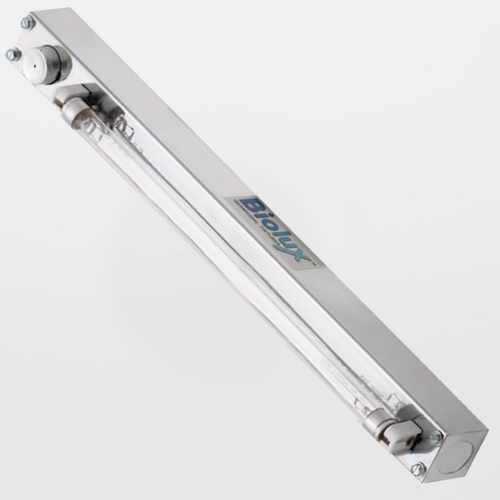
The BIOLUX 25W Germicidal Strip Fixture is a compact, preheat UV-C fixture designed to provide direct germicidal ultraviolet exposure for air and exposed-surface disinfection in small areas and enclosures. This model is commonly specified for controlled environments where repeatable UV-C output, dependable construction, and straightforward maintenance are required. SKU: BIOLUX 25 (40-1110).

Key Highlights
  • Fixture Type: Germicidal UV-C strip fixture (preheat)
  • Wattage: 25W class
  • Primary Wavelength: 254 nm UV-C (germicidal band)
  • UV Output (published): 5.0W rated at 254 nm
  • Dimensions: 19-1/2" L × 2-5/8" W × 3-1/2" H
  • Construction: Polished chrome / chrome-plated steel housing
  • Average Lamp Life (published): 6,000 hours
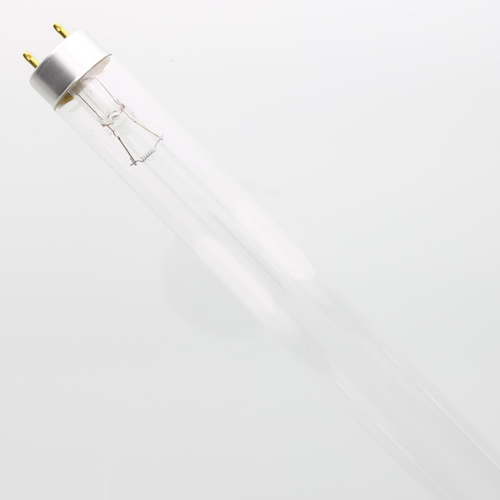
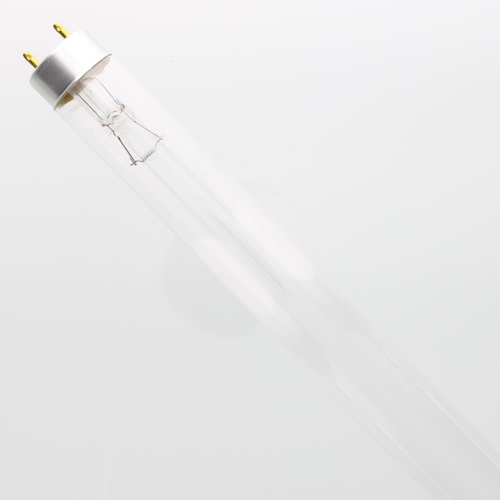
  • Lamp Included: Yes (replacement lamp commonly referenced as G25T8 / 05-1107-R)
  • Mfg. Ordering Code: 40-1110
Typical Applications
  • Laboratories, cleanrooms, and controlled production spaces (when properly safeguarded)
  • Disinfection cabinets, conveyor/inspection stations, and enclosed work areas
  • Laboratory hoods and specialty enclosures with interlocks / administrative controls
Why 254 nm UV-C?
UV-C around 254 nm is widely used because it strongly disrupts microbial DNA/RNA. In practical terms, germicidal performance is driven by dose (intensity × exposure time) and line-of-sight coverage. Surfaces in shadowed areas will not receive the same UV-C exposure without repositioning, reflectors, or multi-angle treatment.
Safety Notice (Read Before Use)
Protect eyes and skin from direct and reflected UV-C radiation. In OEM or facility applications, equipment should be designed and operated to screen, interlock, or administratively control UV-C exposure. Always follow your facility safety procedures and the product instructions.
Cleanroom Handling Tip
Treat lamp changes like a controlled maintenance step: minimize packaging debris, keep the lamp surface clean, and use clean nitrile gloves plus a lint-free cleanroom wipe to reduce residue and particulate transfer prior to operation.
Documentation & Additional Information
• Product family overview & comparison tools: BuyUltraviolet — Biolux Strip Fixtures
• Owner’s manual (installation, operation, maintenance): Biolux Strip Fixture Owner’s Manual (PDF)
About Atlantic Ultraviolet
Atlantic Ultraviolet Corporation has specialized in ultraviolet equipment and lamps for decades, supporting applications across air and surface disinfection, laboratory and industrial environments.
Need help selecting the right product?
If you need additional information please try our SOSCleanroom specific AI ChatBot which draws from our extensive cleanroom specific libraries.
Always confirm your use case, safety controls (interlocks/signage/PPE), mounting location, and required UV-C dose prior to operation.
The Technical Vault
By SOSCleanroom
UV-C Disinfection Engineering
Dose & Validation Lamp Technology Safety & Controls Cleanroom Considerations
Quick Specs
Product BIOLUX 25W Germicidal Strip Fixture with Lamp
Manufacturer / Ordering Code Atlantic Ultraviolet — 40-1110 (SOSCleanroom SKU: BIOLUX 25)
Technology Low-pressure mercury germicidal UV-C lamp + ballast (strip fixture, preheat/hot-cathode class)
Primary Germicidal Wavelength 254 nm (UV-C)
UV Output (published) 5.0W rated at 254 nm (listing). Note: published UV output can vary by rating method, ambient conditions, and product revision.
Dimensions (L × W × H) 19-1/2" × 2-5/8" × 3-1/2"
Lamp Included / Replacement Reference Included; commonly referenced replacement: G25T8 / 05-1107-R
Lamp Life (published) 6,000 hours (listing). In UV systems, “effective life” is output-based—lamps may continue operating while delivering reduced UV intensity.
The Science: Why Germicidal UV-C Disinfects Air & Surfaces
Germicidal ultraviolet is effective primarily because nucleic acids (DNA and RNA) absorb UV strongly in the 200–280 nm range. When microorganisms are exposed to sufficient UV-C dose, the absorbed energy creates photochemical damage (commonly described as lesion formation in genetic material), which blocks replication and renders microbes non-viable.
Key engineering takeaway: UV disinfection is not “magic light”—it is a dose-controlled process. Dose is typically treated as irradiance × time. Distance, fixture geometry, reflectivity, airflow, and shadowing determine how much UV reaches a target. In cleanroom and lab settings, validation often focuses on ensuring that the minimum dose reaches all critical surfaces and air paths.
Engineering: How a 254 nm Germicidal Lamp Produces UV-C
Most classic germicidal fixtures use a low-pressure mercury vapor discharge (similar architecture to a fluorescent lamp, but designed to emit UV rather than visible light). Inside the tube, an electrical discharge accelerates electrons that collide with mercury atoms, exciting them to higher energy states. As mercury returns to lower energy states, it emits photons—most notably the strong 253.7 nm spectral line (commonly referred to as “254 nm”).
Critical design elements include: (1) electrodes optimized for stable discharge, (2) a ballast to control current, (3) materials that transmit UV-C (often quartz or UV-transmitting glass where required), and (4) thermal and pressure management— mercury vapor pressure strongly influences UV-C output. That is why lamp output ratings are typically specified at defined operating conditions and after a burn-in period.
Dose, Distance & Shadowing: What Actually Determines Results
  • Distance matters: UV intensity decreases rapidly as distance increases (geometry-dependent; often approximated by inverse-square behavior in open space).
  • Shadowing is real: UV-C is line-of-sight. Any occluded surface receives dramatically less dose unless repositioned or exposed via reflection.
  • Surface condition: Films, dust, and residues can block UV-C and reduce effective dose. Routine cleaning is part of performance control.
  • Time is a lever: If you cannot increase intensity, longer exposure increases dose (within process and material limits).
Safety & Controls (Non-Negotiable for UV-C)
UV-C can cause eye and skin injury from direct or reflected exposure. For facility deployments, best practice is to treat UV-C like a controlled-energy maintenance operation: interlocks where feasible, warning signage, timers, and defined PPE requirements when entry cannot be avoided.
Also consider material compatibility: UV-C can degrade certain plastics, elastomers, and insulation. Shield sensitive components and avoid exposing non-UV-rated polymers to direct UV-C for extended periods.
Maintenance, Verification & Replacement Strategy
  • Clean the lamp surface: dust and films reduce UV transmission. Use appropriate lint-free materials and facility-approved cleaners.
  • Plan replacement by effective life: UV output decays over time; replace lamps at the rated interval or when intensity falls below your validated threshold.
  • Measure when performance matters: use a UV-C radiometer/detector to confirm irradiance at target locations during validation and periodic checks.
  • Document critical parameters: fixture model, lamp model, installation distance, exposure time, and measured intensity/dose.
Cleanroom Considerations
In controlled environments, UV-C is most effective when treated as part of a broader contamination-control program: minimize debris during installation, stage clean gloves and lint-free wipes, and validate exposure for the actual geometry of your instruments, hoods, cabinets, or conveyor paths. UV-C supports disinfection objectives, but it does not replace cleaning where soils or residues block UV transmission.
Documentation & Resources
• Owner’s Manual (installation/operation/maintenance): Biolux Strip Fixture Manual (PDF)
• Product family overview (plus comparison tools): BuyUltraviolet — Biolux Strip Fixtures
• Air & surface model comparison chart: UV Air & Surface Comparison
• Replacement lamp reference (25W): G25T8 / 05-1107-R
Need deeper specs or cross-references?
If you need additional information please try our SOSCleanroom specific AI ChatBot which draws from our extensive cleanroom specific libraries.
For UV-C installations, confirm safety controls, verify intensity at the point-of-use, and document exposure time/dose as part of your quality program.