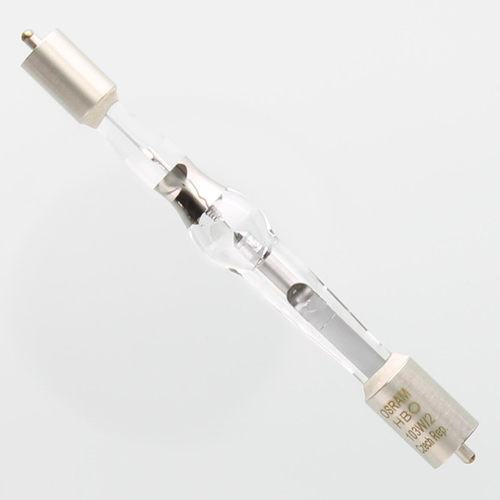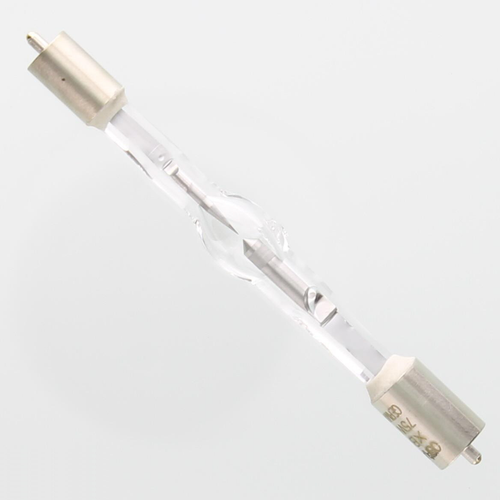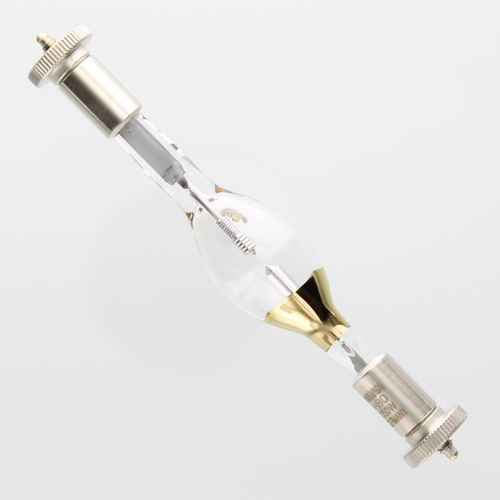
Osram HBO350W Short Arc Mercury Lamp

$516.00
(No reviews yet)
SKU:
HBO350W (69226)
Availability:
Stock Item
Shipping:
Calculated at Checkout
Product Description
High-intensity 350W short-arc mercury source for semiconductor microlithography and precision UV illumination.
SOSCleanroom
Overview

The Osram HBO350W is a direct-current (DC) mercury short-arc lamp engineered to deliver very high radiant intensity in the 350–450 nm region for semiconductor microlithography systems. It is commonly specified for ASM-L PAS 2500 equipment and other precision UV applications where arc stability and repeatable optical coupling are critical. SKU: HBO350W (69226).

Key Highlights
  • Mfg. Ordering Code: 69226
  • Electrical: 350W, 67.5V, 6A (DC)
  • Burning Position: Vertical ± 45°
  • Arc Geometry: Cold arc gap 2.9mm
  • Average Life: 600 hours
  • Application Focus: Semiconductor microlithography (high UV intensity)
Typical Applications
  • Semiconductor wafer exposure and microlithography systems (fixture dependent)
  • Precision UV illumination where a high-radiance short arc is required
  • Optical systems using purpose-built short-arc mercury lamp houses
Handling Tip 
Short-arc mercury lamps emit intense UV and operate at high internal pressure. Use only in properly enclosed, purpose-designed housings with correct shielding and interlocks. Allow full cool-down before handling, avoid shock/impact, and follow the equipment manufacturer’s lamp-change procedure.
Industry Update:
In July 2025, ams OSRAM announced an agreement to sell its Entertainment & Industry Lamps (ENI) business to Ushio, with closing expected by the end of March 2026. During and after a transition, customers may see changes such as labeling, packaging, part-number presentation, and distribution channels. Best practice: qualify replacements by manufacturer code (69226) and system-critical specs (350W/67.5V, orientation limits, and arc geometry) to protect process performance.

SOSCleanroom (Specialty Optical Systems, Inc.) has supported specialty lighting customers as a distribution partner for 40+ years.
Need help selecting the right product?
If you need additional information please try our SOSCleanroom specific AI ChatBot which draws from our extensive cleanroom specific libraries.
Always confirm compatibility with your lamp house/equipment model and cross-reference requirements (DC power supply/ignitor, mounting hardware, burning position, shielding, and cooling) prior to installation.
The Technical Vault
By SOSCleanroom
Short-Arc Mercury Engineering
How It Works Microlithography UV Power & Thermal Safety & Handling
Quick Specs
Manufacturer / Ordering Code Osram HBO350W  |  69226
Lamp Type / Technology High-pressure mercury short-arc discharge lamp (DC)
Wattage / Voltage (Nominal) 350W / 67.5V (nominal)
Operating Current Nominal ~5.3A (equipment and supply dependent)
Arc Geometry Cold electrode gap ~2.9–3.0mm  |  LCL 45.0mm
Dimensions (Typical) Length 128mm  |  Diameter 20mm
Burning Position Vertical ±45° (fixture dependent; follow lamp-house orientation guidance)
UV Relevance High spectral intensity with peak irradiance at 365nm (microlithography i-line)
How a Short-Arc Mercury Lamp Produces Light (Engineering Detail)
A short-arc mercury lamp is a high-pressure gas-discharge source. The light is generated by a plasma arc struck between an anode and cathode inside a compact quartz burner containing mercury. Once operating temperature is reached, mercury vapor pressure becomes very high, increasing plasma density and enabling extremely high radiance. The “short-arc” design (here, ~3mm cold gap) concentrates electrical power into a tiny emitting volume, which is why these lamps couple efficiently into optical systems compared with longer-arc lamps.
Ignition & power regulation: these lamps require a compatible DC power supply and ignitor. The ignitor provides a high-voltage pulse to initiate conduction. After strike, the lamp warms up and the electrical characteristics shift rapidly as pressure rises. Stable performance depends on tight regulation of operating power/current (and correct cabling, connections, and interlocks).
What the plasma emits: mercury plasma produces a UV-visible spectrum with strong discrete features. In lithography, the 365 nm i-line is a major reason these sources are used—optics and photoresist processes are often designed around that band, with filtering and beam conditioning handled at the system level.
Why Arc Size, LCL, and Orientation Are Process-Critical
Microlithography illumination depends on radiance, arc stability, and repeatable arc positioning. Two lamps can share the same wattage yet perform differently if arc gap, light center length (LCL), or mounting geometry changes—because the illumination system is imaging or coupling the arc into an integrator/optical train.
Best practice for replacements: validate ordering code and the optics-critical geometry (arc gap, LCL, overall length/diameter, and allowable burning position) before introducing the lamp into a qualified tool.
Thermal & Life Engineering (What Shortens Service Life)
  • Electrode wear: cathode emitter consumption and anode heating are primary wear mechanisms; instability or over-power accelerates erosion.
  • Cooling effectiveness: lamp houses are engineered for specific airflow/thermal paths; inadequate cooling increases seal temperature and reduces lifetime margin.
  • Duty cycle: frequent hot restrikes and short cycling increase stress; follow the tool manufacturer’s run/cooldown guidance.
  • Power quality: ripple, misregulated current, or incorrect ignitor can cause arc wander, flicker, and premature failure.
Critical Safety Notes
  • Operate only in enclosed lamp housings: high luminance UV and high internal pressure require purpose-built casings with correct shielding and interlocks.
  • UV exposure control: verify filters/shutters/beam path integrity; UV can damage eyes/skin and degrade polymers.
  • Mercury precautions: follow facility procedures for storage, transport, and disposal; treat breakage as a regulated spill event.
  • Cool-down required: allow full cool-down before removal; hot handling increases risk and may damage housings/connectors.
Industry Update: ENI Business Transaction (Expected Close by End of March 2026)
ams OSRAM announced an agreement to sell its Entertainment & Industry Lamps (ENI) business to Ushio, with closing expected by the end of March 2026. For high-dependence tools, the most resilient approach is disciplined qualification: retain the lamp’s core identifier (HBO350W / 69226) and qualify replacements by electrical operating point, optical geometry (arc gap/LCL), mechanical envelope, and the approved lamp house model.
Cleanroom Considerations

Treat lamp changes like a controlled maintenance event: minimize packaging debris, keep lamp-house interfaces clean, and prevent particulate transfer to reflectors, integrators, and quartz windows.

Stage clean nitrile gloves and a cleanroom-grade lint-free wipe during installation to reduce contamination risk and prevent residue transfer to optical surfaces.

Need deeper specs or cross-references?
If you need additional information please try our SOSCleanroom specific AI ChatBot which draws from our extensive cleanroom specific libraries.
For microlithography tools, confirm OEM requirements (approved power supply/ignitor, lamp-house model, orientation limits, cooling, and shielding/filters) and follow the tool’s qualification procedure prior to return-to-service.