Quick Specs
| Manufacturer / Ordering Code |
Osram / Sylvania EJA | Mfg. Ordering Code: 54753 | UPC: 046135547539 |
| Lamp Type / Technology |
Tungsten halogen reflector lamp (MR16) |
| Wattage / Voltage |
150W / 21V |
| Base / Socket |
GX5.3 Bi-Pin |
| Optical Profile |
CCT: 3,350K (typical listing) | MR16 reflector format (focused beam) |
| Average Life |
40 hours |
Critical Compatibility Warning: MR16 Look-Alikes Are Common
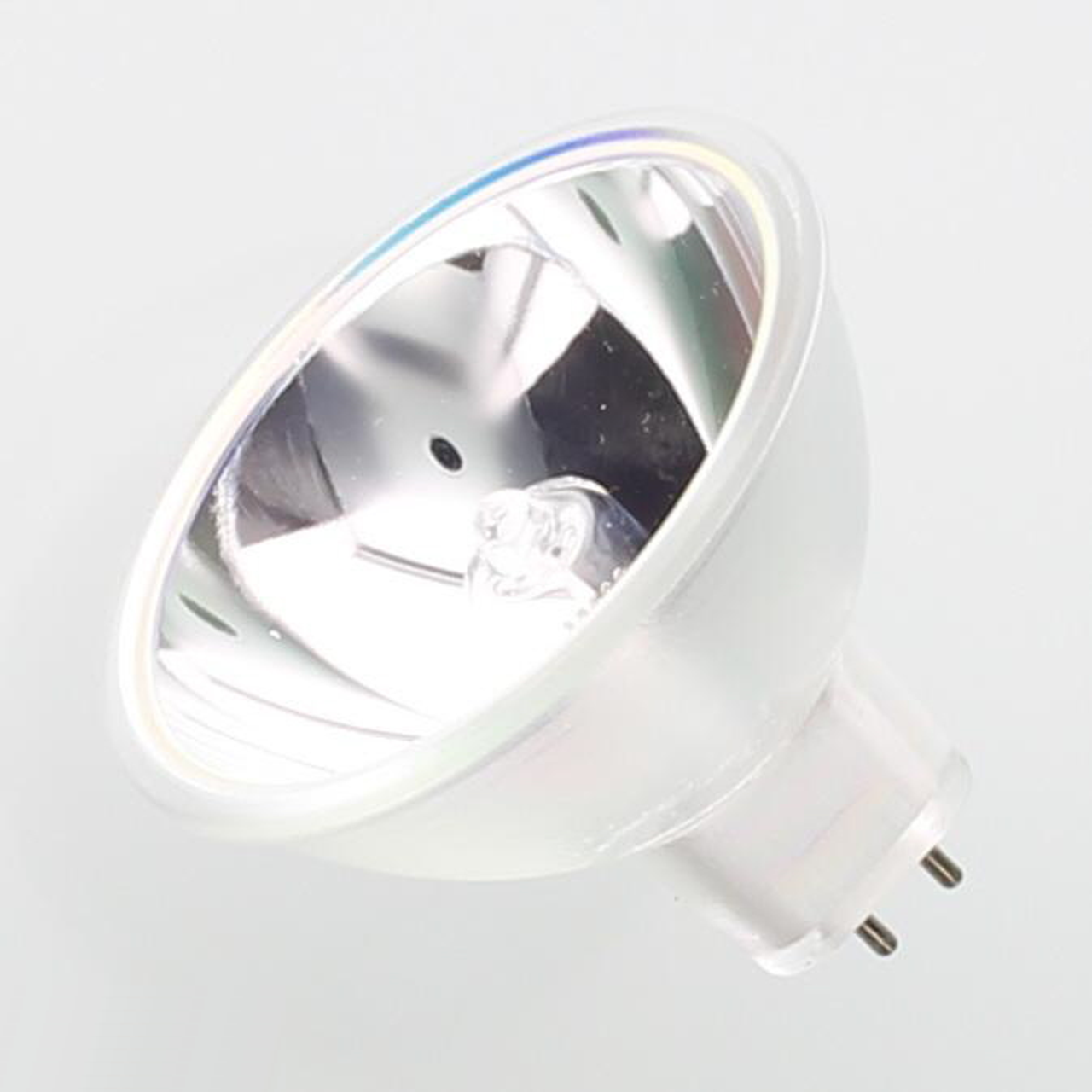
The Osram/Sylvania EJA is a 150W / 21V MR16 halogen lamp on a GX5.3 base.
MR16 lamps with the same “shape” are sold in different voltages (12V, 15V, 21V, 24V) and are not safely interchangeable.
Do not substitute by appearance alone—match voltage, wattage, base, and the exact lamp code specified by your equipment.
The Science: How a Halogen Bulb Produces Light
A halogen lamp is a type of incandescent light source. Electrical current heats a tungsten filament until it becomes white-hot,
producing continuous-spectrum light (visible plus infrared) through thermal radiation.
The “halogen” advantage comes from the halogen cycle inside a quartz (high-silica) envelope: a small amount of halogen (often iodine/bromine)
reacts with evaporated tungsten and helps transport it back toward the filament where it redeposits. This reduces envelope blackening and supports consistent output
while operating at high temperature.
Industry Update: ams OSRAM ENI Business → Ushio (Expected Close by End of March 2026)
Ushio and ams OSRAM announced an agreement for Ushio to acquire ams OSRAM’s Entertainment & Industry Lamps (ENI) business, with closing expected by the end of March 2026.
What this means for buyers: customers may encounter changes in labeling, packaging, part-number presentation, or channel availability across certain specialty lamp lines during the transition.
To reduce risk, qualify replacements by 150W/21V, GX5.3, and the MR16 form factor, and keep the manufacturer ordering code (54753) in maintenance records.
Compatible Illuminators: Where EJA-Class MR16 Lamps Commonly Appear
The EJA is typically used as an OEM-specified replacement in applications where an MR16 reflector lamp is part of a controlled optical path.
Because “MR16” is a shape and not a full spec, the safest approach is to validate compatibility by lamp code + voltage + base from the equipment manual.
Verify-First Checklist (prevents mis-orders)
- Electrical: 21V and 150W must match your illuminator output rating.
- Base: GX5.3 bi-pin must match pin spacing and seating depth.
- Optical geometry: reflector type and filament position affect focus and coupling.
- Thermal: confirm housing is designed for a 150W halogen thermal load.
| Application Category |
Typical System Types |
What Usually Drives Lamp Choice |
| Fiber Optic “Cold Light” Sources |
External illuminators that couple an MR16 lamp into a light guide for inspection stations and stereo microscope workcells.
|
Filament position and reflector geometry for efficient coupling; stable continuous spectrum for inspection.
|
| Instrument / Module Illumination |
Built-in lamp modules in legacy optical instruments, specialty inspection heads, and certain medical/procedure illumination assemblies.
|
Thermal constraints, shielding requirements, and a validated optical path designed around halogen.
|
| Precision Visual Inspection |
Systems where beam focus and field uniformity matter more than raw efficiency.
|
Consistent beam profile, stable color rendering, and compatibility with existing filters/cameras.
|
Important: many “similar” illuminators use 15V or 24V MR16 variants.
If your manual does not explicitly call out 21V, stop and verify before ordering.
Why Some Halogen Lamps Do NOT Have a True LED Direct Replacement
In general lighting, LED MR16 lamps are common. In instrument illumination (fiber coupling, microscopes, medical modules, metrology),
“MR16 shape” is not the full specification. Many systems are engineered around halogen’s filament geometry, electrical behavior,
thermal profile, and continuous spectrum.
1) Optical Coupling (Filament vs LED Emitter)
- Filament position is the optical “datum”: lamp housings often assume a precise filament location relative to reflector and coupling optics.
- LEDs are different sources: LEDs are typically larger-area emitters (or multi-die arrays) with different emission patterns.
- Etendue limits: fiber ports and condensers may not accept LED light efficiently, reducing brightness at the target.
2) Electrical / Dimming Compatibility
- Halogen is a resistive load: many instruments dim by reducing voltage (smooth, predictable filament response).
- LED needs a driver: LED retrofits must add constant-current control and protections inside a small envelope.
- Flicker & control curve risk: incompatible LED retrofits can flicker (bad for imaging) or dim poorly in legacy power supplies.
3) Thermal Design (Heat Path Is Different)
- Halogen radiates: housings often use shielding/airflow designed around radiative heat.
- LED conducts: LEDs require heatsinking into the housing; without it, LED life drops fast.
- Mechanical constraints: “high-output” LED heatsinks often won’t fit where the lamp must sit to preserve optical alignment.
4) Spectrum / Imaging Response
- Halogen is continuous-spectrum: predictable response through filters, optics, and camera sensors.
- LED is spectrally shaped: even “high CRI” can shift color response in cameras and inspection workflows.
- Validation impact: regulated or calibrated workflows may require re-qualification if the source type changes.
Replacement & Handling Notes
- Match voltage exactly: this is a 21V MR16 lamp. Substituting a 12V/15V/24V type can cause incorrect output and shorten life.
- Base fit matters: confirm GX5.3 pin spacing and seating depth to avoid stress on the socket and optical misalignment.
- Beam performance depends on geometry: reflector type and filament positioning drive focus and uniformity—match EJA when possible.
- Keep the envelope clean: fingerprints/residues can create localized hot spots. Use clean nitrile gloves and/or a lint-free wipe.
- Cool-down time: allow full cool-down before removal (high operating temperature).
- Plan spares: rated life is 40 hours; for critical instruments, keep spares onsite.
Storage Guidance
- Store in original packaging to protect reflector surface and quartz envelope.
- Keep dry and temperature-stable; avoid vibration and crushing forces.
- Inspect packaging condition before use (especially older stock).
Cleanroom Considerations
Treat lamp changes as a controlled maintenance step: minimize packaging debris, use low-lint handling materials, and keep the reflector and envelope free of oils and particulates prior to powering the instrument.
Stage clean nitrile gloves and a cleanroom-grade lint-free wipe during installation to reduce contamination risk and prevent residue transfer to nearby optics.
Technical Disclaimer
Specifications and compatibility guidance are provided for informational purposes only.
SOSCleanroom does not manufacture this product and relies on published manufacturer data and industry-standard references.
Always verify compatibility with your equipment documentation and internal validation requirements before installation.
Need a fast compatibility check?
Send us your instrument make/model and the exact lamp callout (voltage + base + lamp code). We’ll confirm a safe match.
For mission-critical optical systems, confirm OEM requirements (voltage, wattage, base type, reflector/beam format, and thermal limits) prior to use.