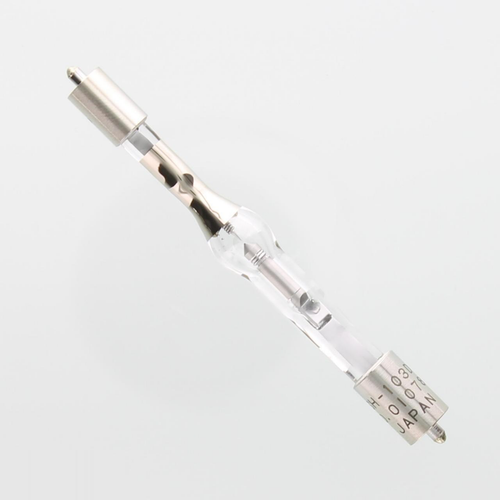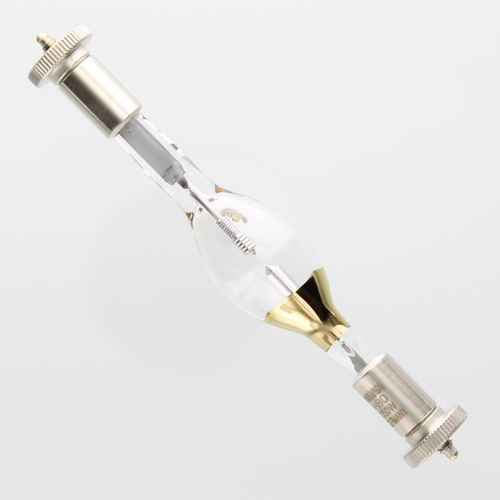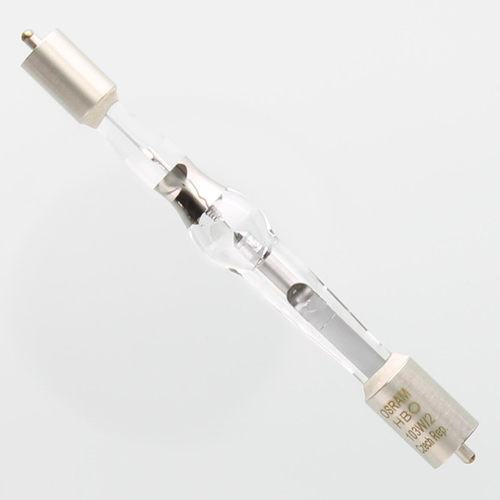
Osram HBO 103W/2 Sylvania 100W Long Life Short Arc Mercury Lamp

$154.00
(No reviews yet)
SKU:
HBO103W/2 (69182)
UPC:
046135691829
Availability:
Stock Item
Shipping:
Calculated at Checkout
Product Description
100W-class (103W nominal) long-life short-arc mercury illumination for fluorescence microscopy, UV curing, and laboratory optics.
SOSCleanroom
Overview

The Osram / Sylvania HBO103W/2 is a high-radiance short-arc mercury discharge lamp engineered to behave like a compact, intense point source with strong output in the UV and visible range. It is widely specified for fluorescence microscopy, UV curing, and laboratory/analytical illumination systems that require stable arc positioning and repeatable optical coupling. SKU: HBO103W/2 (69182).

Key Highlights
  • Power / Electrical: 103W nominal; DC operation; lamp voltage 17–25V; lamp current 4.0–5.0A
  • Output: nominal luminous flux 2550 lm; high radiance “point-source” arc
  • Optical geometry: Light Center Length (LCL) 43.0mm; compact 10.0mm diameter
  • Mechanical: length 90.0mm (mounting length 82.0mm max)
  • Bases: SFa9-2 (anode) / SFa7.5-2 (cathode)
  • Burning position: s90 (anode underneath)
  • Long life: nominal lifetime 300 hours
  • UPC: 046135691829
Typical Applications
  • Fluorescence microscopy and analytical imaging systems
  • UV curing and photopolymerization processes
  • Fiber illumination and laboratory/inspection optics
Handling & Safety Tip 
Short-arc mercury lamps produce intense UV radiation and operate at high internal pressure (when hot). Use only in a purpose-built enclosed housing with proper shielding/interlocks. Allow full cool-down before handling. During installation, use clean nitrile gloves and a lint-free wipe to keep the lamp envelope and bases free of oils and debris.
Industry Update:
In July 2025, ams OSRAM announced an agreement to sell its Entertainment & Industry Lamps (ENI) business to Ushio, with closing expected by the end of March 2026. During and after a transition, customers may see changes in branding, labeling, packaging, and distribution. Best practice: qualify replacements by the manufacturer code and critical specs (HBO103W/2, 69182, DC operation, LCL 43mm, and the specified bases/orientation) to ensure continuity.
Why Buy From SOSCleanroom
SOSCleanroom (Specialty Optical Systems, Inc.) has supported specialty lighting users as distribution partners for 40+ years—helping customers match lamp technology, electrical requirements, and optical geometry for mission-critical equipment.
Need help selecting the right product?
If you need additional information please try our SOSCleanroom specific AI ChatBot which draws from our extensive cleanroom specific libraries.
Always confirm compatibility with your equipment model, required DC power supply/igniter, base types (SFa9-2 / SFa7.5-2), LCL (43mm), and burning position (s90 / anode down) prior to installation.
The Technical Vault
By SOSCleanroom
Specs & Compatibility
Replacement Guidance Handling & Storage Cleanroom Considerations
Quick Specs
Manufacturer / Ordering Code Osram / Sylvania HBO103W/2 (69182)
Lamp Type / Technology High-pressure mercury short-arc discharge (HBO family)
Nominal Wattage / Current Type 103W nominal / DC operation
Lamp Voltage / Current 17–25V / 4.0–5.0A
Nominal Luminous Flux 2550 lm
Arc / Point-Source Behavior Short arc (approx. 0.60 mm); high radiance for efficient optical coupling
Base / Polarity SFa9-2 (anode) / SFa7.5-2 (cathode)
LCL / Dimensions LCL 43.0 mm; Ø 10.0 mm; length 90.0 mm (mounting length 82.0 mm max)
Burning Position s90 (anode underneath)
Nominal Lifetime 300 hours (long-life type)
How a Short-Arc Mercury Lamp Works (Engineering Detail)
HBO lamps are gas-discharge sources: light is produced by an electric arc burning in a high-pressure mercury vapor atmosphere inside a quartz (fused silica) burner. “Short-arc” means the electrode gap is intentionally small, concentrating power into a very small plasma volume. The result is extremely high radiance and near point-source behavior, which is why these lamps are so effective in microscope illuminators and optical systems that rely on efficient collection and focusing.
Start-up and run-up: ignition requires a high-voltage start pulse to initiate the discharge when the lamp is cold. As the arc heats the burner, mercury rapidly vaporizes, internal pressure rises, and optical output stabilizes after a run-up period (commonly several minutes). This warm-up behavior is normal and is part of how high-pressure mercury arcs reach their designed operating state.
Why the spectrum is “multi-line”: mercury plasmas emit strong spectral lines in the UV and visible. In fluorescence microscopy, optical filter sets are frequently designed around prominent mercury emission lines, enabling efficient excitation while controlling what reaches the detector/eyepiece.
DC operation and polarity matter: this HBO103W/2 is specified for DC operation and uses different bases on anode vs cathode (SFa9-2 / SFa7.5-2). DC systems typically provide strong arc stability and predictable electrode wear—provided the lamp is installed in the correct s90 orientation (anode down).
Long-Life Performance: What Drives the 300-Hour Rating
  • Electrode engineering: “long life” types typically emphasize electrode design and operating constraints that reduce erosion and maintain arc stability over time.
  • Thermal management is the hidden variable: keep housing airflow/cooling consistent; excessive base temperature accelerates wear and can reduce life.
  • Avoid short-cycling: frequent on/off switching stresses electrodes and can reduce service life. Follow the equipment manufacturer’s duty-cycle guidance whenever provided.
  • Warm restart behavior: high-pressure mercury arcs can be difficult or impossible to restart immediately after shutdown until the lamp cools (pressure must drop).
Optical Integration: The Specs That Control System Performance
  • LCL (43.0 mm): the optical system is designed around where the arc sits in space. If LCL changes, coupling efficiency, uniformity, and alignment can degrade.
  • Arc length (~0.60 mm): short arc geometry is a primary reason these lamps behave like an intense point source and can be focused efficiently.
  • Orientation (s90 / anode down): supports thermal balance, convection patterns inside the burner, and predictable electrode wear.
  • Electrical subsystem match: correct DC supply, ballast behavior, and ignition method are required for stable operation and rated life.
Safety & Handling (Non-Negotiables)
  • Enclosed housing only: high UV + high internal pressure means these lamps must be operated only in purpose-built enclosed lamp casings.
  • Mercury hazard: if a lamp breaks, mercury may be released—follow your facility’s spill response and disposal procedures.
  • Cool-down before handling: never shock-cool or handle a hot lamp; allow full cool-down prior to service.
  • UV exposure control: maintain shielding, interlocks, and appropriate PPE for any service event.
Industry Update: ENI Business Transition (Closing Expected End of March 2026)
Keep the manufacturer ordering code (HBO103W/2, 69182) in your maintenance records and qualify alternatives by DC electrical requirements, bases/polarity, LCL, and burning position to protect optical performance and service continuity.
Cleanroom Considerations (Best Practice)
  • Stage a clean service kit: clean nitrile gloves, a cleanroom-grade lint-free wiper, and a compatible cleanroom swab for socket/contact cleaning.
  • Minimize debris: keep packaging fragments out of housings; remove any loose fibers/particles prior to re-energizing the system.
  • Protect optics: reflectors and UV optics haze easily—use low-lint technique and avoid touching optical surfaces.
Need deeper specs or cross-references?
If you need additional information please try our SOSCleanroom specific AI ChatBot which draws from our extensive cleanroom specific libraries.
For mission-critical optical instruments, confirm OEM requirements (DC supply/igniter method, polarity/bases, LCL, burning position/orientation, cooling, and UV shielding) prior to use.