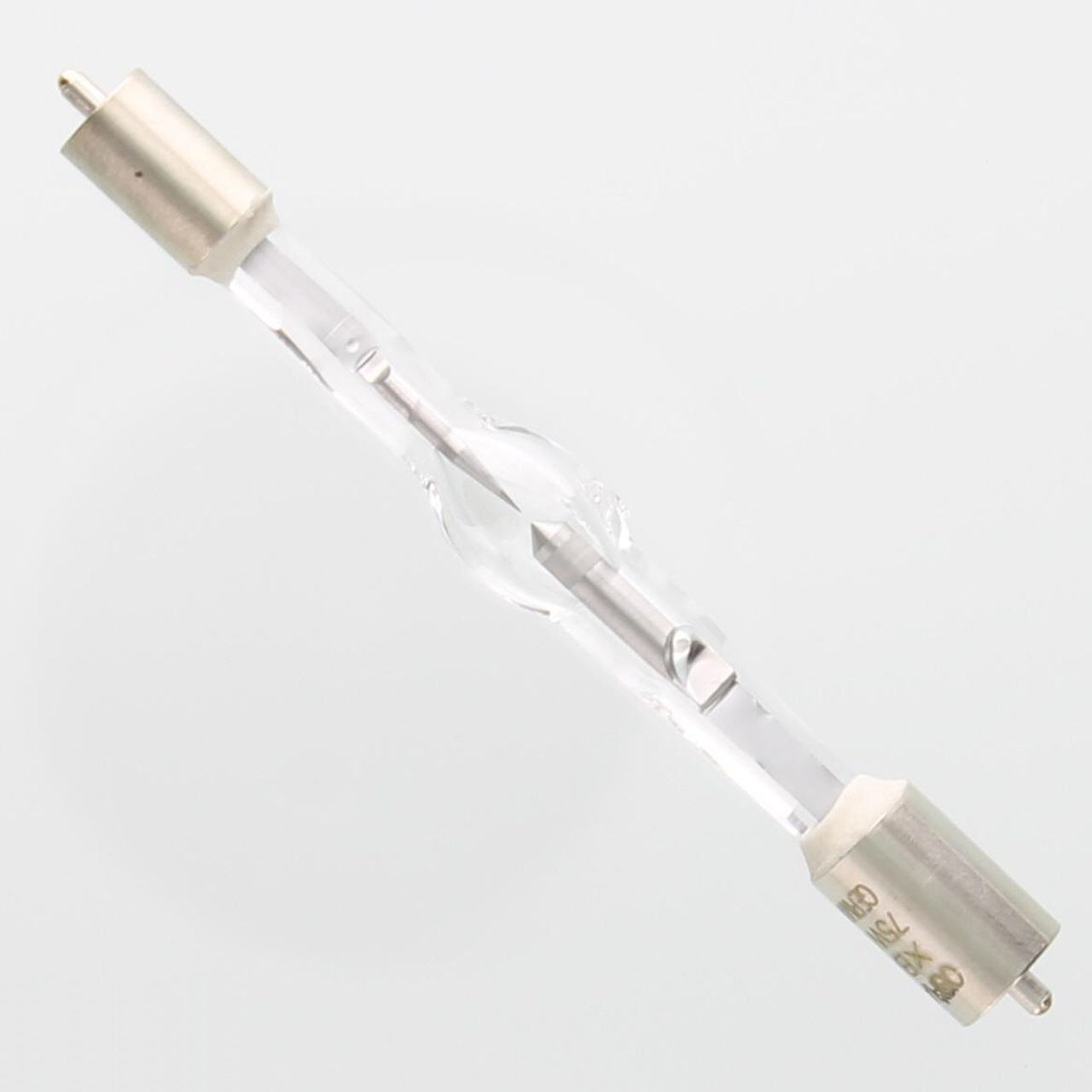
Osram Sylvania XBO75W2 75W Short Arc Xenon Lamp

$336.00
(No reviews yet)
SKU:
XBO75W2 (69231)
UPC:
4050300508801
Availability:
Stock Item
Shipping:
Calculated at Checkout
Product Description
High-radiance 75W short-arc xenon point source for medical/scientific illumination and precision optics.
SOSCleanroom
Overview

The Osram / Sylvania XBO75W2 is a 75W short-arc xenon discharge lamp designed to deliver a compact, intensely bright source point for optical systems that depend on stable coupling and repeatable illumination. It is widely used in microscopy, medical endoscopy illumination, and optical spectroscopy where high radiance and consistent color quality are valued. SKU: XBO75W2 (69231).

Key Highlights
  • Mfg. Ordering Code: 69231
  • Wattage: 75W
  • Voltage: 14V
  • Type of Current: DC
  • Base Type: SFa9-2 specialty base
  • Initial Lumens: 26,000 lm
  • Color Temperature: 6,000K
  • Length: 3.55 in
  • Average Life: 400 hours
  • UPC: 4050300508801
Typical Applications
  • Microscope illuminators and optical instruments
  • Medical endoscope illumination systems
  • Optical spectroscopy and analytical illumination
Handling Tip 
Short-arc xenon lamps operate at high temperature and internal pressure and emit intense light (including UV). Replace only in the intended enclosed housing and follow OEM service procedures. Use clean nitrile gloves and lint-free wipes to prevent residue and reduce contamination during installation.
About OSRAM / ams OSRAM
OSRAM’s Display/Optic portfolio serves diverse markets including entertainment/cinema, medical/scientific, semiconductor fabrication, and airfield/aircraft applications. These specialty halogen and discharge lamp families are produced globally across multiple manufacturing footprints.
Service Note
SOSCleanroom (Specialty Optical Systems, Inc.) has supported specialty lighting customers as a distribution partner for 40+ years. For critical optical systems, qualify replacements by electrical specs (75W / 14V DC), base type (SFa9-2), and the manufacturer code (XBO75W2 / 69231).
Industry Update:
In July 2025, ams OSRAM announced an agreement to sell its Entertainment & Industry Lamps (ENI) business to Ushio, with closing anticipated by the end of March 2026. During and after the transition, customers may see changes in part-number presentation, labeling/packaging, and distribution channels. Best practice: keep maintenance records anchored to the manufacturer code (XBO75W2 / 69231) and qualify alternates strictly by critical specifications.
Need help selecting the right product?
If you need additional information please try our SOSCleanroom specific AI ChatBot which draws from our extensive cleanroom specific libraries.
Always confirm compatibility with your system’s required wattage/voltage, DC operation, base type (SFa9-2), and mechanical clearances prior to installation.
The Technical Vault
By SOSCleanroom
Short-Arc Xenon Engineering
Arc Physics Ignition & Ballast Optical Coupling Thermal Management Safety & Service
Quick Specs
Product / SKU Osram / Sylvania XBO75W2 (69231)
Lamp Type / Technology Short-arc xenon discharge lamp (high radiance point source)
Nominal Power 75W
Voltage / Current Type 14V / DC
Base SFa9-2 specialty base
Initial Output 26,000 lm
Color Temperature 6,000K
Length / Life 3.55 in / 400 hours
The Science: How a Short-Arc Xenon Lamp Produces Light
A short-arc xenon lamp is an arc-discharge source. When the lamp is ignited, a high-voltage pulse initiates conduction through pressurized xenon gas between two closely spaced electrodes. The gas becomes a plasma, and the arc emits intense optical radiation. Xenon plasmas provide a strong broadband output that supports excellent color quality (daylight-like appearance) and efficient coupling into optics.
The “short-arc” architecture intentionally concentrates the light-emitting region into a very small volume. That compact source behaves like a near point source with extremely high radiance—ideal for microscopes, endoscopy light engines, and spectroscopy systems that rely on controlled optical collection.
Engineering Deep Dive: What Drives Performance
  • Electrode geometry: Electrode shapes and spacing stabilize where the arc attaches and define the effective source size—directly impacting brightness, focus, and coupling efficiency.
  • High-pressure xenon fill: As the lamp warms up, xenon pressure and plasma density rise, increasing radiance and helping maintain a compact arc.
  • Quartz envelope: High-silica/quartz construction tolerates thermal load and transmits useful UV/visible output, but must be kept clean to avoid localized heating.
  • Arc stability: Stable arc position improves uniformity in illumination systems and helps maintain repeatable optical alignment over the lamp’s service life.
Ignition & Ballast Control (Lamp + Power Supply = System)
Arc lamps do not behave like resistive filament lamps. Once the arc is established, it exhibits a negative-resistance characteristic, so the system must use a current-regulated ballast/power supply plus an igniter to start and stabilize operation.
  • Start behavior: A high-voltage pulse initiates the discharge; marginal igniters, worn connectors, or poor grounding can appear as “lamp issues.”
  • Warm-up: Output and arc stability improve as the lamp reaches thermal equilibrium; many systems enforce a warm-up window before critical use.
  • Service planning: Consistent performance depends on lamp condition and the health of the ballast/igniter—both should be considered in troubleshooting.
Optical Coupling: Why “Point Source” Matters
  • Microscopy: A compact source supports efficient condenser coupling and stable field illumination.
  • Endoscopy: High radiance improves coupling into light guides, helping deliver bright output at the distal tip.
  • Spectroscopy: Stable emission supports repeatable intensity at the slit/fiber input and reduces baseline drift caused by arc wander.
Ozone Considerations (When It Matters)
Short-arc xenon lamps can emit UV wavelengths that may generate ozone in air within some housings. Certain lamp families offer an “ozone-free” variant designation (commonly labeled OFR) intended to reduce ozone formation in typical operating environments. If your system specifies an ozone-free lamp, follow the OEM requirement and match the exact variant.
Safety: High Luminance, UV, and High Internal Pressure
  • Enclosed housings only: Never operate outside the intended lamp housing; direct viewing of the arc can cause severe eye injury.
  • High pressure: Treat as a pressurized component; allow full cool-down before handling and follow OEM procedures for replacement and disposal.
  • UV exposure: Maintain shielding and interlocks; never defeat safety systems.
  • Clean handling: Fingerprints/residue can create hot spots; use clean nitrile gloves and lint-free wipes/swabs.
Cleanroom Considerations

Treat lamp replacement as a controlled maintenance event: minimize packaging debris, protect nearby optics/sensors, and prevent particle shedding in the lamp bay.

Stage clean nitrile gloves plus cleanroom-grade lint-free wipes/swabs (Texwipe options are commonly used) to reduce contamination and prevent residue transfer during service.

Industry Update: ENI Business Sale to Ushio (Target Close: End of March 2026)
ams OSRAM announced an agreement in July 2025 to sell its Entertainment & Industry Lamps (ENI) business to Ushio, with closing anticipated by the end of March 2026. Practical takeaway: keep procurement and maintenance anchored to manufacturer codes and qualify alternates strictly by the required electrical, mechanical, and optical interface specifications.
Need deeper specs or cross-references?
If you need additional information please try our SOSCleanroom specific AI ChatBot which draws from our extensive cleanroom specific libraries.
For mission-critical optical systems, confirm OEM requirements (power supply/igniter compatibility, lamp housing/cooling, and required lamp variant) prior to installation.