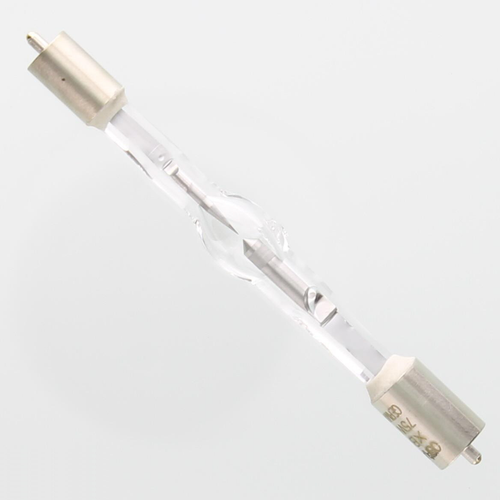
Quick Specs
| Manufacturer / Ordering Code |
Osram / Sylvania XBO 75 W/2 OFR (69232) |
| Lamp Technology |
High-pressure xenon short-arc discharge (near point source) |
| Type of Current |
DC |
| Nominal Electrical |
75W; lamp voltage 12–16V; lamp current 4.9–5.9A |
| Photometric |
1,000 lm; ~6,000K; CRI (Ra) ~98 |
| Arc / Geometry |
Electrode gap (cold) 0.9mm; LCL 37.0mm; length 90mm; diameter 10mm |
| Bases |
Anode: SFa9-2; Cathode: SFa7.5-2 |
| Lifetime |
400 hours (typical) |
| UPC/EAN |
4050300508825 |
How a Short-Arc Xenon Lamp Works (Arc Physics + Engineering)
Short-arc xenon lamps generate light from a dense plasma arc formed in high-pressure xenon gas inside a quartz burner. A dedicated igniter initiates breakdown, then a regulated DC power supply drives controlled current through the arc. Because the arc is extremely compact, it produces very high radiance, allowing optical systems to treat it as a near point source.
Xenon arcs are prized for delivering a bright, “daylight-like” appearance (around 6000K) with strong color fidelity. In real instruments, reflectors and condensers collect the arc, then filters/dichroics shape the delivered spectrum to the application (imaging, endoscopy illumination, solar simulation, scanning, etc.).
Engineering performance is strongly tied to arc stability (minimizing arc wander), correct lamp seating at the designed light center length (LCL), and maintaining cooling/ventilation in the lamphouse. Small alignment errors can reduce coupling efficiency, shift spot uniformity, and increase thermal loading on downstream optics.
What “OFR (Ozone-Free)” Means (and What It Changes)
Ozone forms when oxygen in air is exposed to sufficiently energetic UV that can split O2 into atomic oxygen; those atoms then recombine with O2 to form O3. In practice, wavelengths below ~240nm are the key drivers of ozone formation near UV sources.
OSRAM designates lamps with the OFR suffix as ozone-free versions. In this construction, the quartz is treated to suppress radiation below approximately 250nm, which is why OFR lamps are specified when ozone generation must be minimized.
Practical takeaway: OFR lamps are an excellent choice for most medical/scientific illumination systems where the goal is bright visible output and controlled UV. If an OEM application specifically depends on deep-UV transmission (rare in typical endoscopy/microscopy illumination), confirm with the equipment manufacturer before substituting an OFR model.
Ignition & Power Supply Matching (DC Lamp)
- Use the correct lamp type: This model is specified for DC operation; match the OEM power supply/igniter design.
- Current regulation is critical: Arc lamps are current-driven devices; stable operation requires regulated current in the lamp’s specified window (4.9–5.9A), with lamp voltage typically in the 12–16V range.
- Hot restart capability: Many XBO systems support restart after short cool-down intervals; follow the OEM lamphouse procedure to protect the burner and igniter.
Cross-Reference Guidance
Many instruments reference this lamp by internal OEM codes. When qualifying, anchor your maintenance and purchasing records on the manufacturer identifiers: XBO 75 W/2 OFR and 69232.
Known cross-references often seen in the field include: XBO75W/2, XBO75W2, 69231, Ushio UXL-75XE, Olympus 8-B198, and Nikon 78682. Always validate base/contact style and arc positioning requirements with your lamphouse.
Safety & Handling (High Pressure + UV + High Voltage)
XBO lamps produce very high luminance, UV radiation, and operate under high internal pressure. They must be used in appropriate enclosed casings with the OEM’s shielding and interlocks in place. Use protective handling equipment supplied with the lamp when applicable, and follow OEM procedures for cool-down, disposal, and service.
Cleanroom Considerations
Treat lamp changes like controlled maintenance: minimize packaging debris, avoid shedding materials, and protect adjacent optics (reflectors, condensers, UV windows) from residue and particulates.
For best results, stage clean nitrile gloves and a Texwipe cleanroom-grade lint-free wiper (and cleanroom swabs for tight areas) during installation to reduce contamination risk and preserve optical throughput.
Industry Update (Expected Close by End of March 2026)
ams OSRAM announced an agreement to sell its Entertainment & Industry Lamps (ENI) business to Ushio for EUR 114m, with closing expected by the end of March 2026. Practical takeaway: keep your internal documentation anchored on the ordering code (69232), lamp type (DC), and qualifying specs (75W, 12–16V, 4.9–5.9A, base types, and LCL) to reduce risk during any labeling or channel changes.
Trusted Distribution
SOSCleanroom (Specialty Optical Systems, Inc.) has been specialty lighting distribution partners for over 40 years.