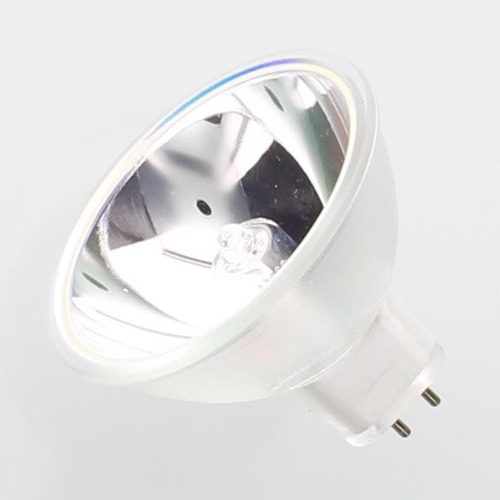
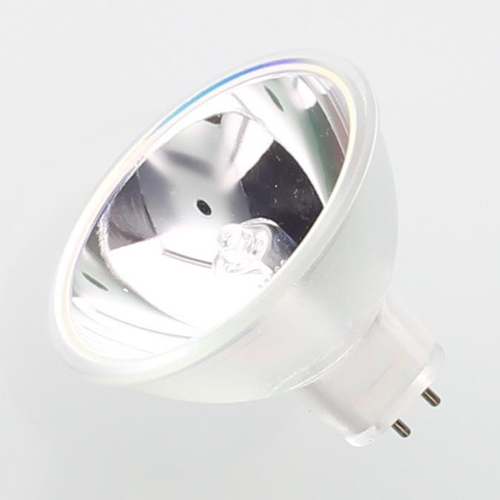
Quick Specs
| Manufacturer / Ordering Code | Ushio EKE | Mfg. Order Code: 1000306 | UPC: 048777119952 |
| Common Description | JCR21V-150W/MR16 |
| Lamp Type / Technology | Halogen lamp with MR16 reflector (instrument-grade) |
| Output / Spectrum | Visible (continuous spectrum) with infrared component typical of halogen sources |
| Wattage / Voltage | 150W / 21V |
| Base / Socket | GX5.3 Bi-Pin Base |
| Shape / Envelope | MR16 (approx. 50.7mm diameter) |
| Color Temperature | Typically listed ~3200K to ~3300K (varies by listing) |
| Average Life | 200 Hours |
Critical Compatibility Warning: EKE (21V) is NOT EFR (15V)
EKE lamps are 150W / 21V on a GX5.3 base. Many common fiber optic illuminators and microscope light sources use
150W / 15V (often EFR) on a different base or with different filament geometry. Do not substitute by "MR16" appearance alone.
Always match voltage, base, and the lamp code specified in your equipment manual.
The Science: How a Halogen Bulb Produces Light
A halogen lamp is a form of incandescent light source. Electrical current passes through a tungsten filament, and the filament's
resistance converts energy into heat. At operating temperature, the filament becomes white-hot and emits continuous-spectrum light
(visible light plus infrared) due to thermal radiation.
The "halogen" advantage comes from the halogen cycle. Inside a quartz (high-silica) envelope, an inert fill gas is combined with a small amount
of halogen (commonly iodine or bromine). Tungsten that evaporates from the filament can react with the halogen to form tungsten-halide compounds.
Near the hotter filament region, these compounds dissociate and redeposit tungsten back onto the filament. This helps reduce glass blackening and supports
higher filament temperatures for strong, stable output—while also requiring careful handling because the lamp operates at high temperature.
Industry Update: ams OSRAM ENI Business → Ushio (Expected Close by End of March 2026)
Ushio announced an agreement to acquire ams OSRAM's Entertainment & Industry Lamps (ENI) business, with closing anticipated by the end of March 2026.
What this means for buyers: during and after the transition, customers may see changes in branding, part-number presentation, packaging,
origin labeling, or channel availability across certain specialty lamp families. To reduce risk, qualify replacements by electrical specs (150W/21V),
base (GX5.3), and MR16 geometry, and retain the manufacturer code (EKE / 1000306) in maintenance records.
Common Cross-References (Verify Before Ordering)
Common identifiers include: EKE, JCR21V-150W, JCR21V-150W/MR16, and 150W 21V MR16 GX5.3.
Always verify voltage and base type before substituting—MR16 lamps may look similar while using different electrical ratings.
Compatible Illuminators & Systems (Model Families to Check)
The Ushio EKE is widely used as an OEM replacement lamp in fiber optic "cold light" sources and specialty medical / inspection illuminators.
Use the table below as a starting point, then confirm your exact model's lamp callout (voltage, base, and lamp code) before ordering.
| Illuminator / System Family |
Examples Commonly Referenced With EKE |
What to Verify |
| Fiber Optic Light Sources (Inspection / Stereo Microscopy) |
Dolan-Jenner / Fiber-Lite families frequently list EKE usage (example models include 170D, 180, PL800/PL900, Mi-150/Mi-152, DC950, A24 series). |
Confirm lamp is 150W / 21V and base is GX5.3. Some "similar" housings use 15V lamps. |
| Medical / Dental / Procedure Illumination (Legacy Halogen Modules) |
EKE is commonly referenced across legacy illumination platforms where MR16 optics and controlled coupling are required. |
Verify voltage and socket depth. Many medical assemblies also require specific reflector type or shielding. |
| Industrial / Specialty Instrument Light Sources |
Some instruments list EKE as the specified MR16 halogen source for stable, continuous-spectrum illumination. |
Confirm beam geometry, filament reference position, and any required filters (IR/heat, ND, color correction). |
Pro tip: If your illuminator manual calls out 15V / 150W (often EFR-family), do not install EKE 21V. Voltage mismatch shortens lamp life or under-drives illumination.
Why Some Halogen Lamps Do NOT Have a True LED Direct Replacement
In general lighting, "LED MR16" is common. In instrument illumination (fiber coupling, microscopy, medical modules, inspection),
"MR16 shape" alone is not the specification. Many EKE applications are engineered around the halogen filament's
optical reference point, electrical load behavior, spectrum, and thermal path.
1) Optical Coupling
- Filament position is the optical datum; LEDs are different emitter geometries that can reduce fiber coupling efficiency.
- Etendue limits fiber ports—many cannot accept larger apparent sources without coupling losses.
2) Electrical / Dimming
- Halogen is a resistive load; instruments that dim by voltage are designed around filament response.
- LEDs require constant-current regulation; incompatible retrofits can introduce flicker or unstable dimming.
3) Thermal Design
- Halogen radiates heat outward; LED heat is conduction-heavy and requires a heatsink path the housing may not support.
4) Spectrum / Imaging
- Halogen is continuous-spectrum; even high-CRI LEDs can shift color in camera pipelines and color-critical inspection.
- When systems are validated on halogen, LED substitution can change results even when it “looks the same.”
Replacement & Handling Notes
- Match electrical specs: use 150W / 21V only.
- Confirm base & format: GX5.3 pin geometry and MR16 reflector dimensions are critical.
- Keep the envelope clean: avoid fingerprints. Use clean nitrile gloves and/or a lint-free wipe.
- Allow full cool-down: let the lamp cool completely before removal.
- Plan spares: typical rated life is 200 hours; keep spares for critical instruments.
Storage Guidance
- Store in original packaging to protect reflector surface and quartz envelope.
- Keep dry and temperature-stable; avoid vibration and crushing forces.
- Inspect packaging condition before use (particularly older stock).
Cleanroom Considerations
Treat lamp changes as a controlled maintenance step: minimize packaging debris, use low-lint handling materials, and keep the lamp envelope free of oils and particulates prior to powering the instrument.
Stage clean nitrile gloves and a cleanroom-grade lint-free wipe during installation to reduce contamination risk and prevent residue transfer to the lamp and optical path.
Technical Disclaimer
Specifications and compatibility guidance are provided for informational purposes only.
SOSCleanroom does not manufacture this product and relies on published manufacturer data and industry-standard references.
Always verify compatibility with your equipment documentation and internal validation requirements before installation.