
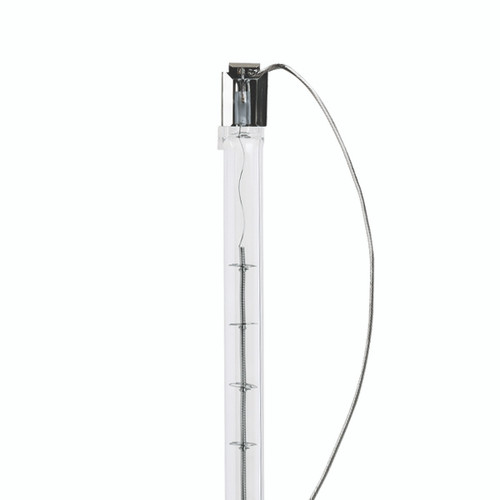
Ushio QIH240-1600/S

$59.95
(No reviews yet)
SKU:
QIH240-1600/S (1001330)
Availability:
Stock Item
Shipping:
Calculated at Checkout
Product Description
Quartz halogen infrared heater lamp for semiconductor epitaxy tools (Applied Materials EPI barrel reactor applications).
SOSCleanroom
Overview

The Ushio QIH240-1600/S is a high-output quartz halogen infrared (QIH) heater lamp engineered for semiconductor process equipment that depends on fast, controllable radiant heating. It is commonly specified for Applied Materials EPI barrel reactor configurations where repeatable thermal performance and stable output are required for process consistency. SKU: QIH240-1600/S (1001330).

Key Highlights
  • Mfg. Ordering Code: 1001330
  • Operating Wattage: 1600W
  • Operating Voltage: 240V
  • Color Temperature: 2500K
  • Average Life: 5,000 hours
  • Primary Use: EPI barrel Applied Materials reactor (tool-dependent)
Typical Applications
  • Semiconductor epitaxy (EPI) heating in AMAT reactor platforms (as specified by the tool)
  • High-stability radiant heating where fast response and repeatable output support process recipes
Why Quartz Halogen IR Heater Lamps Are Used in Process Tools
  • Highly efficient heat source: designed to convert a significant portion of input energy into infrared radiant energy.
  • Ease of control: lamp-based heat is readily managed using reflectors, optics, and power control.
  • Compact, clean energy: no combustion byproducts and a small footprint support tool design flexibility.
  • Instant response: fast ramp-up supports sophisticated heating programs and recipe repeatability.
Handling Tip 
Heater lamps run hot and are sensitive to surface contamination. Before servicing, follow your tool’s lockout/tagout procedure and allow full cool-down. Avoid touching the quartz with bare hands—use clean nitrile gloves and/or a lint-free wipe to reduce residue that can create localized hot spots and shorten life.
About Ushio
Ushio is a global photonics and specialty light source company that develops lamps, LEDs, lasers, and optical technologies used across advanced manufacturing and scientific markets—including semiconductor-related applications. Ushio’s “Applying Light to Life” focus reflects the company’s commitment to light-based solutions spanning ultraviolet through infrared.
Industry Update:
In July 2025, Ushio announced an agreement to acquire ams OSRAM’s Entertainment & Industry Lamps (ENI) business, with closing anticipated by the end of March 2026. During and after a transition, customers may see changes such as labeling, packaging, part-number presentation, and distribution channels. Best practice: qualify replacements by the manufacturer code and critical specs (for this lamp: 240V / 1600W plus tool-required mechanical interfaces) to ensure continuity.

SOSCleanroom (Specialty Optical Systems, Inc.) has served specialty lighting customers as a distribution partner for 40+ years.
Need help selecting the right product?
If you need additional information please try our SOSCleanroom specific AI ChatBot which draws from our extensive cleanroom specific libraries.
Always confirm compatibility with your exact tool configuration (electrical rating, approved lamp house/terminal interface, allowed orientation, and recipe requirements) prior to installation.
The Technical Vault
By SOSCleanroom
Quartz IR Heater Engineering
How It Works Semiconductor Heating Power & Controls Safety & Handling
Quick Specs
Manufacturer / Ordering Code Ushio QIH240-1600/S  |  1001330
Lamp Type / Technology Quartz halogen infrared heater (QIH) for semiconductor thermal processing
Operating Wattage / Voltage 1600W / 240V
Color Temperature 2500K
Average Lifetime 5,000 hours
Primary Application EPI barrel Applied Materials reactor (tool-dependent)
How QIH Heater Lamps Work (Engineering View)
A quartz halogen infrared heater is an incandescent thermal radiator optimized for heating rather than visible illumination. When current flows through the tungsten filament, electrical resistance converts power into heat. As the filament reaches operating temperature, it emits a broad continuous spectrum. For heater designs and lower color temperatures (e.g., 2500K), a large fraction of the emission sits in the near-infrared, which couples effectively to reflectors, chamber hardware, and susceptor/wafer heating architectures (tool-dependent).
The “halogen” portion is a controlled fill gas chemistry (typically an inert gas plus a halogen species) inside a quartz (high-silica) envelope. During operation, tungsten slowly evaporates from the filament. In a standard incandescent lamp, that tungsten can deposit on the envelope (blackening) and reduce output. In a halogen heater, evaporated tungsten reacts with halogen to form tungsten-halide compounds that migrate; near the hottest region the compound dissociates, returning tungsten to the filament. This halogen cycle supports stable radiant output and contributes to extended service life when the lamp is operated within its design envelope.
Because these lamps operate hot, the envelope and seals are designed for thermal stress management. The quartz body tolerates higher temperatures than soda-lime glass, while the internal filament geometry and lead structure are engineered to balance output, mechanical stability, and repeatable coupling to the tool’s optical/reflector system.
Why Semiconductor Tools Use QIH Heaters
  • Fast thermal response: radiant heating reaches target output quickly, enabling recipe ramps and tight process windows.
  • Controllability: power can be modulated in real time via the tool’s controls to maintain repeatable thermal conditions (zone-dependent).
  • Optical management: reflectors and lamp-house geometries direct IR energy where needed while protecting surrounding assemblies.
  • Output stability: consistent radiant output supports repeatable process results across maintenance cycles.
Power, Controls, and Lamp-Life Drivers
  • Voltage discipline: lamp temperature is strongly tied to voltage; sustained over-voltage accelerates evaporation and reduces life.
  • Ramp profiles: controlled ramp-up reduces thermal shock and mechanical stress on filament and seals.
  • Regulation quality: unstable regulation (excess ripple or control oscillation) can impact output stability and component wear.
  • Matched replacements: when tools use multiple lamps/banks, follow OEM guidance on grouping/matching to maintain thermal uniformity.
Installation, Handling, and Qualification Notes
  • Confirm the interface: verify lamp-house mounting, terminal style, and any alignment constraints required by the tool.
  • Keep quartz clean: fingerprints and residues can create localized hot spots—use clean nitrile gloves and lint-free wipes.
  • Protect reflectors and nearby optics: avoid debris/particulates during service; stage wipes/swabs for controlled cleaning as needed.
  • Follow the tool’s qualification procedure: after replacement, confirm the tool returns to recipe targets (stability, uniformity, and safety interlocks).
Industry Update: ENI Business Transaction (Expected Close by End of March 2026)
In July 2025, Ushio announced an agreement to acquire ams OSRAM’s Entertainment & Industry Lamps (ENI) business, with closing anticipated by the end of March 2026. For tool owners, the practical takeaway is disciplined documentation and replacement qualification: retain core identifiers (QIH240-1600/S / 1001330) and validate replacements by electrical rating, mechanical interface, and the process performance expectations of your chamber.
Cleanroom Considerations

Treat heater lamp changes as a controlled maintenance event: minimize packaging debris, prevent particulate transfer to reflectors and quartz windows, and keep service tooling low-lint.

Stage clean nitrile gloves plus cleanroom-grade lint-free wipes/swabs during installation to reduce contamination risk and prevent residue transfer to quartz and nearby optical/thermal surfaces.

Need deeper specs or cross-references?
If you need additional information please try our SOSCleanroom specific AI ChatBot which draws from our extensive cleanroom specific libraries.
For semiconductor tools, confirm OEM requirements (approved power/control method, lamp house hardware, allowable orientation, cooling/airflow, and safety interlocks) and follow the tool’s qualification procedure prior to return-to-service.