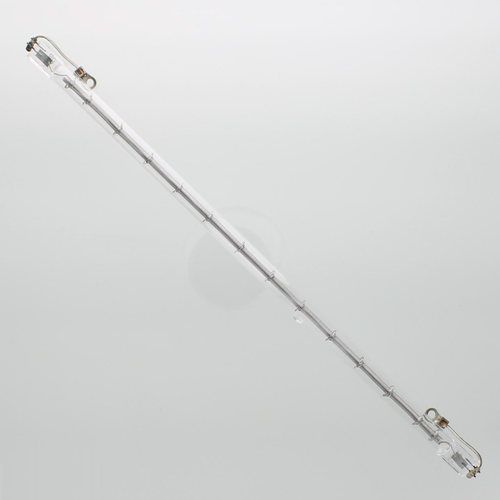
Ushio USH1000KS 1000W Karl Suss Stepper Lamp

$1,700.00
(No reviews yet)
SKU:
USH1000KS (5000545)
Availability:
Stock Item
Shipping:
Calculated at Checkout
Product Description
High-stability short-arc mercury photolithography lamp for Karl Suss stepper/aligner systems.
SOSCleanroom
Overview

The Ushio USH1000KS is a short-arc mercury lamp engineered for photolithography—a high-intensity, compact-arc light source used in stepper and mask aligner illumination systems where output stability, uniformity, and repeatable optical coupling are critical. SKU: USH1000KS (5000545).

Key Highlights
  • Mfg. Ordering Code: 5000545
  • Wattage: 1064W (1000W class)
  • Rated Current: 28A
  • Cold Arc Gap Length: 3mm
  • Burning Position: +/- 15°
  • Average Life: 600 hours (application dependent)
Typical Applications
  • Karl Suss stepper and mask aligner illumination systems
  • Semiconductor and microfabrication photolithography tools requiring a high-intensity point-like UV source
  • Advanced manufacturing exposure systems where arc stability and repeatable coupling are essential
Handling Tip 
Short-arc mercury lamps operate at very high temperature and internal pressure and emit intense UV radiation. Follow your tool’s service procedure, allow adequate cool-down time, and use appropriate PPE. Avoid touching any quartz/glass surfaces; use clean nitrile gloves and lint-free wipes to prevent residue that can create hot spots and premature failure.
About Ushio
Ushio is a global photonics and specialty lighting company focused on “Applying Light to Life,” developing light sources and light-based solutions used in industrial markets (including semiconductor), visual imaging, and life science applications.
Service Note
SOSCleanroom (Specialty Optical Systems, Inc.) has supported specialty lighting customers as a distribution partner for 40+ years. For photolithography lamps, qualify replacements by the manufacturer code and the critical performance drivers (wattage/current, arc gap geometry, and approved burning position).
Industry Update:
In July 2025, Ushio announced an agreement to acquire ams OSRAM’s Entertainment & Industry Lamps (ENI) business, with closing anticipated by the end of March 2026. During and after a transition, customers may see changes such as part-number presentation, labeling, packaging, and distribution channels. Best practice: retain the OEM/manufacturer code (USH1000KS / 5000545) in maintenance records and qualify alternates strictly by the tool’s required electrical and optical specifications.
Need help selecting the right product?
If you need additional information please try our SOSCleanroom specific AI ChatBot which draws from our extensive cleanroom specific libraries.
Always confirm compatibility with your tool model, required lamp family, rated current, arc geometry, and approved burning position before installation.
The Technical Vault
By SOSCleanroom
Photolithography Lamp Engineering
Short-Arc Mercury Stepper / Aligner Arc Physics Power & Thermal Control Safety & Service
Quick Specs
Product / SKU Ushio USH1000KS (5000545)
Lamp Type / Technology Short-arc mercury photolithography lamp (high-intensity, compact arc)
Rated Power 1064W (1000W class)
Rated Current 28A
Cold Arc Gap Length 3mm
Approved Burning Position +/- 15°
Average Life 600 hours (application dependent)
How a Short-Arc Mercury Lamp Produces Light
A short-arc mercury lamp generates light from an electric arc formed between two closely spaced tungsten electrodes inside a quartz arc tube. Once ignited, the arc heats and vaporizes mercury, creating a dense plasma that emits extremely intense radiation—especially in the ultraviolet and visible bands. The “short-arc” design concentrates the emitting region into a very small volume, which functions like a high-brightness point source.
In photolithography tools, that compact arc is valuable because optics can efficiently collect, homogenize, and image the lamp output to deliver stable, uniform irradiance at the wafer/substrate plane—supporting repeatable exposure dose and critical dimension control.
Inside the Lamp: Key Engineering Elements
  • Quartz arc tube: high-silica/quartz is used because it tolerates extreme temperature and UV transmission requirements. The arc tube contains mercury and starting gas.
  • Tungsten electrodes: a cathode and anode are shaped and positioned to form a stable arc. Electrode design influences ignition behavior, arc stability, and wear rate.
  • Arc gap geometry (3mm cold): a short gap concentrates brightness and makes optical coupling more repeatable—critical for stepper illumination systems.
  • Seals and foils: lamp seals are engineered to handle thermal cycling and hermetic containment under high internal pressure during operation.
Ignition, Ballast Control, and Why Current Matters
Short-arc mercury lamps do not operate like resistive loads; once the arc forms, it exhibits a negative resistance characteristic. That means the system requires a ballast/current-regulated power supply plus an igniter to start and stabilize operation.
  • Ignition: a high-voltage pulse initiates the arc across the electrode gap.
  • Warm-up: as mercury vapor pressure rises, electrical characteristics shift and output stabilizes; many tools enforce a warm-up window before exposure use.
  • Current regulation (28A rated): stable lamp current helps stabilize arc position and optical output. Over-driving current accelerates electrode erosion and can shorten life.
  • Hot re-strike behavior: after shut-down, high internal pressure can prevent immediate re-ignition; most systems require a cool-down interval before restart.
Why Mercury Lamps Are Used in Steppers
Mercury lamps produce strong spectral lines that are useful for UV exposure processes. Lithography systems typically select and condition the output with filters, integrators, and projection optics to deliver the required wavelength band(s) and dose uniformity.
  • High radiance point-like source: the short arc supports efficient collection and homogenization.
  • Optical uniformity: integrator optics and homogenizers rely on stable arc position to maintain exposure uniformity over time.
  • Process repeatability: stable output reduces dose drift, helping maintain consistent resist exposure and process windows.
Burning Position (+/- 15°) and Thermal Engineering
Arc lamps are sensitive to orientation because convection currents and thermal gradients influence arc shape and electrode temperature. The approved burning position window is part of the lamp’s reliability envelope—exceeding it can increase arc wander, uneven electrode wear, and thermal stress.
  • Cooling is not optional: lamp houses typically use forced air and/or liquid cooling to protect the lamp, reflectors, and wiring.
  • Keep airflow paths clean: clogged filters or obstructed ducts can elevate temperatures and reduce lamp life.
  • Never defeat interlocks: stepper lamp compartments include shields and interlocks to protect operators from UV and high voltage.
Safety: UV, High Voltage, and High Internal Pressure
  • Intense UV radiation: can injure eyes/skin quickly. Use proper PPE and keep shielding in place.
  • High voltage: ignition circuits can be hazardous; lockout/tagout procedures should be followed for service.
  • Pressure vessel behavior: arc tubes operate at high internal pressure when hot; handle only after cool-down and per OEM instructions.
  • Mercury considerations: follow site EHS procedures for mercury-containing lamps and end-of-life disposal.
Replacement Best Practices for Lithography Tools
  • Record lamp identity and hours: track USH1000KS / 5000545 and run-time to support preventive maintenance and exposure repeatability.
  • Inspect lamp house optics: reflectors, windows, and filters should be free of haze/particles that reduce dose and uniformity.
  • Use clean handling materials: nitrile gloves plus low-lint wipes/swabs reduce residue on optical surfaces and connectors.
  • Verify tool calibration after change: many systems require dose or uniformity checks after lamp replacement to ensure process stability.
Cleanroom Considerations

Treat lamp replacement as a controlled maintenance event: minimize packaging debris, prevent particulate shedding in the lamp bay, and protect nearby optics and sensors.

Stage clean nitrile gloves plus cleanroom-grade lint-free wipes/swabs (Texwipe options are commonly used) to help reduce contamination during service.

Industry Update: ENI Business Sale to Ushio (Target Close: End of March 2026)
Ushio announced an agreement in July 2025 to acquire ams OSRAM’s Entertainment & Industry Lamps (ENI) business, with closing anticipated by the end of March 2026. For buyers, the practical takeaway is to keep procurement and maintenance records anchored to manufacturer codes and to qualify alternates strictly by electrical and optical requirements.
Need deeper specs or cross-references?
If you need additional information please try our SOSCleanroom specific AI ChatBot which draws from our extensive cleanroom specific libraries.
For photolithography tools, confirm OEM requirements (lamp family, power/current regulation, cooling configuration, approved burning position, and arc geometry) prior to installation.