
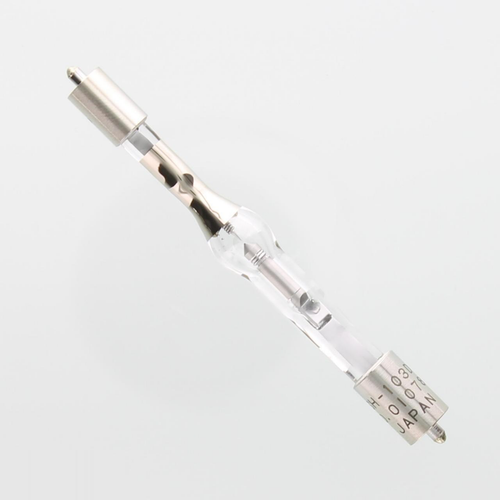
Ushio USH103D 100W Short Arc Mercury Lamp Long Life

$156.00
(No reviews yet)
SKU:
USH103D (5001329)
Availability:
Stock Item
Shipping:
Calculated at Checkout
Quantity Option (Each):
1 Bulb
Product Description
Long-life 100W short-arc mercury illumination for fluorescence microscopy and precision optical instruments.
SOSCleanroom
Overview

The Ushio USH103D is a 100W, 20V short-arc mercury lamp built for high-radiance UV/visible output in compact optical systems. This Long Life version is rated for 300 hours and is widely used in fluorescence microscopy and legacy microscope illumination platforms where stable arc performance and repeatable lamp seating are critical. SKU: USH103D (5001329).

Key Highlights
  • Electrical: 100W, 20V
  • Base: SFa7.5-2 Specialty Base
  • Length: 3.54 in
  • Diameter: 0.39 in
  • Average Life: 300 hours (Long Life)
  • Mfg. Ordering Code: 5001329
Typical Applications
  • Fluorescence microscopy illumination systems
  • Microscope platforms specified for USH103D geometry and SFa7.5-2 basing
  • Optical instruments requiring high radiance from a compact arc source
Handling Tip 
Short-arc mercury lamps operate at high temperature and high internal pressure. Do not touch quartz with bare hands and follow OEM cool-down requirements. Use clean nitrile gloves and a lint-free wipe to minimize residue and contamination risk.
About Ushio
Ushio is a global photonics and specialty lighting company developing light sources and light-based solutions across industrial markets (including semiconductor-related applications), visual imaging, and life sciences. Ushio’s specialty lamp portfolio includes short-arc technologies used in microscopy, analytical instrumentation, and high-performance optical systems.
Trusted Distribution Experience
SOSCleanroom (Specialty Optical Systems, Inc.) has been distribution partners for over 40 years, supporting customers with sourcing continuity, cross-references, and application-driven product selection for mission-critical instruments and systems.
Industry Update:
In July 2025, Ushio announced an agreement to acquire ams OSRAM’s Entertainment & Industry Lamps (ENI) business, with closing expected in Q1 2026 (by the end of March 2026). During and after transitions in specialty lamp portfolios, customers may see changes such as labeling, packaging, part-number presentation, and distribution channels. Best practice: qualify replacements by the manufacturer code and critical specs (100W/20V, SFa7.5-2, and the lamp’s mechanical envelope) to maintain continuity.
Need help selecting the right product?
If you need additional information please try our SOSCleanroom specific AI ChatBot which draws from our extensive cleanroom specific libraries.
Always confirm compatibility with your instrument OEM requirements (wattage, voltage, basing, lamp orientation, and mechanical envelope) prior to installation.
The Technical Vault
By SOSCleanroom
Short-Arc Mercury Engineering
Optics & Alignment Power & Ballast Safety & Handling
Partner Insight: 40+ Years in Specialty Lighting Distribution
SOSCleanroom (Specialty Optical Systems, Inc.) has been distribution partners for over 40 years. In short-arc systems, that experience matters because replacement accuracy depends on matching the right interfaces: electrical (wattage/voltage + ballast), mechanical (basing/envelope), and optical (arc position in the lamp house).
Quick Specs
Manufacturer / Ordering Code Ushio USH103D (Long Life) | SKU: USH103D (5001329)
Lamp Type / Technology Mercury short-arc (HID) | High-radiance UV/visible arc source
Wattage / Voltage 100W / 20V
Base / Basing SFa7.5-2 Specialty Base
Physical Envelope Length: 3.54 in | Diameter: 0.39 in
Average Life 300 hours (Long Life)
How a Short-Arc Mercury Lamp Produces Light
Short-arc mercury lamps produce light from a plasma arc struck across a very small gap between two electrodes inside a quartz (fused silica) arc tube. A dedicated igniter applies a high-voltage pulse to initiate conduction. Once struck, current heats the plasma intensely and vaporizes mercury, increasing vapor pressure and shifting output to mercury’s characteristic UV/visible line spectrum. Because electrical power is concentrated into a tiny arc volume, the lamp achieves very high radiance, enabling efficient optical collection and imaging into microscope illumination paths.
Key Engineering Blocks (What OEM Lamp Houses Are Designed Around)
  • Arc tube as a pressure vessel: at operating temperature, internal pressure rises substantially; quartz quality and thermal-stress control are essential for reliability.
  • Electrode physics: the cathode is engineered for electron emission; the anode runs hotter due to electron bombardment. Tip geometry controls arc attachment stability and erosion rate.
  • Arc gap + optical coupling: a small arc produces a compact emitting region that can be efficiently imaged into apertures, condensers, or light guides—critical for microscopy uniformity and excitation intensity.
  • Mechanical basing = optical repeatability: the SFa7.5-2 base and seating geometry help place the arc where the reflector/collector expects it. Small seating shifts can move focus and reduce delivered irradiance.
Power & Ballast Engineering (Why Matching the System Matters)
Once established, an arc behaves like a negative-resistance load. If current increases, arc voltage tends to drop, which can cause runaway current without regulation. That’s why these lamps require an OEM-specified ballast (for current control) and igniter (for starting pulses).
  • Current regulation: maintains stable radiance and arc position; reduces electrode overstress.
  • Ripple control: electrical ripple can become optical ripple (intensity instability), which can show up as flicker or unstable excitation in imaging workflows.