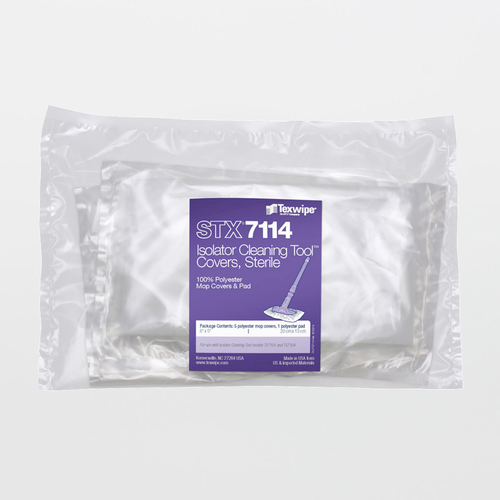
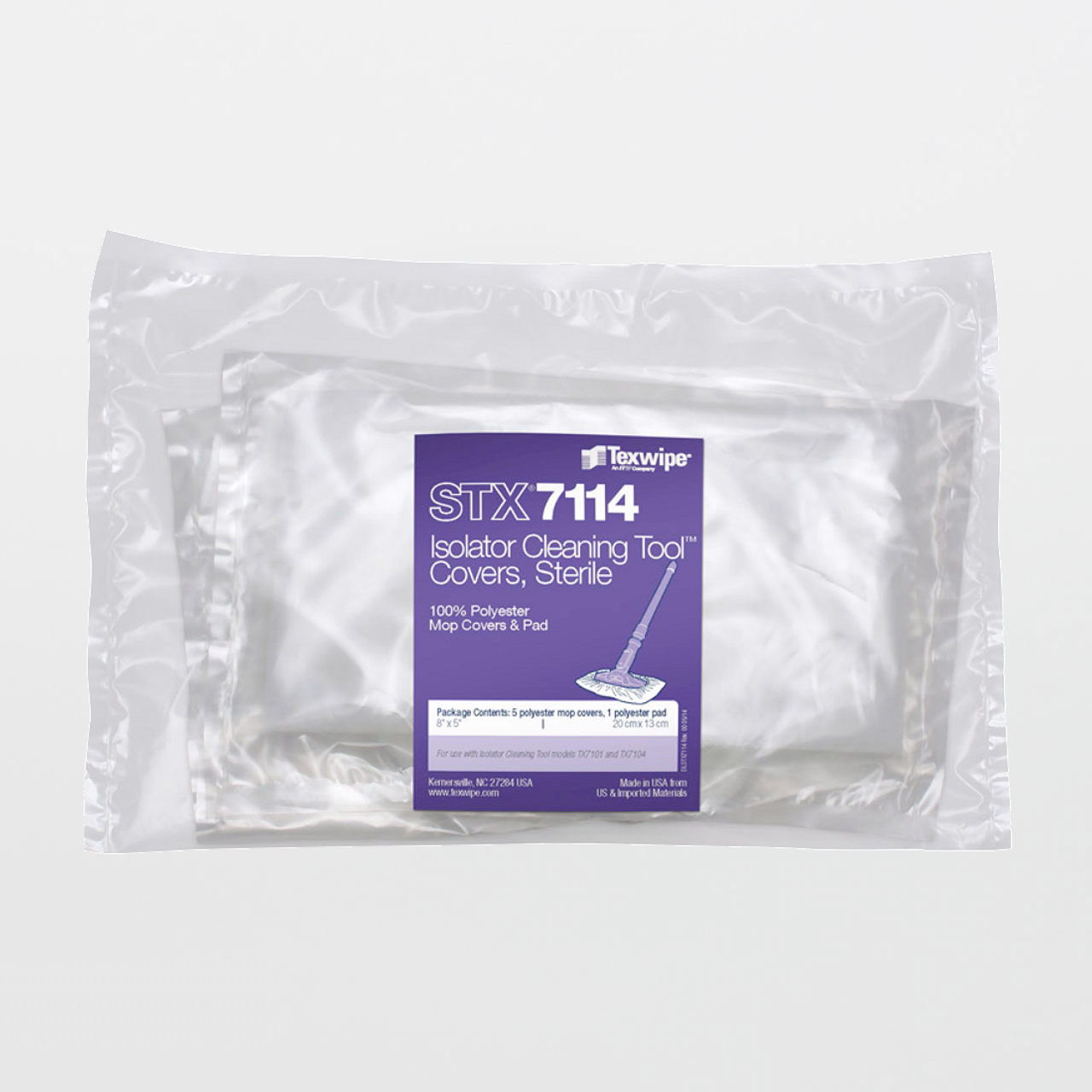
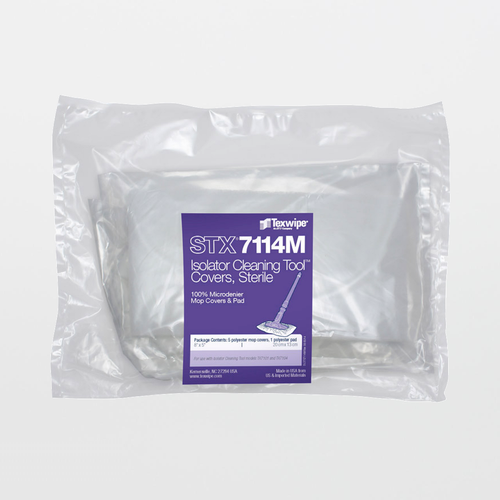
Texwipe STX7114 Mini AlphaMop™ Polyester Mop Covers — Sterile Replacement Covers (Formerly TX3264)
STX7114 is a sterile, pre-sterilized double-knit polyester replacement cover set (with matching pads) designed for the Mini AlphaMop™ / Isolator Cleaning Tool™ system used in isolators, glove boxes, biosafety cabinets, laminar flow hoods, and other small or hard-to-reach critical surfaces. Covers are gamma irradiated to a Sterility Assurance Level (SAL) of 10-6 in accordance with ANSI/AAMI/ISO 11137 to support aseptic cleaning protocols and lot-specific documentation control.
For over 35 years, SOS and Texwipe have been close partners, and SOSCleanroom is the authorized Master Distributor of ITW Texwipe for the United States market. That relationship matters in critical environments: it supports continuity of supply, stable product lineage, and fast access to the manufacturer documentation your QA/QC team expects.
Published configuration (STX7114)
- System compatibility: Replacement covers for Mini AlphaMop™ / Isolator Cleaning Tool™ kits, including TX7101 and TX7104 assemblies
- Sterile/Non-sterile: Sterile
- Cover material: Cleanroom-laundered, knitted 100% polyester (double-knit polyester cover construction)
- Pad material: Polyester pad included to help the cover conform to surfaces for consistent cleaning
- Packaging per inner bag: 5 covers and 1 pad per bag
- Packaging per case: 25 bags per case (total 125 covers and 25 pads per case)
- Lot/expiry labeling: Easy-to-read lot code and expiration date on each bag
- Certificates: Lot-specific Certificates of Compliance and irradiation documentation provided for traceability
- Cleanroom environment (as published): ISO Class 3–7; EU Grade A–D (programs may also reference ISO Class 3–5 in legacy documentation)
- Shelf life (as published): Sterile — 3 years from date of manufacture
Low fiber release — and the reality check
These covers are engineered for very low releasable fibers and low particle generation for critical cleaning. Even so, no textile cleaning component is truly “zero-shedding.” Treat mop covers like a contamination-controlled component: control how they are introduced, how long they are exposed, and when they are changed out.
Practical cleanroom use guidance (technicians and engineers)
- Introduction discipline: Open the outer packaging outside the critical zone per your gowning/material transfer SOP. Present the inner bag to the controlled area with minimal air movement and avoid “bag snapping” that can mobilize particles.
- One-cover, one-direction practice: Use a single-direction, overlapping stroke pattern (e.g., controlled “S” passes) and avoid backtracking into cleaned lanes. Change covers at a defined area/room threshold to prevent re-deposition.
- Pad management: The pad is a conformability aid. Follow your facility SOP on pad re-use versus change-out. If pad reuse is permitted, segregate “clean” versus “used” pads and never return a used pad to a sterile bag.
- Surface loading control: Replace the cover before it becomes visibly loaded. Overloading increases drag, reduces wetting uniformity, and raises the risk of streaking and residue transfer.
- Edge control in tight areas: In isolators and glove boxes, keep the mop head edges from contacting hardware, fasteners, or sharp corners. Mechanical snagging is a primary driver of fiber release and cover damage.
- Documentation readiness: Keep lot/expiry information accessible for batch record linkage. In aseptic programs, ensuring the used lot matches the approved cleaning record set is as important as the wipe pattern.
Compatibility and solution-handling notes
- Cleaning/disinfecting solutions: The system is intended for applying and removing common cleaning and disinfecting solutions. Confirm compatibility and contact time under your site SOP before standardizing.
- Do not “re-dip” used covers: A common contamination failure mode is returning a used cover to a clean solution reservoir. Use a controlled dispensing method or segregated reservoirs per SOP (e.g., “clean” vs. “used” handling).
- Dry-time discipline: Allow complete dry time where required by your residue/bioburden strategy. Premature contact with sensitive product or packaging can transfer residual chemistry.
Packaging and traceability controls (why it matters in sterile programs)
| Control element |
What to verify during receiving / staging |
Why technicians care |
| Lot code |
Matches the approved cleaning record set and the case paperwork |
Supports traceability and deviation containment if an excursion occurs |
| Expiration date |
Within program window; rotated FIFO/FEFO as required |
Prevents using out-of-window sterile goods in aseptic areas |
| Certificates |
Lot-specific compliance and irradiation documentation present |
Shortens QA review time and supports audit readiness |
| Inner-bag count |
5 covers + 1 pad per bag; 25 bags per case |
Enables predictable changeout planning per room / shift |
Typical performance characteristics
Published as typical analyses (not specifications) to support qualification planning and contamination-risk reviews.
| Property |
Typical value |
Notes (as published) |
| Basis weight |
163 g/m2 |
Typical analysis from sterile replacement cover datasheet |
| Sorptive capacity |
472 mL/m2 |
Supports solution pickup/transfer planning in SOPs |
| Sorptive rate |
0.5 seconds |
Typical analysis |
Typical contamination characteristics
| Property |
Typical value |
Notes (as published) |
| Particles (0.5–5.0 µm) |
10 x 106 particles/m2 |
Typical analysis |
| Particles (5.0–100 µm) |
144,000 particles/m2 |
Typical analysis |
| Fibers (>100 µm) |
5,700 fibers/m2 |
Typical analysis |
| Nonvolatile residue (IPA extractant) |
0.07 g/m2 |
Typical analysis |
| Nonvolatile residue (DIW extractant) |
0.03 g/m2 |
Typical analysis |
Common failure modes
- Streaking / residue transfer: Typically caused by overloaded covers, insufficient overlap, or poor dry-time discipline. Prevent with defined area-per-cover limits and a consistent stroke pattern.
- Fiber release from snags: Triggered when covers catch on sharp edges, fasteners, or hardware. Prevent with edge control and slower corner work in isolators and glove boxes.
- Cross-contamination from re-dipping: Returning used covers to a clean solution reservoir can seed contamination across a room. Prevent with segregated solution handling and one-way workflow.
- Loss of sterility during staging: Often from uncontrolled packaging opens, extended exposure, or mixing lots on the cart. Prevent with staged introduction, minimal exposure time, and lot segregation on the cleaning cart.
Storage and handling best practices
- Keep bags in original case packaging until needed; use FEFO (first-expire, first-out) where expiry is controlled.
- Stage only the quantity needed for the shift/room to reduce exposure time and packaging touches.
- Maintain lot segregation on the cleaning cart to support batch record linkage and faster deviation response.
- Protect unused inner bags from splash zones and aerosolized chemicals; chemical wetting of packaging can compromise handling discipline.
Documentation
SOS-hosted Texwipe datasheet (TX3264/TX3268 Sterile Replacement Covers for AlphaMop™ Cleanroom Mops, Effective: December 2012):
Click HereTexwipe Technical Data Sheet (Mini AlphaMop™ Series, US-TDS-068 Rev.11/21):
Click Here
If you have any questions please email us at Sales@SOSsupply.com or give us a call at (214)340-8574.
Check out the AI ChatBot powered by SOSCleanroom data libraries - give it a try!
THIS IS NEW FOR 2026!
Last updated: January 9, 2026.
© 2026 SOS Supply. All rights reserved.