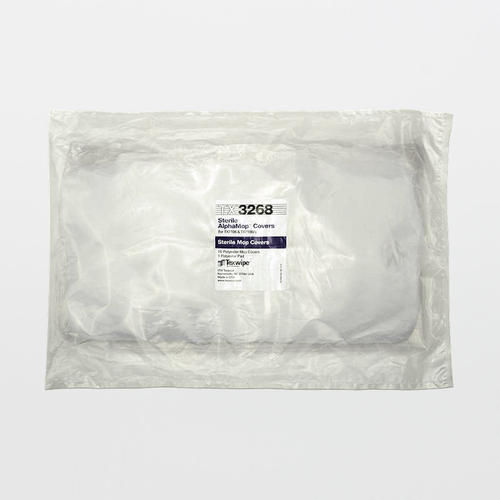
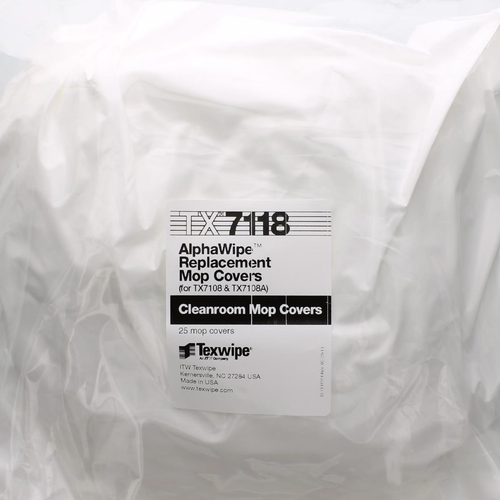
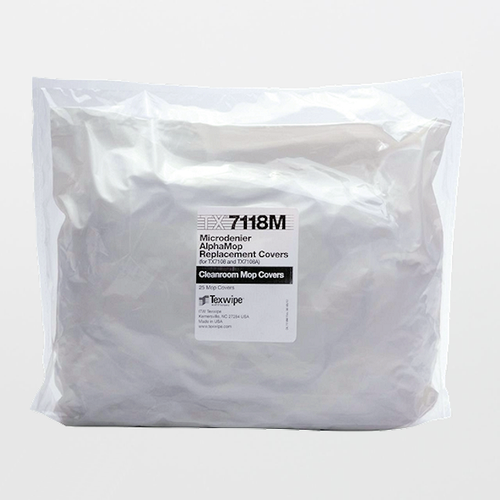
Texwipe STX7118 AlphaMop™ Sterile Replacement Mop Covers & Pads — Fits 8" x 15" Flat Mop Heads
STX7118 is a sterile, pre-irradiated replacement cover-and-pad set for the Texwipe AlphaMop™ flat mop system used in critical environments for floors, walls, and ceilings. The covers are pre-sterilized, double-knit polyester and are designed for frequent change-outs to support strict cleaning protocols and controlled contamination risk during disinfectant application and removal.
For over 35 years, SOS and Texwipe have been close partners, and SOSCleanroom is the authorized Master Distributor of ITW Texwipe for the United States market. That relationship matters when you are standardizing cleanroom mops: it supports continuity of supply, stable product lineage, and fast access to the manufacturer documentation your QA/QC team expects.
Configuration STX7118:
- Product type: Sterile replacement mop covers and pads (dry)
- Material (cover): Double-knit polyester (pre-sterilized)
- Material (pad): Polyester pad (replacement pads included; supports surface conformity)
- Compatibility: For use with 15" x 8" (38 cm x 20 cm) AlphaMop™ flat mop head systems (e.g., TX7108 and autoclave-safe AlphaMop head listings)
- Packaging (case): 120 covers and 12 pads per case
- Inner packaging: 10 covers and 1 pad per bag
- Case count: 12 bags per case (each bag marked with lot code and expiration date)
- Sterility method: Gamma irradiated to a Sterility Assurance Level (SAL) of 10-6 (as published)
- Cleanroom use (published): ISO Class 3–5 for sterile replacement covers; AlphaMop cover/pad systems are also published for ISO Class 3–7 usage depending on protocol and area classification
Low particle and low-linting substrate — and the reality check
STX7118 is built for controlled environments with low particle and low-linting performance. Even so, no textile product is truly particle-free. Treat mop covers like a contamination-controlled component: control bag opening, staging, wetting, change-out intervals, and how the cover contacts non-clean surfaces between passes.
Practical cleanroom use guidance:
- Change-out discipline: Treat each cover as a controlled-use surface. Replace covers frequently (per your SOP) to prevent re-deposition of residues and to maintain consistent wetting and contact.
- One-direction passes: Use controlled, overlapping strokes. Avoid back-and-forth scrubbing in critical areas where it can rework soil films and spread residue.
- Edge control: Keep the mop head flat to maintain full pad contact. “Riding an edge” can concentrate pressure, increasing streaking and leaving wet lines.
- Zone segregation: Do not cross zones with the same cover (e.g., lower wall to floor, corridor to core, Grade B to Grade A). Stage fresh covers by area and direction of workflow.
- Bag-to-room transfer: Introduce bags using your approved transfer procedure. Open the inner bag only where allowed, and immediately reseal or discard outer packaging to prevent fiber/particle carry-in.
- Pad management: Pads are part of the fit and contact system. Use the correct pad and replace when compression set, tears, or chemical swelling reduce conformity and leave uncontacted “skip” regions.
Compatibility and disinfectant-use notes:
- Designed for disinfectant workflows: Published for applying and removing cleaning and disinfecting solutions in controlled environments.
- Chemical exposure: Published to withstand exposure to common cleaning and disinfecting solutions. Qualify with your exact chemistry, dwell time, and surface type before full standardization.
- Solvent usage: AlphaMop cover/pad documentation references use with solvents such as isopropyl alcohol (IPA), ethanol, acetone, and degreasers. Follow site PPE and fire safety requirements.
- Temperature limitations: AlphaMop cover/pad documentation references use at temperatures less than 400°F (205°C). If you are working near hot equipment, validate real contact temperatures and drying behavior.
- Autoclave practice: STX7118 is provided sterile (gamma irradiated). If your program also uses autoclaving as a secondary control, establish a documented protocol and evaluate fit/handling after cycles rather than assuming equivalence.
At-a-glance tables:
| Category |
Published detail |
Why it matters in critical areas |
| Sterility assurance |
Gamma irradiated; SAL 10-6 |
Supports aseptic workflows when combined with proper transfer, handling, and change-out discipline. |
| Lot traceability |
Lot code and expiration date on each bag; certificates attached to each case (as published) |
Enables QA review, deviation investigations, and release documentation aligned to contamination control programs. |
| System size |
Fits 15" x 8" (38 cm x 20 cm) AlphaMop™ head systems |
Correct fit reduces bunching, edge lift, and streaking that can leave uncleaned “skip” zones. |
| Packaging |
120 covers + 12 pads/case; 10 covers + 1 pad/bag; 12 bags/case |
Supports controlled introduction (one bag per room/shift) and predictable usage planning for validation schedules. |
Typical performance characteristics
These are published as typical analyses (not specifications) to support qualification planning and contamination-risk reviews.
| Property |
Typical value |
Test method (as published) |
| Basis weight |
163 g/m2 |
(Not stated) |
| Sorptive capacity |
472 mL/m2 |
(Not stated) |
| Sorptive rate |
0.5 seconds |
(Not stated) |
Typical contamination characteristics
These are published as typical analyses (not specifications) and are commonly used for contamination control reviews and cleaning validation planning.
| Property |
Typical value |
Test method (as published) |
| Particles (0.5–5.0 µm) |
10 x 106 particles/m2 |
(Not stated) |
| Particles (5.0–100 µm) |
144,000 particles/m2 |
(Not stated) |
| Fibers (>100 µm) |
5,700 fibers/m2 |
(Not stated) |
| Nonvolatile residue (IPA extractant) |
0.07 g/m2 |
(Not stated) |
| Nonvolatile residue (DI water extractant) |
0.03 g/m2 |
(Not stated) |
Sterility, packaging, and lot traceability
- Pre-sterilized supply chain: Sterile replacement covers are gamma irradiated and provided as a sterile product (as published), reducing the operational burden of in-house autoclave documentation and repackaging.
- Bag labeling: Each bag is published with an easy-to-read lot code and expiration date to support aseptic material control.
- Case documentation: Lot-specific Certificates of Compliance and Irradiation are published as attached to each case to support QA release documentation.
- Clean introduction: Covers and pads are published as double-bagged together for easier introduction into clean environments while maintaining sterility controls.
Common failure modes
- Streaking / filming: Often caused by overwetting, insufficient wring-out, mismatched chemistry-to-surface pairing, or reusing a saturated cover too long. Prevent with controlled wetting, defined passes, and cover change-out intervals.
- Residue carryover: Occurs when covers cross zones or contact non-clean carts, bins, or garments. Prevent with zone segregation, dedicated staging, and “clean side/dirty side” handling rules.
- Particle release from abrasion: Triggered by dragging over rough welds, fasteners, floor chips, or sharp edges. Prevent by inspecting routes, avoiding snag points, and replacing covers immediately if damaged.
- Loss of surface contact: Caused by missing/incorrect pad placement or a compressed pad that no longer conforms. Prevent with pad checks and replacement when compression set is visible.
- Sterility breach: Inner bag opened outside the permitted area, bag placed on a non-clean surface, or partial-bag storage without controls. Prevent with defined transfer SOPs and one-bag-per-use discipline when required.
Storage and handling best practices
- Keep covers and pads in original sealed packaging until the point of controlled introduction.
- Store to protect bag integrity (avoid punctures and compression that can distort covers or pads).
- Stage by room/zone and label opened inventory per your site’s sterile material control procedure (do not “float” opened bags between areas).
- If pre-wetting is performed on-site, use documented chemistry concentration, container cleanliness controls, and discard timing to prevent bioburden growth and residue variability.
Documentation
SOS-hosted Texwipe datasheet (Sterile Replacement Covers for AlphaMop™ Cleanroom Mops, TX3264/TX3268, Effective: December 2012):
Click HereTexwipe AlphaMop™ Series Technical Data Sheet (includes STX7118 cover/pad listings):
Click Here
If you have any questions please email us at Sales@SOSsupply.com or give us a call at (214)340-8574.
Check out the AI ChatBot powered by SOSCleanroom data libraries - give it a try! THIS IS NEW FOR 2026!
Last updated: January 9, 2026
© 2026 SOS Supply. All rights reserved.