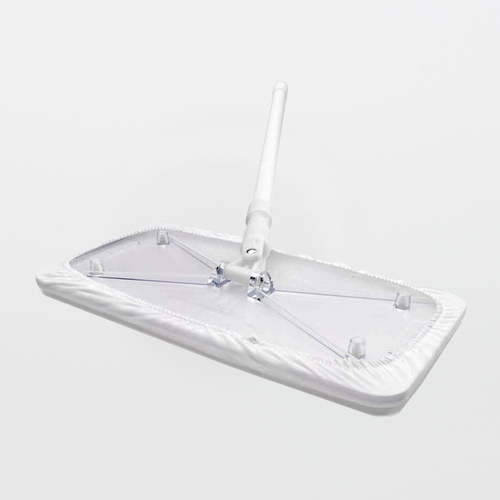
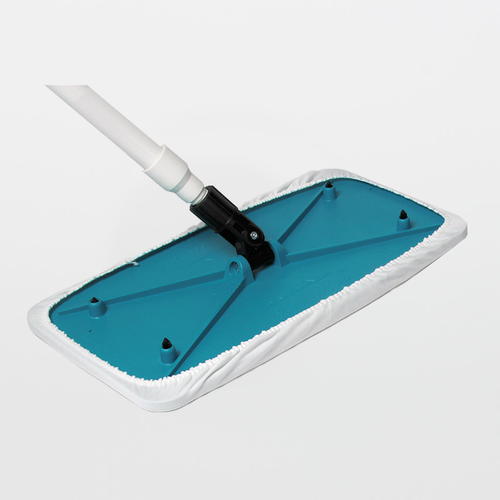
Texwipe TX7108A Autoclavable AlphaMop™ Cleanroom Mop System — 15" x 8" Head, 60" Fiberglass Handle
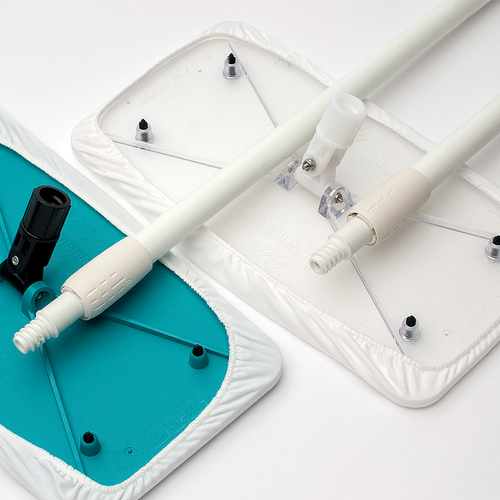
TX7108A is an autoclavable flat-mop cleaning system built for controlled environments where floor, wall, and ceiling cleaning must be repeatable, low-linting, and documentation-friendly. The system uses a large thermoplastic swivel head with a rapid-change cover-and-pad architecture so technicians can change the wiping surface frequently (instead of pushing contamination around), supporting disciplined mopping protocols in aseptic and cleanroom operations.
For over 35 years, SOS and Texwipe have been close partners, and SOSCleanroom is the authorized Master Distributor of ITW Texwipe for the United States market. That relationship matters for critical-environment mopping programs: it supports continuity of supply, stable product lineage, and fast access to the manufacturer documentation your QA/QC team expects.
Published configuration (TX7108A)
- System type: Autoclavable AlphaMop™ cleaning system (multi-use mop platform)
- Mop head: 15" x 8" thermoplastic head (low-profile, swivel head)
- Handle: 60" fiberglass handle
- Cover system: Rapid-change, laundered polyester AlphaMop-compatible covers (used with a pad understructure)
- Pad: Polyester foam pad (supports cover conformance on textured surfaces)
- Packaging: Bag-within-a-bag cleanroom packaging (as published)
- Cleanroom use: Ideal for critically clean and cleanroom environments; preferred for walls, ceilings, and floors (as published)
Low-linting intent — and the reality check
This system is designed to support low-linting, low particle-generation cleaning when used with appropriate AlphaMop-compatible covers and disciplined technique. Even so, no textile is truly “lint-free,” and any mop can become a contamination source if covers are overused, mishandled, or cross-zoned. Treat mop heads, covers, pads, and buckets as contamination-controlled components with defined change-out rules and documented handling.
System contents and compatible refills (for planning and standardization)
Use this table to align purchasing, stocking levels, and SOP change-out cadence. Values below reflect published packaging descriptions (not site-specific consumption rates).
| Item |
What it is used for |
Published packaging / notes |
| TX7108A |
Autoclavable mop system (head + handle platform) for walls/ceilings/floors |
15" x 8" head; 60" fiberglass handle; includes a polyester foam pad; includes starter components as published in the TX7108A datasheet |
| TX7118 |
Polyester replacement covers (routine cleaning and solution application) |
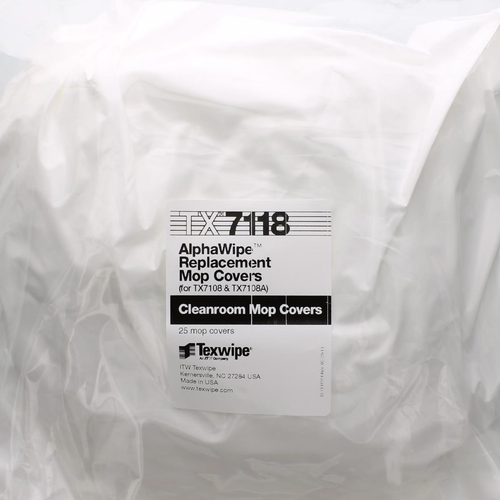
150 covers/case (6 bags of 25); foam pads packaged separately (as published) |
| TX7118M |
Microdenier replacement covers (enhanced particle lift / streak-sensitive areas) |
25 covers/bag; 6 bags/case (as published) |
| TX3268 |
Sterile AlphaMop™ covers (sterile programs requiring sterile change-outs) |
120 covers and 12 pads/case (12 bags of 10 covers and 1 pad) (as published) |
| TX7026 |
Pre-wetted polyester replacement covers (6% IPA / 94% DI water) for controlled wetting |
25 covers/bag; 4 bags/case; 4 pads/case (as published) |
| TX7118F |
Replacement pads / fasteners (maintains cover fit and surface contact) |
25 pads & 4 fastening pins/bag; 3 bags/case (as published) |
Practical cleanroom mopping guidance (technicians and engineers)
- Define zones and direction: Treat the mop as a controlled tool. Assign dedicated mops/covers by room, bay, or grade and maintain one-way flow (clean-to-less-clean) to reduce cross-contamination risk.
- Change the wiping surface early: A flat-mop system works best when covers are changed before they look dirty. Overusing a cover increases particle redistribution and streaking, and it can push residues into seams and joints.
- Use consistent stroke geometry: Use overlapping, unidirectional strokes with controlled pressure. Avoid scrubbing with the same cover when the surface chemistry changes (e.g., from detergent to disinfectant), unless your SOP explicitly permits it.
- Control wetting: Over-wetting is a top cause of streaks and residue films. If your program requires tight wetting control, consider pre-wetted refills (when qualified) or measured wetting methods in a validated bucket process.
- Protect the mop head and pad integrity: Replace pads/fasteners when compression, deformation, or loose fit is observed. Poor conformance reduces mechanical pick-up and increases “skip lines.”
- Keep sterile handling sterile: For sterile programs, stage sterile covers/pads in the correct gowning sequence, avoid touching exterior bags, and document lot/sterility info per your batch record expectations.
Compatibility and sterilization notes
- Autoclave use: TX7108A is published as an autoclavable mop system. The manufacturer also publishes autoclave conditions for autoclave-safe AlphaMop components (20 minutes at 250°F / 121°C). Verify your site cycle parameters and material compatibility under your validated process before standardizing.
- Disinfectants and cleaners: The AlphaMop platform is designed for applying and removing solutions, including disinfectants. Match cover type to the soil load and chemistry (polyester vs. microdenier vs. pre-wetted covers) per your cleaning validation rationale.
- Solvent exposure: Published AlphaMop system documentation references cleaning with solvents such as isopropyl alcohol (IPA), ethanol, acetone, and degreasers. Always confirm compatibility against your specific chemical list, contact time, and surface materials.
- DI water / aqueous processes: Not stated as a standalone qualification statement for this system. If your program uses DI water rinsing or high-aqueous contact, qualify the mop covers/pads under your process conditions to confirm streaking, residue, and fiber-shedding performance.
- Temperature ceiling: Published AlphaMop documentation references use with temperatures less than 400°F (205°C). Do not use beyond your facility’s validated temperature limits and material compatibility constraints.
Process control checklist (reduces streaking, residue, and particle redistribution)
| Control point |
What to standardize |
Why it matters in critical environments |
| Cover change-out cadence |
Define max area per cover (or time per cover) by room grade and soil load |
Prevents “re-deposition” and streaking from overloaded covers |
| Wetting control |
Measured wetting method (pre-wet refills, measured bucket charge, or validated dosing) |
Over-wetting drives film residue, longer dry times, and track marks |
| Stroke geometry |
Unidirectional passes with overlap; avoid back-and-forth scrubbing unless required |
Reduces particle mobilization and improves repeatability for audits |
| Zoning and segregation |
Dedicated tools by grade/area; label handles; separate dirty-to-clean transport paths |
Controls cross-contamination and supports contamination investigations |
| Pad/fastener condition |
Inspect for compression, loose fit, damaged fasteners; replace on defined triggers |
Maintains surface contact and prevents skip lines and debris generation |
Common failure modes
- Streaking / film residue: Usually from over-wetting, chemistry mismatch (detergent/disinfectant carryover), or inadequate change-out frequency. Prevent with controlled wetting, defined cover cadence, and chemistry sequencing discipline.
- Particle redistribution: Triggered when the same cover is used too long or pressure is increased to “scrub out” soils. Prevent by changing covers early and using the appropriate cover type for the soil load (polyester vs. microdenier) under your SOP.
- Cover slippage / poor surface contact: Often caused by worn pads, damaged fasteners, or incorrect installation. Prevent with pre-use checks and defined replacement triggers for pads/fasteners.
- Cross-zone contamination: Happens when tools are moved between rooms/grades without segregation. Prevent with zoning labels, controlled staging, and documented tool ownership by area.
- Autoclave damage / deformation: Can occur if the cycle exceeds published conditions or if non-qualified components are sterilized. Prevent by validating the exact cycle and limiting sterilization to components and configurations proven under your process.
Storage and handling best practices
- Keep covers and pads in original cleanroom packaging until introduction; open at the point of use to reduce particle deposition.
- Stage refills by zone/grade in closed containers or drawers; avoid open carts that allow airborne deposition.
- Transport used covers in sealed bags per SOP; do not place used textiles on benches or in pass-throughs without containment.
- Maintain a defined mop head/handle cleaning or sterilization routine (as applicable) and document it like any other controlled tool.
Documentation
SOS-hosted Texwipe datasheet (TX7108A Autoclavable AlphaMop™ Cleaning System, Effective: January 2013):
Click HereTexwipe AlphaMop™ Series Technical Data Sheet (PDF, Rev02 / 11-16):
Click HereTexwipe manufacturer AlphaMop™ system page (platform overview, compatible components):
Click Here
If you have any questions please email us at Sales@SOSsupply.com or give us a call at (214)340-8574.
Check out the AI ChatBot powered by SOSCleanroom data libraries - give it a try!
THIS IS NEW FOR 2026!
Last updated: January 9, 2026
© 2026 SOS Supply. All rights reserved.