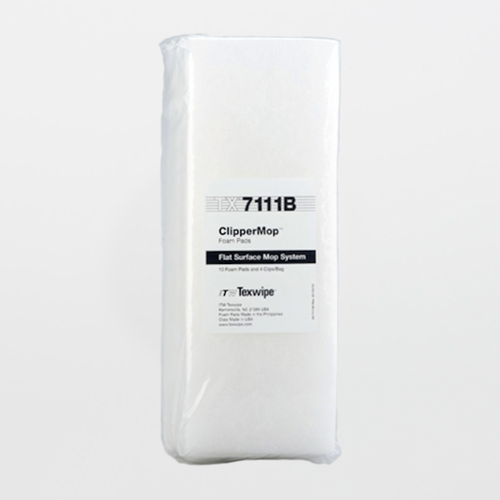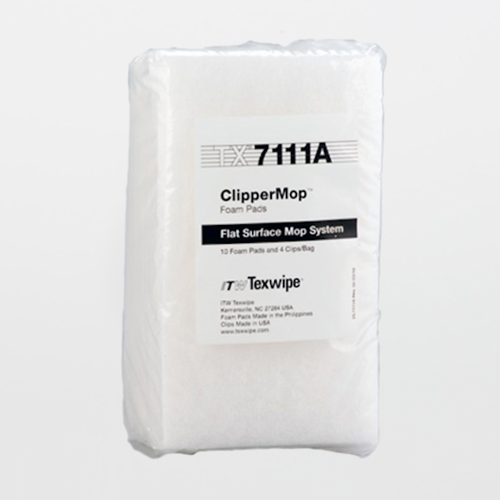
Texwipe TX7111A ClipperMop 7" x 4" Cleanroom Replacement Foam Pads (Refills)

$265.91
(No reviews yet)
SKU:
TX7111A CASE
Availability:
7 - 10 Business Days
Shipping:
Calculated at Checkout
Quantity Option (Case):
100 Foam Pads and 40 Fasteners Per Case (10 Bags of 10 Foam Pads and 4 Fasteners)
Type:
Dry Mop
Texwipe TX7111A ClipperMop™ Cleanroom Replacement Foam Pads — 7" x 4" (Refills)
TX7111A is a replacement foam-pad refill set for the Texwipe ClipperMop™ 7" x 4" head format. The foam pad sits between the mop head and the attached cleanroom wiper, helping the wiping face conform to surface texture and maintain more uniform contact during solution application and pickup. In critical environments, replacing worn pads is a practical contamination-control step: a compressed or damaged pad can create streaking, skip lines, uneven wet film, and higher residue carryover risk.

For over 35 years, SOS and Texwipe have been close partners, and SOSCleanroom is the authorized Master Distributor of ITW Texwipe for the United States market. That relationship matters for mop programs in critical environments: it supports continuity of supply, stable product lineage, and fast access to the manufacturer documentation your QA/QC team expects.

Published configuration (TX7111A)
  • Product type: Replacement foam pads (refills) for ClipperMop™
  • Head format: 7" x 4" ClipperMop™ head systems
  • Pad material: Foam (exact composition not published on the SOS product page content provided in this request)
  • Packaging (per bag / per case): Not published on the SOS product page content provided in this request
  • Sterility: Not stated
Why foam pads are a performance-control item (not just an accessory)
In a validated cleaning program, pad condition directly affects mechanical pickup and liquid management. When pads compress permanently, tear, or become chemically swollen, the mop face stops behaving predictably — which is when streaks, missed areas, and residue films show up. Treat foam pads as consumables with defined inspection triggers and a clear replacement cadence.

Where TX7111A fits in a critical-environment cleaning process
Use this table as a practical decision aid when writing mop-tool SOPs and setting spare-part stock levels.
Use case What the foam pad improves Control point to document
Wiping on slightly textured floors (epoxy, sealed concrete, coated surfaces) Better conformance so the attached wiper stays in contact across microtexture Pad inspection trigger (compression set, tearing, “skip lines” observed)
Solution application and removal passes More uniform wet film; helps reduce puddling and streaking when technique is consistent Define wetting limits and cover change cadence (do not “stretch” a loaded wiping face)
Tight areas using 7" x 4" head geometry Maintains contact across corners and transitions when pressure is controlled Technique training: overlap, unidirectional passes, controlled pressure

Practical cleanroom use guidance (technicians and engineers)
  • Inspect before every shift: Check for permanent compression (“flat spots”), tears, edge crumbling, and residue build-up. If the pad no longer rebounds, it will not maintain uniform contact.
  • Keep the pad dry at installation: Installing a pad while saturated increases handling risk and can trap residues at the interface, which later transfers as streaks.
  • Control pressure: Excess pressure accelerates foam compression and can create skip lines because the wiper bunches or drags. Use the minimum pressure that achieves pickup under your validated chemistry and soil load.
  • Change the wiping face early: A fresh pad does not compensate for an overloaded wiper. In critical environments, the fastest path to residue carryover is reusing the same wiping face too long.
  • Segregate by zone: Keep pads, heads, and handles dedicated by room/grade (and ideally by chemistry family) to reduce cross-residue and cross-bioburden risk.

Compatibility and chemistry notes
  • Chemical compatibility: Not published for TX7111A on the SOS product page content provided in this request. If your program uses aggressive solvents or oxidizers, qualify pad performance under your concentrations and contact times before standardizing.
  • Residue control: Foam interfaces can trap chemistry if the tool is stored wet. Build “clean and dry” end-of-shift rules into the SOP to prevent film transfer the next time the tool is used.
  • Sterile programs: Sterility is not stated here. If sterile execution is required, standardize sterile-designated consumables and keep transfer steps under change control.

Troubleshooting table (fast diagnosis for streaking and missed areas)
Symptom Likely root cause Corrective action
Skip lines / uneven wet film Pad compressed or distorted; wiping face not seated flat Replace pad; reinstall wiping face; reduce pressure; verify head condition
Streaking / film trails Over-wetting; pad and interface storing chemistry; wiping face overloaded Reduce wetting; change wiping face earlier; add a dry-down / interface-clean step to SOP
Pad tearing or edge crumbling Tool impact on thresholds; aggressive scrubbing; chemical swelling Replace pad; retrain technique; qualify compatibility under site chemistry set
Recurring residue carryover between zones Shared tools; wet storage; reusing wiping faces across rooms Enforce zoning; dedicate tools by area; define one-way flow and change-out rules

Common failure modes 
  • Compression set: Pad stays flattened, leading to reduced contact and skip lines. Prevent with inspection triggers and proactive replacement.
  • Chemistry entrapment: Wet storage traps residues at the pad interface and causes streaking later. Prevent with end-of-shift cleaning/dry-down rules.
  • Mechanical damage: Impacts on thresholds or edges tear foam and can generate debris. Prevent with controlled technique and replacing damaged pads immediately.
  • Cross-zone carryover: Shared tools and reusing wiping faces across rooms moves residues and particulates. Prevent with strict zoning and change-out discipline.

Storage and handling best practices
  • Keep replacement pads in original packaging until point-of-use; open only what you need to reduce loose handling events.
  • Store pads clean, dry, and protected from compression (do not stack heavy tools on top of pad inventory).
  • If the mop is stored assembled, ensure the pad is not trapped under load while wet (compression + chemistry accelerates pad degradation).
  • Segregate spare pads by zone when required; avoid moving open inventory between grades.
Documentation 
SOSCleanroom product page (TX7111A): Click Here
Texwipe ClipperMop™ Series Technical Data Sheet (system overview and related components): Click Here
Texwipe ClipperMop™ platform page (family overview): Click Here
If you have any questions please email us at Sales@SOSsupply.com
or give us a call at (214)340-8574.

Check out our AI ChatBot powered by SOSCleanroom data libraries - give it a try!
 
THIS IS NEW FOR 2026!

Last updated: January 9, 2026
© 2026 SOS Supply. All rights reserved.
The Technical Vault Detail-Zone Mop Process Control (Applied Use Case: Texwipe™ TX7111A ClipperMop™ 7" x 4" Replacement Foam Pads)

Purpose & Scope

In a ClipperMop™ detail-cleaning system, the foam pad is the compression layer that determines pressure uniformity, solution hold-and-release, and streak control. The TX7111A foam pads are sized for the 7" x 4" ClipperMop head—commonly used for tight, high-soil areas (thresholds, corners, equipment bases, cart paths). Because these zones amplify technique and tool-condition issues, foam pad control should be included in your SOP.

Visual Aids (Technique, Zoning, Lifecycle)

Use this graphic as a training reinforcement tool: unidirectional strokes, zone-based tool control, and lifecycle discipline (including pads that determine contact quality).

Cleanroom mopping technique (unidirectional vs figure-8), cleanroom zoning map concept, and mop head lifecycle diagram

Implementation note: Diagram intent is educational. Align technique, zoning, and change-out rules to your facility SOP and validated cleaning program.

Why the 7" x 4" Foam Pad Is a Control Point (Not an “Accessory”)

The smaller the head, the more sensitive the system becomes to misalignment and compression drift. A 7" x 4" tool is often used in the most residue-prone areas, meaning the foam pad experiences heavy chemical exposure and mechanical loading. If the pad is worn or mis-seated, the result is typically repeatable streak patterns and uneven wetting that are often misdiagnosed as chemistry problems.

  • Pressure uniformity supports consistent pickup in short, controlled strokes.
  • Compression set creates high/low spots that “print” into the lane.
  • Residue retention in degraded foam can transfer back to surfaces during later passes.

Pad Seating & Handling (Do This Before Every Task)

In tight areas, operators reposition often, which makes pad seating even more important. Train operators to verify that the pad is centered, flat, and fully engaged before installing the cover and applying chemistry.

  • Centering: prevents edge-biased wetting and striping.
  • Flatness: eliminates “high spots” that become drag rails.
  • Clean attachment points: residue at seams can create localized bulges that show up as streak lines.

Common Foam-Pad Failure Modes (What to Watch For)

  • Repeating streak lines that track the same location pass after pass (pressure distribution issue).
  • Edge striping (pad compression set or off-center seating).
  • Uneven wetting where one side of the lane dries differently.
  • Loss of rebound (pad stays compressed) or a stiff, “boardy” feel when flexed.
  • Tackiness/odor suggesting chemistry buildup retained in the foam.

Lifecycle Management (How to Control Pads in an SOP)

Foam pads typically drift out of effective performance before they look damaged. Strong programs manage pads with objective triggers rather than waiting.

  • Replace by performance trigger: persistent streaking/striping after changing the cover.
  • Replace by inspection trigger: compression set, permanent deformation, embedded debris, or tacky residue.
  • Replace by validated cycle limit: if your site tracks “uses per pad,” define the limit via internal evaluation.
  • Segregate by zone: do not move pads from high-soil zones into cleaner zones.

Troubleshooting: If You See Streaking, Check This Order

  1. Technique: unidirectional lanes, overlap, and no backtracking with a loaded cover.
  2. Cover condition: change the cover; don’t “chase” streaks with an overloaded cover.
  3. Foam pad seating/condition: inspect alignment and compression set.
  4. Head assembly: inspect for warping or edge deformation.
  5. Solution loading: confirm damp-to-wet (not dripping) and any dwell/removal steps required by SOP.

SOP & Audit Readiness Checklist (Foam Pads)

  • Define pad inspection points (compression set, deformation, residue, embedded debris).
  • Define objective change-out criteria (performance triggers + validated cycle limits where applicable).
  • Train pad seating verification before installing covers and before introducing chemistry.
  • Segregate pads/tools by zone and chemistry where applicable; label storage to prevent cross-use.
  • Include foam-pad checks in corrective action workflow before changing chemistry or escalating.

Disclaimer: This Technical Vault content is provided for educational purposes only. Manufacturer instructions, facility SOPs, and site-specific risk assessments must always take precedence. Cleanroom suitability and contamination performance are determined by the complete system configuration (pad + cover + head assembly + chemistry + handling) and validated site practice.

© SOSCleanroom. All rights reserved.