Texwipe TX7111B ClipperMop 11" x 4" Cleanroom Replacement Foam Pads (Refills)

$422.58
(No reviews yet)
SKU:
TX7111B CASE
Availability:
7 - 10 Business Days
Shipping:
Calculated at Checkout
Quantity Option (Case):
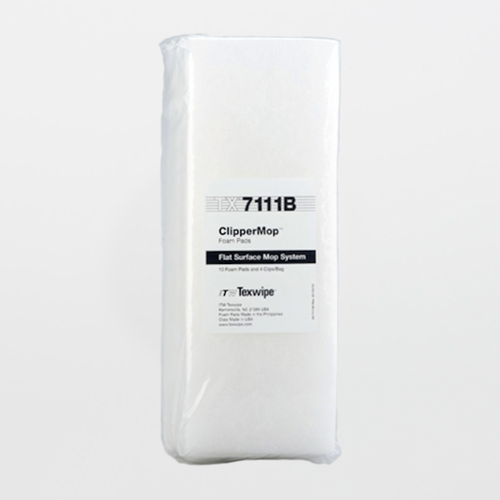
100 Foam Pads and 40 Fasteners Per Case (10 Bags of 10 Foam Pads and 4 Fasteners)
Type:
Dry Mop
Texwipe TX7111B ClipperMop™ Replacement Foam Pads — 11" x 4" Pad Kit with Fasteners (Non-Sterile)
TX7111B is the replacement pad kit for the 11" ClipperMop™ system (TX7103). The pad is designed to help the ClipperMop head conform to uneven surfaces so your chosen cleanroom wiper maintains consistent contact during floor, wall, ceiling, hood, and equipment-exterior cleaning. Each kit includes foam pads plus fasteners so technicians can restore the system to “like-new” wipe-down efficiency without improvising attachments that can shed particles or fail mid-task.

For over 35 years, SOS and Texwipe have been close partners, and SOSCleanroom is the authorized Master Distributor of ITW Texwipe for the United States market. That relationship matters when you are standardizing critical cleaning tools: it supports continuity of supply, stable product lineage, and fast access to the manufacturer documentation your QA/QC team expects.

Published configuration (TX7111B)
  • Part number: TX7111B
  • Pad size: 11" x 4" (27.9 cm x 10 cm)
  • System compatibility: For use with TX7103 ClipperMop™ (12" x 12" wiper size platform)
  • Configuration: Replacement foam pads and white fasteners
  • Sterility: Non-sterile (as published)
  • Packaging (case): 100 foam pads and 40 fasteners per case (10 bags of 10 foam pads and 4 fasteners)
  • Cleanroom packaging: Double-bagged (bag-within-a-bag practice is described for the system accessories)
What you replace Why it matters in critical environments Practical technician trigger
Foam pad (conformability layer) Helps keep your selected wiper in uniform contact to reduce streaking, skip-lines, and “edge-only” wiping that can leave residues behind Wiper contact feels inconsistent, pad compresses permanently, visible wear, or cleaning results drift even with the same chemistry and dwell time
White fasteners (included) Maintains the designed attachment method so the pad stays seated and does not shift (pad shift can create smear patterns and redeposition) Fasteners show damage, looseness, or repeated field rework that slows change-outs and invites handling errors
Low-linting intent — and the reality check
ClipperMop accessories are designed to support low particle and low fiber release versus conventional mops, but no mopping system is truly non-shedding. Treat pad changes like a contamination-control step: change before performance drifts, and keep replacement parts protected until the point of use.

How TX7111B fits into the ClipperMop™ workflow
TX7111B is not a mop cover. It is the replacement pad layer that sits under the wiper on the ClipperMop head and helps the wiper conform to real-world surfaces (floor texture, epoxy seams, cove base transitions, and equipment legs). The ClipperMop system is designed to use standard cleanroom wipers as the contact layer, which can simplify qualification because you can leverage wipers you may already have validated for your process.
Process step What the pad contributes Risk if the pad is worn
Load wiper(s) onto ClipperMop head Provides a compliant backing so the wiper lays flat and follows the surface profile Wrinkles, bridging, or “high spots” that smear, skip, or leave thin chemical films
Apply/remove solutions and disinfectants Helps maintain uniform wipe pressure to improve contact-time consistency and residue removal Streaking, uneven wetting, longer dry times, and redeposition during the “pullback” stroke
Change wipers frequently (protocol discipline) Supports efficient change-outs without tearing wipers or causing the head to snag Handling delays, overuse of a loaded wiper, and higher cross-contamination risk between zones

Practical cleanroom use guidance (technicians and engineers)
  • Change the pad before the room tells you: Do not wait for visible failure. When pad compliance drifts, technicians compensate by adding force, which can increase streaking, redeposition, and edge drag.
  • Minimize handling time in the critical zone: Stage replacement pads and fasteners in a controlled staging area. Open bags only when needed; keep remaining pads protected to limit particle deposition.
  • Keep the wiper as the contact layer: The designed approach is wiper-on-head with clips/attachments; do not improvise tapes or non-qualified attachments that can shed adhesive residue or fail under disinfectant exposure.
  • Control the wetness variable: Over-wetting makes any system smear and can leave films; under-wetting increases friction and can abrade residues across the surface. Standardize load level per your SOP.
  • Zone discipline: Treat mop tools like “zone assets.” Use defined lanes and clean-to-dirty progression; change wipers (and pads when required) rather than crossing back over cleaned areas with a loaded surface.

Compatibility and sterilization notes (as published)
  • Wiper compatibility (system-level): ClipperMop™ is described to use standard 9" x 9" or 12" x 12" cleanroom wipers, including dry, pre-wetted, sterile, or non-sterile wipers (your wiper selection is where most compatibility decisions live).
  • Sterilization options (system-level): Manufacturer documentation describes compatibility with sterilization by gamma irradiation, chemicals, vaporized hydrogen peroxide (VHP), or ethylene oxide (EO). Validate your site method and post-sterilization handling before standardizing.
  • Cleanroom environment: Recent manufacturer TDS lists ISO Class 3–7 (Class 1–10,000) and EU Grade A–D; an earlier system datasheet describes compatibility with protocols for ISO Class 3–8. Use the latest TDS as the primary qualification reference for audits.
  • Chemistry exposure: Not published as a pad-only chemical-compatibility specification. If you run aggressive oxidizers or specialty disinfectants, qualify pad integrity under your chemistry and contact-time conditions before rollout.

Common failure modes 
  • Streaking / uneven film removal: Often driven by a worn pad (loss of compliance), over-wetting, or inconsistent stroke pressure. Prevent with scheduled pad replacement and controlled solution loading.
  • Pad shift / poor seating: Happens when fasteners are damaged, missing, or reworked repeatedly. Prevent by replacing fasteners as intended and performing a quick seating check before entering the controlled zone.
  • Particle redeposition from overuse: When wipers are pushed past capacity, soils and residues can redeposit. Prevent with frequent wiper changes (the system is designed for that discipline).
  • Residue carryover between zones: Caused by using the same loaded wiper/tool across “clean” and “dirty” areas. Prevent with zone segregation and defined lane progression.

Storage and handling best practices
  • Keep pads in original cleanroom packaging until the point of use; avoid staging open bags in airflow.
  • Store away from sharp tools and rough surfaces that can nick or compress pads and degrade conformability.
  • If your SOP requires wipe-down of incoming materials, wipe the outer bag first and introduce the inner bag per your gowning/antechamber practice.
  • Document pad replacement as part of your cleaning tool control plan (traceability reduces investigation time when cleaning performance is questioned).
Documentation 
SOS-hosted Texwipe datasheet (DS-7102, Effective: December 2009): Click Here
Texwipe manufacturer page (TX7111B): Click Here
Texwipe manufacturer PDF (ClipperMop™ Series Technical Data Sheet, US-TDS-058 Rev. 11/21): Click Here
Last updated: January 9, 2026
 
If you have any questions please email us at Sales@SOSsupply.com or give us a call at (214)340-8574.

Check out the AI ChatBot powered by SOSCleanroom data libraries - give it a try!
 
THIS IS NEW FOR 2026!

© 2026 SOS Supply. All rights reserved.
The Technical Vault Detail-Zone Mop Process Control (Applied Use Case: Texwipe™ TX7111B ClipperMop™ 11" x 4" Replacement Foam Pads)

Purpose & Scope

In a ClipperMop™ detail-cleaning system, the foam pad is the compression layer that influences pressure uniformity, solution hold-and-release, and streak control—especially in tight zones where operators use shorter, higher-frequency strokes. The TX7111B foam pads are sized for the 11" x 4" ClipperMop head and should be treated as a controlled consumable within your cleaning SOP.

Visual Aids (Technique, Zoning, Lifecycle)

Use this graphic as a training reinforcement tool: unidirectional technique, zone-based tool control, and lifecycle discipline (including pads that determine contact quality).

Cleanroom mopping technique (unidirectional vs figure-8), cleanroom zoning map concept, and mop head lifecycle diagram

Implementation note: Diagram intent is educational. Align technique, zoning, and change-out rules to your facility SOP and validated cleaning program.

Why Replacement Foam Pads Matter (Detail Zones Magnify Pad Issues)

Detail zones (corners, thresholds, equipment bases) load the mop system faster and often require more pressure changes and repositioning. If the foam pad is worn or mis-seated, the result is usually repeatable streak patterns, edge striping, or uneven wetting that looks like a chemistry problem—but is actually pressure distribution drift.

  • Uniform pressure supports uniform wetting and pickup.
  • Compression set creates high/low contact zones that “print” into the lane.
  • Residue retention in degraded foam can re-transfer onto the next surface.

Pad Seating & Handling (Small Step, Big Impact)

In an 11" x 4" head, even minor misalignment can shift contact pressure noticeably. Train operators to confirm the pad is centered, flat, and fully engaged before installing the cover and before introducing chemistry.

  • Centering: prevents edge-biased wetting and striping.
  • Flatness: eliminates “high spots” that create drag rails.
  • Clean attachment points: residue at seams can create localized bulges that show up as streak lines.

Common Foam-Pad Failure Modes (What to Watch For)

  • Streaking that repeats in the same pattern across passes (pressure distribution issue).
  • Edge striping and “rail lines” (pad compression set or mis-seating).
  • Uneven wetting where one side of the lane dries differently than the other.
  • Loss of rebound (pad stays compressed) or a stiff, “boardy” feel when flexed.
  • Tackiness/odor indicating chemistry buildup retained in the foam.

Lifecycle Management (How to Control Pads in an SOP)

Foam pads rarely fail catastrophically—they drift. Strong programs manage pads using objective triggers rather than waiting for visible damage.

  • Replace by performance trigger: persistent streak/striping after changing the cover.
  • Replace by inspection trigger: compression set, permanent deformation, embedded debris, or tacky residue.
  • Replace by validated cycle limit: if your site tracks “uses per pad,” set a limit based on internal evaluation.
  • Segregate by zone: do not move pads from high-soil zones into cleaner zones.

Troubleshooting: If You See Streaking, Check This Order

  1. Technique: unidirectional lanes, consistent overlap, no backtracking with a loaded cover.
  2. Cover condition: change the cover; don’t “chase” streaks with an overloaded cover.
  3. Foam pad seating/condition: inspect alignment and compression set.
  4. Head assembly: inspect for warping or edge deformation.
  5. Solution loading: confirm damp-to-wet (not dripping) and any dwell/removal steps required by SOP.

SOP & Audit Readiness Checklist (Foam Pads)

  • Define pad inspection points (compression set, deformation, residue, embedded debris).
  • Define objective change-out criteria (performance triggers + validated cycle limits where applicable).
  • Train pad seating verification before installing covers and before introducing chemistry.
  • Segregate pads/tools by zone and chemistry where applicable; label storage to prevent cross-use.
  • Include foam-pad checks in corrective action workflow before changing chemistry or escalating.

Disclaimer: This Technical Vault content is provided for educational purposes only. Manufacturer instructions, facility SOPs, and site-specific risk assessments must always take precedence. Cleanroom suitability and contamination performance are determined by the complete system configuration (pad + cover + head assembly + chemistry + handling) and validated site practice.

© SOSCleanroom. All rights reserved.