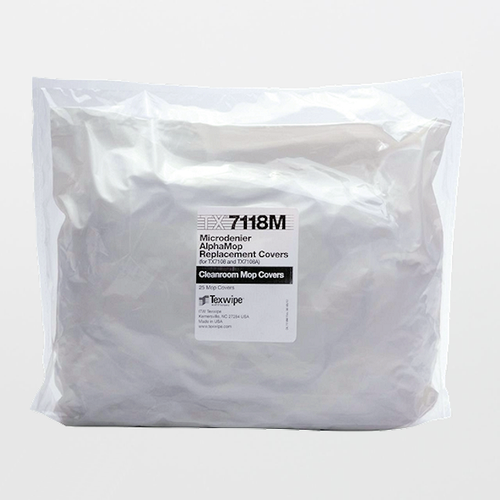
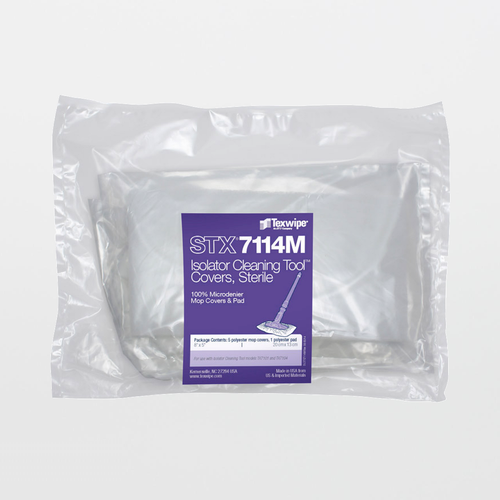
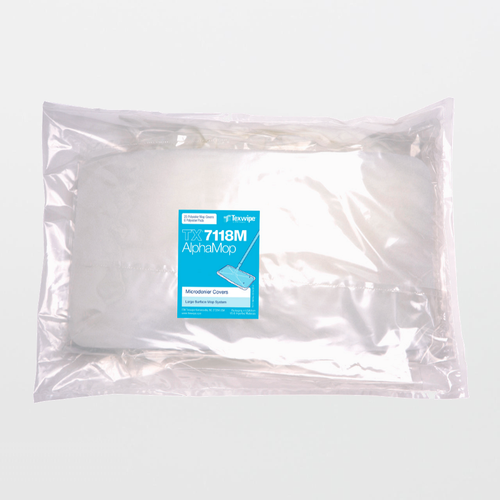
Texwipe TX7114M Mini AlphaMop™ Microdenier Cleanroom Replacement Mop Covers (Refills) — Non-Sterile, Case Pack
TX7114M is a microdenier polyester replacement mop cover set designed for the Mini AlphaMop™ / Isolator Cleaning Tool system used in isolators, glove boxes, biosafety cabinets, laminar flow hoods, and other small, hard-to-reach controlled-environment surfaces. The microdenier construction is engineered to capture and hold fine contamination while supporting wet cleaning with disinfectants — including quat-based cleaners — when used with disciplined wipe technique and change-out control.
For over 35 years, SOS and Texwipe have been close partners, and SOSCleanroom is the authorized Master Distributor of ITW Texwipe for the United States market. That relationship matters when you are standardizing critical cleaning tools: it supports continuity of supply, stable product lineage, and fast access to the manufacturer documentation your QA/QC team expects.
Published configuration (TX7114M)
- SKU: TX7114M
- Product type: Dry mop cover (replacement covers for Mini AlphaMop™ / Isolator Cleaning Tool)
- Material (cover): Microdenier 100% polyester (not a blend)
- Sterile / non-sterile: Non-sterile
- Compatibility (as published): Engineered for quat-based cleaners; also referenced for use with IPA and other solutions in manufacturer literature
- System fit (as published): Replacement covers for TX7101 and TX7104 tool systems
- Case quantity option: 150 mop covers and 6 foam pads per case (6 bags of 25 mop covers)
- Packaging (manufacturer-published): Inner bags: 25 mop covers and 1 pad/bag; outer: 6 bags/case; total 150 mop covers and 6 polyester pads/case
- Product dimensions: Not published on this SOS listing (qualify to your tool head and SOP)
- SOS listing weight: 4.20 lbs (case)
- Availability (SOS listing): 7 - 10 business days
Low particle and fiber generation — and the reality check
This mop cover is designed for critical cleaning with low contamination contribution and strong capture of fine residues. Even so, no textile is truly particle-free. Treat mop covers like contamination-controlled components: introduce them correctly (bag discipline), control wetting to prevent dripping, and change them before they become a mobile contamination source.
Practical cleanroom use guidance (technicians and engineers)
- Bag-in discipline: Stage the case outside the room, wipe down the outer carton per your SOP, then introduce only the required inner packaging. Open inner bags only at the point of use.
- Pre-wet control (avoid drip events): Wet the cover to the point of uniform dampness — not saturation. Excess solution at the leading edge is a common driver of streaking, residue film, and pooling at corners.
- Wipe pattern: Use overlapping, unidirectional passes (e.g., top-to-bottom or back-to-front), then rotate the mop head to a clean face before returning over the same path. Avoid scrubbing in tight circles unless the surface tolerance and residue type require it.
- Edge and corner technique: Slow down at corners and gasket lines. Use light pressure and short strokes to avoid “solution squeeze-out” that can drive residues into crevices.
- Change-out logic: Replace covers early and often. The moment a cover starts to drag, leave streaks, or show visible loading, it is no longer doing controlled cleaning — it is redistributing contamination.
- Glove control: Handle covers with clean, dry gloves. Wet gloves transfer disinfectant chemistry to packaging surfaces and can create uncontrolled residues on the next change-out.
Compatibility and wipe-down notes
- Quat disinfectants: This microdenier cover is engineered for quat-based cleaners (helpful for routine disinfecting cycles where quat film control and coverage consistency matter).
- IPA and solvent use: Manufacturer literature references use with IPA and other cleaning solutions; qualify the complete process (solution + contact time + surface + dry time) under your facility SOP before standardizing.
- Residue management: Quats can leave films if over-applied or not removed per your SOP. Control solution volume, use appropriate overlap, and consider a final pass per your validated cleaning sequence if your program requires it.
- Surface sensitivity: On optics, polished metals, and coated plastics, avoid dry dragging. Any textile can contribute micro-marring risk if used dry on sensitive surfaces; keep the cover properly wetted and pressure-controlled.
Packaging and system fit (planning table)
| Item |
Published value |
Why it matters in critical environments |
| Inner pack |
25 mop covers and 1 pad per bag |
Supports controlled introduction and predictable change-outs per shift/campaign. |
| Case pack |
6 bags per case (total 150 covers and 6 pads per case) |
Simplifies replenishment math and reduces “partial case” handling in the gowning flow. |
| Compatible systems |
Replacement covers for TX7101 and TX7104 |
Prevents field improvisation (wrong head size, loose fit, bypass wiping at edges). |
| Typical use areas |
Isolators, glove boxes, biosafety cabinets, laminar flow hoods, workbenches |
Targets the “small surface” problem where hand wipes are inconsistent and re-contact risk is high. |
Typical performance characteristics
These are published as typical analyses (not specifications) to support qualification planning and contamination-risk reviews.
| Property |
Typical value |
Test method (as published) |
| Sorptive capacity |
350 mL/m2 |
TM20 (referenced with IEST-RP-CC004.3 context) |
| Sorptive rate |
0.3 seconds |
TM20 (referenced with IEST-RP-CC004.3 context) |
Typical contamination characteristics
These are published as typical analyses (not specifications). Use them to compare risk levels and to plan validation/qualification sampling where required.
| Property |
Typical value |
Test method (as published) |
| LPC (≥ 0.5 µm) |
19 x 106 particles/m2 |
TM22 |
| Particles (0.5–5.0 µm) |
10.9 x 10⁶ particles/m2 |
TM22 (referenced with ASTM E2090-00 context) |
| Particles (5.0–100 µm) |
320,000 particles/m2 |
TM22 (referenced with ASTM E2090-00 context) |
| Fibers (> 100 µm) |
1,200 fibers/m2 |
TM22 (referenced with ASTM E2090-00 context) |
| Nonvolatile residue (IPA extractant) |
0.09 g/m2 |
TM1 |
| Nonvolatile residue (DIW extractant) |
0.02 g/m2 |
TM1 |
| Sodium |
0.4 ppm |
TM18 |
| Potassium |
0.06 ppm |
TM18 |
| Chloride |
0.05 ppm |
TM18 |
Common failure modes
- Streaking / film: Most often from over-wetting, uneven overlap, or allowing quat chemistry to dry as a visible residue. Control wetting level and maintain consistent pass overlap; follow your validated final-pass sequence if required.
- Cross-contamination: Reusing a loaded cover across zones (e.g., from “dirty” perimeter surfaces to critical interior surfaces) transfers residues and particles. Use zone-based change-out rules and color/step segregation per SOP.
- Particle mobilization from poor technique: Aggressive scrubbing or rapid direction changes can re-aerosolize loosened contamination. Use controlled, unidirectional strokes and rotate to a clean face.
- Snagging on sharp features: Threaded fasteners, burrs, or sharp rack edges can snag any textile and generate debris. Deburr hardware where permitted and keep pressure light on edges.
- Residue carryover from wet gloves: Handling covers with solvent-wet gloves can leave uncontrolled chemistry on the cover and packaging. Standardize “dry-glove” handling for consumable change-out.
Storage and handling best practices
- Keep mop covers in original packaging until introduction into the controlled area; do not stage opened bags on common benches.
- Store in a clean, dry cabinet to prevent humidity-driven packaging softening and unintended contamination deposition.
- Segregate covers from tools, clips, and metal parts that can puncture bags and create uncontrolled introductions.
- Use first-in/first-out (FIFO) and keep a case-level lot record consistent with your cleaning program traceability requirements.
Documentation
SOS-hosted Texwipe technical datasheet (TX7114M / TX7118M Microdenier Mop Covers, Effective: December 2012):
Click HereTexwipe Mini AlphaMop™ Technical Data Sheet (US-TDS-068 Rev.11/21):
Click Here
If you have any questions please email us at Sales@SOSsupply.com or give us a call at (214)340-8574.
Check our the AI ChatBot powered by SOSCleanroom data libraries - give it a try!
THIS IS A NEW WEBSITE FEATURE FOR 2026!
Last updated: January 9, 2026
© 2026 SOS Supply. All rights reserved.