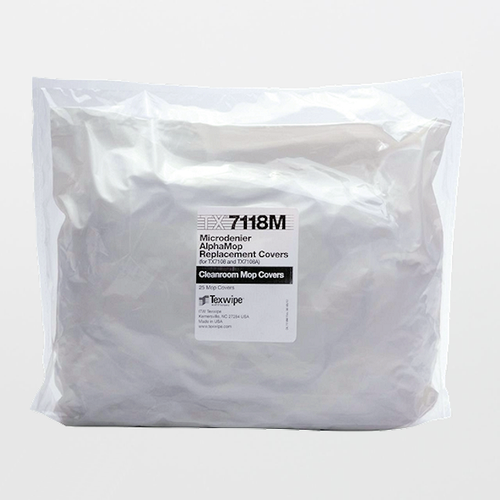
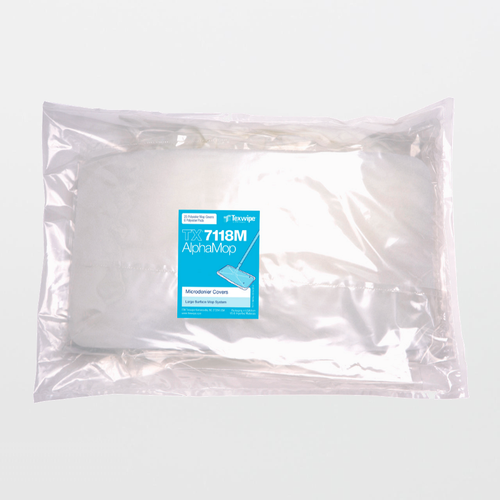
Texwipe TX7118M AlphaMop™ Microdenier Cleanroom Replacement Mop Covers — Fits 8" x 15" Flat Mop Heads, Non-Sterile
TX7118M is a microdenier (microfiber-style) mop cover engineered for critical cleaning where higher contaminant capture and streak-free solution application matter — including routine cleaning of walls, ceilings, and floors, plus applying and removing disinfectants (with specific design intent for quat-based cleaners). It is used with Texwipe’s AlphaMop™ 8" x 15" flat mop head systems (including TX7108 and TX7108A).
For over 35 years, SOS and Texwipe have been close partners, and SOSCleanroom is the authorized Master Distributor of ITW Texwipe for the United States market. That relationship matters when you are standardizing cleanroom mopping: it supports continuity of supply, stable product lineage, and fast access to the manufacturer documentation your QA/QC team expects.
Published configuration (TX7118M)
- System fit: Designed for 8" x 15" (20 cm x 38 cm) AlphaMop™ flat mop heads; works with TX7108 and compatible AlphaMop heads.
- Cover material: 100% polyester microdenier (microfiber-style textile), never a blend.
- Sterile / non-sterile: Non-sterile.
- Inner packaging (as published): 25 mop covers and 1 pad per bag.
- Case packaging (as published): 6 bags per case = 150 mop covers per case.
- Pads included (as published): 6 polyester pads per case (used to cushion the head and help the cover conform to surfaces for consistent contact).
- Cleanroom environment (as published for AlphaMop system): ISO Class 2–7 and ISO Class 3–7 are both published across AlphaMop technical documentation (programs should qualify to their own limits).
- Shelf life (as published for AlphaMop covers): Non-sterile — 5 years from date of manufacture.
- Autoclave: Microdenier covers are published as autoclave safe; cover-specific cycle conditions are not stated — qualify under your site’s autoclave recipe before standardizing for sterile transfer workflows.
Low particle/fiber intent — and the reality check
TX7118M is built to increase capture of fine contamination (microdenier construction with more fibers and more surface area than standard polyester covers). Even so, no textile cover is truly zero-shedding in every use scenario. Treat mop covers like process consumables: control how they are introduced, how often they are changed, and how aggressively they are used on abrasive surfaces.
Practical cleanroom use guidance (technicians and engineers)
- Change-cover discipline (core control): Use the AlphaMop quick-change approach intentionally — replace covers frequently to avoid redepositing captured contamination. Define a change trigger in your SOP (area cleaned, time in use, or visible loading).
- Clean-to-dirty pattern: Mop from the cleanest zone toward the dirtiest zone (or highest-risk product area outward) and avoid backtracking with the same cover.
- Overlap and edge control: Use controlled, overlapping strokes (e.g., S-stroke) with consistent pressure. Avoid scrubbing the same line repeatedly; that can drive streaking and can increase mechanical shedding on rough surfaces.
- Pad and conformity: Install the polyester pad correctly so the cover maintains full contact. Poor pad seating reduces contact area and increases streak risk, especially on walls/ceilings.
- Residue removal approach: For disinfectants that can leave films, plan a defined removal step (fresh cover and appropriate removal chemistry per site policy) rather than trying to “buff out” residue with an overused cover.
Cleaner and disinfectant use notes (published intent)
- Quat workflow: The microdenier AlphaMop M Series cover is engineered to work with quat-based cleaners/disinfectants and is positioned to help avoid performance loss associated with quat breakdown in some wiping substrates.
- Application + removal: AlphaMop documentation positions the system for applying and removing solutions including disinfectants (walls, ceilings, floors). Validate contact time and removal practices under your SOP.
- Solvent use: AlphaMop technical documentation references cleaning with solvents such as IPA, ethanol, acetone, and degreasers at the system level. Compatibility is process-dependent — qualify your chemistry and surface combination before broad release.
Why microdenier matters (mechanism-based)
Microdenier fabric is published as having increased capturing power versus standard polyester materials (more fibers and more surface area). The smaller filament diameter supports lifting and holding fine contamination (including particles as small as microbes) while improving solution coverage for large-surface cleaning.
| Published mechanism |
What it helps with in the field |
How to operationalize |
| Higher fiber density / surface area (microdenier) |
Improved fine contaminant pick-up; reduced “push-around” behavior |
Define cover-change intervals; avoid overloading a single cover on high-soil passes |
| Enhanced sorption / wicking (published for microdenier covers) |
More uniform wet film; fewer dry streaks on large panels |
Pre-wet consistently or control dispense volume; avoid flooding edges and seams |
| Designed intent for quat cleaning |
Improved performance when using quat disinfectants in routine cleaning |
Use defined application/removal steps; do not “stretch” a cover through multiple rooms |
Typical performance characteristics
These are published as typical analyses (not specifications) to support qualification planning and contamination-risk reviews.
| Property |
Typical value |
Test method (as published) |
| Sorptive capacity |
350 mL/m2 |
TM20 |
| Sorptive rate |
0.3 seconds |
TM20 |
Typical contamination characteristics
These are published as typical analyses (not specifications). Use them to support internal qualification, cleaning validation planning, and comparator reviews.
| Property |
Typical value |
Test method (as published) |
| LPC (≥ 0.5 µm) |
19 x 106 particles/m2 |
TM22 |
| Particles (0.5–5.0 µm) |
10.9 x 10⁶ particles/m2 |
TM22 |
| Particles (5.0–100 µm) |
320,000 particles/m2 |
TM22 |
| Fibers (>100 µm) |
1,200 fibers/m2 |
TM22 |
| Nonvolatile residue (IPA extractant) |
0.09 g/m2 |
TM1 |
| Nonvolatile residue (DIW extractant) |
0.02 g/m2 |
TM1 |
| Sodium |
0.4 ppm |
TM18 |
| Potassium |
0.06 ppm |
TM18 |
| Chloride |
0.05 ppm |
TM18 |
Common failure modes
- Streaking / film trails: Typically from inconsistent wetting, overloaded covers, or uneven pad seating. Prevent with controlled dispense volume, correct pad installation, and more frequent cover changes.
- Residue carryover: Caused by continuing to mop after the cover is loaded (or moving between rooms/grades with the same cover). Prevent by defining area-per-cover limits and enforcing clean-to-dirty zoning.
- Particle shedding on abrasive surfaces: Triggered by aggressive scrubbing on rough coatings, damaged epoxy, or sharp edges. Prevent by reducing mechanical aggression and addressing the surface defect as a maintenance item.
- Cross-contamination from handling: Touching the working face during installation or setting the mop head down on non-controlled surfaces. Prevent with glove discipline and controlled staging (clean cart, clean tray, or hanging storage).
- Coverage loss in corners/edges: Poor conformity when the pad is missing, worn, or incorrectly installed. Prevent by verifying pad presence and replacing pads when compression set is observed.
Storage and handling best practices
- Keep covers and pads in original packaging until introduced into the controlled area; open bags at point-of-use to minimize airborne deposition.
- Store cases in a clean, dry location; avoid humidity extremes that can complicate controlled wetting and can drive inconsistent wipe film.
- Stage only the quantity needed for the shift to reduce repeated bag opening and handling events.
- If your program autoclaves covers, segregate “to-be-autoclaved” inventory and apply clear status labeling to prevent mix-ups.
Documentation
SOS-hosted Texwipe datasheet (TX7114M / TX7118M Microdenier Mop Covers, Effective: December 2012):
Click HereTexwipe AlphaMop™ Series Technical Data Sheet (US-TDS-067 Rev. 3/22):
Click Here
If you have any questions please email us at Sales@SOSsupply.com or give us a call at (214)340-8574.
Check out the AI ChatBot powered by SOSCleanroom data libraries - give it a try!
THIS IS NEW FOR 2026!
Last updated: January 9, 2026
© 2026 SOS Supply. All rights reserved.