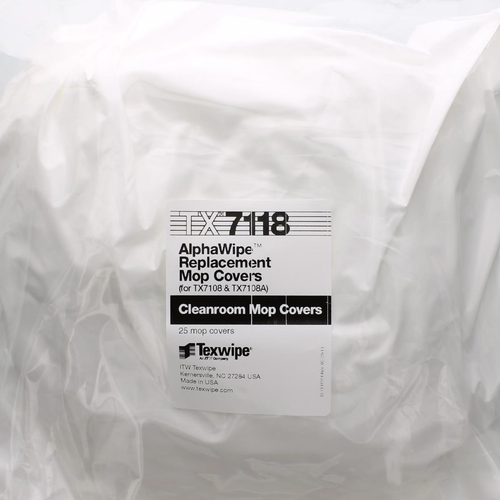
Texwipe STX1720 Revolve™ Sterile Mini AlphaMop™ Integrated Covers/Pads — 7" x 4" (18 cm x 10 cm)
STX1720 is a sterile, triple-bagged replacement cover/pad that fits the Mini AlphaMop™ / Isolator Cleaning Tool system for technician cleaning in isolators, glove boxes, biosafety cabinets, laminar flow hoods, and other small, hard-to-reach controlled areas. The Revolve™ integrated design replaces the cover and pad in one step, supporting faster change-outs and better wiping discipline when you are managing residue risk, cross-contamination risk, and surface re-deposition risk in critical environments.
Revolve™ products are manufactured using upcycled post-consumer polyester (rPET) yarn, designed to deliver comparable functional performance to virgin polyester while supporting sustainability goals.
For over 35 years, SOS and Texwipe have been close partners, and SOSCleanroom is the authorized Master Distributor of ITW Texwipe for the United States market. That relationship matters for cleanroom mopping systems: it supports continuity of supply, stable product lineage, and fast access to manufacturer documentation for QA/QC qualification and audit readiness.
Published configuration (STX1720)
- Part number (SOS / manufacturer): STX1720
- Type: Dry mop cover/pad (integrated cover/pad)
- Size: 7" x 4" (18 cm x 10 cm)
- Material: Revolve™ sustainable polyester (upcycled polyester / rPET)
- Sterile: Yes (gamma irradiated to SAL 10-6, as published)
- Inner packaging: 10 covers per bag; triple-bagged
- Case packaging: 10 bags per case; total 100 covers per case
- System compatibility: Use with Mini AlphaMop™ / Isolator Cleaning Tool™ (TX7101 and TX7105)
- Cleanroom environments (as published for the series): ISO Class 3–7 (Class 1–100,000); EU Grade A–D
- Shelf life (as published for sterile): 3 years from date of manufacture
- Temperature guidance (as published): Appropriate for use with temperatures < 400°F (205°C)
Low-linting intent — and the reality check
These covers are built for contamination-controlled mopping with low-linting performance. Even so, no textile or wiping substrate is truly “lint-free.” Treat mop covers like a controlled component: control bag opening, control change-out frequency, and control how wet chemistry is introduced to prevent residue trails, re-deposition, and film transfer.
System compatibility (what it fits and why it matters)
Use STX1720 as the working wiping surface on the Mini AlphaMop™ platform for small-area cleaning where maneuverability, controlled change-outs, and edge/corner access are operational priorities.
| Component |
Part number |
How technicians typically use it |
| Integrated cover/pad |
STX1720 |
Primary wiping surface; one-step cover/pad replacement to support strict change frequency. |
| Mini AlphaMop™ / Isolator Cleaning Tool™ kit |
TX7101 |
Low-profile, swivel-head tool for isolators, glove boxes, biosafety cabinets, and confined areas. |
| Replacement head kit |
TX7105 |
Head refresh / spares program; helps sites keep a qualified tool in rotation without improvisation. |
Practical cleanroom use guidance (technicians and engineers)
- Change-out frequency is the control knob: In critical environments, the most common failure is running a single cover too long. Change covers on a defined interval (area-based or time-based), and treat every change as a contamination-control reset.
- Control wetting level: Aim for a controlled “damp-mop” condition when applying chemistry. Over-wetting drives streaking, residue trails, and wicking into edges that can carry contaminants forward.
- One direction, one pass mindset: Use unidirectional strokes with planned overlap. Avoid backtracking over the same path with a loaded cover (classic re-deposition mechanism).
- Edge and corner discipline: In isolators and cabinets, corners concentrate residues. Use the swivel head deliberately, and rotate the contact face (or change covers) before the edge becomes visibly loaded.
- Bag handling: Open outer bags outside the controlled area when your SOP allows. Present the inner sterile bag into the controlled zone, then open only at point-of-use to reduce airborne deposition on the wipe surface.
Compatibility and chemical-use notes
- Solvents (as published): Intended for cleaning with solvents such as isopropyl alcohol (IPA), ethanol, acetone, and degreasers. Always verify compatibility to your exact chemistry, concentration, contact time, and surface material before standardizing.
- Disinfectants (as published): Suitable for applying and removing disinfectants. To avoid residue films, control wetting level and include a validated residue-management step where required by the program.
- Temperature limit (as published): Use for temperatures < 400°F (205°C). Do not assume suitability for hot tooling or heated assemblies without site qualification.
- Autoclave considerations: The Revolve™ integrated cover/pad is described as autoclave safe. Autoclaving a pre-sterilized, triple-bagged product introduces sterile-barrier and packaging considerations; qualify under your process if autoclave cycles are required.
Sterility, packaging, and traceability controls (critical environments)
| Control element |
What is published |
Why technicians care |
| Sterility method |
Gamma irradiated to SAL 10-6 (per published guidance) |
Supports sterile-area introductions; reduces bioburden risk when used per SOP. |
| Bagging format |
10 covers per bag; triple-bagged |
Enables staged introduction and cleaner point-of-use opening; reduces handling errors. |
| Case quantity |
100 covers per case (10 bags of 10) |
Simplifies kitting, consumption planning, and change-out cadence control. |
| Shelf life |
Sterile: 3 years from date of manufacture |
Supports inventory rotation and expiration control for sterile programs. |
Operational planning table (how teams typically standardize change-outs)
Use this as a starting point for SOP drafting. Final change frequency must be set by your contamination limits, surface type, and chemistry.
| Task |
Wetting level |
Change-out trigger (examples) |
| Isolator interior wipe-down (routine) |
Damp |
After defined area coverage; before corners become visibly loaded; before switching chemistry. |
| Disinfectant application / removal |
Controlled wet |
After dwell + removal step; change covers before final “finish pass” to reduce streaking. |
| Spill control |
As needed |
Replace immediately once loaded; do not “re-spread” a spill with a saturated cover. |
Common failure modes
- Streaking / residue trails: Typically from over-wetting, poor dwell/finish discipline, or reusing a loaded cover. Prevent with controlled dampness, defined passes, and frequent change-outs.
- Re-deposition: Happens when the same wipe face is dragged back across cleaned surfaces. Prevent with unidirectional strokes, planned overlap, and rotation/change of the contact face.
- Particle attraction (low humidity): Polyester can attract fines under static-prone conditions. Prevent by following site ESD/humidity controls and avoiding rapid rubbing or aggressive dry buffing.
- Seal / bag integrity errors: Introducing a compromised sterile bag defeats sterility intent. Prevent with visual seal checks, controlled opening methods, and lot/expiry discipline.
Storage and handling best practices
- Keep triple-bagged packaging intact until point-of-use; do not “stage open” inner bags in airflow.
- Store in a dry, controlled area away from carton damage that can compromise sterile packaging.
- Use FIFO and track expiration for sterile programs; remove expired material from controlled inventories.
- Standardize kit contents so technicians are not forced to substitute non-qualified mop covers in critical zones.
Documentation
SOS-hosted Mini AlphaMop™ system sheet (tooling + cover program context):
Click HereSOS-hosted Revolve™ TechNote (sustainability line context):
Click HereTexwipe Technical Data Sheet (Mini AlphaMop™ Series; includes STX1720; US-TDS-068 Rev.11/21):
Click Here
If you have any questions please email us at Sales@SOSsupply.com or give us a call at (214)340-8574.
Check out the AI ChatBot powered by SOSCleanroom data libraries - give it a try!
THIS IS NEW FOR 2026!
Last updated: January 9, 2026. © 2026 SOS Supply. All rights reserved.