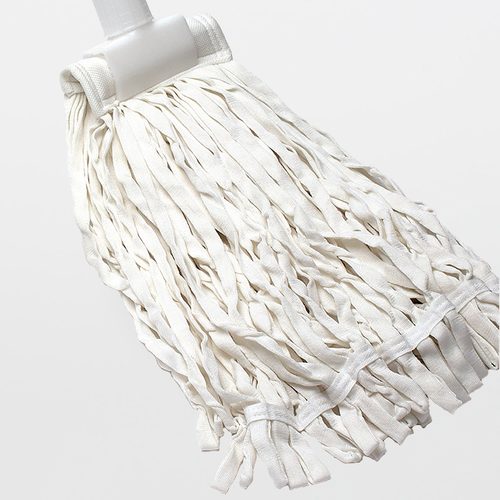
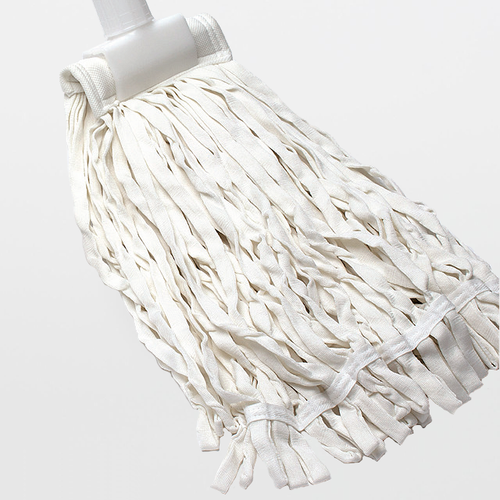
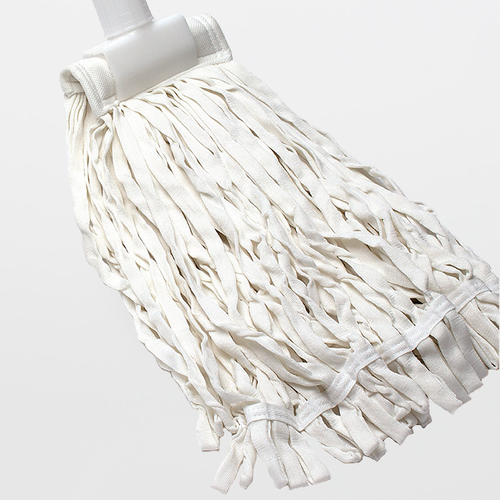
Texwipe STX1722 BetaMop™ Revolve™ Sustainable String Mop Refills — Sterile, Triple-Bagged (6 Heads/Case)
STX1722 is a sterile, cleanroom-engineered BetaMop™ string refill for applying and removing disinfectants and cleaning solutions on floors in critical environments, including sterile areas. It is part of Texwipe’s Revolve™ sustainable program and is made from 100% upcycled polyester material with published absorbency capacity of 1.5 liters per mop head. The refill is designed for fast change-outs and compatibility with BetaMop™ hardware for consistent floor coverage and controlled handling.
For over 35 years, SOS and Texwipe have been close partners, and SOSCleanroom is the authorized Master Distributor of ITW Texwipe for the United States market. That relationship matters when you are standardizing critical cleaning tools: it supports continuity of supply, stable product lineage, and fast access to the manufacturer documentation your QA/QC team expects.
Published configuration (STX1722)
- Part number: STX1722
- Product type: Dry mop head refill (string-style)
- Material: Revolve™ sustainable polyester string refill (100% upcycled polyester material)
- Absorbency capacity (as published): 1.5 liters per mop head
- Sterility: Gamma irradiated to a Sterility Assurance Level (SAL) of 10-6 (per published guidance)
- Packaging: 1 mop head refill per bag, triple-bagged
- Case quantity: 6 bags per case (6 heads per case)
- Compatibility: Compatible with BetaMop™ hardware; also compatible with other cleanroom mop handles designed for string mops (as published)
- Cleanroom environment (as published): ISO Class 3–7; EU Grade A–D (sterile recommended for EU Grade A–B)
- Disinfectant compatibility: Compatible with most disinfectants (as published)
- Certificates: Certificates of Compliance, Analysis, and Irradiation available (as published)
Sterile triple-bagging is a contamination-control feature — protect it
Treat the sterile barrier system as part of your contamination control strategy. Keep the outer bags intact through transfer steps, open bags deliberately (no tearing that sheds debris), and stage the mop head only at the point of use. If the sterile packaging is compromised, manage it as a deviation per your site CCS and cleaning SOPs.
Annex 1 alignment considerations (practical, CCS-driven)
EU GMP Annex 1 expectations are built around a risk-based Contamination Control Strategy (CCS), validated cleaning/disinfection, and disciplined material transfer. This sterile mop refill supports those programs when it is integrated into qualified procedures and documentation (it is not a compliance claim by itself).
- Validated disinfectant use: Pair the mop head with your qualified disinfectants/sporicides and documented contact times; control solution concentration and dwell time at the floor.
- Two-bucket method control: For sterile/aseptic suites, many CCS programs prefer separation of apply vs. rinse/dirty collection to reduce redeposition risk.
- Material transfer discipline: Use triple-bag transfer consistent with your airlock strategy (outer-bag wipe-down, staged opening, defined clean-to-dirty flow).
- Traceability: Record lot, irradiation certificate reference, and area-of-use in the batch record or cleaning log to support investigations and trend review.
- Rotation strategy: If your CCS requires sporicide rotation, manage mop head changes and bucket changes as part of the rotation plan (avoid cross-using tools between chemistries unless qualified).
Practical cleanroom mopping technique (technicians and engineers)
- Define the pattern: Use unidirectional strokes and overlap lanes to prevent missed strips and reduce back-and-forth redeposition.
- Control saturation: Pre-wet to the qualified level (not dripping) so chemistry contact time is achieved without pooling that can drive residue lines.
- Clean-to-dirty zoning: Start at the highest cleanliness zone and work outward; do not re-enter a cleaner zone with a mop head that has touched a dirtier area.
- Change-out triggers: Replace the mop head when loading increases (visual soil, streaking, reduced glide) or when moving between rooms/grades per SOP.
- Handle discipline: Keep the handle above the floor, avoid bumping walls/equipment, and protect the clamp area from contact that can transfer residues back to the head.
Published performance and selection table (BetaMop™ refills)
These values are published to support planning and selection; verify final choices under your site cleaning SOPs and surface/disinfectant conditions.
| Refill |
Material family |
Capacity (L/head) |
Packaging (as published) |
| TX716R |
Polyester string |
1.3 |
Non-sterile, double-bagged (6 heads/case) |
| TX7070 |
Microdenier polyester string |
1.8 |
Non-sterile, double-bagged (6 heads/case) |
| STX1722 |
Revolve™ sustainable polyester string (upcycled) |
1.5 |
Sterile, triple-bagged (6 heads/case) |
Common failure modes
- Streaking / residue lines: Often from over-wetting, chemistry concentration drift, or incomplete rinse strategy. Prevent with controlled saturation, verified dilution, and SOP-defined bucket changes.
- Cross-contamination between rooms/grades: Typically from reusing a head or handle across zones. Prevent with zone-dedicated tools and defined change-out points.
- Loss of sterile barrier control: Caused by early opening, damaged bags, or uncontrolled staging. Prevent with triple-bag transfer discipline and point-of-use opening.
- Particle mobilization during aggressive scrubbing: High friction at seams/edges or on rough floors can increase shedding risk. Prevent with correct dwell time (let chemistry work) and controlled pressure.
- Re-deposition from overloaded mop head: When a head becomes saturated with soil/chemistry, it can drag contaminants. Prevent with frequency-based head changes and clean-to-dirty workflow.
Storage and handling best practices
- Keep refills in original triple-bag packaging until the defined transfer step; do not stage open bags in corridors or uncontrolled carts.
- Protect from puncture/crush damage that can compromise sterile barrier integrity.
- Shelf life/expiry is not published in the cited TDS; follow the lot label and your site receiving/expiry control procedure.
- If a mop head is reprocessed (e.g., autoclaved) after opening, manage it under your validated reprocessing program and treat it as a controlled change (sterile status is a system, not a label).
Documentation
SOS-hosted Texwipe datasheet (BetaMop™ Series, PDF):
Click HereTexwipe TDS (BetaMop™ Series, TEX-LIT-TDS-002-11/21, PDF):
Click HereTexwipe certificates (CoC/CoA/Irradiation, as available):
Click Here
Last updated: January 9, 2026
If you have any questions please email us at Sales@SOSsupply.com or give us a call at (214)340-8574.
Check out the NEW AI ChatBot powered by SOSCleanroom data libraries - give it a try!
THIS IS NEW FOR 2026!
© 2026 SOS Supply. All rights reserved.