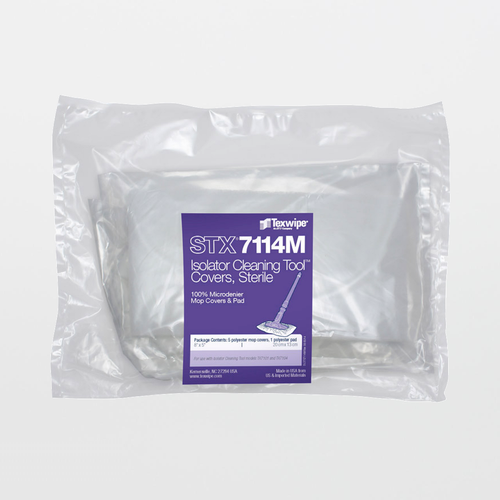
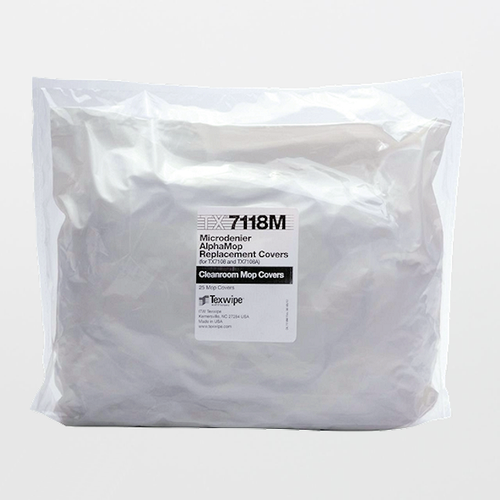
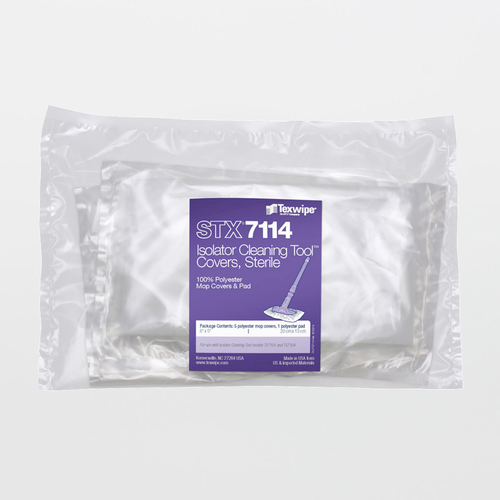
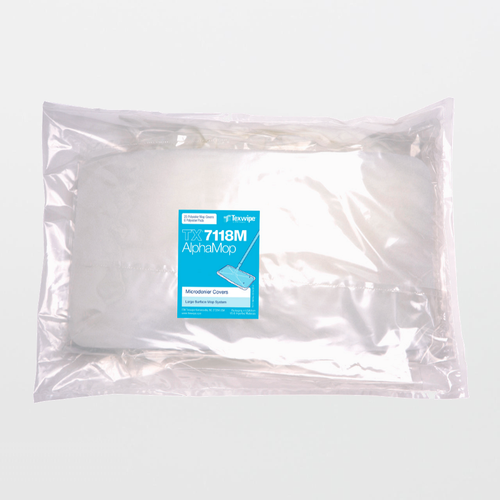
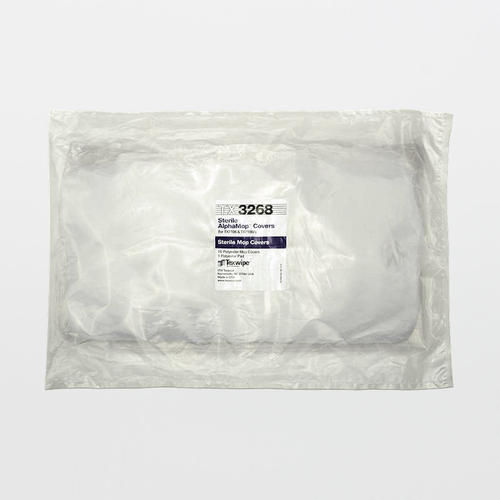
Texwipe STX7114M Mini AlphaMop™ / Isolator Cleaning Tool™ Sterile Microdenier Replacement Mop Covers (Refills)
STX7114M is a sterile, microdenier (microfiber) replacement cover set designed for the Mini AlphaMop™ / Isolator Cleaning Tool™ platform used in isolators, glove boxes, biosafety cabinets, laminar flow hoods, and other small, hard-to-reach critical zones. The microdenier knit is engineered to lift and hold fine contamination while supporting streak-free cleaning and strong sorption for common cleanroom disinfectants (including quat systems) when used with validated wipe/mop chemistry and technique.
For over 35 years, SOS and Texwipe have been close partners, and SOSCleanroom is the authorized Master Distributor of ITW Texwipe for the United States market. That relationship matters when you are standardizing cleanroom mopping systems: it supports continuity of supply, stable product lineage, and fast access to the manufacturer documentation your QA/QC team expects.
Published configuration (STX7114M)
- Product type: Dry mop covers (replacement covers / refills)
- Sterile: Yes (pre-sterilized / gamma irradiated; see documentation)
- Material: Microdenier (microfiber) cover fabric (polyester microdenier construction as published)
- Intended platform: Mini AlphaMop™ / Isolator Cleaning Tool™ system (small-area critical cleaning tool)
- Applications (as published): Isolators; small, hard-to-reach areas; glove boxes; biosafety cabinets; laminar flow hoods; workbenches
- Cleanroom environment (as published): ISO Class 3–7 (Class 1–100,000); EU Grade A–D
Low-linting performance — and the reality check
These covers are engineered for low-linting, low-residue cleaning in controlled environments. Even so, no textile or mop system is truly “lint-free.” Treat mop covers as contamination-controlled components: control how they are introduced, how they are staged, and what touches the working face before and during use.
Packaging and sterile transfer notes
Use the packout information below to align purchasing, gowning-room staging, and aseptic transfer SOPs. When counts differ by listing vs. manufacturer documentation, qualify against the documents shipped with the case (COA/processing/irradiation certificate) and your site inventory controls.
| Packout element |
Published value |
Why it matters in critical environments |
| Inner bag content |
5 covers and 1 pad per bag (manufacturer) |
Supports controlled dispensing and reduced “bag dwell time” at the hood/isolator interface. |
| Bags per case |
25 bags per case (manufacturer) |
Enables lot-controlled issuance by shift, room, or suite for deviation traceability. |
| Total per case |
Manufacturer documentation: 125 covers and 25 pads per case (25 bags of 5 covers and 1 pad).
SOSCleanroom site listing: 120 covers and 12 pads per case (12 bags of 10 covers and 1 pad). |
Counts impact cycle counts, reorder points, and batch record reconciliation. Confirm your site’s qualified packout at receiving. |
| Sterile presentation |
Sterile product with sterile validation documentation available upon request (manufacturer) |
Drives how you introduce materials into ISO 5/Grade A zones and how you document sterile status in GMP records. |
Practical cleanroom use guidance (technicians and engineers)
- Start clean, stay clean: Introduce unopened bags using your approved transfer method (pass-through, spray/wipe, or bag-in-bag-out). Do not stage open bags in uncontrolled air.
- One cover per defined task: Use a fresh cover whenever you change rooms, change chemistry, or transition from “dirty perimeter” to “critical interior” zones. Microdenier holds contamination effectively—do not push beyond SOP limits.
- Contact discipline: Maintain full-face contact without excessive pressure. High pressure can drive residues into microtexture, increase smearing, and create uneven wet films.
- Edge control: Use overlapping strokes and keep the leading edge oriented consistently. Random direction changes are a common cause of redeposition lines.
- Pad usage: Pads are designed to maintain uniform contact. Replace pads when compressed, torn, or chemically compromised (per SOP) to avoid skip marks and incomplete wetting.
- Glove control: Avoid touching the working face of the cover. If you contact the face, treat it as contaminated and change the cover to protect the process.
Compatibility and chemistry notes (as published)
- Disinfectant compatibility: Microdenier covers are published as compatible with all disinfectants, including quat-based systems (manufacturer guidance). Always verify your specific formulation under your site’s validation protocol.
- Solvent use: When solvents are used in critical areas, apply with controlled wetting—avoid oversaturation that can cause dripping, pooling, and streaks. Follow your chemical exposure, VOC, and residue limits.
- Residue management: If a disinfectant leaves film, use your approved neutralizer/rinse step (if applicable) and change covers between chemical steps to prevent cross-chemistry reactions and residue carryover.
Critical-environment reminder
In ISO/GMP spaces, the mop cover is part of the contamination-control system—not general housekeeping. Pair STX7114M with validated chemistry, defined stroke patterns, dwell-time discipline, and documented change-out rules to reduce the risk of redeposition, residue, and bioburden persistence.
Sterility, validation, and shelf-life notes (as published)
| Item |
Published detail |
Implementation tip |
| Sterilization |
Gamma irradiated to a Sterility Assurance Level (SAL) of 10−6 (manufacturer) |
Store and issue by lot; retain irradiation/processing documentation per GMP record-retention rules. |
| Certificates |
Certificates of Compliance, Analysis, and Processing/Irradiation available (manufacturer) |
For investigations, reconcile lot numbers across the case label, certificates, and batch documentation. |
| Shelf life |
Sterile: 3 years from date of manufacture (manufacturer) |
Implement FEFO (first-expire, first-out) and quarantine any compromised packaging. |
Common failure modes
- Streaking / smearing: Usually from over-wetting, poor dwell control, or reusing a cover past its loading limit. Prevent with measured wetting, defined strokes, and change-out discipline.
- Redeposition lines: Typically caused by “turning back into the clean zone” with a loaded leading edge. Prevent by maintaining a clean-to-dirty workflow and overlapping strokes.
- Residue carryover: Occurs when changing chemistries without a cover change, or when the cover contacts contaminated staging areas. Prevent by segregating chemical steps and staging in controlled packaging.
- Fiber/particle mobilization: Triggered by aggressive scrubbing on abrasive surfaces or damaged pad/cover interfaces. Prevent by inspecting pads, controlling pressure, and replacing damaged components immediately.
- Packaging compromise: Tears, seal failures, or wet-out can invalidate sterile introduction assumptions. Prevent with receiving inspection and controlled storage; quarantine suspect cases.
Storage and handling best practices
- Keep unopened bags in original case packaging until issuance to reduce handling and label damage.
- Store in a clean, dry area away from direct sunlight and chemical vapors that can degrade packaging over time.
- Use lot-controlled issuance (room/suite/shift) to support deviation investigations and traceability.
- Do not stage opened covers near floor drains, trash, or non-controlled carts where airborne transport risk is highest.
Documentation
SOS-hosted Texwipe datasheet (STX7114M):
Click HereTexwipe manufacturer TDS (Mini AlphaMop™ Series, US-TDS-068 Rev.11/21):
Click Here
If you have any questions please email us at Sales@SOSsupply.com or give us a call at (214)340-8574.
Check out the AI ChatBot powered by SOSCleanroom data libraries - give it a try!
THIS IS NEW FOR 2026!
© 2026 SOS Supply. All rights reserved.