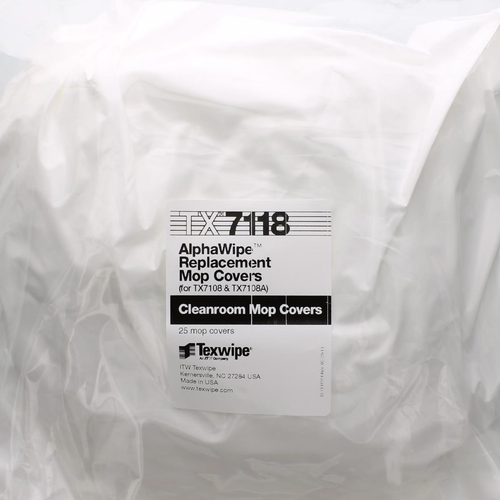
Texwipe TX1721 Revolve™ AlphaMop™ Sustainable Integrated Covers/Pads — Non-Sterile (Fits 15" x 8" Flat Mop Heads)
TX1721 is a Revolve™ AlphaMop™ cover/pad integrated mop cover designed for technician floor and surface cleaning in controlled environments where particulate, residue, and recontamination risk must be actively managed. These covers are made from 100% upcycled polyester and are intended for one-step changeover (no separate pad required), helping teams maintain disciplined “fresh surface” mopping practices while also supporting sustainability initiatives.
For over 35 years, SOS and Texwipe have been close partners, and SOSCleanroom is the authorized Master Distributor of ITW Texwipe for the United States market. That relationship matters when you are standardizing critical cleaning tools: it supports continuity of supply, stable product lineage, and faster access to manufacturer documentation and lot-support expectations your QA/QC team relies on.
Published configuration (TX1721)
- Product type: Revolve™ AlphaMop™ cover/pad integrated covers (no separate pads needed)
- Sterile/Non-sterile: Non-sterile
- Material: Revolve™ sustainable polyester; made from 100% upcycled polyester
- Fit/compatibility: Sized to fit 15" x 8" flat mop heads such as AlphaMop™ TX7108 / TX7108AH
- Inner packaging: 10 covers/bag, double-bagged
- Outer packaging: 10 bags/case
- Case quantity: 100 covers/case
- Cleanroom environment: ISO Class 3–7 (Class 1–100,000); EU Grade A–D
- Temperature guidance: Appropriate for use with temperatures less than 400°F (205°C)
- Autoclave: Autoclave safe (as published); validate under site cycle and handling discipline before standardizing for aseptic workflows
- Shelf life: Non-sterile — 5 years from date of manufacture
Low particle and low-linting performance — and the reality check
Revolve™ covers are engineered for critical cleaning with low levels of ions, non-volatile residues (NVRs), particles and fibers. Even so, no textile cleaning tool is truly “shed-free” in all conditions. Treat mop covers like contamination-controlled components: manage how they are introduced, how long they are exposed, and how consistently operators follow a single-pass, fresh-surface process.
Practical cleanroom mopping guidance (technicians and engineers)
- Fresh-surface discipline: Treat each cover as a controlled-use cleaning surface. Change covers before they “feel dirty” — the trigger should be process-defined (zone, time, or soil load), not convenience.
- One-direction passes: Use straight, overlapping strokes. Avoid back-and-forth scrubbing that can redeposit residues and drag captured particles back across the floor.
- Edge control: Keep the leading edge “clean” and avoid rolling debris into corners. If you must work edges or baseboards, do them last (or use a separate cover) to prevent cross-contamination into open floor zones.
- Wetting control (when applying solutions): Apply enough solution to keep a uniform, thin wet film — but avoid oversaturation that can cause pooling, slow dry-down, and residue streaking.
- Changeover control: Perform cover changes away from exposed product when possible. Handle the used cover as contaminated waste to avoid re-aerosolizing fines during removal.
Compatibility and wipe-down notes
- Solvent cleaning: Published for use with solvents such as isopropyl alcohol (IPA), ethanol, acetone, and degreasers. Match solvent selection to your soil chemistry and validate residue limits for your program.
- Disinfectant use: Published for applying and removing disinfectants. In sterile/aseptic areas, use a defined rotation and contact-time discipline per site CCS, and qualify the mop cover’s performance under your chosen chemistries (especially sporicidals).
- Autoclave considerations: Autoclave safe is published, but cycle conditions for the cover itself are not stated. If you intend to autoclave, qualify cover integrity (fit, sorption, shedding, and residue) post-cycle and control post-sterilization handling to prevent recontamination.
- Temperature: Appropriate for use with temperatures less than 400°F (205°C). Do not use in high-heat decon cycles unless explicitly validated for your process.
Process and contamination-control table (operator-focused)
Use this table as a practical checklist when writing or tightening a mopping SOP for critical environments.
| Control point |
What goes wrong in the real world |
How to prevent it (with TX1721) |
| Cover change frequency |
Overusing a “dirty” cover spreads a thin residue film and drags particles across zones. |
Set zone/time/soil triggers and treat covers as controlled-use. Document change points in the logbook for auditability. |
| Solution application |
Pooling, streaking, or sticky residue from overdosing or poor dry-down control. |
Use measured dispense volumes, maintain a thin wet film, and enforce contact time + dry-time before re-entry. |
| Cross-contamination between areas |
Operators carry bioburden/chemistry from “dirty” to “clean” rooms via tools and covers. |
Color-code carts/tools by area, keep covers staged by room, and do not “finish the box” in a different grade. |
| Introduction of supplies |
Outer packaging contamination transfers to operators’ gloves and then to the mop head/cover. |
Use double-bag transfer discipline; open the outer bag outside the clean zone, then introduce the inner bag per CCS. |
EU GMP Annex 1 alignment considerations (CCS-focused)
EU GMP Annex 1 emphasizes a risk-based Contamination Control Strategy (CCS) that integrates cleaning/disinfection, material transfer, and operator discipline across the facility. TX1721 can support that approach when it is embedded into a controlled mopping process (defined zones, defined changeover triggers, documented chemistry and contact times, and controlled introduction of consumables). This section is guidance only — it does not claim compliance on its own.
Common failure modes
- Streaking / residue film: Typically from overdosing disinfectant/solvent, poor overlap control, or re-wiping partially dried areas. Prevent with measured solution delivery, consistent stroke patterns, and defined dry-time discipline.
- Cross-contamination: Reusing a cover beyond its defined zone/time window or carrying covers between grades spreads particles and chemistry. Prevent with zone-based consumption rules and documented change triggers.
- Particle re-aerosolization during changeout: Snapping or shaking used covers during removal can mobilize captured fines. Prevent by slow removal, immediate containment, and changing away from exposed product when feasible.
- Static attraction (low humidity): Polyester textiles can attract fines when humidity is low. Prevent by following site ESD/humidity controls and avoiding aggressive rubbing against garments or plastic packaging.
Storage and handling best practices
- Keep covers in original double-bagged packaging until introduced into the controlled area per your CCS material transfer rules.
- Stage inner bags by room/grade to prevent mixed-area stock and reduce operator decision-making under time pressure.
- Protect from moisture and chemical vapors during storage to prevent unintended pre-exposure that can change wetting behavior and residue control.
- Track consumption by area and shift; unusual spikes often indicate rework, process drift, or poor wetting control.
Documentation
Texwipe AlphaMop™ Series Technical Data Sheet (includes TX1721 details):
Click HereTexwipe manufacturer page (TX1721 Revolve™ AlphaMop™ covers):
Click HereSOS-hosted Revolve™ TechNote (May 2020):
Click HereSOS-hosted Revolve™ Questions & Answers:
Click Here
If you have any questions please email us at Sales@SOSsupply.com
or give us a call at (214)340-8574.
Check out the AI ChatBot powered by SOSCleanroom data libraries - give it a try!
THIS IS NEW FOR 2026!
Last updated: January 9, 2026
© 2026 SOS Supply. All rights reserved.