Practical solutions in a critical environment
Kimtech 34256 Science Kimwipes are designed for delicate, light-duty wiping where the goal is clean handling, controlled usage, and reduced rework—especially around optics, labware, and sensitive electronics.
SOSCleanroom customers typically choose this format when they want a predictable, one-at-a-time wipe from a pop-up box, with a low-linting tissue that behaves gently on smooth surfaces.
Important context for critical environments: this is a lab-grade tissue wipe with “low extractables” positioning, but it is not presented as a cleanroom-validated synthetic wiper with published ionic/NVR tables.
If your process requires audit-grade extractables documentation, batch-to-batch cleanliness limits, or ISO-class cleaning validation, treat Kimwipes as a convenience wipe and validate suitability in your own quality system before adopting it into regulated steps.
What is this swab used for
While the Technical Vault “swab” template is locked, Kimtech 34256 functions as a delicate-task wiper for:
- Optics and lens-adjacent cleaning where a gentle wipe is preferred (verify your lens coating compatibility first).
- Laboratory instruments, slides, and general bench-top wipe-down of noncritical surfaces.
- Light spill pickup and dust/particle pickup in lab and electronics areas using controlled, one-at-a-time dispensing.
- General delicate wiping where portability and consumption control matter (pop-up box at point of use).
Why should customers consider this swab
- One-at-a-time dispensing helps reduce waste and discourages bare-hand “fishing” in the box.
- Low-linting tissue + low extractables positioning for delicate wiping tasks (validate for your limits).
- Gentle wipe feel intended for delicate surfaces when used wet (reduce dry-swipe abrasion risk).
- Standardized case configuration supports predictable re-ordering and stocking (see put-up in specifications).
- Portable pop-up format fits benches, carts, and instrument stations without additional dispensers.
Materials and construction
Kimtech 34256 is described as a 1-ply tissue wipe in a pop-up dispensing box. Manufacturer materials emphasize low-linting and low extractables positioning for lab and delicate wiping tasks.
The dispensing system is designed to reduce lint release and electrostatic buildup during dispensing, supporting use around sensitive work areas.
Operator reality check
Tissue-based wipes can shed fibers depending on wiping pressure, surface roughness, and whether the wipe is used dry vs. wet. If your surface is textured, sharp-edged, or particulate-sensitive,
run a quick in-house check (wipe a defined area, inspect under your normal lighting/magnification, and confirm residue behavior with your chosen solvent).
Specifications in context
These are SKU-level identifiers and logistics details that matter when you are standardizing bench stations, stocking cabinets, or writing materials lists.
If your internal documents use metric, the manufacturer lists the sheet size as 42.1 cm x 37.3 cm (equivalent class to 16.6" x 14.7").
| Attribute |
Kimtech 34256 (SKU) |
| Product name |
Kimtech Science Kimwipes Delicate Task Wipers |
| Material / ply |
1-ply tissue |
| Sheet size |
14.7" x 16.6" (also listed as 42.1 cm x 37.3 cm) |
| Color |
White |
| Dispensing format |
Pop-up box; one-at-a-time dispensing |
| Put-up / case configuration |
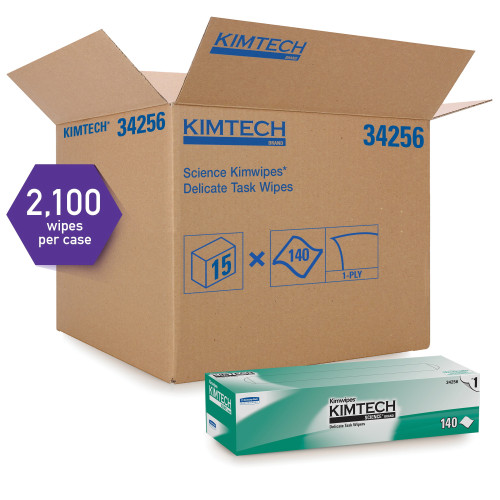
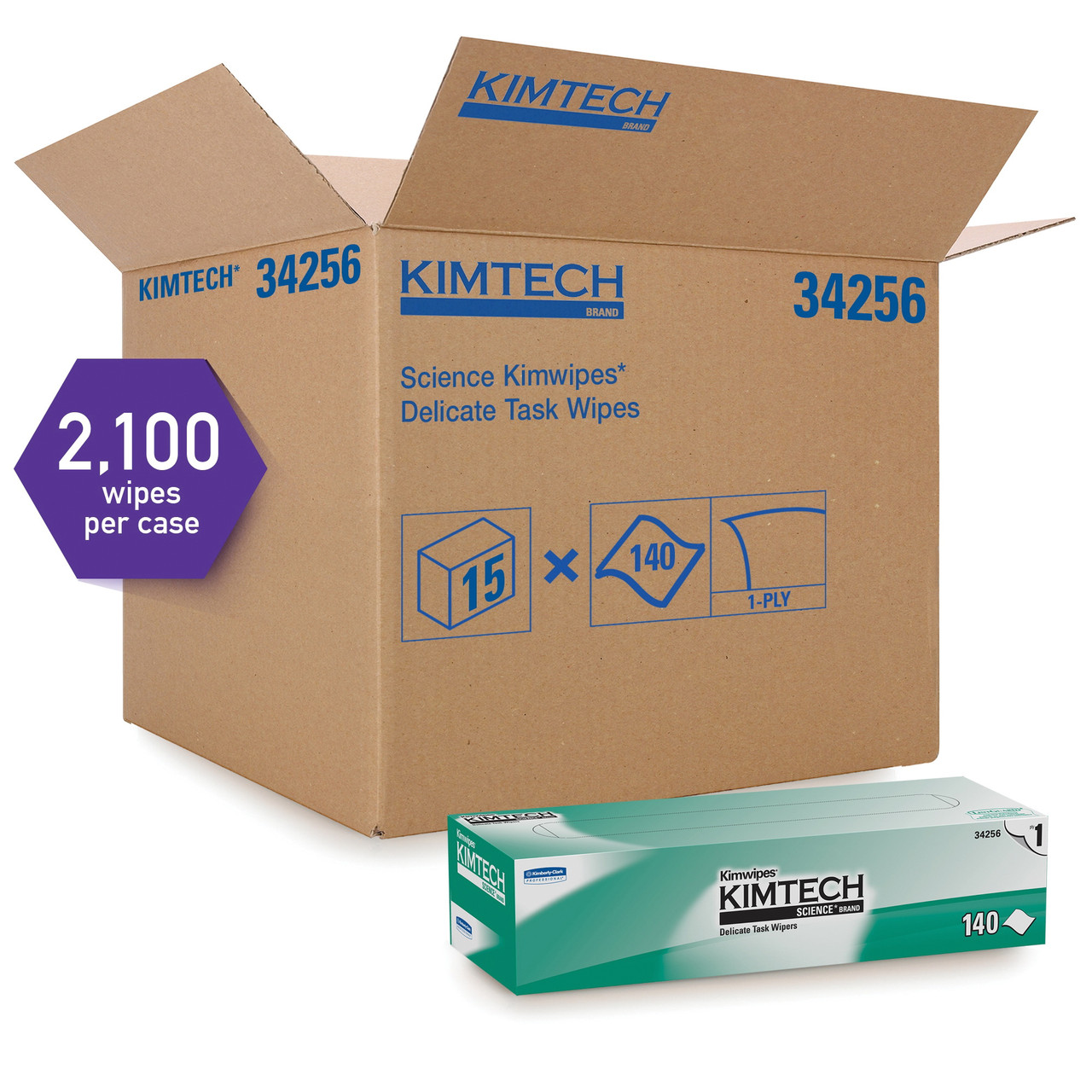
140 wipers per box; 15 boxes per case; 2,100 wipers per case |
| Manufacturer product code |
34256 |
| GTIN (manufacturer listing) |
10036000342564 |
| SOSCleanroom listing (case option) |
Available quantity option: Case |
| Shipping weight (SOSCleanroom listing) |
20.00 lbs (case) |
Cleanliness metrics
Many cleanroom-grade wipers publish typical ionic extractables and typical nonvolatile residue (NVR) to support contamination budgets.
For Kimtech 34256, the manufacturer positions the wipe as low-linting and low extractables for delicate tasks, but typical ionic/NVR tables are not published in the source basis.
If you are applying this wipe in a controlled process, treat the tables below as “not stated” and use your internal extraction method/acceptance criteria.
Typical ion extractables
| Ion |
Typical value |
Notes |
| All common ions (Na, Cl, K, etc.) |
Not published |
No typical ionic extractables table found in the source basis for this SKU. |
Typical NVR
| Solvent system |
Typical NVR |
Notes |
| Water / IPA / process solvent (your method) |
Not published |
No typical NVR table found in the source basis for this SKU. |
Packaging, sterility and traceability
- Packaging configuration: 140 sheets per box; 15 boxes per case; 2,100 sheets per case.
- Dispensing control: pop-up box; one-at-a-time dispensing to reduce waste and reduce “box rummaging.”
- Traceability identifiers (examples from manufacturer listing): Product code 34256; GTIN 10036000342564; material number 10028743; short code 34256B.
- Sterility: not stated in source basis (no terminal sterilization claim located for this SKU). If sterility is required, use a sterile-qualified wipe and confirm packaging integrity requirements in your SOP.
- Country of origin (manufacturer statement): Thailand.
Best-practice use
Kimtech 34256 performs best when you treat it as a controlled, delicate wipe—minimizing friction, minimizing re-contact, and controlling solvent load. For delicate surfaces, “wet-wipe first” is often safer than aggressive dry wiping.
Operator-level swabbing technique module
- Gloves on, clean hands: handle the wipe by edges; avoid touching the wipe face that will contact the surface.
- Control your wipe geometry: fold into a flat pad (not a crumpled ball) to reduce snagging and to keep pressure uniform.
- Wet vs. dry: if compatible, lightly wet the wipe (do not soak) to reduce friction and help capture fine residues; confirm solvent/material compatibility first.
- One direction, single pass: wipe in one direction, then refold to a fresh face; do not “scrub back and forth” if residue control matters.
- Edge discipline: on optics and polished parts, keep the fold edge off the critical zone; use the smoothest face of the folded wipe.
- End-of-use control: discard after visible loading, after rough contact, or after a solvent wipe—reusing a tissue wipe is a common contamination reintroduction pathway.
Common failure modes
- Fiber transfer on rough edges: tissue wipes can snag on burrs, threads, or sharp corners; deburr the surface or switch wipe type for that step.
- Dry-wipe micro-scratching risk: wiping dry on delicate coatings can increase abrasion potential—use a compatible wet wipe technique where appropriate.
- Over-wetting: excessive solvent load can cause streaking, residue redistribution, or long dry times; apply solvent control, not saturation.
- Re-contact contamination: refolding onto a used face or reusing a wipe spreads residue; treat each face as “one pass” for critical areas.
- Process mismatch: using a lab wipe where a validated cleanroom wipe is required can create documentation gaps (extractables/NVR) during audits.
Closest competitors
If you are staying within the Kimtech Science Kimwipes family and want to adjust durability, thickness, or sheet format, these closely adjacent options are commonly evaluated:
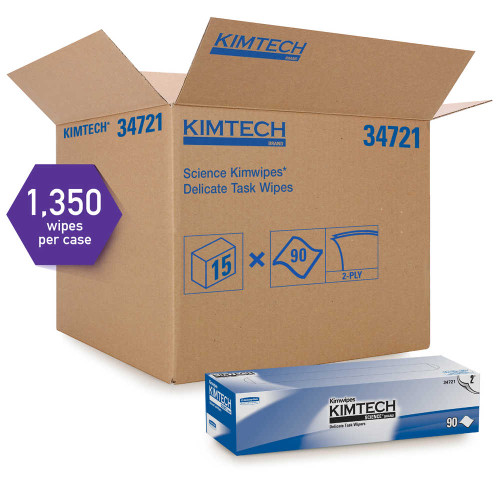
- Kimtech 34721 (2-ply Science Kimwipes, 14.7" x 16.6"): similar footprint; heavier wipe feel (SOSCleanroom related product listing).
- Kimtech 34155 (1-ply, smaller sheet format with higher box/case counts): suited to high-consumption bench stations where smaller sheets reduce waste (manufacturer “other products to consider”).
- Leading private label delicate-task wipes: typically compete on price, but can vary in fiber blend and softness; validate linting and residue behavior before substitution.
Critical environment fit for this swab
Kimtech 34256 fits best as a bench-ready, delicate-task wipe in laboratories, electronics work areas, and non-sterile support zones where controlled dispensing and low-linting behavior are valued.
It is also practical for instrument wipe-downs, lens-adjacent tasks, and general precision wiping where you want to reduce wipe overuse and keep a consistent format at point-of-use.
For higher-stringency cleanroom steps (published ionic/NVR limits, validated cleaning protocols, or documentation packages), SOSCleanroom customers often standardize cleanroom-grade wiping systems that come with stronger lot-to-lot documentation discipline.
SOSCleanroom’s long-standing relationship with ITW Texwipe supports that “audit-ready” path when your program requires it—continuity of supply, consistent product identity, and the documentation ecosystem that quality teams typically ask for.
Practical selection rule
If your acceptance criteria is “no visible lint, no streaks, and clean handling” for a lab bench or delicate surface task, Kimtech 34256 is a strong candidate.
If your acceptance criteria includes “measured ions/NVR to a limit” or “cleanroom validation documentation,” validate this wipe with your method or step up to a wiper family that publishes those metrics.
SOSCleanroom note about SOP's
The Technical Vault is written to help customers make informed contamination-control decisions and improve day-to-day handling technique.
It is not your facility’s Standard Operating Procedure (SOP), batch record, or validation protocol.
Customers are responsible for establishing, training, and enforcing SOPs that fit their specific risks, products, equipment, cleanroom classification, and regulatory obligations.
Always confirm material compatibility, cleanliness suitability, sterility requirements, and acceptance criteria using your internal quality system and documented methods.
If you adapt any technique guidance from this entry, treat it as a starting template. Your team should review and approve the final method, then qualify it for your specific surfaces,
solvents, cleanliness limits, inspection methods, and risk profile. In short: use these best-practice suggestions to strengthen your SOPs—not to replace them.
Source basis
Product and manufacturer references
- SOSCleanroom product page (Kimtech 34256): https://www.soscleanroom.com/product/ppe/kimberly-clark-kimtech-34256-1-ply-science-kimwipes-delicate-task-wipers-14-7-x-16-6/
- Manufacturer product page (Kimberly-Clark Professional / Kimtech Science Kimwipes 34256): https://www.kcprofessional.com/en-my/products/wiping-and-cleaning/controlled-environments/delicate-task-wipes/991034256/991034256
- Product specification sheet PDF copy (Kimberly-Clark Professional spec sheet; hosted by HD Supply): https://hdsupplysolutions.com/
- Additional PDF copy (legacy KCP print-style PDF; third-party host): https://www.etd.com.my/image/etd/image/data/pdf/kimberly-clark-professional-34256.pdf
- Standards/regulatory bodies (as applicable): https://www.iso.org/standard/53394.html, https://www.fda.gov/, https://www.astm.org/, https://www.iest.org/
Note: Where third-party hosts mirror manufacturer PDFs, SOSCleanroom recommends using them as reference copies and confirming critical requirements (dimensions, COO, packaging) against the manufacturer product page and your internal receiving inspection.
SOSCleanroom is the source for this Technical Vault entry.
Briefed and approved by the SOSCleanroom (SOS) staff.
If you have any questions please email us at Sales@SOSsupply.com
Last reviewed: 2026-01-06
© 2026 SOSCleanroom