Shown: Altra Disinfecting Tablets bottle image (thumbnail).
Altra NaDCC Disinfecting Tablets: Sporicidal, pH-neutral chlorine chemistry for facility-wide surface disinfection
1) Practical solutions in a critical environment
When teams need sporicidal performance without shipping and storing liquid drums, tablet-based disinfectants can simplify day-to-day execution.
In practice, these tablets are often pulled when (1) a facility is standardizing a disinfectant chemistry across multiple departments, (2) storage space is tight,
or (3) you need a repeatable “mix-to-strength” approach for sprayers, mop buckets, and wipe-down bottles.
Typical real-world scenarios include terminal cleaning of carts, pass-through interiors, door handles, and other high-touch hard surfaces; routine floor disinfection
in support areas; and quick-turn disinfection in rooms where multiple teams cycle through equipment. If your site operates under a quality system (GxP, medical device,
compounding, or regulated manufacturing), treat the dilution, labeling, contact time, and change-out rules as controlled steps—because that’s where most failures occur.
2) What this product is used for
Altra Disinfecting Tablets are dissolved in water to create a disinfecting solution for use on washable, hard, non-porous surfaces.
The manufacturer positions the chemistry for broad-spectrum disinfection and cleaning, including sporicidal performance and kill claims against organisms such as
Clostridioides difficile spores and Candida auris, plus virucidal use cases that include SARS-CoV-2 when used per label directions.
Applications include spray-and-wipe, mop-and-bucket, cloth/sponge application, and coarse trigger or mechanical sprayer use.
3) Why customers consider this product
- Space-efficient concentrate: tablets reduce storage footprint versus ready-to-use liquid disinfectants.
- EPA-registered disinfectant tablet chemistry with documented contact-time claims (per published literature/SDS/label basis).
- pH-neutral use-solution range is described as mildly acidic to neutral (often easier on many finishes than highly alkaline bleach solutions).
- No peroxyacetic acid (PAA) or liquid bleach is claimed in the product literature.
- Flexible deployment: make solution for spray bottles, mop buckets, cloth application, and coarse sprayers as needed.
- Helps standardize execution: a defined “tablet-per-volume” approach supports training and auditability.
4) Materials, composition, and build
This product is supplied as an off-white, effervescent solid tablet intended to be dissolved in water.
The Safety Data Sheet lists the primary active chemistry as sodium dichloro-s-triazinetrione (NaDCC), with additional components including adipic acid and sodium carbonate (ranges are provided on the SDS).
When dissolved, NaDCC releases hypochlorous acid (HOCl), which is the antimicrobial species also associated with bleach solutions—but with different co-products and typical use-solution pH behavior than sodium hypochlorite.
Operationally, “tablet disinfectants” succeed or fail based on three controllable variables: tablet count, water volume, and contact time.
If any of those drift, the disinfectant concentration and performance drift with them.
5) Specifications in context
| Attribute |
SKU value |
| SOSCleanroom SKU |
BE70110410 |
| Form |
Solid effervescent tablets (dissolve in water to create use-solution) |
| Solution type (site category) |
Sporicide |
| Tablet size/weight |
13.1 g tablet (published in product literature/FAQ) |
| Pack options sold on this page |
Bottle: 1 bottle (256 tablets) or Case: 2 bottles (512 tablets total) |
| Example mix strength (published) |
1 tablet per quart of water yields 4306 ppm (published in FAQ) — contact time varies by claim/organism |
| Use-solution pH behavior (published) |
Mildly acidic to neutral pH (reported as ~6–7 in FAQ) |
| EPA registration |
EPA Reg. No. 71847-7-559 (published on SDS) |
| Transport identifier (published) |
UN3077 (published on SDS) |
| Shelf life (published) |
Tablet: 2 years (published in FAQ) |
Contact time is not “one number.” It is claim-specific and depends on the target organism and concentration.
The manufacturer’s literature includes a table of pathogens with associated minimum dose (ppm) and minimum contact times; use that table and the EPA label directions when building or revising your internal method.
6) Performance and cleanliness considerations
NaDCC tablets are designed to deliver consistent available chlorine in solution when mixed correctly. The practical performance levers are:
(1) correct dilution, (2) correct wet contact time, and (3) adequate pre-cleaning when required.
The manufacturer notes that a pre-clean step is required for C. diff and biofilm disinfection claims and that testing has been conducted in the presence of soil load (see literature table notes).
Residue management matters in controlled environments. The FAQ notes a slight residue may be observed on reflective surfaces and recommends rinsing as needed and avoiding oversaturation.
In critical areas, teams commonly treat disinfection and residue control as separate steps: disinfect to the required dwell time, then follow with a compatible rinse/wipe step if residue or ionic carryover is a risk to your process or surfaces.
Compatibility and “do not mix” discipline
Chlorine-releasing chemistries require strict chemical segregation. Do not mix with acids, ammonia, or other cleaners/disinfectants unless your EHS program has formally reviewed the combination.
Use the manufacturer’s compatibility guidance and spot-test when a surface/finish is high value or hard to replace.
7) Packaging, sterility, traceability, and country of origin
- Pack sizes sold on this SOSCleanroom page: 1 bottle (256 tablets) or 2 bottles per case (512 tablets total).
- Sterility: Not stated on the SOSCleanroom product page or the referenced product literature/FAQ/SDS as a sterile product.
- EPA registration: EPA Reg. No. 71847-7-559 is published on the SDS; use the EPA label as the controlling document for claims and directions.
- Country of origin: The product label image on the SOSCleanroom page displays “Made in Ireland.” The SDS lists the manufacturer address as Wexford, Ireland.
- Receiving/QA cues: On receipt, document bottle integrity (cap/seal), confirm lot/expiry markings are present and legible, and verify the product identifier matches your approved list (especially if you control disinfectants by EPA Reg. No.).
8) Best-practice use
Below is a practical mixing-and-application playbook used by many contamination-control teams. Treat it as training guidance to adapt into your internal method.
Your label directions, risk assessment, and quality system control the final process.
- Pick the target concentration and dwell time first. Select the organism claim you need and set dilution and contact time to match that claim (do not “assume it’s all the same”).
- Use a measured container. Graduated bottles and marked mop buckets prevent the #1 failure mode: “eyeballed volume.”
- Add cold or slightly warm water, then tablets. The FAQ recommends avoiding hot water and indicates typical dissolve time of ~4–5 minutes.
- Allow off-gassing during dissolution. Keep the lid off while the tablet dissolves; cap only after fully dissolved and the solution is ready to deploy.
- Label the bottle/bucket. Include chemical name, concentration (ppm or tablet-per-volume), prep date/time, preparer initials, and discard time per your program.
- Apply “wet enough” to hold the surface wet for the full dwell time. If the surface dries early, you did not achieve the required contact time—reapply and restart the dwell timer.
- Control wipe technique. Use a single-direction wipe, overlap strokes, and rotate to a clean side frequently. For high-risk touch points, avoid re-dipping a used cloth into the main container.
- Rinse as needed for residue-sensitive areas. If residue is observed or your process cannot tolerate ionic carryover, follow with a compatible rinse/wipe step after disinfection dwell time is met.
9) Common failure modes
- Wrong dilution: “Close enough” volumes lead to under-strength solutions and missed claims.
- Short dwell time: Wiping dry too quickly is a routine compliance gap—especially on warm, high-airflow surfaces.
- Hot-water mixing: Using hot water can work against the manufacturer’s recommended dissolution approach and may increase off-gassing during prep.
- Sealing during dissolution: Capping the container while tablets are dissolving traps gases and can create messy (and unsafe) pressure/venting events.
- Chemical incompatibility or unsafe mixing: Combining chlorine chemistries with other cleaners/disinfectants without EHS review is a serious hazard.
- Residue left unmanaged: Oversaturation and “one pass and done” technique can leave film on reflective or residue-sensitive surfaces.
10) Closest competitors
Selection is usually chemistry-driven (chlorine donor tablets vs. liquid bleach vs. peroxides/quats) and execution-driven (space, training, residue tolerance, and required kill claims).
Common alternatives customers evaluate in this tablet/disinfectant class include:
- Texwipe TexTab TX6460 (tablet-based sporicidal disinfectant option sold on SOSCleanroom; compare label claims, tablet strength, residue profile, and handling controls).
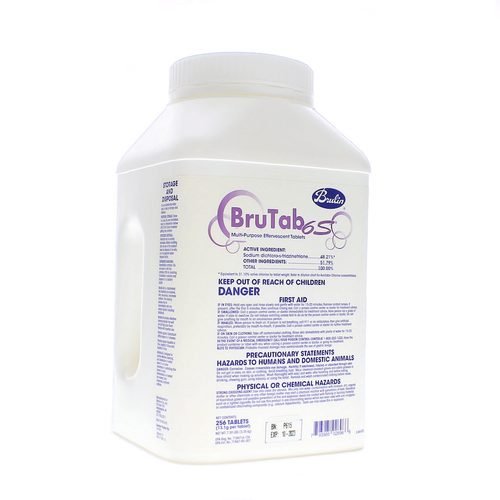
- Brulin BruTab 6S (tablet-based disinfectant option sold on SOSCleanroom; compare mix instructions and claim set).
- Liquid sodium hypochlorite (bleach) solutions (common baseline; typically higher pH and more aggressive on some finishes—compare compatibility, odor, and program controls).
11) Critical environment fit for this product
These tablets are commonly positioned for healthcare hard-surface disinfection, and the published literature includes broad claims across bacteria, viruses, fungi/yeast, and spores.
In controlled environments, fit typically depends on your residue tolerance, surface compatibility, and your ability to control dilution and dwell time.
If you run a validated cleaning/disinfection program, consider adding a simple verification control (for example: measured volumes, documented tablet count, and a defined change-out schedule).
For specialized applications such as hazardous drug deactivation/decontamination workflows, the FAQ references NaDCC chemistry in the context of USP 800 consensus discussions.
If your operation is regulated, confirm the method and acceptance criteria through your internal quality system and safety program before standardizing the chemistry.
12) SOSCleanroom note about SOP's
The Technical Vault is written to help customers make informed contamination-control decisions and improve day-to-day handling technique.
It is not your facility’s Standard Operating Procedure (SOP), batch record, or validation protocol.
Customers are responsible for establishing, training, and enforcing SOPs that fit their specific risks, products, equipment, cleanroom classification, and regulatory obligations.
Always confirm material compatibility, cleanliness suitability, sterility requirements, and acceptance criteria using your internal quality system and documented methods.
If you adapt any technique guidance from this entry, treat it as a starting template. Your team should review and approve the final method, then qualify it for your specific surfaces,
solvents, cleanliness limits, inspection methods, and risk profile. In short: use these best-practice suggestions to strengthen your SOPs—not to replace them.
13) Source basis
SOSCleanroom is the source for this Technical Vault entry.
Briefed and approved by the SOSCleanroom (SOS) staff.
If you have any questions please email us at Sales@SOSsupply.com
or give us a call at (214)340-8574.
Last reviewed: Jan. 8, 2026
© 2026 SOSCleanroom