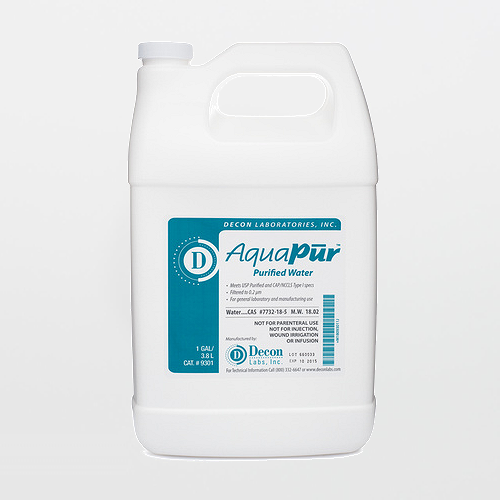
Decon AquaPur purified water, 1 gallon bottle.
Practical solutions in a critical environment
Water is an easy place for contamination programs to drift: a jug gets opened too often, caps touch gloves, a “clean” pour spout lives in a drawer, or a rinse step quietly becomes a particle and endotoxin risk.
AquaPur 9301 is positioned for operations that need a published, compendial-targeted purified water profile and repeatable handling in day-to-day lab and manufacturing workflows.
It is packaged for point-of-use, and the manufacturer states it is intended for manufacturing and general laboratory use (not sterile irrigation, injection, infusion, or parenteral administration).
What this product is used for
- Processes requiring purified water that is published as meeting USP/EP specifications for purified water applications (manufacturer-positioned).
- Controlled rinsing, dilution, and prep steps where a consistent purified water baseline helps reduce variability in conductivity, TOC, and bioburden targets (as defined by your quality system).
- General laboratory and production applications where point-of-use packaging reduces handling exposure versus shared reservoirs or open carboys.
Why customers consider this product
- Published specification targets tied to USP/EP test methods (e.g., USP <645> conductivity, USP <643> TOC, and USP/EP microbial contamination limit).
- Manufacturing method described as deionization, reverse osmosis, UV treatment, and ultrafiltration.
- Point-of-use 1-gallon packaging supports practical segregation (e.g., “open bottle” control, dedicated areas, and reduced cross-contact).
- Not regulated for transport per the published SDS, simplifying inbound receiving and internal movement.
Materials, composition, and build
AquaPur is described by the manufacturer as purified water produced using deionization, reverse osmosis, UV treatment, and ultrafiltration.
The SDS lists the composition as water (95–100%). The package format for 9301 is a 1-gallon container, sold as 4 bottles per case on SOSCleanroom.
If your application is sensitive to extractables or leachables, treat the container as part of your qualification: confirm container resin, closure compatibility, and any required documentation in your receiving checklist (not published in the source basis for this listing).
Specifications in context
Use these published attributes as a starting point, then align acceptance criteria to your internal specifications and the actual use step (final rinse, dilution, buffer prep, or general lab use).
| Attribute |
AquaPur 9301 |
| Manufacturer / Part No. |
Decon Laboratories, Inc. / 9301 |
| Solution type |
Purified Water |
| Package size / case quantity |
1 gallon bottle / 4 per case |
| Shelf life (published) |
2 years |
| USP water conductivity (published) |
USP <645>: < 1.3 µmhos/cm (at time of manufacturing) |
| Total organic carbon (published) |
USP <643>, EP: < 0.50 ppm |
| Microbial contamination (published) |
USP/EP harmonized: < 100 cfu/mL |
| Handling / storage note (published) |
Store at room temperature |
Performance and cleanliness considerations
In practice, purified water is only as “clean” as the last handling step. Even when a water spec is strong on paper, contamination can be introduced by caps, funnels, shared tubing, or leaving containers open during staging.
The manufacturer publishes USP/EP-aligned targets for conductivity, TOC, and microbial contamination, and notes the specification is maintained through the stated shelf life.
If your process is sensitive to ions, TOC, or microbiological control, treat the bottle as a controlled component: define how long an opened bottle may be used, how it is labeled, and what conditions trigger discard.
Receiving and QA cues that prevent surprises
- Verify the correct part number (9301) and that the case count matches “4 x 1 gallon.”
- Inspect the closure integrity: no cracked caps, no wet cartons, no evidence of freezing/overheating.
- Pull the current SDS/TDS and archive them with your batch/lot receiving record.
- If your program requires it, obtain lot-specific documentation (e.g., COA) directly from the manufacturer’s documentation portal.
Packaging, sterility, traceability, and country of origin
- Packaging: Case unit is four (1 gallon) bottles per case (published on SOSCleanroom).
- Sterility: Not stated as sterile for 9301; if sterility is required, do not assume—select a sterile purified water product with published sterile packaging and documentation.
- Traceability: The manufacturer maintains a documentation ecosystem (including COA availability by lot). Integrate lot capture into your receiving practice when required.
- Country of origin: Not published in the source basis for this listing. The SDS lists the supplier address as King of Prussia, Pennsylvania, USA, but country of origin is not explicitly stated.
- Transport: SDS lists the product as not regulated for transportation.
Best-practice use
The fastest way to degrade a purified water step is casual dispensing. Use a simple “open, pour, close, label” discipline that matches your risk.
These practices reduce recontamination without adding process friction:
- Cap control: Never place the cap on a bench. Hold it (interior facing down and protected) or use a clean, dedicated cap rest inside the controlled area.
- Pour technique: Pour without letting the bottle lip touch receiving vessels, funnels, or glove surfaces. If contact occurs, treat the bottle as potentially compromised per your SOP.
- Dedicated dispensing: If you must use a pump or spigot, dedicate it to the bottle and area, and define cleaning/replace intervals. Shared pumps are a common cross-contamination path.
- Open-bottle time limit: Define “opened on” labeling and a maximum use window based on your microbial/chemistry risk (not published; must be set internally).
- Segregation: Keep water for final rinse or higher-critical steps physically separated from water used for general rinse-down or utility tasks.
- Storage: Store at room temperature as stated in the SDS. Avoid heat sources and direct sunlight that can accelerate microbial growth once opened.
Common failure modes
- Using purified water as a “sterile water substitute” in steps that require sterile irrigation/injection/infusion or parenteral-grade water (explicitly not intended per manufacturer documentation).
- Leaving caps off during staging or line clearance, increasing airborne bioburden and particulate exposure.
- Using shared funnels, tubing, or transfer devices without defined cleaning controls.
- Lack of an opened-bottle time limit, leading to “mystery jugs” that sit through multiple shifts.
- Assuming container/closure compatibility for sensitive processes without qualification (extractables/leachables and closure cleanliness are not stated in the source basis).
Closest competitors
Competitor selection should be driven by the same core questions: published compendial targets, packaging discipline, available documentation (TDS/SDS/COA), and how the product behaves in your actual handling workflow.
Common alternatives customers evaluate in this category include other USP/EP-grade purified water suppliers offered in comparable 1-gallon case formats, as well as validated in-house purified water systems where point-of-use controls are robust.
Critical environment fit for this product
AquaPur 9301 fits programs that need a published, compendial-targeted purified water profile in a manageable, point-of-use container for manufacturing and general laboratory workflows.
If your environment requires sterile water or a validated sterile transfer presentation, select a sterile purified water option with explicit sterile claims and packaging controls.
SOSCleanroom has been a distributor of Decon for over 10 years supporting cleanrooms across the United States—customers typically choose Decon when they want practical packaging, dependable documentation, and consistency that holds up under audit questions.
SOSCleanroom note about SOP's
The Technical Vault is written to help customers make informed contamination-control decisions and improve day-to-day handling technique.
It is not your facility’s Standard Operating Procedure (SOP), batch record, or validation protocol.
Customers are responsible for establishing, training, and enforcing SOPs that fit their specific risks, products, equipment, cleanroom classification, and regulatory obligations.
Always confirm material compatibility, cleanliness suitability, sterility requirements, and acceptance criteria using your internal quality system and documented methods.
If you adapt any technique guidance from this entry, treat it as a starting template. Your team should review and approve the final method, then qualify it for your specific surfaces,
solvents, cleanliness limits, inspection methods, and risk profile. In short: use these best-practice suggestions to strengthen your SOPs—not to replace them.
Source basis
- SOSCleanroom product page: https://www.soscleanroom.com/product/solutions/aquapur-9301-purified-water-1-gallon-bottle-4-case/
- Manufacturer product page (Decon Labs): https://deconlabs.com/products/purified-water-aquapur/
- SOS-hosted Technical Data Sheet (primary stable copy): “Purified Water — AquaPur™ Tech Sheet” (Rev. 07/2021): https://www.soscleanroom.com/content/Decon_pdf/AquaPur%20Tech%20Sheet.pdf
- Manufacturer Technical Data Sheet: “Purified Water — AquaPur™ Tech Sheet” (Rev. 07/2021): https://deconlabs.com/tds/AquaPur%20Tech%20Sheet.pdf
- SOS-hosted Safety Data Sheet (primary stable copy): “AquaPur Purified Water — Safety Data Sheet (SDS)” (Date of Revision: 12/31/2024R): https://www.soscleanroom.com/content/Decon_pdf/AquaPur%20SDS.pdf
- Manufacturer Safety Data Sheet: “AquaPur Purified Water — Safety Data Sheet (SDS)” (Date of Revision: 12/31/2024R): https://deconlabs.com/sds/AquaPur%20SDS.pdf
- Standards/regulatory reference hubs (as applicable): https://www.iso.org/standard/53394.html, https://www.fda.gov/, https://www.astm.org/, https://www.iest.org/
SOSCleanroom is the source for this Technical Vault entry.
Briefed and approved by the SOSCleanroom (SOS) staff.
If you have any questions please email us at Sales@SOSsupply.com
Last reviewed: January 8, 2026
© 2026 SOSCleanroom