Reducing Residue and Re-Deposit During Routine 70% IPA Cleanroom Wipe-Downs
The Technical Vault
By SOSCleanroom
ISO 14644-5 Operations
70% IPA Method Control
Damp-Film Technique
Operator Technique Control
Residue & Rework Reduction
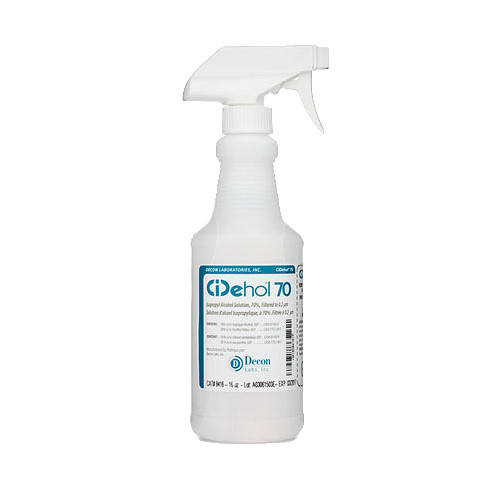
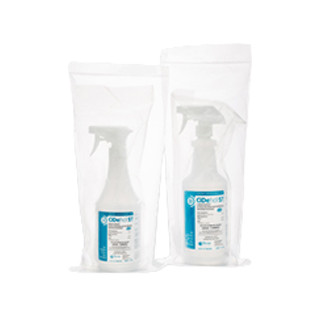
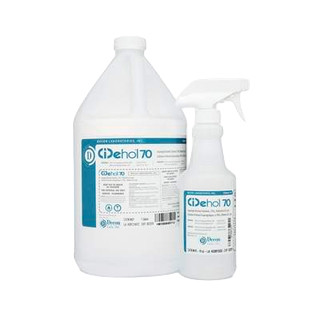
Cidehol 8416 Non-Sterile 70% IPA (16 oz) — what this solution is intended to control
Cidehol 8416 is a non-sterile 70% isopropyl alcohol (IPA) solution supplied in a
16 oz container for routine cleanroom wipe-down and surface cleaning. It is commonly used to remove
light organic residues, fingerprints, and particulate films when paired with disciplined wiping
technique and cleanroom-compatible applicators.
In controlled environments, 70% IPA performance is defined primarily by method control:
wetness target (damp film vs. flooding), wipe direction, clean-face rotation, and change-out rules.
Failures such as streaking, haze, and residue re-deposit usually originate from over-wetting,
backtracking, or reusing a solvent-loaded wipe, not from the chemistry concentration alone.
ISO- and USP-aligned context for 70% IPA wipe-downs
ISO 14644-5 emphasizes that cleaning and disinfection practices are operational controls that must be
standardized and executed consistently to maintain cleanroom conditions. USP <797> and <800>
reinforce similar concepts in pharmaceutical environments: surface cleaning and disinfection depend on
repeatable technique, defined frequency, and documentation to prevent method drift and cross-contamination.
Although Cidehol 8416 is non-sterile and intended for non-sterile cleanroom operations, the discipline
required to achieve repeatable results (wetness control, wipe pattern control, and operator contamination
control) is the same principle applied in higher-criticality programs.
Technical data summary (reference — consult current manufacturer SDS/TDS for controlled programs)
| Chemical composition |
70% IPA / 30% purified water (typical) |
| Sterility |
Non-sterile |
| Container size |
16 oz |
| Intended use |
Routine cleanroom wipe-down and surface cleaning |
| EHS note |
Flammable liquid — follow SDS, ignition control, and ventilation rules |
Controlled-program reminder: For validated or defect-sensitive environments, always reference the
current manufacturer SDS/TDS for composition, filtration, packaging controls, and use limitations.
Best-practice 70% IPA wipe-down method (operator-procedure level)
Best practice for 70% IPA wipe-down begins with controlling wetness. In most cleanroom methods, IPA should be
applied to the wiper or swab rather than sprayed directly onto the surface. This reduces uncontrolled pooling,
prevents solvent migration into seams and interfaces, and makes it easier to maintain a damp-film condition.
Operators should target “damp, not flooded,” where the applicator is wet enough to mobilize contamination but
does not drip or leave standing liquid.
Wiping should be performed using straight, overlapping strokes in one direction. Circular scrubbing and
backtracking increase redeposit risk by spreading dissolved contamination. Wipers should be folded consistently
and rotated to a clean contact face after each pass. Applicators should be discarded and replaced as soon as
they become visibly loaded, tacky, lose structure, or begin leaving streaks.
For residue-sensitive work, a two-step approach is commonly used: a first damp pass to mobilize residues followed
by a second clean pass to remove dissolved material before it dries into a film. These controls should be written
into the site SOP and reinforced through training to reduce shift-to-shift variability.
Typical cleanroom failures & how to avoid them (ISO & USP perspective)
- Over-wetting surfaces: Causes pooling and residue re-deposit. Prevention includes damp-film control and dispensing IPA to the applicator (ISO 14644-5; USP <797>).
- Backtracking over cleaned areas: Re-deposits dissolved contamination. Prevention includes one-direction wiping and defined stroke patterns (ISO 14644-5).
- Reusing solvent-loaded wipes: Smears contamination instead of removing it. Prevention includes face-rotation rules and early change-out triggers (ISO 14644-5).
- Using non-cleanroom gloves: Introduces particles and residues that negate cleanroom wiper performance. Prevention includes cleanroom-qualified gloves and glove-change discipline (ISO 14644-5 personnel controls).
- Using non-sterile IPA in sterile workflows: Creates regulatory non-conformance. Prevention includes selecting sterile IPA when sterility is required (USP <797> / <800>).
Suggested companion products and technical rationale
SOSCleanroom suggests the following companion products based on cleanroom compatibility, published performance
characteristics, and their ability to support consistent 70% IPA technique. The goal is to reduce operator-driven
variability and prevent common wipe-down failures such as re-deposit, streaking, and localized contamination migration.
-
Texwipe TX1009 AlphaWipe® (polyester cleanroom wiper): Continuous-filament polyester construction supports low lint contribution and predictable absorbency, enabling damp-film technique and consistent fold/rotation practices. A 9" x 9" format supports standardized wipe patterns in SOPs.
-
Texwipe TX761 Alpha® Long-Handle Swab (polyester knit): Used for localized cleaning in seams, grooves, and interfaces where a flat wipe cannot maintain controlled contact. Thermal bond construction (no adhesive) reduces contamination variables in solvent-heavy work and the long handle reduces glove intrusion near critical surfaces.
-
Ansell 93-311 Nitrilite® Cleanroom Nitrile Gloves (ISO 5): Gloves are often the dominant contamination vector during wipe-down operations. Cleanroom-qualified nitrile gloves reduce operator-introduced particles and residues and help preserve the contamination-control intent of cleanroom wipers and swabs.
-
Why a 16 oz format is used: A smaller bottle format supports point-of-use control and reduces repeated pouring/transfer steps that can introduce contamination. It also supports standardized wetness application to wipes/swabs when used as a controlled dispensing source.
Process control tip: If your facility refills dispensers, treat refill as a controlled operation:
label secondary containers, control bottle exposure time, and capture lot/expiration where required by SOP.
Disclaimer
This Technical Vault content is provided for general operational guidance and procurement planning only.
It does not replace facility SOPs, validation protocols, quality risk assessments, or manufacturer documentation.
Always follow applicable ISO standards, USP chapters, SDS instructions, and site-specific procedures. Cidehol 8416 is non-sterile;
if sterility is required, select chemistry packaged and documented for sterile workflows and follow facility transfer procedures.
Questions? Email Sales@SOSsupply.com or call (214) 340-8574.
© 2026 SOSCleanroom. All rights reserved.