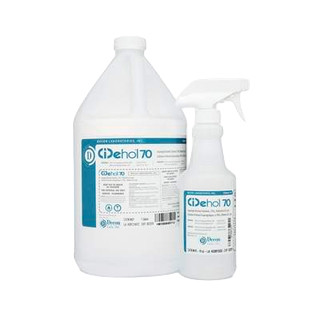
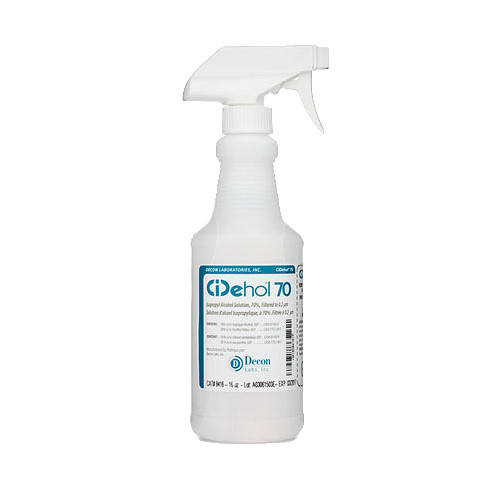
CiDehol ST 8301 Sterile 70% Isopropyl Alcohol Solution (1 Gallon Bottle, 4/Case)

$273.35
(No reviews yet)
SKU:
8301
Availability:
Stock Item
Shipping:
Calculated at Checkout
Solution Type:
70% Isopropyl Alcohol
Sterile:
Yes

CiDehol ST 8301 Sterile 70% Isopropyl Alcohol (IPA) Solution — 1 Gallon Bottles (4/Case)

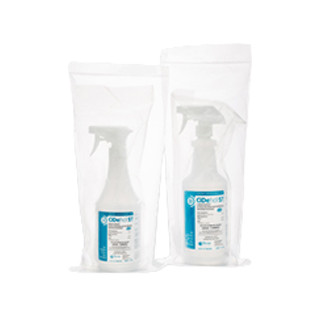
CiDehol ST 8301 is a sterile, ready-to-use 70% isopropyl alcohol (IPA) / 30% Water-for-Injection (WFI) solution designed for sterile cleanroom cleaning and disinfection. It is 0.2 µm filtered, bottled and individually double-bagged in a cleanroom, then gamma-irradiated to a sterility assurance level (SAL) of 10-6. Each case is shipped with lot-specific documentation supporting QC, irradiation, sterility testing, and bacterial endotoxin limits.

Hazmat / shipping note: This item is considered a hazardous shipment. Ground shipping only, commercial address only, and a $35.00 Hazmat charge per case is added to shipping for each package/case.

Specifications:
  • Product / SKU: CiDehol ST 8301
  • Format: Sterile, ready-to-use alcohol solution (no dilution required)
  • Concentration: 70% Isopropyl Alcohol, USP (v/v) / 30% Water-for-Injection (WFI), USP (v/v)
  • Filtration: Filtered to 0.2 µm
  • Sterility assurance: Gamma-irradiated to SAL 10-6
  • Packaging discipline: Bottled and individually double-bagged within a cleanroom
  • Endotoxin control: Lot tested for bacterial endotoxin via LAL; WFI endotoxin criterion stated as < 0.25 EU/mL
  • Sterility testing: USP 14-day sterility test (lot testing)
  • EPA registration: EPA Reg. No. 56753-1
  • Pack size: Four (1 Gallon) bottles per case
  • Typical shelf life: 2 years (see product label/expiration date)
  • Case weight (shipping weight): 33.00 lbs
About Decon Laboratories:

Decon Laboratories Inc. produces CiDehol ST as a sterile alcohol solution for controlled environments in pharmaceutical, biotechnology, and medical device facilities and other sterile/aseptic operations where a non-pyrogenic alcohol solution is required. The product positioning emphasizes process control: WFI-grade water content, 0.2 µm filtration, cleanroom bottling and double-bagging, and terminal gamma irradiation.


SOSCleanroom has been a distributor of Decon for over 10 years supporting cleanrooms across the United States. We help contamination-control teams standardize replenishment, keep documentation aligned to internal quality requirements, and maintain dependable supply for critical cleaning and disinfection workflows.

Key features that matter in cleanrooms:
  • WFI-based formulation: 70% IPA (USP) blended with 30% Water-for-Injection (USP) for controlled, repeatable chemistry.
  • 0.2 µm filtration: Supports particulate control expectations for sterile-area cleaning steps.
  • Terminal sterility assurance: Gamma-irradiated to SAL 10-6 for sterile area use.
  • Double-bag packaging: Supports cleaner staging and transfer into higher-grade areas per site SOP.
  • Case-level documentation: Lot-specific paperwork accompanies each case to support QA review and traceability.
Where this 1-gallon sterile IPA is commonly used:
  • Routine sterile cleanroom wipe-downs of benches, carts, fixtures, and equipment exteriors (per SOP).
  • Spray-and-wipe cleaning steps where sterile alcohol is required for process consistency and documentation alignment.
  • Cleaning support in isolators, sterile and controlled areas, gowning rooms, and process lines (as allowed by site procedure).
  • Applications requiring sterile, non-pyrogenic alcohol solution chemistry for regulated environments.
Best-practice use (operator-focused):
  • Pre-clean heavy soil first: Remove gross contamination before applying alcohol to avoid spreading residues.
  • Keep surfaces wet for the required time: If the step is disinfection/sanitation (not just cleaning), follow your site contact-time requirements and ensure the surface stays visibly wet for the full interval.
  • Use clean wiping technique: Fold wipers to present fresh faces; use straight-line strokes; do not “scrub back and forth” over already-cleaned zones.
  • Compatibility check: Verify surface/material compatibility (polymers, coatings, printed labels) and any residue/streaking criteria in your SOP.
  • Flammability controls: Keep away from ignition sources; ensure ventilation meets your site safety requirements.
Efficacy / contact time notes (from manufacturer sheet):

CiDehol ST is described as an EPA-registered disinfectant/sanitizer with stated contact (dwell) times depending on organism and claim. Always follow your site SOP and the most current manufacturer labeling for required wet-contact time, application method, and change-out frequency.

  • 5 minutes: Sanitizing contact time for Staphylococcus aureus (ATCC 6538); also noted for Enterobacter aerogenes (ATCC 13048) sanitizing.
  • 10 minutes: Disinfecting contact time for Staphylococcus aureus (ATCC 6538), Salmonella enterica (ATCC 10708), and Pseudomonas aeruginosa (ATCC 15442).

Documentation (TDS / SDS):
  • DeconLabs Technical Data Sheet (CiDehol ST 70 WFI): Click Here
  • SOS-hosted Technical Data Sheet copy: Click Here
  • DeconLabs Safety Data Sheet (CiDehol ST): Click Here
  • SOS-hosted Safety Data Sheet copy: Click Here

Operational note: For sterile areas, align your alcohol chemistry, contact time, wiping technique, and documentation retention (lot paperwork) to your internal cleaning/disinfection SOP and quality requirements. If you need help selecting sterile vs. non-sterile alcohols, package sizes, or documentation expectations for audits, SOSCleanroom can assist.

Product page updated: Jan. 8, 2026 (SOS Technical Staff)

If you have any questions please email us at Sales@SOSsupply.com or give us a call at (214)340-8574.

© 2026 SOS Supply. All rights reserved.

The Technical Vault
By SOSCleanroom
Decon Labs | Sterile 70% IPA (WFI)
0.2 µm filtered • Double-bagged • Gamma irradiated (SAL 10⁻⁶)
Hazmat: Ground shipping only • Commercial address only
CiDehol® ST 8301 Sterile 70% Isopropyl Alcohol Solution — 1-gallon bottles (4/case) for aseptic cleaning and disinfection workflows
SOSCleanroom has been a distributor of Decon for over 10 years supporting cleanrooms across the United States.
CiDehol ST 8301 Sterile 70% Isopropyl Alcohol Solution (1 Gallon Bottle, 4/Case)
Product image from SOSCleanroom listing.
1) Practical solutions in a critical environment

In ISO-classified and aseptic processing areas, 70% isopropyl alcohol remains a daily workhorse for fast turn cleaning, routine disinfection, and final wipe-down before operations resume. The practical risk is not “whether IPA works” — it is whether teams can keep the workflow sterile and consistent (no non-sterile decanting, no touch contamination of sprayers, no improvised contact-time habits, and no missing traceability during audits).

CiDehol® ST is positioned for sterile cleanroom cleaning and disinfection use: a sterile, ready-to-use 70% (v/v) USP isopropyl alcohol solution made with Water-for-Injection (WFI), filtered to 0.2 µm, double-bagged, and gamma irradiated. It is manufactured and packaged with documentation discipline intended to support controlled programs.

2) What this product is used for
  • Sterile wipe-down of benches, carts, stainless, pass-through surfaces, and non-porous equipment exteriors in controlled environments.
  • Routine disinfection steps in pharmaceutical, biotechnology, and medical device cleanroom operations where sterile alcohol is required.
  • Final “reset” wipe after detergent cleaning, before setup, staging, or material transfer into higher-grade areas.
  • Programs needing lot-linked documentation covering QC, irradiation, sterility testing, and bacterial endotoxin limits.
3) Why customers consider this product
  • Sterile, ready-to-use formulation: no mixing or in-house filtration steps that can introduce variability.
  • WFI-based blend and filtration: described as made with Water-for-Injection (WFI) and filtered to 0.2 µm.
  • Gamma irradiation sterility assurance: documented SAL 10⁻⁶; double-bagged to support clean introduction.
  • Endotoxin discipline: manufacturer documentation states endotoxin is guaranteed to be <0.25 EU/mL (WFI criterion).
  • Lot-specific traceability: each case is shipped with documentation detailing QC, irradiation, sterility, and bacterial endotoxin limits.
  • Operational realities covered: Hazmat ground-only shipping and commercial-address requirements align with flammable liquid controls and compliance expectations.
4) Materials, composition, and build

CiDehol® ST is a 70% (v/v) USP isopropyl alcohol solution formulated with high-purity water (WFI per manufacturer documentation). The solution is processed through 0.2 µm filtration, then bottled and double-bagged in a cleanroom environment and terminally sterilized by gamma irradiation.

  • Alcohol content: 70% isopropyl alcohol, USP (v/v).
  • Water content: WFI per manufacturer technical data sheet; SOSCleanroom ingredient line lists purified water, USP.
  • Sterility processing: gamma irradiated to SAL 10⁻⁶; double-bagged for cleaner transfer.
  • Safety profile (SDS): flammable liquid and vapor; causes skin and eye irritation; handle with appropriate PPE and ventilation.
5) Specifications in context
Attribute CiDehol ST 8301
Brand / Manufacturer Decon Laboratories (Decon Labs)
SOS SKU 8301
Solution type (SOS listing) 70% Isopropyl Alcohol
Alcohol concentration 70% (v/v) USP isopropyl alcohol
Water grade Water-for-Injection (WFI) per manufacturer technical data sheet; SOSCleanroom ingredient line lists purified water, USP
Filtration 0.2 µm filtered
Sterility / processing Gamma irradiated to SAL 10⁻⁶; bottled and double-bagged in a cleanroom
Endotoxin control (manufacturer documentation) Guaranteed <0.25 EU/mL (WFI criterion); endotoxin testing referenced
Sterile status (SOS listing) Yes
Pack configuration Four (1 gallon / 3.8 L) bottles per case
Availability (SOS listing) Stock Item
Weight (SOS listing) 33.00 lbs (case)
Hazmat shipping controls (SOS listing) Ground shipping only; commercial address only; $35.00 Hazmat fee per case added to shipping
EPA registration (manufacturer/SOS description) EPA-registered disinfectant; EPA Reg. No. 56753-1 (see manufacturer technical data sheet)
Why these specs matter on the floor

Sterile alcohol programs often fail due to process drift: staff top off bottles, decant into unqualified containers, reuse sprayers, or lose lot traceability. A documented sterile supply chain (0.2 µm filtration, cleanroom packaging, gamma irradiation, and case-level documentation) helps quality teams reduce variability, tighten receiving checks, and defend routine disinfection steps during audits.

6) Performance and cleanliness considerations

70% IPA is widely used because it evaporates quickly and, when properly applied, supports effective routine disinfection on non-porous surfaces. It is not a sporicide, so high-performing programs typically use sterile IPA as a frequent “daily driver” while rotating in an appropriate sporicidal disinfectant per facility risk and regulatory expectations.

  • Coverage beats speed: incomplete wetting and “spray-and-wave” habits leave untreated islands that become recontamination sources.
  • Contact time is still real: even fast-evaporating alcohol needs a deliberate, wet contact interval on the surface to be meaningful.
  • Bioburden and soil load matter: if a surface has visible residue, clean first; disinfecting over soil is unreliable and increases residue smearing.
  • Residue control: alcohol is typically low residue, but your acceptance criteria should be defined (visual inspection, NVR limits, or other facility-defined checks).
7) Packaging, sterility, traceability, and country of origin
  • Pack format: four 1-gallon bottles per case (3.8 L each) per SOSCleanroom listing and manufacturer documentation.
  • Sterility handling: processed via gamma irradiation to SAL 10⁻⁶; bottled and double-bagged in a cleanroom; each lot is tested for sterility (USP 14-day sterility test) and bacterial endotoxin (LAL) prior to release per manufacturer documentation.
  • Traceability: each case is shipped with lot-specific documentation detailing QC, irradiation, sterility, and bacterial endotoxin limits.
  • Shipping controls (Hazmat): SOSCleanroom requires ground shipping only, commercial address only, and adds a $35.00 Hazmat shipping charge per case.
  • Transport classification (SDS): UN1219, Isopropanol, Class 3, Packing Group II.
  • Country of origin: not stated in source basis.
8) Best-practice use

The best sterile IPA technique is the one your quality system can repeat: controlled opening, controlled application, controlled wipe pattern, and controlled discard. The points below are practical habits that reduce common contamination and documentation failures while staying aligned with typical cleanroom discipline and SDS safety expectations. Always follow your validated internal procedure and the manufacturer’s documentation.

  1. Introduce the case cleanly: verify outer packaging integrity at receiving; retain lot documentation; stage the inner bag for cleanroom entry using your facility’s approved transfer method.
  2. Open without touch contamination: treat sprayers, caps, and bottle mouths as critical surfaces. If you add or change a dispensing closure, do it under controlled conditions consistent with your SOP and risk profile.
  3. Use a disciplined wipe pattern: apply enough solution to keep the surface visibly wet, then wipe in one direction with overlapping passes (do not “scrub in circles” and redeposit soil). Change wipes frequently — if a wipe looks loaded, it is already past its useful life.
  4. Separate cleaning from disinfection: if residue or grime is present, clean first with your approved cleaner, then disinfect with sterile IPA. This avoids smearing and improves repeatability.
  5. Control evaporation and dwell: on large surfaces, work in sections so the surface remains wet long enough to be meaningful. If the surface dries immediately, you are not achieving practical contact.
  6. Safety fundamentals: maintain ventilation; keep away from ignition sources; use eye protection and gloves as required by your hazard assessment and SDS guidance.
9) Common failure modes
  • Touch contamination at dispensing points: sprayer heads and caps contact gloves, carts, or benchtops; sterile workflow is compromised without anyone noticing.
  • Spray-only habits: alcohol is misted without a controlled wipe, leaving uneven coverage and redeposition risk.
  • Cleaning skipped: disinfectant is applied over soil; residues are smeared, and disinfection becomes inconsistent.
  • Improvised transfers/decanting: solution is moved into unqualified secondary containers; lot traceability and sterility controls break.
  • Ignoring flammability controls: use near ignition sources or poor ventilation increases safety risk; shipping/handling controls exist for a reason.
  • Documentation gaps: lot paperwork is not retained, or opened containers are not controlled per internal rules, creating audit exposure.
10) Closest competitors

Comparable sterile alcohol solutions are differentiated less by “70% IPA” and more by packaging controls, sterility assurance approach, documentation support, and delivery-system integrity during use. Two common alternatives in similar programs include:

  • Ecolab Klercide™ 70/30 IPA (WFI blend): sterile alcohol positioned for cleanroom disinfection programs, offered with delivery-system features depending on configuration.
  • Contec® Sterile 70% Isopropanol: sterile 70% isopropanol with 0.2 µm filtration and gamma irradiation positioning, with lot coding and cleanroom packaging controls.
11) Critical environment fit for this product

CiDehol® ST 8301 aligns best with facilities that require a sterile alcohol solution supported by controlled processing (0.2 µm filtration, cleanroom packaging, gamma irradiation), and that must demonstrate traceability and repeatability under a quality system. Typical fits include pharmaceutical sterile compounding support areas, biotech cleanrooms, and medical device clean manufacturing where sterile handling discipline is expected.

Fit is strongest when the facility has defined rules for (1) clean introduction (bag removal steps), (2) dispensing control, (3) wipe technique, and (4) rotation logic (recognizing alcohol is not sporicidal). If your environment requires a sporicide step, sterile IPA should be treated as one component of a documented, risk-based program.

12) SOSCleanroom note about SOP's

The Technical Vault is written to help customers make informed contamination-control decisions and improve day-to-day handling technique. It is not your facility’s Standard Operating Procedure (SOP), batch record, or validation protocol.

Customers are responsible for establishing, training, and enforcing SOPs that fit their specific risks, products, equipment, cleanroom classification, and regulatory obligations. Always confirm material compatibility, cleanliness suitability, sterility requirements, and acceptance criteria using your internal quality system and documented methods.

If you adapt any technique guidance from this entry, treat it as a starting template. Your team should review and approve the final method, then qualify it for your specific surfaces, solvents, cleanliness limits, inspection methods, and risk profile. In short: use these best-practice suggestions to strengthen your SOPs—not to replace them.

13) Source basis
  • SOSCleanroom product page (CiDehol ST 8301): https://www.soscleanroom.com/product/solutions/cidehol-st-8301-sterile-70-isopropyl-alcohol-solution-1-gallon-bottle-4-case/
  • Decon Labs product page (CiDehol ST): https://deconlabs.com/products/disinfectant-cidehol-st/
  • Decon Labs Technical Data Sheet (CiDehol ST 70 WFI): https://deconlabs.com/tds/CiDehol_ST_70_WFI_Tech_sheet.pdf
  • Decon Labs Safety Data Sheet (CiDehol ST): https://deconlabs.com/sds/CiDehol%20ST%20SDS.pdf
  • SOS-hosted Safety Data Sheet copy: https://www.soscleanroom.com/content/Decon_pdf/CiDehol%20ST_SDS.pdf
  • SOS-hosted Technical Data Sheet copy: https://www.soscleanroom.com/content/Decon_pdf/Cidehol%20ST%2070%20WFI%20Tech%20sheet.2011%20doc.pdf
  • ISO: https://www.iso.org/standard/53394.html
  • FDA: https://www.fda.gov/
  • ASTM: https://www.astm.org/
  • IEST: https://www.iest.org/
SOSCleanroom is the source for this Technical Vault entry.
Briefed and approved by the SOSCleanroom (SOS) staff.
If you have any questions please email us at Sales@SOSsupply.com
Last reviewed: Jan. 8, 2026
© 2026 SOSCleanroom