The Technical Vault
Sterile 70% IPA (WFI) · Non-Pyrogenic Positioning · Documentation-Driven Cleanroom Disinfection
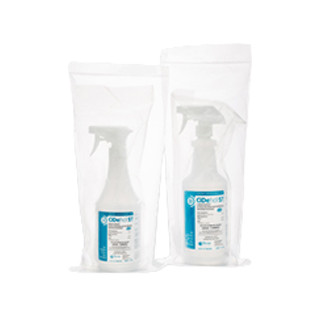
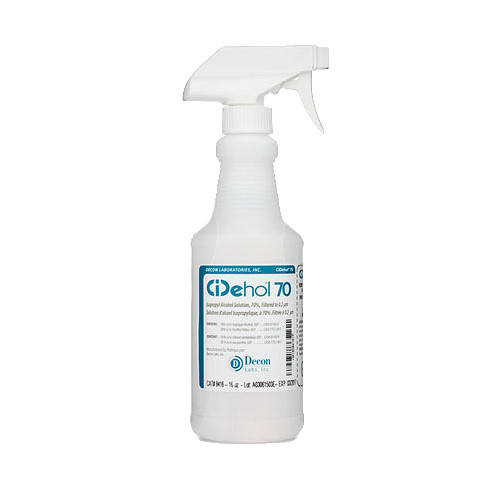
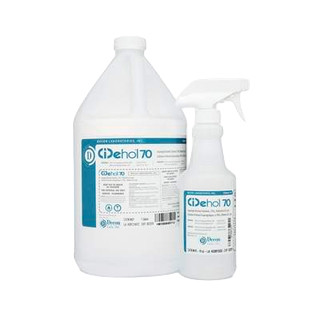
CiDehol® ST 8316 Sterile 70% Isopropyl Alcohol (IPA) Solution Made with WFI (16 oz. Trigger Spray) — 12/Case
CiDehol ST 8316 (Decon Laboratories) is a ready-to-use sterile 70% (v/v) USP isopropyl alcohol solution made with
Water for Injection (WFI) for cleanroom cleaning and disinfection steps where a sterile, non-pyrogenic alcohol is required.
The solution is filtered to 0.2 µm, bottled and double-bagged in a Class 100 cleanroom, and gamma-irradiated
to a Sterility Assurance Level (SAL) of 10−6. Each lot is tested via a USP 14-day sterility test and
bacterial endotoxin (LAL) testing prior to release, and cases ship with traceable, lot-specific documentation.
At-a-glance (published attributes)
- Manufacturer: Decon Laboratories, Inc. (Decon Labs)
- Catalog / SKU: 8316
- Composition (by volume): 70% Isopropyl Alcohol, USP / 30% Water for Injection (WFI), USP
- Filtration: Filtered to 0.2 µm
- Cleanroom processing: Bottled and double-bagged within a Class 100 cleanroom
- Sterilization: Gamma-irradiated to SAL 10−6
- Lot release testing: USP 14-day sterility test; bacterial endotoxin testing (LAL) prior to release
- Endotoxin criterion: < 0.25 EU/mL (WFI endotoxin level criterion; per TDS)
- EPA registration (per manufacturer documentation): EPA Reg. No. 56753-1
- Package size: 16 oz trigger spray bottle
- Case unit: 12 bottles per case
- Shelf life / storage: 2 years; expiration date on product; do not store above 120°F (per TDS)
- Shipping constraint: Ground shipping only (Consumer Commodity ORM-D)
1) Where ST 8316 fits in a contamination control program
Sterile 70% IPA is commonly used as a routine or intermediate disinfectant step in ISO-classified environments and aseptic workflows.
ST 8316 is typically selected when programs want additional controls that support documentation-driven operations—including WFI as the water
component, defined filtration, cleanroom packaging controls, validated sterilization, and lot-level release testing for sterility and endotoxin.
Important scope note (accuracy-first)
70% IPA is not a sporicide. Many validated programs use IPA for routine/intermediate disinfection and implement a separate
sporicidal agent on a defined schedule as part of a rotation. Follow your site’s contamination control strategy and validation protocol.
2) Standards alignment (USP, ISO, Annex 1) — educational reference
In critical environments, standards and guidance consistently emphasize: (1) clean and disinfected surfaces, (2) trained personnel using appropriate
garb/PPE, and (3) documented, validated procedures. USP <797> and USP <800> expect cleaning/disinfection activities to be
controlled through SOPs using suitable agents and appropriate PPE for the task and risk profile. EU GMP Annex 1 reinforces the need for a robust
contamination control strategy, validated disinfection processes, and disciplined operator behavior in Grade A/B environments. ISO cleanroom operations
guidance supports establishing an operations control program covering personnel practices, cleaning, and material movement.
Key compliance reality: these frameworks do not “approve” a specific brand or bottle style. Facilities are responsible to select, validate,
document, and train on the exact products and methods used in their rooms.
3) Application technique (what drives repeatable outcomes)
A. Prefer “spray-to-wipe” in critical zones
Where feasible, apply IPA onto a sterile, low-linting wiper and then wipe the surface. This improves saturation control and reduces overspray
and airborne droplets—especially near open components, sensitive assemblies, and airflow paths.
B. Wipe pattern discipline
Use straight-line, overlapping strokes and rotate to a fresh wiper face frequently. Avoid back-and-forth scrubbing with a loaded wipe.
Replace wipes when they become visibly soiled, over-saturated, or dry out below effective use.
C. Contact time is defined by your SOP and validation
Maintain the surface visibly wet for the contact time specified in your procedure. Contact time and technique should be validated for your
surface types, wiping method, and environmental conditions.
4) Donning discipline & PPE interface control
In critical environments, audits frequently identify failures tied to touch events (adjusting eyewear/hoods, contacting non-controlled objects,
or poor glove–sleeve overlap). Ensure personnel are fully gowned before introducing sterile solutions into ISO-classified areas. Many aseptic
programs don sterile gloves last, then sanitize gloved hands with sterile IPA at defined intervals per SOP.
5) System pairings (commonly validated companions)
ST 8316 is typically paired with sterile cleanroom consumables engineered for controlled wiping and low residue transfer. Final selection must match
your ISO class, surface materials, disinfectant rotation strategy, and SOP validation.
6) Why customers specify “WFI + lot testing + documentation” for sterile IPA
- Non-pyrogenic positioning: made with WFI and supported by lot testing for endotoxin (LAL) prior to release.
- Audit readiness: lot-specific documentation supports QA files, investigations, and change control.
- Controlled entry packaging: bottled and double-bagged in a Class 100 cleanroom to support staged de-bagging SOPs.
- Validated sterility approach: gamma-irradiated to SAL 10−6 with lot sterility testing called out by the manufacturer.
7) Safety and handling (non-negotiables)
Flammability & storage
70% IPA is a highly flammable liquid and vapor. Control ignition sources, use appropriate ventilation, and follow your site’s PPE/EHS program.
Follow manufacturer storage guidance (including the published note: do not store above 120°F) and always refer to the current SDS for full
hazard, handling, spill response, and disposal guidance.
Revision control
Technical Vault entry (SOSCleanroom): Review this content whenever manufacturer documentation/TDS/SDS changes, or when your facility updates
USP/ISO/Annex 1 interpretations, cleaning SOPs, disinfectant rotation strategy, or validation parameters.
Disclaimer: This Technical Vault content is provided for educational and reference purposes only. It does not constitute regulatory, quality,
engineering, environmental health & safety, or legal advice. Cleaning agents, contact times, wiping techniques, PPE requirements, disinfectant
rotation, EPA claims/uses, and all related procedures must be defined, validated, and documented by the end user in accordance with internal SOPs,
risk assessments, and applicable standards and regulations. Always follow manufacturer instructions and the current SDS/TDS.
© 2026 SOS Supply. All rights reserved.