LopHene 8811 (LopHene II) Concentrated Phenolic Disinfectant, 1 Gallon Bottle, 4/Case — Low-pH Rotation-Ready Chemistry for Routine Hard-Surface Disinfection
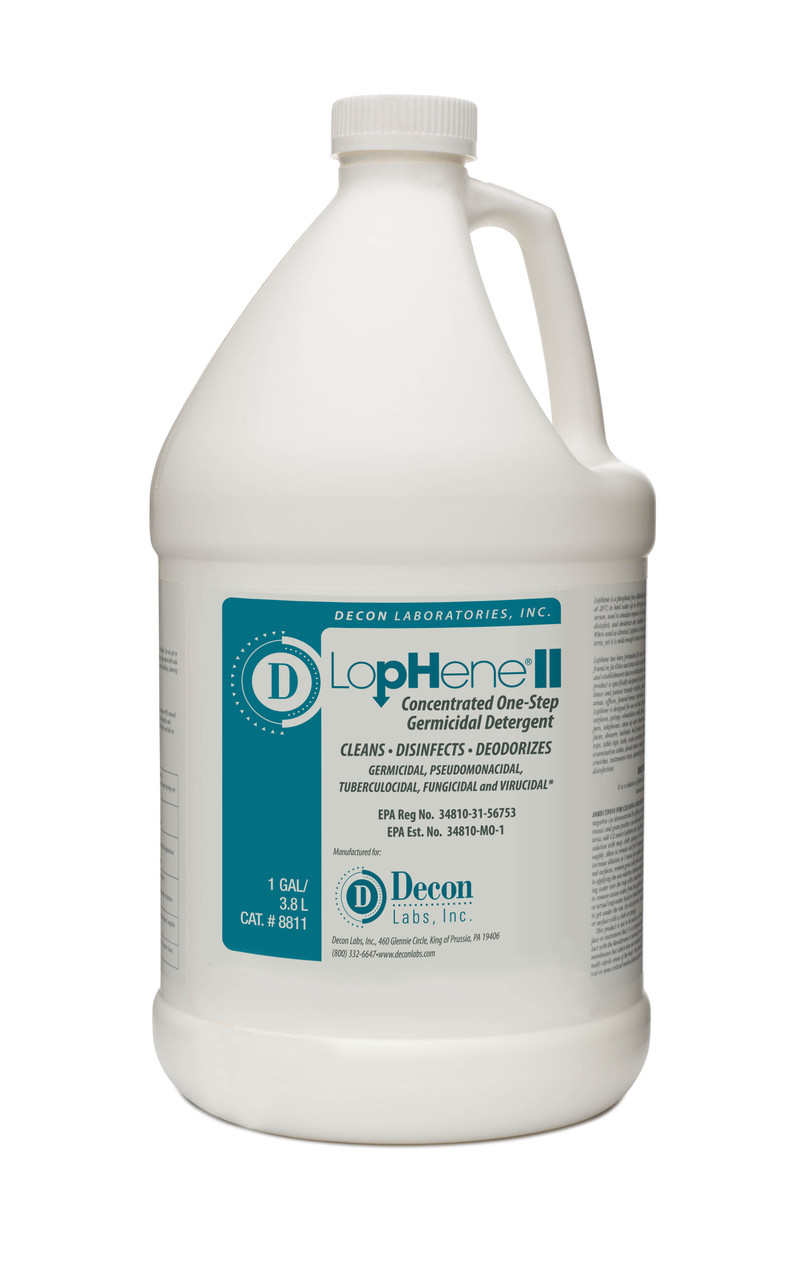
Reference image for receiving and line-side identification.
1) Practical solutions in a critical environment
LopHene II (Decon #8811) is a concentrated, low-pH phenolic detergent disinfectant intended for routine cleaning and disinfection of hard, non-porous surfaces.
In controlled environments, concentrates like this are typically selected when a site wants consistent, measurable dilution control (central mixing station, metered dispensers, or
per-gallon preparation) and a repeatable step that fits a rotational disinfection program.
Practical example: A facility running scheduled disinfection on floors, carts, pass-through exteriors, and non-product-contact work surfaces often needs a chemistry that tolerates
everyday soil while still meeting required organism claims. For teams that rely on labeled dilution and verified wet contact time, LopHene II provides a structured, label-driven approach.
SOSCleanroom has been a distributor of Decon for over 10 years supporting cleanrooms across the United States. That continuity matters when customers need stable labeling, documentation,
and repeat ordering for validated cleaning programs.
2) What this product is used for
- Cleaning and disinfection of hard, non-porous surfaces (environmental surfaces) where routine disinfection efficacy is required.
- Common surface examples in manufacturer directions include walls, floors, bathroom fixtures, stainless steel, chrome, glass, and vinyl.
- Application methods include cloth, mop, brush, or soaking, depending on the surface and the facility method.
- Often evaluated as part of rotational disinfection programs (the manufacturer notes use alone or alternation with an alkaline phenolic disinfectant when rotation is desired).
3) Why customers consider this product
- Label-driven dilution: directions list 1 ounce per gallon of water (1:128) for many hard, non-porous surface uses.
- Defined disinfection dwell: directions call for thoroughly wetting surfaces and maintaining a 10-minute contact time.
- Broad claim set on the Tech Sheet: described as germicidal, pseudomonacidal, tuberculocidal, fungicidal, and virucidal (verify site-specific claims against the current label and Tech Sheet).
- Low-pH profile: SDS lists typical pH in the ~2.05–2.4 range (use this to inform surface-compatibility assessments).
- Shelf-life clarity: Tech Sheet lists a 2-year shelf life for the concentrate and advises preparing a fresh solution for each use.
- Program fit: manufacturer describes suitability for use alone or within a rotational disinfection program when desired.
- Documentation discipline: Decon provides an SDS and a Tech Sheet, and offers lot-based documentation support via their certificate-of-analysis lookup workflow.
4) Materials, composition, and build
LopHene II is a phenolic detergent disinfectant concentrate designed to be diluted prior to use. The Tech Sheet lists the following active ingredients (by weight percent):
ortho-Phenylphenol (3.40%) and orthobenzyl-para-Chlorophenol (3.03%), with inert ingredients making up the balance.
The SDS describes the product as a clear to light yellow liquid with a light citrus odor. From a practical handling perspective, treat it as a concentrate that demands accurate measuring,
controlled mixing, and strong labeling discipline to prevent unintended over- or under-dilution.
5) Specifications in context
| Attribute |
LopHene 8811 (LopHene II) |
| Manufacturer / brand |
Decon Laboratories, Inc. (Decon) |
| Decon catalog / product code |
8811 |
| Form |
Liquid concentrate (intended to be diluted prior to use) |
| Typical labeled dilution (example) |
1 oz per gallon of water (1:128) for many hard, non-porous surface uses (per Tech Sheet directions) |
| Disinfection contact time |
10 minutes wet contact time (per Tech Sheet directions) |
| Active ingredients (Tech Sheet) |
ortho-Phenylphenol 3.40%; orthobenzyl-para-Chlorophenol 3.03% |
| pH (SDS) |
2.05 – 2.4 |
| Appearance / odor (SDS) |
Clear to light yellow liquid; light citrus odor |
| Shelf life |
Concentrate: 2-year shelf life (Tech Sheet). In-use solution: prepare fresh solution for each use (Tech Sheet). |
| Package configuration |
1 gallon (3.8 L) bottle; 4 per case |
| SOSCleanroom listed weight / lead time |
36.00 lbs per case; 7–10 business days availability (SOSCleanroom listing) |
| Sterility |
Not stated in the Tech Sheet or SDS for #8811; do not treat as sterile unless sterility documentation is provided for the exact ordered product. |
| Country of origin |
Not stated in the source basis documents reviewed. |
| Shipping constraints |
SOSCleanroom listing requires acknowledgment and indicates ground shipping only. |
6) Performance and cleanliness considerations
The manufacturer describes LopHene II as a one-step detergent disinfectant that cleans, disinfects, and deodorizes. Practically, “one-step” still depends on how your operators handle soil:
the Tech Sheet states gross filth and heavy soil must be removed before applying the cleaning solution. In real work, that means you should not expect a single pass to perform miracles on
visible residue; pre-clean or change tools when soil loads are high.
Contact time matters operationally. A frequent failure in disinfectant use is applying a thin film that flashes off early or gets wiped dry to “save time.” If your SOP relies on the 10-minute
labeled dwell, plan your workflow so surfaces remain visibly wet for the full interval (re-apply as needed, and sequence areas so you are not forced to prematurely wipe).
Compatibility and residues should be evaluated. Phenolic chemistries can leave residues depending on dilution, surface texture, and drying conditions. If your process includes a rinse or residue-management
step, it must follow label directions and your validated method. Do not mix LopHene II with other cleaners or chemicals in the same bucket or bottle.
7) Packaging, sterility, traceability, and country of origin
Packaging is listed as 1 gallon (3.8 L) bottles, 4 per case. For receiving, check that the outer case and each bottle label match the ordered identifier (8811) and that the container is upright,
tightly capped, and free of leaks. Because this is a concentrate intended for dilution, the integrity of the cap and any tamper evidence is a primary receiving control.
Sterility is not stated for LopHene II #8811 in the reviewed Tech Sheet/SDS. Treat it as a standard chemical concentrate unless you have explicit sterility documentation for the exact product ordered.
Traceability support is available through manufacturer documentation (SDS/Tech Sheet) and Decon’s lot documentation workflow (certificate-of-analysis lookup referenced on the product page).
Country of origin is not stated in the source basis documents reviewed. For regulated applications, confirm COO through your approved supplier documentation process before recording it in a batch record or quality file.
8) Best-practice use
A practical, audit-friendly workflow for concentrates
- Set up a controlled dilution point: use a dedicated measuring device (do not “free-pour”). Prepare the labeled dilution per the current manufacturer directions and your SOP.
- Label the working solution immediately: product name, dilution, preparer initials, prep date/time, and expiration per your method. The Tech Sheet advises preparing a fresh solution for each use.
- Pre-clean heavy soil: remove gross filth and heavy soil before relying on the disinfectant step. Replace wipes/mop heads when visibly loaded.
- Apply to thoroughly wet the surface: cloth, mop, brush, or soak per surface needs. Do not apply a “mist and wipe” film that dries early.
- Hold the wet contact time: the Tech Sheet lists 10 minutes. Sequence your rooms/equipment so you can keep surfaces wet for the full interval.
- Control your bucket discipline: if mopping from an open pail, change the solution at least daily or sooner if diluted/soiled (per Tech Sheet). Avoid “topping off” dirty solution.
- Do not mix with other chemicals: the Tech Sheet and SDS state not to mix with other cleaners/chemicals. If your SOP includes a follow-on step (rinse/residue management), keep it segregated and label-controlled.
9) Common failure modes
- Wrong dilution: over-dilution can reduce efficacy; under-dilution can increase residues and material risk. Use controlled measuring.
- Missed contact time: wiping dry early, or allowing partial drying during the dwell window, undermines label-based performance.
- Skipping soil removal: applying disinfectant directly onto heavy visible soil rather than removing it first.
- Cross-contamination: re-dipping a dirty mop/wipe into the working solution without control; not changing open-pail solution when soiled.
- Mixing chemicals: combining with other cleaners or oxidizers (explicitly discouraged by label/SDS) or using unlabeled, “mystery” bottles.
- Surface compatibility misses: ignoring low-pH implications for sensitive materials/finishes; failing to validate compatibility before broad deployment.
10) Closest competitors
Customers evaluating phenolic disinfectants in controlled environments often compare across three practical dimensions: (1) label claims and required wet contact time, (2) residue profile and
material compatibility, and (3) documentation/traceability support for their quality system.
- STERIS Vesphene™ III se Phenolic Disinfectant: a phenolic disinfectant option positioned for routine disinfection of hard, non-porous surfaces in pharmaceutical manufacturing environments.
- Contec® Sporicidin® Disinfectant Solution: phenolic-based cleaner/disinfectant commonly evaluated for broad-spectrum environmental disinfection where material compatibility and user handling considerations are central.
- Professional Amphyl® phenolic disinfectant cleaner concentrates: phenolic-based disinfectant concentrates that some facilities benchmark for dilution economics and general hard-surface disinfection workflows.
Selection note: do not “swap” products based on chemistry family alone. Required dwell times, organism claims, residue behavior, and rinsing directions vary by label. Validate any change through your change-control process.
11) Critical environment fit for this product
LopHene II is typically evaluated for controlled environments where routine environmental disinfection of hard, non-porous surfaces is required and where the facility is prepared to execute
disciplined dilution control and verified wet contact time. It can be relevant to pharmaceutical, biotech, medical device, compounding, and laboratory controlled areas when permitted by facility SOP,
surface-compatibility assessments, and regulatory obligations.
For higher-stringency programs, the operational question is often not “does it disinfect,” but “can we execute it the same way, every time.” If you can control dilution, labeling, dwell time, and tool hygiene,
concentrates like LopHene II can support consistent outcomes and cleaner audit narratives.
12) SOSCleanroom note about SOP's
The Technical Vault is written to help customers make informed contamination-control decisions and improve day-to-day handling technique.
It is not your facility’s Standard Operating Procedure (SOP), batch record, or validation protocol.
Customers are responsible for establishing, training, and enforcing SOPs that fit their specific risks, products, equipment, cleanroom classification, and regulatory obligations.
Always confirm material compatibility, cleanliness suitability, sterility requirements, and acceptance criteria using your internal quality system and documented methods.
If you adapt any technique guidance from this entry, treat it as a starting template. Your team should review and approve the final method, then qualify it for your specific surfaces,
solvents, cleanliness limits, inspection methods, and risk profile. In short: use these best-practice suggestions to strengthen your SOPs—not to replace them.
13) Source basis
- SOSCleanroom product page (LopHene 8811): https://www.soscleanroom.com/product/solutions/lophene-8811-lophene-ii-concentrated-phenolic-disinfectant-1-gallon-bottle-4-case/
- Manufacturer product page (DeconLabs, LopHene II): https://deconlabs.com/products/lophene-ii/
- Manufacturer Tech Sheet PDF (LopHene II Tech Sheet, Rev. 07/2021): https://deconlabs.com/tds/LopHene_II_Tech_Sheet.pdf
- Manufacturer SDS PDF (LopHene II SDS; Issue Date 28-Mar-2018; Revision Date 31-Dec-2024): https://deconlabs.com/sds/LopHene%20II%20SDS.pdf
- ISO (cleanroom/controlled environment reference point): https://www.iso.org/standard/53394.html
- FDA (regulated manufacturing context): https://www.fda.gov/
- ASTM (test methods and materials standards): https://www.astm.org/
- IEST (contamination control recommended practices): https://www.iest.org/
SOSCleanroom is the source for this Technical Vault entry.
Briefed and approved by the SOSCleanroom (SOS) staff.
If you have any questions please email us at Sales@SOSsupply.com
Last reviewed: Jan. 8, 2026
© 2026 SOSCleanroom