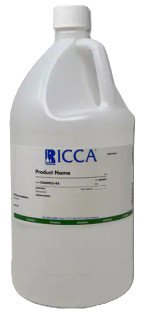
Product image shown for identification (container style may vary by lot).
1) Practical solutions in a critical environment
Purified water is often the “silent variable” in contamination control: the wrong water quality can leave residues, drive ionic contamination, and
introduce microbial risk through dispensers and open containers. Ricca 9190-1 is produced under a validated continuous process and positioned
for applications where USP/EP Purified Water performance matters at the point of use, with lot-level documentation available for receiving and QA review.
2) What this product is used for
- Final rinse water for equipment parts, tools, or non-product-contact surfaces after detergent or disinfectant cleaning (per your SOP).
- Diluent/makeup water for laboratory reagents or cleaning solutions when USP/EP Purified Water is specified by method or internal quality requirements.
- Low-residue wipe-down workflows where water quality impacts spotting, residue film, and ionic contribution.
- Analytical or QC preparation steps where documented water quality limits and COA traceability support investigations and audit trails.
3) Why customers consider this product
- Published quality limits: specification targets include conductivity, TOC, endotoxins, and microbial count limits for USP/EP Purified Water control.
- Lot documentation discipline: COA-based receiving review is straightforward when investigations require “what changed?” evidence.
- Controlled purification train: includes RO, mixed-bed deionization, UV irradiation, and 0.2 micron membrane filtration within the process.
- Non-hazmat shipping profile: SDS classifies the product as not hazardous and not regulated for transport, simplifying facility logistics.
4) Materials, composition, and build
Composition is water (H2O), published as 100% with CAS 7732-18-5. The manufacturer describes a multi-step purification process
that includes conventional softening, prefiltration, activated carbon organic adsorption, reverse osmosis, mixed-bed triple deionization,
ultraviolet light irradiation, and 0.2 micron membrane filtration. Container format for 9190-1 is a 4 L natural poly bottle.
5) Specifications in context
This table consolidates what is explicitly published for the product code. If an attribute is not stated in the source basis, it is listed as not published.
| Attribute |
Ricca 9190-1 |
| Product name / grade |
Water, USP/EP Purified |
| SKU / part number |
9190-1 |
| Container |
4 L natural poly bottle |
| Shelf life (unopened) |
12 months |
| Sterility |
Non-sterile (explicitly stated; not for injection/parenteral preparation) |
| Recommended storage |
15°C – 30°C (59°F – 86°F); protect from freezing and physical damage |
| Case pack |
SOSCleanroom page title indicates “4L … (4/Case),” while the same page also shows “Four (1 Liter) Bottles Per Case.”
Manufacturer sources do not publish a case-pack quantity for 9190-1. Confirm case pack at time of ordering.
|
6) Performance and cleanliness considerations
For water used in controlled environments, “clean” typically means measurable limits on ions, organics, and bioburden, plus a traceable paper trail.
Ricca publishes specification limits and provides lot-level Certificates of Analysis to support receiving decisions and deviations.
| Quality parameter |
Published limit (product specification) |
Why it matters in practice |
| Conductivity (25°C) |
Max 1 µS/cm |
Indicator for ionic load that can contribute to corrosion risk, residue film, and analytical interference. |
| TOC (Organic Carbon) |
Max 0.50 ppm |
Helps control organic residue contribution that can drive spotting and microbial growth in dispensers. |
| Endotoxins (chromogenic) |
Max 0.25 EU/mL |
Relevant when water touches sensitive assays, medical-device components, or bioburden-controlled workflows. |
| Microbial count (time of manufacture) |
Max 100 CFU/mL |
Useful for assessing baseline bioburden risk; downstream handling and dispensing controls still matter. |
| Residue after evaporation (NVM) |
Max 0.001% |
Predictor of visible residue and film on wipe-down or rinse-dry processes. |
Receiving/QA tip (use the lot’s COA)
Ricca provides lot-specific COAs. As an example only, one published COA lot shows conductivity, TOC, endotoxin, and microbial results well below the specification limits.
Do not treat example values as universal—pull the COA for the lot you received and review it against your internal acceptance criteria.
7) Packaging, sterility, traceability, and country of origin
- Sterility: not sterile; not filled in a sterile area or into sterilized containers; do not use for injection or parenteral solution preparation.
- Traceability: manufacturer publishes specifications and provides lot-specific Certificates of Analysis; Ricca also provides an online COA/SDS lookup portal by lot number or product code.
- Transport/Hazmat: SDS indicates no GHS hazard classification and not regulated for DOT/IATA transport; manufacturer lists HazMat info as N/A for 9190-1.
- Country of origin: not stated in the published source basis. Manufacturer addresses include U.S. locations, but COO is not explicitly declared for this product.
8) Best-practice use
- Treat the dispenser as the risk point: the water may meet tight limits at packaging, but open pours, shared pumps, and “topped off” bottles are common root causes in investigations.
- Use dedicated, labeled point-of-use containers: if you decant, use clean, closed containers dedicated to purified water only, and assign a discard/rotation time aligned to your SOP.
- Avoid cross-contact with detergents and disinfectants: never insert used funnels or wipe heads back into the source bottle; residue backflow is a frequent contamination pathway.
- Control storage temperature and handling: store within the recommended range; protect from freezing and physical damage, which can compromise packaging integrity and traceability.
- Document the lot: record the lot number on the label into your batch record, cleaning log, or lab notebook so the COA can be pulled quickly during excursions and deviations.
9) Common failure modes
- Using non-sterile water where sterile water is required: most often seen when a workflow silently changes (new operator, new area classification, new requirement).
- “Topping off” dispensers: mixing old and new inventory defeats traceability and can create a microbial incubator in the container headspace or pump.
- Residue/spotting surprises: often caused by contaminated spray bottles, dirty nozzles, or surfaces that were not adequately rinsed after detergent use.
- Freeze damage: freezing can crack containers, weaken closures, or create micro-leaks—store and ship to avoid freeze exposure.
10) Closest competitors
When comparing purified water options, focus on (1) documented USP/EP alignment, (2) lot-specific COA availability, (3) sterility status, and (4) the packaging format that best controls downstream handling risk.
Common alternatives to evaluate include:
- Decon Labs purified water offerings (verify USP/EP claims, sterility status, and case configuration per their TDS/COA).
- Avantor / J.T.Baker purified water products (verify grade designation and COA format by lot).
- Thermo Fisher / Fisher Chemical purified water offerings (confirm whether COA is manufacturer-issued and lot-traceable for your receiving needs).
11) Critical environment fit for this product
Ricca 9190-1 is a strong fit for controlled environments that need documented purified water quality for rinse, dilution, and analytical preparation,
while managing risk through disciplined handling and dispenser control. Because it is non-sterile, it is not appropriate where sterile water is required
by regulation, product, or process. Ricca’s published guidance also emphasizes that users are responsible for confirming fitness for use in manufacturing,
clinical, or analytical applications where bulk pure water is indicated.
12) SOSCleanroom note about SOP's
The Technical Vault is written to help customers make informed contamination-control decisions and improve day-to-day handling technique.
It is not your facility’s Standard Operating Procedure (SOP), batch record, or validation protocol.
Customers are responsible for establishing, training, and enforcing SOPs that fit their specific risks, products, equipment, cleanroom classification, and regulatory obligations.
Always confirm material compatibility, cleanliness suitability, sterility requirements, and acceptance criteria using your internal quality system and documented methods.
If you adapt any technique guidance from this entry, treat it as a starting template. Your team should review and approve the final method, then qualify it for your specific surfaces,
solvents, cleanliness limits, inspection methods, and risk profile. In short: use these best-practice suggestions to strengthen your SOPs—not to replace them.
13) Source basis
- SOSCleanroom product page: https://www.soscleanroom.com/product/solutions/ricca-9190-1-purified-usp-ep-water-4l-natural-poly-bottle-4-case/
- Manufacturer product listing (9190 series / 9190-1): https://www.riccachemical.com/products/water/usp/ep-purified-water/9190-%28-r9190000-%29
- Ricca Product Specification (includes published limits and packaging formats; Version 1.6): https://www.riccachemical.com/WebsiteDocuments/Specifications/R9190000.pdf
- Ricca Safety Data Sheet (SDS) for Water, USP/EP Purified (Product 9190; last revision date shown on document): https://www.riccachemical.com/WebsiteDocuments/SDS/9190.pdf
- Ricca COA/SDS lookup portal (use your lot number for the exact COA shipped to you): https://www.riccachemical.com/cofa-and-sds
- Example manufacturer COA (illustrative only; always verify your received lot): https://www.riccachemical.com/websitedocuments/cofa/4503H83.pdf
- ISO: https://www.iso.org/standard/53394.html
- FDA: https://www.fda.gov/
- ASTM: https://www.astm.org/
- IEST: https://www.iest.org/
SOSCleanroom is the source for this Technical Vault entry.
Briefed and approved by the SOSCleanroom (SOS) staff.
If you have any questions please email us at Sales@SOSsupply.com
Last reviewed: January 8, 2026
© 2026 SOSCleanroom