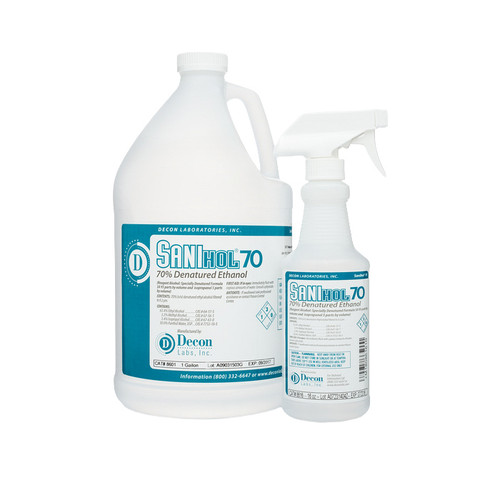
Sanihol 8601 Non-Sterile 70% Denatured Ethanol Solution (1 Gallon Bottle, 4/Case)

$127.94
(No reviews yet)
SKU:
8601
Availability:
10 - 14 Business Days
Shipping:
Calculated at Checkout
Solution Type:
Ethanol

Sanihol® 8601 Non-Sterile 70% Denatured Ethanol Solution (1 Gallon, 4/Case) — Bulk Alcohol for Controlled-Environment Wipe-Downs

Sanihol 8601 is a ready-to-use, non-sterile 70% (v/v) denatured ethanol solution intended for routine cleaning and sanitizing workflows in controlled environments where sterile alcohol is not required by SOP. This 1-gallon, 4/case format is commonly selected for higher-consumption programs (refill stations, janitorial/housekeeping carts, and point-of-use secondary bottles) where repeatable alcohol concentration and consistent coverage technique matter.

Shipping / handling note: This product is classified for hazmat ground shipment. A hazmat shipping-and-handling fee applies per case, and shipment is restricted to ground shipping to a commercial address.

Specifications:
  • Manufacturer: Decon Laboratories, Inc. (Decon Labs)
  • Product: Sanihol 70 (non-sterile 70% denatured ethanol solution)
  • Catalog / SKU: 8601
  • Concentration: 70% (v/v) denatured ethanol solution
  • Package size: 1 gallon bottle
  • Case pack: 4 bottles per case (4 x 1 gallon)
  • Shelf life: 2 years from date of manufacture (expiration date printed on product)
  • Storage: Do not store above 120°F; keep containers closed when not in use
  • Shipping constraints: Ground shipping only; commercial address only; hazmat fee applies per case
About the Manufacturer: 

Decon Laboratories, Inc. (Decon Labs) manufactures contamination-control and critical-cleaning chemistries used in regulated and controlled environments. The Sanihol product family is positioned to support repeatable alcohol-based cleaning and sanitizing steps with consistent formulation, clear documentation (TDS/SDS), and practical packaging options that fit real facility workflows.


SOSCleanroom has been a distributor of Decon for over 10 years supporting cleanrooms across the United States—helping customers standardize cleaning programs with dependable supply, fair pricing, and responsive service.

Sanihol 70 Features:
  • Ready-to-use non-sterile 70% (v/v) denatured ethanol solution for routine cleaning and sanitizing
  • Bulk 1-gallon packaging supports higher consumption areas and refill workflows
  • Commonly used in controlled environments where sterile alcohol is not required by SOP
  • Designed to evaporate without a rinse step in typical use (process- and surface-dependent)
  • Documented product and safety information via TDS/SDS for qualification files
Sanihol 70 Benefits:
  • Bulk efficiency: Reduces change-outs and supports higher-throughput wipe-down schedules.
  • Consistent concentration: Helps standardize cleaning technique across operators compared with ad hoc mixing.
  • Fits secondary container programs: Supports refilling of approved point-of-use bottles when secondary container labeling and controls are in place.
  • Program documentation: SDS/TDS availability supports EHS review and internal documentation requirements.
Common Applications:
  • Routine wipe-down of benches, carts, stainless surfaces, and pass-through surfaces (per site SOP)
  • Cleaning programs in controlled manufacturing and laboratory areas where non-sterile alcohol is acceptable
  • Refill workflows for labeled point-of-use trigger sprays and dispensing bottles (per your SOP)
  • Final wipe steps where fast evaporation is desired (process dependent)
Best-Practice Use:
  • Flammables control: Denatured ethanol is flammable. Use with appropriate ventilation, keep away from ignition sources, and follow your EHS program and the SDS.
  • Surface wetting: Apply enough solution to fully wet the surface, then allow to air dry unless your SOP requires a wipe-back step.
  • Wipe technique: Use straight-line, overlapping strokes; rotate to clean wipe faces; replace wipes when visibly soiled or when streaking begins.
  • Secondary container discipline: If transferring to smaller bottles, label secondary containers per SOP (contents, hazards, prep/open date if required).
  • Compatibility validation: Confirm compatibility on plastics, coatings, labels, and adhesives as part of your internal qualification.
Selection Notes (1 Gallon 4/Case vs. Smaller Formats):
  • Choose gallon format when: You have refill programs, higher-throughput cleaning, or centralized dispensing where decanting controls are qualified.
  • Choose smaller bottles when: Minimizing transfer steps is a priority, or when point-of-use mobility matters.
  • Non-sterile vs. sterile: Use non-sterile in controlled areas where sterility is not required; select sterile alcohol solutions for aseptic/ISO 5 or other SOP-driven sterile areas.

Datasheet Links:


Notes: Sanihol 70 is a flammable alcohol solution. Keep away from heat, sparks, and open flame. Always follow your facility SOP, PPE requirements, and compatibility/validation requirements for surfaces and residues.

If you have any questions please email us at Sales@SOSsupply.com or give us a call at (214)340-8574.

Product page updated: Jan. 7, 2026 (SOS Technical Staff)

© 2026 SOS Supply. All rights reserved.

The Technical Vault
By SOSCleanroom
70% denatured ethanol
0.2 µm filtered
Bulk 1-gallon format
Hazmat ground shipping
Use this as the permanent instruction set for SOSCleanroom Technical Vault entries in the category: Solutions.
Sanihol 8601: Non-sterile 70% denatured ethanol in 1-gallon bottles (4/case) for high-throughput controlled-environment wipe-downs
Sanihol 8601 Non-Sterile 70% Denatured Ethanol Solution (1 Gallon, 4/Case)
Sanihol 8601 (1 gallon, 4/case) — non-sterile 70% denatured ethanol solution for controlled-environment cleaning workflows.
1) Practical solutions in a critical environment

Bulk alcohol programs are where cleanroom technique either holds the line—or quietly drifts. A 1-gallon format is efficient for refill stations and housekeeping carts, but it also introduces real-world risk: transfer steps, mislabeled secondary bottles, and inconsistent “wet coverage” from one operator to the next.

Sanihol 8601 is positioned for controlled environments where sterile alcohol is not required by SOP, but repeatable concentration and predictable handling still matter. SOSCleanroom has been a distributor of Decon for over 10 years supporting cleanrooms across the United States—helping teams standardize cleaning programs with dependable supply, fair pricing, and responsive service.

2) What this product is used for
  • Routine cleaning wipe-downs of hard, non-porous surfaces in labs and production areas where non-sterile alcohol is allowed.
  • Refill programs for validated secondary bottles (trigger sprays, squirt bottles, and dispense systems) when you want a consistent 70% denatured ethanol blend.
  • High-consumption applications in microbiology and tissue culture support areas where quick evaporation and low residue are operational priorities.
  • General facility cleaning steps where you want a ready-to-use alcohol solution that evaporates away without a rinse step (confirm with your internal residue limits).
3) Why customers consider this product
  • High-throughput value: 1-gallon bottles reduce unit handling and support centralized dispensing.
  • Particulate control: filtered to 0.2 microns to reduce particulate contamination contribution.
  • Operational simplicity: ready-to-use 70% (v/v) denatured ethanol—no mixing steps, no dilution math on the floor.
  • Documentation support: clear Technical Data Sheet and Safety Data Sheet that QA can reference for training, storage, and hazard controls.
  • Program consistency: a stable, repeat-order alcohol option that helps prevent “substitute drift” across shifts and sites.
4) Materials, composition, and build

Sanihol 70 is a denatured ethanol solution specified at 70% (v/v) and filtered to 0.2 microns. The manufacturer’s technical data sheet lists the ingredients by volume as: 63.4% ethyl alcohol, 3.2% methyl alcohol, 3.4% isopropyl alcohol, and 30% USP purified water.

For facilities, the “build” is the repeatable blend plus the particulate filtration—useful when the goal is predictable evaporation behavior and a controlled residue profile. For hazard controls, note that the SDS explicitly highlights flammability and the presence of methanol—treat storage, dispensing, and point-of-use handling as a formal safety and quality control item.

5) Specifications in context
Attribute Sanihol 8601 (1 gallon, 4/case)
Product type Non-sterile 70% (v/v) denatured ethanol solution (ready-to-use)
Filtration 0.2 µm filtered
Ingredients (by volume) 63.4% ethyl alcohol; 3.2% methyl alcohol; 3.4% isopropyl alcohol; 30% USP purified water
Package size 1 gallon bottle
Case pack 4 bottles per case (4 × 1 gallon)
Shelf life 2 years from date of manufacture (expiration date printed on product)
Storage limit Do not store above 120°F; keep containers closed when not in use
Weight (shipping) 36.00 lbs (listed on SOSCleanroom product page)
Availability 10–14 business days (listed on SOSCleanroom product page)
Shipping constraints Hazmat ground shipping only; commercial address only; hazmat fee applies per case
Country of origin Not published on the SOSCleanroom listing or the Decon documents included in the Source basis.
6) Performance and cleanliness considerations

Decon positions Sanihol 70 as a ready-to-use denatured ethanol solution for cleaning surfaces in labs and production areas, emphasizing complete evaporation with no rinse requirement and 0.2 µm filtration. For day-to-day operations, performance depends on three controllable variables: coverage, dwell behavior, and wipe discipline.

  • Coverage matters more than “one quick spray.” Alcohol can flash off fast, especially on warm stainless, under laminar flow, or near HEPA returns.
  • This is non-sterile. It is intended for areas where sterility is not required by your SOP; do not treat non-sterile alcohol as a substitute in aseptic/ISO 5 programs.
  • Not an EPA-registered disinfectant claim set in the included sources. The referenced TDS focuses on cleaning use; align any “disinfection” language to your validated facility program and approved label/chemistry where required.
  • Residue control is process-specific. Even when a solution evaporates away cleanly, your facility may still require a follow-up wipe or inspection step for critical surfaces.
7) Packaging, sterility, traceability, and country of origin
  • Packaging: 1 gallon bottles; 4 per case (catalog number 8601 listed on TDS and SOSCleanroom product page).
  • Sterility: non-sterile (do not use where sterile alcohol is required).
  • Traceability: use the label and case markings to record lot/expiration in your receiving log; the TDS notes the expiration date is printed on the product.
  • Hazmat controls: SOSCleanroom lists a required hazmat fee of $35 per case added to shipping, ground shipping only, and commercial address only.
  • Country of origin: not stated in the sources listed below.
8) Best-practice use

The Sanihol 70 TDS describes a practical method: use in a well-ventilated area; spray or wipe until the surface is completely covered; allow to air dry; when using trigger spray, point away from eyes and skin; hold bottle six to eight inches from the surface. In a bulk format, add two facility-proven controls: secondary container governance and wipe technique discipline.

Bulk alcohol handling module (1-gallon programs)
  1. Control transfer steps: if you decant into secondary bottles, only use approved containers, cap types, and labels. Record lot and expiration at the time of fill.
  2. Label like QA will audit it: chemical name, concentration, hazards/flammable marking (per your program), date filled, lot/expiration, and owner/area.
  3. Apply to full coverage: wet the surface fully; avoid “mist-and-run” habits that leave dry islands.
  4. Wipe in one direction: overlap strokes; rotate to a clean wiper face frequently; do not circle-scrub and redeposit soil.
  5. Close containers immediately: reduces evaporation drift and helps maintain consistent use behavior across shifts.
Safety realities that show up on the floor
  • Flammability controls are non-negotiable: keep away from heat, sparks, open flames, and hot surfaces; no smoking; follow your facility’s flammable liquid storage limits.
  • Ventilation matters: the SDS and TDS both emphasize well-ventilated use; avoid sustained spray use in tight rooms without engineered controls.
  • Methanol content: the SDS explicitly notes methanol; treat ingestion/inhalation risk and PPE selection as a documented element of your safety program.
9) Common failure modes
  • Uncontrolled decanting: secondary bottles without lot/expiration traceability and fill-date controls.
  • Evaporation drift: caps left off, partially closed spigots, or long-duration open handling that changes how the solution behaves in use.
  • Inconsistent coverage: quick misting that never fully wets the surface, creating “clean-looking” but unevenly treated areas.
  • Cross-contamination wiping: one wiper used too long across high-to-low risk zones, redistributing residue and bioburden.
  • Wrong environment fit: non-sterile alcohol used in sterile/aseptic areas due to convenience rather than SOP and validation requirements.
10) Closest competitors

Non-sterile 70% denatured ethanol is a common category. The meaningful differences are filtration, documentation clarity (TDS/SDS revision discipline), and how well the product supports bulk handling without process drift.

  • VWR / Avantor 70% denatured ethanol offerings — commonly used lab/production alcohol products with comparable “clean and evaporate” positioning.
  • Fisher Scientific channel 70% ethanol solutions — broad availability in lab environments; documentation and filtration details vary by private label and source.
11) Critical environment fit for this product

Sanihol 8601 fits best in controlled environments that want a consistent alcohol blend for routine surface cleaning and wipe-downs, especially where bulk format supports throughput and cost-control without sacrificing documentation. It is also a practical choice for refill programs when your quality system has clear rules for secondary containers, labeling, and expiration governance.

For sterile or aseptic areas, use alcohol solutions that are explicitly specified as sterile by your SOP and qualification program. Non-sterile products belong where the facility’s contamination-control strategy and risk assessment allow them.

12) SOSCleanroom note about SOP's

The Technical Vault is written to help customers make informed contamination-control decisions and improve day-to-day handling technique. It is not your facility’s Standard Operating Procedure (SOP), batch record, or validation protocol.

Customers are responsible for establishing, training, and enforcing SOPs that fit their specific risks, products, equipment, cleanroom classification, and regulatory obligations. Always confirm material compatibility, cleanliness suitability, sterility requirements, and acceptance criteria using your internal quality system and documented methods.

If you adapt any technique guidance from this entry, treat it as a starting template. Your team should review and approve the final method, then qualify it for your specific surfaces, solvents, cleanliness limits, inspection methods, and risk profile. In short: use these best-practice suggestions to strengthen your SOPs—not to replace them.

13) Source basis
  • SOSCleanroom product page (Sanihol 8601 Non-Sterile 70% Denatured Ethanol Solution, 1 Gallon Bottle, 4/Case): https://www.soscleanroom.com/product/solutions/sanihol-8601-non-sterile-70-denatured-ethanol-solution-1-gallon-bottle-4-case/
  • Manufacturer product page (Sanihol 70): https://deconlabs.com/products/sanihol-70/
  • SOS-hosted Technical Data Sheet (70% Denatured Ethanol Solution, Technical Data Sheet; Revised 9/13/2013): https://www.soscleanroom.com/content/Decon_pdf/Sanihol%20Tech%20sheet%202010.pdf
  • Manufacturer Technical Data Sheet (Sanihol Tech sheet 2010; Rev. 07/2021): https://deconlabs.com/tds/Sanihol%20Tech%20sheet%202010.pdf
  • SOS-hosted Safety Data Sheet (Sanihol 70 SDS; Date of Revision 06/19/2015): https://www.soscleanroom.com/content/Decon_pdf/Sanihol%2070%20SDS.pdf
  • Manufacturer Safety Data Sheet (Sanihol 70 SDS; Date of Revision 12/31/2024R): https://deconlabs.com/sds/Sanihol%2070%20SDS.pdf
  • ISO (cleanrooms and associated controlled environments): https://www.iso.org/standard/53394.html
  • FDA: https://www.fda.gov/
  • ASTM: https://www.astm.org/
  • IEST: https://www.iest.org/
SOSCleanroom is the source for this Technical Vault entry.
Briefed and approved by the SOSCleanroom (SOS) staff.
If you have any questions please email us at Sales@SOSsupply.com
Last reviewed: January 8, 2026
© 2026 SOSCleanroom