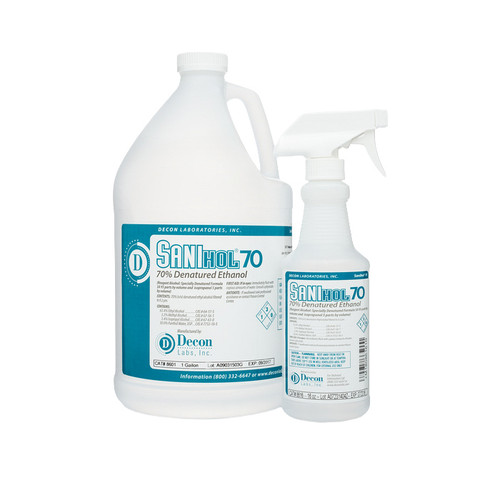
Sanihol 8616 Non-Sterile 70% Denatured Ethanol Solution (16 oz.)

$107.94
(No reviews yet)
SKU:
8616
Availability:
7 - 10 Business Days
Shipping:
Calculated at Checkout
Solution Type:
Ethanol

Sanihol® 8616 Non-Sterile 70% Denatured Ethanol Solution (16 oz. Trigger Spray) — Point-of-Use Alcohol for Controlled Environments

Sanihol 8616 is a ready-to-use, non-sterile 70% (v/v) denatured ethanol solution intended for routine cleaning and sanitizing workflows in controlled environments where sterile alcohol is not required by SOP. The 16 oz. trigger-spray format is a practical bench and cart size for day-to-day wipe-downs, spot cleaning, and quick turnaround surface cleaning when you want a consistent alcohol concentration without on-site mixing.

Shipping / handling note: This product is classified for hazmat ground shipment. A hazmat shipping-and-handling fee applies per shipment/case, and shipment is restricted to ground shipping to a commercial address.

Specifications:
  • Manufacturer: Decon Laboratories, Inc. (Decon Labs)
  • Product: Sanihol 70 (non-sterile 70% denatured ethanol solution)
  • Catalog / SKU: 8616
  • Concentration: 70% (v/v) denatured ethanol solution
  • Package size: 16 oz. trigger spray bottle
  • Quantity option: Single bottle
  • Shelf life: 2 years from date of manufacture (expiration date printed on product)
  • Storage: Do not store above 120°F; keep container tightly closed when not in use
  • Availability: 7–10 business days (typical)
  • Shipping constraints: Ground shipping only; commercial address only; hazmat fee applies per shipment/case
About the Manufacturer: 

Decon Laboratories, Inc. (Decon Labs) manufactures contamination-control and critical-cleaning chemistries used across laboratories and controlled environments. The Sanihol 70 product family is positioned to support repeatable alcohol-based cleaning and sanitizing steps with consistent formulation, clear documentation (TDS/SDS), and practical packaging formats that fit real facility workflows.


SOSCleanroom has been a distributor of Decon for over 10 years supporting cleanrooms across the United States—helping customers keep daily cleaning programs consistent with dependable supply, fair pricing, and responsive service.

Sanihol 70 Features:
  • Ready-to-use non-sterile 70% (v/v) denatured ethanol solution for routine cleaning and sanitizing
  • Convenient 16 oz. trigger spray format for benches, carts, and point-of-use stations
  • Fast-evaporating alcohol solution for quick turnaround cleaning steps (process dependent)
  • Supports standardized alcohol concentration without on-site mixing
  • SDS/TDS documentation available to support EHS review and internal qualification files
Sanihol 70 Benefits:
  • Daily workflow efficiency: Ready-to-use 16 oz. bottle reduces handling steps and supports fast wipe-downs.
  • Consistent cleaning practice: Defined alcohol concentration helps standardize operator technique shift-to-shift.
  • Reduced residue concerns: Alcohol typically evaporates without a rinse step (verify acceptance criteria and surface compatibility per SOP).
  • Documentation support: Clear SDS/TDS simplifies safety review, training, and audit documentation.
Common Applications:
  • Routine wipe-down of benches, carts, stainless surfaces, and equipment exteriors (per site SOP)
  • Cleaning of tools, fixtures, and touch points during operations (as permitted by SOP)
  • Point-of-use spray-and-wipe cleaning steps in controlled lab and production areas
  • Final wipe steps where fast evaporation is desired (process dependent)
Best-Practice Use:
  • Flammables control: Denatured ethanol is flammable. Use with appropriate ventilation, keep away from ignition sources, and follow the SDS and your EHS program.
  • Apply for full coverage: Spray until the area is fully wet, then allow to air dry unless your SOP specifies a wipe-back step.
  • Wipe technique: Use clean, low-linting wipers (no wiper is truly “lint-free” in every process condition); wipe in straight lines and rotate faces frequently.
  • Change-out triggers: Replace wipes when visibly soiled or when streaking begins to avoid re-depositing contaminants.
  • Compatibility check: Validate on sensitive plastics, coatings, labels, and adhesives as part of your internal cleaning validation.
Selection Notes (16 oz. Trigger Spray vs. Other Packs):
  • 16 oz. trigger spray: Best for bench-top use, carts, and point-of-use stations where portability matters.
  • 1 gallon bulk: Typically selected for refill workflows and higher consumption areas with qualified decanting/dispensing controls.
  • Non-sterile vs. sterile: Use non-sterile in controlled areas where sterility is not required. Choose sterile denatured ethanol when your SOP requires sterile/non-pyrogenic solutions and lot documentation.

Datasheet Links:


Notes: Sanihol 70 is a flammable alcohol solution. Keep away from heat, sparks, and open flame. Always follow your facility SOP, PPE requirements, and compatibility/validation requirements for surfaces and residues.

If you have any questions please email us at Sales@SOSsupply.com or give us a call at (214)340-8574.

Product page updated: Jan. 8, 2026 (SOS Technical Staff)

© 2026 SOS Supply. All rights reserved.

The Technical Vault
By SOSCleanroom
Non-sterile alcohol solution
70% (v/v) denatured ethanol
0.2 µm filtered (manufacturer-stated)
16 oz. trigger spray format
SaniHol 8616 Non-Sterile 70% Denatured Ethanol Solution (16 oz. trigger spray) — Ready-to-use point-of-use alcohol for routine controlled-environment wipe-downs
Decon SaniHol 70 denatured ethanol solution product image
Product image shown for reference. Packaging style and labeling may vary by lot.
Practical solutions in a critical environment
Alcohol is a staple “daily chemistry” in many controlled environments because it supports fast dry-down and straightforward operator workflows. The performance risk is rarely the bottle — it is technique drift: partial wetting, spray-only habits without wipe control, reuse of a loaded wipe face, and overspray into seams and hardware. SaniHol® 8616 addresses the “ready-to-use” need by providing a defined 70% (v/v) denatured ethanol solution in a portable, point-of-use trigger-spray bottle intended for routine cleaning steps where sterility is not required by your internal program.
What this product is used for
  • Routine spray-and-wipe cleaning on benches, carts, stainless, and equipment exteriors (per facility SOP).
  • Quick turnaround wipe-downs between tasks when a fast-evaporating alcohol step is part of the workflow.
  • Point-of-use cleaning where a portable bottle reduces transfers/decanting and helps standardize handling.
  • General laboratory and production-area surface cleaning where a filtered denatured ethanol solution is acceptable.
Why customers consider this product
  • Ready-to-use 70% (v/v) denatured ethanol eliminates on-site dilution variability.
  • 0.2 µm filtration is stated by the manufacturer to help reduce particulate contamination (confirm fit to your acceptance criteria).
  • 16 oz. trigger-spray format supports bench/carts/point-of-use staging and reduces unnecessary container transfers.
  • Manufacturer documentation (Tech Sheet and SDS) supports EHS review, training, and qualification files.
  • Shelf life is published as 2 years from date of manufacture; expiration is printed on the product.
  • SOSCleanroom has been a distributor of Decon for over 10 years supporting cleanrooms across the United States.
Materials, composition, and build
Decon Laboratories, Inc. positions SaniHol® 70 as a ready-to-use 70% (v/v) denatured ethanol solution filtered to 0.2 microns. The Decon technical documentation lists the denatured alcohol composition by volume as: 63.4% ethyl alcohol, 3.2% methyl alcohol, 3.4% isopropyl alcohol, and 30% USP purified water. The 16 oz. package is a trigger-spray bottle intended for spray application followed by air-dry and/or spray-and-wipe use patterns depending on your SOP and surface requirements.
Specifications in context
The table below consolidates published attributes for the Decon 8616 pack format and common program-impact notes for controlled environments.
Attribute 8616 details
Manufacturer Decon Laboratories, Inc. (Decon Labs)
Product family SaniHol® 70 (denatured ethanol solution)
Concentration 70% (v/v) denatured ethanol solution (manufacturer-stated)
Filtration Filtered to 0.2 µm (manufacturer-stated)
Package size 16 oz. trigger-spray bottle
Packaging (case pack) 12 per case (manufacturer-stated in Tech Sheet; SOS product page may be sold as single-bottle quantity selection)
Shelf life 2 years from date of manufacture; expiration date printed on product
Storage Do not store above 120°F; keep container tightly closed when not in use
Sterility Non-sterile
Shipping constraints Ground shipping only; hazmat shipping-and-handling fee applies per shipment/case (per SOS product page note)
Country of origin Not published in source basis
Performance and cleanliness considerations
  • Evaporation and residues: Decon positions SaniHol® 70 as evaporating away without a rinse step. In practice, residue outcomes depend on surface energy, wipe selection, spray volume, and soils. Confirm acceptance criteria on your actual materials.
  • Particulate control: Filtration to 0.2 µm is stated by the manufacturer to reduce particulate contamination relative to unfiltered alcohol sources. Pair this with receiving inspection and controlled handling to preserve that benefit.
  • Denaturants matter: This is denatured ethanol. Review the Tech Sheet and SDS with EHS/QA to ensure compatibility with sensitive plastics, coatings, labels, and adhesives and to ensure your hazard communication aligns to the actual formulation.
  • Flammability and vapor control: SDS indicates a flammable liquid/vapor. Use appropriate ventilation and ignition-source controls, especially in small rooms, pass-throughs, or enclosed equipment areas.
Packaging, sterility, traceability, and country of origin
  • Pack format: 16 oz. trigger-spray bottle intended for direct spray application; manufacturer documentation lists 12 per case for the 16 oz. format.
  • Sterility: Non-sterile. If your program requires sterile/non-pyrogenic alcohol, select a sterile designated product and verify sterility assurance and packaging controls in the source documents for that product.
  • Traceability: Shelf life is published as 2 years; expiration date is printed on the product. Decon provides documentation resources (SDS/Tech Sheet), and Decon’s product page includes a Certificate of Analysis lookup capability.
  • Country of origin: Not published in source basis.
Best-practice use
For alcohol solutions, “good technique” is about wet coverage, wipe control, and preventing re-deposition. The goal is repeatable cleaning behavior, not just spraying a surface and hoping it dries clean.
  • Set up the work zone: Ensure ventilation is adequate, eliminate ignition sources, and stage clean wipes and waste disposal before starting (SDS-driven controls).
  • Wet the surface fully: Spray until the area is completely covered (manufacturer guidance). For vertical surfaces, work top-to-bottom to control runs.
  • Spray-and-wipe discipline: Use a clean, low-linting wiper appropriate to your surface and cleanliness limits. Wipe in straight, overlapping strokes; rotate to a fresh face frequently; do not “polish” with a saturated/dirty face.
  • Nozzle control: Keep the trigger/nozzle clean. Avoid touching the nozzle to the work surface. If the nozzle contacts a dirty area, treat it as a contamination event and follow your internal change-out/cleaning practice.
  • Dry-down behavior: Allow to air dry unless your SOP specifies a follow-up wipe. Do not trap wet alcohol under covers, plates, or tape without assessing material compatibility.
  • Receiving/QA cues: Verify container integrity, label legibility, and expiration date on receipt. Retain SDS/Tech Sheet in the qualification file and align training to the hazards and handling requirements.
Common failure modes
  • Spray-only cleaning: Spraying without controlled wiping can leave soils redistributed or pooled at edges and hardware.
  • Wipe re-use: Reusing a loaded wipe face re-deposits contaminants and can create streaking.
  • Over-wetting seams and labels: Alcohol can undermine certain adhesives or inks; validate on your specific label stocks and equipment markings.
  • Poor flammables control: Storing or using alcohol near ignition sources, hot surfaces, or in poorly ventilated rooms elevates risk.
  • Unqualified substitution: Swapping between ethanol/IPA or between sterile/non-sterile products without formal review can break program assumptions and documentation controls.
Closest competitors
Comparable options typically include other ready-to-use 70% ethanol-based solutions offered through major lab and controlled-environment suppliers (including house-brand alcohol solutions) in similar trigger-spray or bulk formats. When comparing, validate: (1) ethanol type (denatured vs non-denatured), (2) filtration/grade statements, (3) documentation set (Tech Sheet/SDS/COA availability), (4) packaging controls, and (5) how the product is classified/shipped under your hazmat program.
Critical environment fit for this product
SaniHol® 8616 is a practical fit for controlled lab and production environments that need a documented, filtered denatured ethanol solution for routine surface cleaning steps where sterility is not required. It is commonly selected for point-of-use cleaning because the 16 oz. trigger-spray format reduces decanting and helps standardize operator handling. If your risk assessment requires sterile alcohol, validated sterile packaging controls, or enhanced lot documentation tied to sterility assurance, qualify the appropriate sterile-designated product and align it to your SOP and quality system.
SOSCleanroom note about SOP's

The Technical Vault is written to help customers make informed contamination-control decisions and improve day-to-day handling technique. It is not your facility’s Standard Operating Procedure (SOP), batch record, or validation protocol.

Customers are responsible for establishing, training, and enforcing SOPs that fit their specific risks, products, equipment, cleanroom classification, and regulatory obligations. Always confirm material compatibility, cleanliness suitability, sterility requirements, and acceptance criteria using your internal quality system and documented methods.

If you adapt any technique guidance from this entry, treat it as a starting template. Your team should review and approve the final method, then qualify it for your specific surfaces, solvents, cleanliness limits, inspection methods, and risk profile. In short: use these best-practice suggestions to strengthen your SOPs—not to replace them.

Source basis
  • SOSCleanroom product page: https://www.soscleanroom.com/product/solutions/sanihol-8616-non-sterile-70-denatured-ethanol-solution-16-oz/
  • Manufacturer product page (DeconLabs): https://deconlabs.com/products/sanihol-70/
  • Manufacturer Tech Sheet PDF: https://deconlabs.com/tds/Sanihol%20Tech%20sheet%202010.pdf (Rev. 07/2021)
  • Manufacturer SDS PDF: https://deconlabs.com/sds/Sanihol%2070%20SDS.pdf (Date of revision: 12/31/2024R)
  • SOS-hosted Tech Sheet PDF (reference copy): https://www.soscleanroom.com/content/Decon_pdf/Sanihol%20Tech%20sheet%202010.pdf (Revised 9/13/2013)
  • SOS-hosted SDS PDF (reference copy): https://www.soscleanroom.com/content/Decon_pdf/Sanihol%2070%20SDS.pdf (Date of revision: 06/19/2015)
  • Standards/regulatory bodies (as applicable to internal programs): https://www.iso.org/standard/53394.html, https://www.fda.gov/, https://www.astm.org/, https://www.iest.org/
  • Note: Values not listed above are not published in the source basis for this product format.
SOSCleanroom is the source for this Technical Vault entry.
Briefed and approved by the SOSCleanroom (SOS) staff.
If you have any questions please email us at Sales@SOSsupply.com
Last reviewed: January 8, 2026
© 2026 SOSCleanroom