The Technical Vault
Sterile 70% Denatured Ethanol (EtOH) · WFI / Non-Pyrogenic Controls · Bulk Throughput + Dispensing Discipline · ISO / USP / Annex 1 Mindset
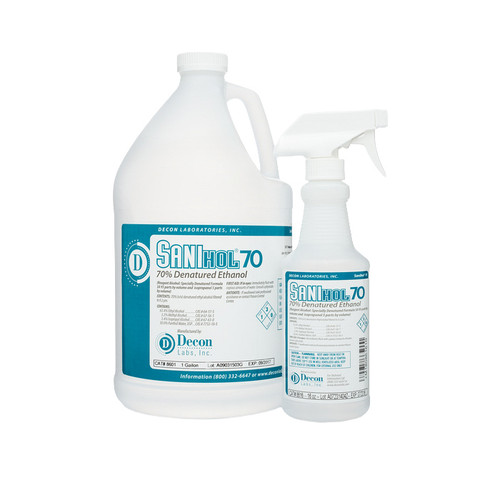
Decon Sanihol® ST 8101 — Sterile 70% Denatured Ethanol Solution (1 Gallon Bottles, 4/Case)
Sanihol ST 8101 is a sterile, ready-to-use 70% (v/v) denatured ethanol solution designed for controlled-environment cleaning and disinfection
workflows where a sterile, non-pyrogenic alcohol is required by SOP. It is made with Water-For-Injection (WFI), filtered to 0.2 microns,
bottled and double-bagged in a controlled cleanroom environment, and gamma-irradiated to a sterility assurance level (SAL) of 10−6.
Each lot is tested for sterility via the USP 14-day sterility test and for bacterial endotoxins prior to release, and each case supports
lot-traceable documentation for QA files.
At-a-glance (published attributes)
- SKU: 8101
- Solution type: Denatured Ethanol (EtOH)
- Concentration: 70% (v/v) denatured ethanol solution (ready-to-use)
- Sterile: Yes
- WFI / non-pyrogenic controls: Made with WFI; lots are tested for bacterial endotoxins prior to release
- Filtration: 0.2 micron filtered
- Sterilization: Gamma-irradiated to SAL 10−6
- USP sterility testing: USP 14-day sterility test (each lot)
- EPA registration: EPA Reg. No. 56753-2
- Packaging: Double-bagged for controlled transfer
- Format: 1 gallon bottles (3.8 L)
- Case pack: Four (1 gallon) bottles per case
- Shelf life: 2 years (expiration on label)
- Ingredients (by volume): 63.4% ethyl alcohol; 3.2% methyl alcohol; 3.4% isopropyl alcohol; 30% USP purified water
Shipping controls (plan receiving)
This item is listed as Hazmat and restricted to Ground shipping only to a commercial address only.
A $35.00 Hazmat shipping charge per case is applied (per listing). Build these constraints into reorder planning for critical programs.
1) Where sterile denatured ethanol fits (and where it does not)
Sterile alcohol is commonly used for routine/intermediate disinfection and wipe-down of hard, non-porous surfaces
(benches, carts, pass-through interiors, equipment exteriors, stainless panels) when the site requires sterile-packaged chemistry.
Sanihol ST is often staged as a “repeatable daily touch” agent in ISO-classified areas—provided the facility controls technique, dwell time,
and contamination interfaces.
Important scope note (accuracy-first)
70% alcohol is not a sporicide. Many validated programs use sterile alcohol for routine steps and implement a separate
sporicidal agent on a defined schedule (rotation) based on risk assessment and contamination control strategy (CCS).
2) Standards alignment (USP, ISO, Annex 1) — educational reference
Regulated cleanrooms are evaluated on process control: written procedures, trained behavior, documentation, and repeatable execution.
USP <797> and USP <800> expect cleaning/disinfection to be SOP-driven (agents, technique, frequencies, PPE).
EU GMP Annex 1 emphasizes a contamination control strategy (CCS), validated cleaning/disinfection, and disciplined operator practices in Grade A/B.
ISO cleanroom operations guidance supports an operations control program covering personnel practices, cleaning, and material movement.
Key compliance reality: standards do not mandate a specific alcohol brand. Facilities must select, qualify, validate, document, and train
on the exact product, wipe method, and wet-contact expectations used in their rooms.
3) Dwell time discipline (disinfection intent must be executed, not assumed)
The most common failure with alcohol disinfectants is contact time collapse: spray once and wipe dry immediately.
If your SOP uses this product as a disinfectant/sanitizer step, execution must preserve full coverage and the required wet contact time.
Published contact-time guidance (verify current label/TDS)
- Disinfection (hard, non-porous surfaces): keep surface wet for a minimum of 10 minutes, then allow to air dry or wipe dry with a sterilized wiper if needed.
- Sanitizing (hard, non-porous surfaces): 5-minute contact time on listed compatible surfaces/areas (see TDS conditions).
- Reality check: in high airflow zones, alcohol can flash off fast—wiper choice and re-wetting determine whether you meet validated conditions.
4) Bulk gallon format: throughput is good—dispensing discipline is mandatory
Bulk containers reduce change-outs and support lot continuity, but they increase audit exposure if teams improvise dispensing.
Define in SOP how Sanihol ST 8101 is dispensed (direct-to-wiper, controlled pour, or transfer into qualified bottles) and how you prevent
top-offs, mixed lots, and missing expiration tracking.
Controls to include (common audit-grade practices)
- Qualified containers only: if transferring, use cleanroom-appropriate bottles/triggers rated for alcohol and approved by your site.
- No “top-off” behavior: do not refill partially used containers unless your SOP allows it under validated controls.
- Traceability: preserve lot/expiration linkage from source bottle to point-of-use containers (labels/logs per SOP).
- Staged de-bagging: remove outer bags in the correct airlock/transition locations before introducing into cleaner zones.
- Documentation retention: capture/retain lot documentation (QC, irradiation, sterility, endotoxin limits) per SOP.
5) System pairings (sterile alcohol + sterile tools + PPE barrier)
Sterile alcohol performance is inseparable from the wiper and PPE interface. Choose tools that match your residue limits,
particle sensitivity, and ISO grade—and validate the method in your SOP.
6) Common failure modes (what auditors and QA teams watch)
- Wet-time failure: wiping dry immediately when disinfection intent requires dwell time.
- Cross-contamination wiping: using a loaded wipe face over large areas (re-deposition).
- Dispensing drift: refilling (“top-off”), mixing lots, or unlabeled secondary containers.
- Transfer drift: bypassing staged de-bagging or staging sterile-packaged bottles on non-controlled surfaces.
- PPE touch events: adjusting hood/mask/eyewear with gloved hands without defined recovery steps.
7) Safety and handling (non-negotiables)
Flammability + SDS control
Denatured ethanol solutions are highly flammable. Control ignition sources, ensure appropriate ventilation, and follow your facility EHS program.
Always refer to the current SDS and the current label/TDS for hazards, handling, spill response, and disposal guidance.
Disclaimer: This Technical Vault content is provided for educational and reference purposes only. It does not constitute regulatory, quality,
engineering, environmental health & safety, or legal advice. Alcohol use as a cleaner/disinfectant, EPA label compliance, required wet-contact time,
wipe technique, dispensing/transfer controls, PPE requirements, and disinfectant rotation strategy must be defined, validated, and documented by the end user
in accordance with internal SOPs, risk assessments, and applicable standards and regulations. Always follow manufacturer instructions and the current SDS/TDS/label.
© 2026 SOS Supply. All rights reserved.