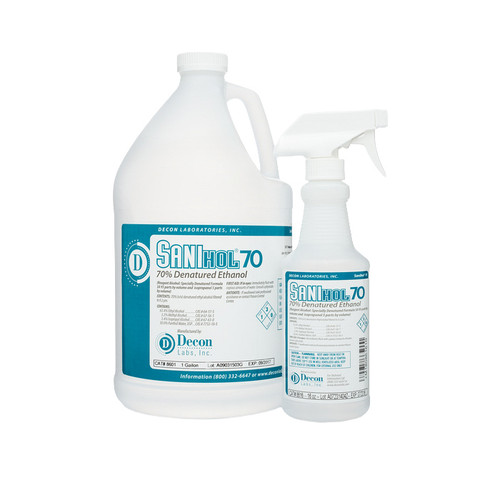
Sanihol ST 8116 Sterile 70% Ethanol Solution – Denatured Ethanol Disinfectant (16 oz.)

$176.03
(No reviews yet)
SKU:
8116
Availability:
Stock Item
Shipping:
Calculated at Checkout
Solution Type:
Ethanol
Sterile:
Yes

Sanihol ST 8116 Sterile 70% Denatured Ethanol Solution (16 oz. Spray Bottle) — Sterile Cleanroom Disinfectant

Sanihol ST 8116 is a sterile, ready-to-use 70% (v/v) denatured ethanol solution intended for critical cleanroom cleaning and disinfection where a sterile, non-pyrogenic alcohol solution is required. It is commonly used for routine wipe-downs, spot cleaning, and disinfection of hard, non-porous surfaces and equipment in pharmaceutical, biotechnology, medical device, and other controlled environments where documentation discipline and lot traceability matter.

Shipping note: This item is classified as a Consumer Commodity (ORM-D) and is restricted to Ground transportation only. Follow your site SOPs, the EPA label, and local regulations for storage, handling, and use.

Specifications:
  • Product: Sterile 70% (v/v) denatured ethanol solution (ready-to-use)
  • SKU: 8116
  • Size: 16 oz. spray bottle
  • Case pack: 12 bottles per case (16 oz. trigger spray bottles)
  • Filtration: Filtered to 0.2 microns (0.2 µm)
  • Packaging: Bottled and double-bagged in a cleanroom; documentation provided for lot traceability
  • Sterilization: Gamma-irradiated to a sterility assurance level (SAL) of 10-6
  • Sterility testing: USP 14-day sterility test (each lot, prior to release)
  • Endotoxin: Each lot tested for bacterial endotoxins; lots are guaranteed < 0.25 EU/mL (WFI endotoxin criterion)
  • EPA registration: EPA Reg. No. 56753-2
  • Shelf life: 2 years from date of manufacture (see product labeling for expiration date)
  • Storage: Do not store above 120°F; keep container tightly closed when not in use
About the Manufacturer: 

Sanihol ST is produced by Decon Laboratories, Inc. (Decon Labs), a long-established manufacturer of contamination-control chemistries and cleanroom-support solutions. In this sterile alcohol format, the manufacturer positions Sanihol ST around repeatability and qualification readiness: controlled filtration, cleanroom packaging practices, gamma irradiation to a defined SAL, and lot-level test documentation for sterility and bacterial endotoxins.


SOSCleanroom has been a distributor of Decon for over 10 years supporting cleanrooms across the United States. If you are qualifying a sterile alcohol for a specific area (ISO cleanroom, aseptic suite, or controlled manufacturing line), our team can help you align packaging, documentation, and delivery cadence to your program needs.

Sanihol ST Features:
  • Sterile 70% (v/v) denatured ethanol solution for controlled-environment cleaning and disinfection
  • Filtered to 0.2 microns (0.2 µm)
  • Bottled and double-bagged within a Class 100 cleanroom environment (per manufacturer documentation)
  • Gamma-irradiated to SAL 10-6 to support sterility assurance
  • Each lot tested via USP 14-day sterility test and for bacterial endotoxins prior to release
  • Lot-specific documentation provided (QC, irradiation, sterility, endotoxin results); QR code on each case links to lot documentation
  • EPA-registered disinfectant (EPA Reg. No. 56753-2)
Sanihol ST Benefits:
  • Qualification-friendly: Defined filtration, gamma sterilization, and lot documentation help support validation/qualification workflows.
  • Operational consistency: Ready-to-use sterile alcohol reduces variability versus field-mixing and helps standardize operator practice.
  • Program confidence: Lot-level sterility and endotoxin testing supports higher-control areas where audit-readiness matters.
  • Fast turnaround cleaning: Alcohol solutions typically evaporate without a rinse step (verify surface compatibility and your site cleaning/disinfection SOP).
Ingredients (by volume):
  • 63.4% Ethyl Alcohol
  • 3.2% Methyl Alcohol
  • 3.4% Isopropyl Alcohol
  • 30% USP Purified Water
Typical disinfection and sanitizing guidance (follow label + site SOP):
  • Ready to use: Do not dilute. Pre-clean heavy soil or gross filth before application.
  • Application distance: Hold bottle upright, about 6–8 inches from the surface, and spray away from eyes and face.
  • Disinfection contact time: Keep surface wet for a minimum of 10 minutes (then air dry, or after 10 minutes wipe dry with a sterilized cloth/wiper if needed).
  • Sanitizing contact time: 5 minutes on hard, non-porous surfaces (per manufacturer efficacy guidance).
  • Target organisms (per AOAC efficacy testing): Pseudomonas aeruginosa (ATCC 15442) and Staphylococcus aureus (ATCC 6538) in 10 minutes (with organic load); sanitizer efficacy includes Staphylococcus aureus (ATCC 6538) and Enterobacter aerogenes (ATCC 13048) in 5 minutes (with organic load).
Best-Practice Use:
  • Ventilation: Use in a well-ventilated area and keep away from ignition sources (flammable liquid).
  • Wipe discipline: When wiping, use clean, low-linting wipers and straight-line strokes; rotate wipe faces to avoid re-depositing contamination.
  • Wet-time control: For disinfection steps, manage dwell time (surface must remain visibly wet for the required contact time).
  • Change-out triggers: Replace wipers promptly when they become visibly soiled or begin streaking.
  • Documentation: Retain lot documentation as required by your quality system (sterility/endotoxin/irradiation records).
Selection Notes (Sanihol ST sterile ethanol vs. other alcohol options):
  • Sterile vs. non-sterile alcohol: Choose sterile alcohol solutions when your area classification, product contact risk, or quality system requires sterility and traceable documentation.
  • Ethanol vs. IPA: Ethanol and IPA are both commonly used in contamination control programs; choose based on residue profile, surface compatibility, and your validated cleaning/disinfection SOP.
  • Spray bottle vs. larger formats: 16 oz spray bottles support point-of-use cleaning; larger containers can reduce packaging handling when you have dedicated dispensing controls in place.
Other Similar Decon Products Available From SOSCleanroom.com

Decon alcohol solutions

Notes: Need help selecting sterile vs. non-sterile alcohol, ethanol vs. IPA, or bottle vs. bulk formats for your controlled-area workflow? Contact SOSCleanroom for practical guidance based on your surface set, residue type, area classification, and validated cleaning/disinfection approach.

If you have any questions please email us at Sales@SOSsupply.com or give us a call at (214)340-8574.

Product page updated: Jan. 7, 2026 (SOS Technical Staff)

© 2026 SOS Supply. All rights reserved.

The Technical Vault
By SOSCleanroom
Sterile 70% denatured ethanol
0.2 µm filtered
Double-bagged + gamma-irradiated (SAL 10⁻⁶)
EPA Reg. No. 56753-2
Use this as the permanent instruction set for SOSCleanroom Technical Vault entries in the category: Solutions.
Sanihol ST 8116: Sterile 70% Denatured Ethanol (EtOH) for cleanroom disinfection with WFI-quality endotoxin control (16 oz. trigger spray)
Sanihol ST 8116 Sterile 70% Denatured Ethanol Solution (16 oz.)
Sanihol ST 8116 (16 oz.) — sterile denatured ethanol solution, cleanroom packaged.
1) Practical solutions in a critical environment

In a cleanroom, alcohol is often the “every-shift” workhorse: fast evaporation, low residue, and practical coverage for benches, carts, stainless panels, and gloved hands when used correctly. Sanihol ST is built for sterile areas where you want the convenience of a trigger spray but still need lot documentation, terminal sterilization, and tight endotoxin control.

SOSCleanroom has been a distributor of Decon for over 10 years supporting cleanrooms across the United States. That matters most when your QA team needs the same formulation, same documentation set, and predictable availability for ongoing programs—not a “close enough” substitute.

2) What this product is used for
  • Routine disinfection of hard, non-porous cleanroom surfaces when a sterile alcohol is required (e.g., staging tables, carts, pass-through interiors, stainless worktops).
  • Sanitizing tasks where a 5-minute contact time is acceptable and controlled documentation is required.
  • Glove and tool wipe-down workflows (when your facility allows alcohol use and you control flammability risk).
  • Programs that require non-pyrogenic alcohol performance targets aligned to Water-for-Injection endotoxin limits (<0.25 EU/mL stated by the manufacturer).
3) Why customers consider this product
  • Sterile, terminally processed alcohol designed for controlled environments (0.2 µm filtration, double-bagging, gamma irradiation to SAL 10⁻⁶).
  • Endotoxin control with a manufacturer-stated guarantee of <0.25 EU/mL (WFI criterion).
  • Operationally realistic packaging — 16 oz. trigger spray for frequent use without decanting.
  • Program documentation discipline — case-linked lot documentation describing QC, irradiation, sterility, and endotoxin limits.
  • Published contact times for disinfection (10 minutes) and sanitation (5 minutes) on hard, non-porous surfaces.
4) Materials, composition, and build

Sanihol ST is a ready-to-use denatured ethanol solution filtered to 0.2 microns and packaged for sterile cleanroom use. The manufacturer lists the formulation (by volume) as: 63.4% ethyl alcohol, 3.2% methyl alcohol, 3.4% isopropyl alcohol, and 30% USP purified water.

From a contamination-control perspective, the “build” is as much about process as chemistry: filtration, cleanroom bottling, double-bagging, and gamma irradiation to protect sterility until use.

5) Specifications in context
Attribute Sanihol ST 8116 (16 oz.)
Product type Sterile denatured ethanol solution (ready-to-use)
Concentration 70% (v/v) denatured ethanol (per manufacturer tech sheet)
Filtration 0.2 µm filtered
Sterility processing Gamma-irradiated to SAL 10⁻⁶; lot sterility tested via USP 14-day sterility test
Endotoxin control Manufacturer states <0.25 EU/mL (WFI criterion); bacterial endotoxin testing prior to release
Ingredients (by volume) 63.4% ethyl alcohol; 3.2% methyl alcohol; 3.4% isopropyl alcohol; 30% USP purified water
EPA registration EPA Reg. No. 56753-2
Primary use claims (published) Disinfectant: minimum 10-minute wet contact time on hard, non-porous surfaces; Sanitizer: 5-minute contact time (per manufacturer tech sheet)
Container format 16 oz trigger spray bottle (sold by case)
Case pack 12 bottles per case (16 oz trigger spray bottles)
Shelf life 2 years (manufacturer published)
Storage limitation Do not store above 120°F (manufacturer published)
Shipping note (published on SOSCleanroom page) Ground transportation only (ORM-D / consumer commodity classification noted on SOSCleanroom listing)
Country of origin Not published on the SOSCleanroom listing or the manufacturer documents referenced in the Source basis.
6) Performance and cleanliness considerations

Alcohol performance in cleanrooms is less about “how strong” and more about how it is used: wet contact time, surface coverage, and how often you replace wipers/cloths during the wipe-down. Sanihol ST’s documented 0.2 µm filtration, sterile packaging controls, and endotoxin limit target are intended to reduce the variability that can show up when teams decant bulk alcohol or use non-sterile bottles in sterile areas.

  • Wet contact time is the requirement. The label/published guidance calls for a minimum 10-minute wet time for disinfection on hard, non-porous surfaces and 5 minutes for sanitation.
  • Residue profile. Alcohol typically flashes off without a rinse step for many applications, which is useful when you want fewer secondary wipes. Always confirm with your own residue/compatibility limits.
  • Not a sporicide. Alcohols are widely used for routine disinfection/sanitation, but spore control typically requires a separate sporicidal program. Align the product to your site’s contamination control strategy and risk assessment.
  • Material compatibility is surface-dependent. Alcohol can stress-crack some plastics (e.g., certain clear plastics) and can affect some painted/printed surfaces. Validate on representative coupons before broad rollout.
7) Packaging, sterility, traceability, and country of origin
  • Sterility controls (published): filtered to 0.2 µm; bottled and double-bagged in a cleanroom; gamma-irradiated to SAL 10⁻⁶; sterility tested via USP 14-day sterility test; bacterial endotoxin testing prior to release.
  • Traceability package: manufacturer states each case includes lot-specific documentation detailing QC, irradiation, sterility, and bacterial endotoxin limits; manufacturer also notes a QR code on each case linked to lot documentation.
  • Case configuration: 12 × 16 oz trigger spray bottles per case (sold as a case on SOSCleanroom).
  • Hazmat/shipping note: the SOSCleanroom listing notes consumer commodity/ORM-D restrictions and ground shipping only.
  • Country of origin: not stated in the SOSCleanroom listing or the manufacturer documents included in the Source basis.
8) Best-practice use

The fastest way to “fail” alcohol disinfection is to let it flash off before the required contact time. In practice, teams often spray, wipe once, and move on—especially on large surfaces. Use a method that controls coverage, wet time, and wipe discipline.

Cleanroom surface workflow (spray + wipe)
  1. Pre-clean first if there is visible soil or residue. Alcohol is not a “degreaser” for heavy soils, and soil load can reduce disinfection performance.
  2. Apply to full coverage (hold bottle upright; typical guidance is 6–8 inches from the surface). Avoid spraying toward eyes/face.
  3. Maintain wet time: keep the surface visibly wet for 10 minutes for disinfection or 5 minutes for sanitation (as published by the manufacturer). Re-wet as needed—do not assume one spray pass is enough on warm or high-airflow surfaces.
  4. Wipe with intent: use a sterile, low-linting cleanroom wiper/cloth and wipe in one direction, overlapping strokes. Rotate to a clean face frequently. Do not “scrub in circles” (it redistributes soil).
  5. Drying decision: after the contact time, allow to air dry, or wipe dry with a sterilized cloth/wiper if your process requires it (manufacturer guidance allows wiping dry after 10 minutes if needed).
Safety and handling cues from real cleanroom use
  • Flammability controls: remove ignition sources, respect hot surfaces, and avoid aerosol buildup in small rooms. Ventilation matters.
  • Trigger discipline: avoid over-misting. Excess fine mist increases inhalation risk and can drift onto sensitive optics/electronics unintentionally.
  • Compatibility check: validate on plastics, labels, inks, and coated surfaces before program-wide adoption.
9) Common failure modes
  • Contact time collapse: spraying a warm surface once and immediately wiping dry (surface is never wet long enough to meet the published 5–10 minute contact times).
  • Cross-contamination wiping: using one saturated wiper for an entire bench, then “finishing” with the same face (redistributing bioburden/particulates).
  • Using alcohol as a heavy-soil remover: it can smear oils/soils; pre-clean is often required for reliable disinfection performance.
  • Improper storage: storing above the manufacturer’s published maximum temperature or near heat sources; increased evaporation and container stress can follow.
  • Uncontrolled “mixing” behavior: combining with other chemistries on the same surface without validated sequencing (risking reduced efficacy or residue issues).
10) Closest competitors

In sterile alcohol programs, most products converge on similar basics (0.2 µm filtration, cleanroom packaging, terminal sterilization). The practical differentiators are documentation completeness, ergonomic delivery, wet contact-time labeling, and how consistently lots behave in your process.

  • Veltek STER-AHOL WFI — sterile 70% denatured ethanol options marketed for classified environments; commonly positioned with WFI blending and EPA registration.
  • Ecolab Life Sciences sterile alcohols — sterile alcohol ranges that include denatured ethanol blends (often WFI/DI options) and multiple delivery formats.
11) Critical environment fit for this product

Sanihol ST is aligned to controlled environments that demand sterile handling and documentation: cleanroom bottled, double-bagged, gamma irradiated to SAL 10⁻⁶, and supported with lot-specific documentation. It is commonly selected for sterile areas where teams prefer not to decant bulk alcohol, and where endotoxin control matters for product-contact-adjacent surfaces.

Decon Laboratories markets Sanihol ST as an EPA-registered disinfectant and emphasizes a WFI-quality endotoxin limit criterion alongside sterility and irradiation documentation. For users, the “fit” is strongest when your program explicitly requires sterile alcohol, traceability paperwork, and published wet contact times—and you have a separate strategy for spore control when needed.

12) SOSCleanroom note about SOP's

The Technical Vault is written to help customers make informed contamination-control decisions and improve day-to-day handling technique. It is not your facility’s Standard Operating Procedure (SOP), batch record, or validation protocol.

Customers are responsible for establishing, training, and enforcing SOPs that fit their specific risks, products, equipment, cleanroom classification, and regulatory obligations. Always confirm material compatibility, cleanliness suitability, sterility requirements, and acceptance criteria using your internal quality system and documented methods.

If you adapt any technique guidance from this entry, treat it as a starting template. Your team should review and approve the final method, then qualify it for your specific surfaces, solvents, cleanliness limits, inspection methods, and risk profile. In short: use these best-practice suggestions to strengthen your SOPs—not to replace them.

13) Source basis
  • SOSCleanroom product page (Sanihol ST 8116 Sterile 70% Ethanol Solution – Denatured Ethanol Disinfectant, 16 oz.): https://www.soscleanroom.com/product/solutions/sanihol-st-8116-sterile-70-denatured-ethanol-solution-16-oz/
  • Manufacturer product page (Sanihol ST): https://deconlabs.com/products/sanihol-st/
  • SOS-hosted Technical Data Sheet (SANIHOL ST Technical Data Sheet; revised 2/02/2016): https://www.soscleanroom.com/content/Decon_pdf/Sanihol%20ST%20Tech%20sheet.pdf
  • Manufacturer Tech Sheet PDF (70% Denatured Ethanol Solution / Sanihol ST details; Rev. 03/2023): https://deconlabs.com/tds/Sanihol%20ST%20Tech%20sheet.pdf
  • SOS-hosted SDS (Sanihol ST SDS; Date of Revision 06/19/2015): https://www.soscleanroom.com/content/Decon_pdf/Sanihol%20ST%20SDS.pdf
  • Manufacturer SDS PDF (Sanihol ST SDS; Date of Revision 12/31/2024R): https://deconlabs.com/sds/Sanihol%20ST%20SDS.pdf
  • ISO (cleanrooms and associated controlled environments): https://www.iso.org/standard/53394.html
  • FDA: https://www.fda.gov/
  • ASTM: https://www.astm.org/
  • IEST: https://www.iest.org/
SOSCleanroom is the source for this Technical Vault entry.
Briefed and approved by the SOSCleanroom (SOS) staff.
If you have any questions please email us at Sales@SOSsupply.com
Last reviewed: January 8, 2026
© 2026 SOSCleanroom