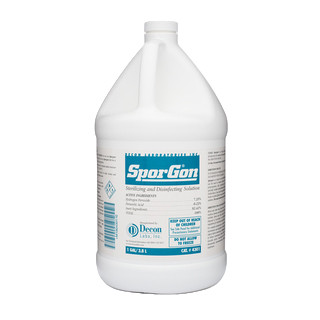
Product image from SOSCleanroom listing.
1) Practical solutions in a critical environment
When a contamination-control program needs a true sporicidal chemistry (not just routine disinfectant rotation), the operational challenge is predictable:
spores tolerate many “daily” chemistries, and they tend to show up at the worst times (after maintenance, a humidity event, a drain issue, or an excursion).
SporGon® is a ready-to-use peracetic acid and hydrogen peroxide disinfectant/sterilant chemistry intended for high-level disinfection and sterilization use cases
when used according to published directions.
In practice, teams choose products like SporGon when they need a controlled, documented approach to spore-formers, and they want a chemistry that does not require mixing
or activation and that breaks down into oxygen, water, and acetic acid per the manufacturer’s description.
2) What this product is used for
- Sporicidal disinfection/sterilant applications where a peracetic acid + hydrogen peroxide chemistry is required and validated.
- High-level disinfection with a published 15-minute contact time at room temperature (20°C) when used as directed by the manufacturer.
- Sterilant-use cases with a published 180-minute (3-hour) contact time at 20°C when used as directed by the manufacturer.
- Programs that prefer a ready-to-use format (no mixing, no activation) to reduce dilution errors and improve procedural consistency.
3) Why customers consider this product
- Ready-to-use sporicide: no mixing and no activation per the manufacturer technical data sheet.
- Clear published contact times: 15 minutes for high-level disinfection and 180 minutes for sterilization at 20°C (when used as directed).
- Known actives: hydrogen peroxide (7.35%) and peracetic acid (0.23%) listed in manufacturer documentation.
- Documented positioning: described as FDA 510(k) cleared and conforming to OSHA Bloodborne Pathogens Standard in manufacturer materials.
- Operational handling guidance is available: storage, PPE expectations, and handling precautions are detailed in the SDS/TDS.
- Convenient case format: four 1-gallon bottles per case supports stocking and scheduled rotations.
4) Materials, composition, and build
SporGon® is a liquid disinfectant/sterilant chemistry built around a hydrogen peroxide and peracetic acid blend.
Manufacturer documentation lists the active ingredients as hydrogen peroxide at 7.35% and peracetic acid at 0.23%, with inert ingredients comprising the remainder.
- Appearance/odor (SDS): yellow liquid with a slight acidic odor.
- pH (SDS): 1.8–2.2.
- Oxidizer precautions (SDS): product contains oxidizers; do not allow the product to dry on clothing, rags, or other combustible material.
- Notable handling hazard (SDS): causes serious eye damage; eye protection is emphasized.
5) Specifications in context
| Attribute |
SporGon 4301 |
| Brand / Manufacturer |
Decon Laboratories (Decon Labs) |
| SOS SKU |
4301 |
| Solution type (SOS listing) |
Sporicide |
| Package configuration (SOS listing / TDS) |
Case: four (1 gallon / 3.8 L) bottles per case |
| Availability (SOS listing) |
Stock item |
| Weight (SOS listing) |
36.00 lbs (case) |
| Active ingredients (TDS/SDS) |
Hydrogen peroxide 7.35%; peracetic acid 0.23% |
| Appearance / odor (SDS) |
Yellow liquid; slight acidic odor |
| pH (SDS) |
1.8–2.2 |
| Published contact time for high-level disinfection (TDS) |
15 minutes at 20°C (68°F) when used as directed |
| Published contact time for sterilization (TDS) |
180 minutes (3 hours) at 20°C when used as directed |
| Shelf life / storage (TDS) |
2 years from date of manufacture; store 15–30°C (59–86°F); do not allow to freeze |
| Sterility |
Not stated in source basis |
| Country of origin |
Not stated in source basis |
Why the specs matter in practice
Sporicides frequently fail in the field for predictable reasons: incorrect dwell time, application on dirty surfaces, freezing during storage,
or unintended dilution. The “ready-to-use” format and the published time/temperature conditions in the manufacturer TDS are the anchor points
a quality team can build into receiving checks, training, and documented rotation schedules.
6) Performance and cleanliness considerations
Manufacturer efficacy information for SporGon includes published contact times against specific organisms. Examples in the technical data sheet
include 180 minutes for Bacillus subtilis and Clostridium sporogenes spores, 15 minutes for Mycobacterium bovis, and shorter contact times for
several vegetative bacteria and select fungi and viruses (see TDS for the full list and conditions).
- Pre-cleaning is non-negotiable: organic soil reduces real-world kill performance; treat sporicide use as a two-step process (clean first, then disinfect with validated dwell).
- Control dilution: the TDS emphasizes ready-to-use use; avoid informal “stretching” practices that silently break your program.
- Material and corrosion awareness: peracetic acid/peroxide blends are potent; validate compatibility for sensitive metals, coatings, and elastomers before broad rollout.
- Residue management is program-specific: if a surface must be residue-controlled (optics, sensors, critical seals), define a documented rinse/removal step using your facility’s approved water/solvent and acceptance criteria.
7) Packaging, sterility, traceability, and country of origin
- Pack size: case of four 1-gallon (3.8 L) bottles per SOSCleanroom listing and manufacturer technical data sheet.
- Documentation: SDS and technical data sheet are available and should be attached to receiving and EH&S review for controlled deployment.
- Storage expectations (TDS): store in original sealed container at 15–30°C (59–86°F); do not allow to freeze.
- Freeze/condition check (SDS): do not use if product has been frozen, becomes cloudy, or has visible precipitants.
- Sterility: not stated in source basis. If sterility is required by your process, obtain and file the correct sterility documentation before use.
- Country of origin: not stated in source basis.
8) Best-practice use
The highest ROI improvement most teams can make with a sporicide is procedural consistency: define the sequence, define the dwell time, and verify coverage.
Below are practical handling suggestions that align with common contamination-control discipline and the product’s published precautions.
Always follow the manufacturer label/SDS/TDS and your validated internal method.
-
Stage the job: post signage, confirm ventilation, and stage compatible tools (dedicated bucket/tray for immersion workflows; dedicated applicators for surface workflows).
Ensure eyewash access is known and unobstructed.
-
Pre-clean first: remove gross soil and residues with your approved cleaner. If soil remains, sporicide performance becomes unpredictable.
-
Apply for full coverage: the surface must stay wet for the full validated dwell. Under-wetting is the most common hidden failure.
For controlled wipe application, use a low-lint wipe appropriate to your cleanroom and surface; avoid reusing visibly loaded wipes.
-
Honor time and temperature: manufacturer documentation references 20°C (68°F). If your area runs colder, your quality team should evaluate whether dwell time needs adjustment for your validated method.
-
Rinse or remove residue where required: if a process requires residue control, document the rinse/removal step and inspection method (visual, NVR, conductivity, TOC, or other facility-defined acceptance criteria).
-
Handle oxidizer precautions: do not allow product to dry on rags or combustible absorbents. Collect waste materials into the facility’s approved container and dispose per local regulations.
9) Common failure modes
- Short dwell time: surfaces “look wet” but dry early; spores survive and the program quietly fails.
- Applying over soil: sporicide is used as a one-step cleaner; organic load shields organisms and reduces efficacy.
- Freeze damage: product freezes in transit or storage; cloudiness/precipitants appear and the solution is still used.
- Informal dilution or decanting without controls: secondary containers without labeling, dates, or controls create traceability and efficacy gaps.
- PPE gaps: eye protection is skipped; SDS identifies serious eye damage hazard.
- Improper waste handling: allowing the product to dry on rags/combustibles increases risk; the SDS includes explicit warnings on this point.
10) Closest competitors
Competitor selection should be driven by your validated efficacy claims, compatibility requirements, residue controls, and documentation expectations.
Two widely used alternatives in similar contamination-control programs include:
-
STERIS Spor-Klenz™ Ready-to-Use Cold Sterilant: a peracetic acid/hydrogen peroxide/acetic acid blend marketed for cleanroom environmental surfaces and equipment, with strong documentation support.
-
Ecolab Klercide™ Rapid Sporicide: a peracetic acid/hydrogen peroxide-based sporicide positioned for cleanroom disinfection programs, with validation-support offerings depending on program needs.
11) Critical environment fit for this product
SporGon 4301 is typically evaluated for higher-risk microbial control steps where spore-formers must be addressed and a facility can support the required dwell,
handling controls, and documentation discipline. This includes regulated and semi-regulated environments where cleaning and disinfection must be defensible
(training, logs, and documented methods), and where sporicide rotation is part of a contamination-control strategy.
Because peracetic acid/hydrogen peroxide chemistries are potent, fit is strongest when your team has completed material compatibility checks, defined residue-control steps where needed,
and aligned the process with your quality system (receiving checks, storage controls, and periodic effectiveness review).
12) SOSCleanroom note about SOP's
The Technical Vault is written to help customers make informed contamination-control decisions and improve day-to-day handling technique.
It is not your facility’s Standard Operating Procedure (SOP), batch record, or validation protocol.
Customers are responsible for establishing, training, and enforcing SOPs that fit their specific risks, products, equipment, cleanroom classification, and regulatory obligations.
Always confirm material compatibility, cleanliness suitability, sterility requirements, and acceptance criteria using your internal quality system and documented methods.
If you adapt any technique guidance from this entry, treat it as a starting template. Your team should review and approve the final method, then qualify it for your specific surfaces,
solvents, cleanliness limits, inspection methods, and risk profile. In short: use these best-practice suggestions to strengthen your SOPs—not to replace them.
13) Source basis
- SOSCleanroom product page (SporGon 4301): https://www.soscleanroom.com/product/solutions/sporgon-4301-sporicidal-disinfectant-1-gallon-bottle-4-case/
- Decon Labs product page (SporGon): https://deconlabs.com/products/sporgon/
- Decon Labs Technical Data Sheet (Rev. 05/2023): https://deconlabs.com/tds/SPORGON%20Tech%20Sheet.pdf
- Decon Labs Safety Data Sheet (revision date shown on document): https://deconlabs.com/sds/Sporgon%20%20SDS.pdf
- SOS-hosted Safety Data Sheet copy: https://www.soscleanroom.com/content/Decon_pdf/Sporgon%20SDS.pdf
- SOS-hosted Technical Data Sheet copy: https://www.soscleanroom.com/content/Decon_pdf/SPORGON%20Tech%20Sheet.pdf
- ISO: https://www.iso.org/standard/53394.html
- FDA: https://www.fda.gov/
- ASTM: https://www.astm.org/
- IEST: https://www.iest.org/
SOSCleanroom is the source for this Technical Vault entry.
Briefed and approved by the SOSCleanroom (SOS) staff.
If you have any questions please email us at Sales@SOSsupply.com
Last reviewed: Jan. 8, 2026
© 2026 SOSCleanroom