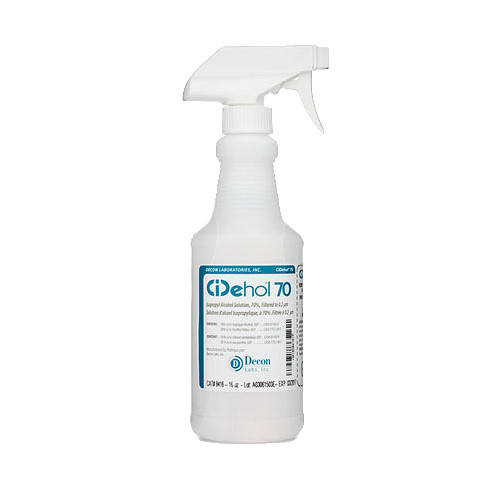
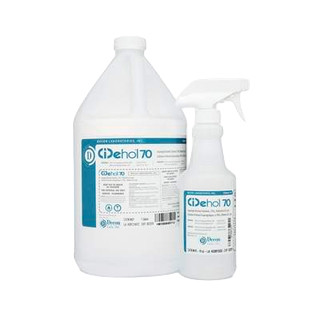
Texwipe TX117 Non-Sterile 70% Isopropyl Alcohol Solution (1 Gallon Bottle, 4/Case)

$126.61
(No reviews yet)
SKU:
TX117
Availability:
Stock Item
Shipping:
Calculated at Checkout
Quantity Option (Case):
Four (1 Gallon) Bottles Per Case
Solution Type:
70% Isopropyl Alcohol

Texwipe TX117 Non-Sterile 70% Isopropyl Alcohol (IPA) Solution — 1 Gallon Bottles (4/Case)

Texwipe TX117 is a ready-to-use, non-sterile 70% isopropyl alcohol (IPA / isopropanol) and 30% USP-purified water solution packaged in cleaned, double-bagged 1 gallon (3.8 L) poly bottles. It is commonly standardized for routine controlled-environment wipe-downs, pass-through prep, and residue removal where consistent wetting, low residue expectations, and lot-level traceability matter. The solution is 0.2 µm filtered, lot coded, and labeled with an expiration date to simplify logs, audits, and recurring replenishment.

Shipping note: This item is considered a hazardous shipment and can only be shipped Ground. All Hazmat shipments require a $35.00 Hazmat shipping charge added for each package/case.

Specifications:
  • Part number: TX117
  • Solution type: 70% Isopropyl Alcohol (IPA), non-sterile
  • Composition: 70% by volume USP-grade isopropanol + 30% USP-purified water
  • Filtration: 0.2 µm filtered
  • Container: 1 gallon (3.8 L) poly bottle (bulk container)
  • Case pack: 4 bottles per case
  • Packaging: Filled into cleaned containers; double-bagged in solvent-safe bags
  • Residue / evaporative behavior: Evaporates leaving low residue (process-dependent)
  • NVR (typical): Does not exceed 5 mg in 50 mL (0.01%)
  • % IPA content (typical): 68%–72%
  • Shelf life (non-sterile): 3 years from date of manufacture
  • Storage conditions: Ambient 59°F to 86°F (15°C to 30°C); keep away from ignition sources
  • Traceability: Each bottle is lot coded with an expiration date; Certificates of Compliance and Analysis available per lot
  • Approx. shipping weight: 32.00 lbs per case (site-listed)
About the Manufacturer: 

TX117 is produced by ITW Texwipe, a long-established contamination-control manufacturer known for process discipline and documentation support that helps cleanroom teams standardize routine cleaning steps. For non-sterile IPA solutions, the manufacturer positions the product around operational repeatability: defined USP-grade chemistry, 0.2 µm filtration, cleaned-container filling, double-bag packaging for controlled entry, and lot coding that supports recordkeeping.


In practice, bulk 1 gallon packaging is often selected when you want fewer change-outs and a stable supply format for staging, refill programs (where allowed), or dedicated dispensing at the point of use. Pair with compatible low-linting cleanroom wipers (no wiper is truly ‘zero-lint’ in every process condition) and a controlled wipe pattern to avoid re-depositing residues and particles.

TX117 Features:
  • Made with USP-grade isopropyl alcohol (isopropanol)
  • 0.2 µm filtered for cleanliness
  • Filled into cleaned containers and double-bagged in solvent-safe bags
  • Lot traceable with expiration date marked on each package
  • Designed for controlled-environment wipe-downs and pass-through prep when sterile packaging is not required
  • Note: Non-atomizing trigger-spray delivery is available on related Texwipe non-sterile IPA trigger formats (bulk TX117 is a 1 gallon bottle intended for controlled dispensing/decant per your SOP).
TX117 Benefits:
  • Process consistency: Standard chemistry and filtration help reduce variability versus ad-hoc mixing or uncontrolled refills.
  • Low-residue cleaning support: Commonly used to lift and remove many routine residues (verify compatibility to your surfaces and SOP).
  • Audit-friendly traceability: Lot coding and manufacturer documentation support cleaning logs and qualification workflows.
  • Bulk efficiency: 1 gallon packaging reduces bottle change-outs for teams with higher consumption.
Common Applications:
  • Surface cleaning and residue removal on compatible, non-porous cleanroom surfaces
  • Wipe-down for pass-through to controlled environments (non-sterile programs)
  • Cleaning gloves, notebooks, phones, and supplies entering controlled areas (when allowed by site SOP)
  • Ideally suited for use with low-linting cleanroom wipers and controlled wipe patterns
  • Replacing solvent blending operations in facilities where standardization and documentation matter
Best-Practice Use:
  • Dispense with control: For bulk bottles, use an approved dispenser or decant method aligned to your SOP to reduce splash, vapor release, and cross-contamination.
  • Wet the wipe, not the room: For critical surfaces, apply IPA to the wipe first (reduces overspray and airborne droplets).
  • Fold for control: Fold into quarters to create multiple clean faces; rotate faces instead of re-wiping with a loaded surface.
  • Wipe pattern: Use straight-line, overlapping strokes; avoid circular wiping that can re-deposit contamination.
  • Change-out triggers: Replace wipes when visibly soiled, tacky, or when they begin leaving streaks (process-dependent).
  • Safety discipline: Keep containers closed when not dispensing; use adequate ventilation; keep away from ignition sources; follow current SDS and site EHS rules.

Safety reminder: Highly flammable liquid and vapor. Use in a well-ventilated area, keep away from ignition sources, and follow PPE requirements. Refer to the current SDS for full hazard, handling, and disposal guidance.

Selection Notes (This 70% Non-Sterile 1 Gallon Bulk Bottle vs. Other Options)
  • Non-sterile vs. sterile: Choose non-sterile (TX117) for controlled environments that do not require sterile packaging/irradiation documentation; choose sterile equivalents when your SOP requires sterile-use controls (e.g., sterile 70% IPA gallon formats).
  • 1 gallon bulk vs. trigger spray: Bulk bottles favor throughput and fewer change-outs; trigger sprays favor point-of-use application control and reduce open-container time.
  • 70% vs. 100% IPA: 70% IPA is commonly selected for routine wipe-downs and residue removal; 100% IPA is typically chosen when higher concentration is required by process needs and compatibility.
Other Similar Products Available From SOSCleanroom.com

Texwipe Isopropyl Alcohol Solutions

  • TX167: Non-sterile 70% IPA trigger spray, 16 fl oz (473 mL), 12 bottles/case
  • TX3290: Sterile 70% IPA, 1 gallon (3.8 L) poly bottle, 4 bottles/case (sterile-use programs)
  • TX111: Non-sterile 100% IPA, 1 gallon (3.8 L) poly bottle, 4 bottles/case (higher concentration)

Notes: Need help selecting 70% vs. 100% IPA, bulk bottle vs. trigger spray, or compatible low-linting wipers for your wipe-down step? Contact SOSCleanroom for practical selection guidance based on surface, residue type, and workflow constraints.

SOSCleanroom.com supports contamination-control programs with dependable supply, fair pricing, and responsive support—backed by customer service that understands real cleanroom workflows.

Product page updated: Jan. 7, 2026 (SOS Technical Staff)

© 2026 SOS Supply. All rights reserved.

The Technical Vault
By SOSCleanroom
TX117 • Non-sterile 70% IPA
1 gallon (3.8L) polybottle
4 bottles per case
Hazmat • Ground shipping only
0.2 µm filtered • Double-bagged
Bulk 70% IPA for controlled-environment wipe-downs: how to use TX117 without creating new contamination risk
Texwipe TX117 Non-Sterile 70% Isopropyl Alcohol (1 gallon) bottle image
Product photo shown on SOSCleanroom listing (TX117, 1 gallon bottle).
1) Practical solutions in a critical environment

A 1-gallon IPA case looks like “just a solvent purchase,” but in a controlled environment it is also a process decision: how you bring a flammable liquid through receiving, control lot/expiration, and dispense it without turning the bottle neck, cap, or transfer tools into the highest bioburden/particle contributors on the job.

Texwipe TX117 is positioned as a non-sterile, ready-to-use 70% isopropyl alcohol solution for wipe-downs, pass-through cleaning, and support-area cleaning where sterility is not required but cleanliness and traceability still matter (0.2 µm filtration, double-bagging, lot coding, expiration marking). TX117 also helps eliminate in-house solvent blending operations that often create variability and documentation gaps.

2) What this product is used for
  • Routine surface cleaning and residue removal in controlled areas and support spaces.
  • Wipe-down of items prior to pass-through into more controlled zones (when your procedure allows non-sterile IPA).
  • Glove and small-tool wipe-downs where quick evaporation and low residue are desired.
  • Bulk supply for refilling facility-approved secondary dispensers (spray bottles, wetted-wipe containers) under controlled transfer technique.
3) Why customers consider this product
  • Defined formulation: 70% by volume USP-grade isopropanol with 30% USP purified water (by volume).
  • Cleanliness controls that support controlled-environment handling: 0.2 µm filtered, filled into cleaned containers, double-bagged.
  • Traceability cues for QA: lot-coded packaging with expiration date marking, plus certificates available by lot.
  • Bulk format reduces frequent changeovers: 1 gallon bottles (4/case) for facilities with recurring wipe-down demand.
  • Process simplification: reduces variability and risk associated with in-house blending and ad-hoc dispensing.
  • Supply continuity: SOSCleanroom’s ongoing relationship with ITW Texwipe supports consistent sourcing and documentation discipline when customers standardize a cleaning program.
4) Materials, composition, and build

TX117 is a premixed 70% IPA solution intended for controlled-environment cleaning. Texwipe describes it as 70% by volume USP-grade isopropanol and 30% by volume USP purified water, processed with 0.2 µm filtration, then filled into cleaned containers and double-bagged in solvent-safe bags. The packaging is lot coded and marked with an expiration date to support record keeping.

Note on dispenser language: some Texwipe and SOSCleanroom literature discusses TX117 alongside TX167 (trigger spray). Spray/nozzle statements apply to the trigger-spray format; TX117 is the 1-gallon bulk polybottle intended for facility dispensing practices.

5) Specifications in context

The table below lists SKU-level attributes that matter operationally (receiving, storage, cleaning use, and QA documentation). If an item is not explicitly published in the source basis, it is shown as “not published.”

Attribute TX117 (as published)
Product / SKU Texwipe TX117
Solution 70% isopropyl alcohol (IPA) solution (non-sterile)
Composition 70% by volume USP-grade isopropanol + 30% by volume USP purified water
Filtration 0.2 µm filtered
Fill environment Filled in an ISO Class 5 environment
Container size 1 gallon (3.8 liters) polybottle
Case pack 4 polybottles per case
Bagging Double-bagged in solvent-safe bags
Traceability Individually lot coded; expiration date marked; certificates available by lot
Shelf life 3 years from date of manufacture (non-sterile)
Storage conditions Ambient storage: 59°F (15°C) to 86°F (30°C)
Shipping constraints (common) Hazmat; ground shipping only; commercial address only (per SOSCleanroom checkout requirements)
6) Performance and cleanliness considerations

“70% IPA” is a familiar cleaner, but controlled environments care about the residuals you leave behind and the repeatability of the mixture. Texwipe publishes typical product characteristics for non-sterile 70% IPA, including concentration range and a low non-volatile residue (NVR) profile that supports wipe-down tasks where visible films and ionic residues are unacceptable.

Characteristic Typical / published value (non-sterile 70% IPA) Why it matters on the floor
% IPA content (by volume) 68%–72% Supports consistent dry time and cleaning behavior; avoids “too wet” (slow dry) and “too dry” (poor wetting).
Specific gravity 0.872–0.883 @ 20°C A quick QA plausibility check when facilities verify incoming chemical lots.
Acidity Not more than 1.0 mL of 0.02 N NaOH per 50 mL IPA solution Helps reduce corrosion risk and unpredictable residue behavior on metals and sensitive assemblies.
NVR Does not exceed 5 mg in 50 mL (0.01%) Lower residue helps reduce filming on optics, stainless, and coated surfaces after evaporation.
Practical note (selection logic)

If your operation requires a sterile disinfectant step, sterile processing, or aseptic core cleaning, a non-sterile IPA is typically a mismatch regardless of how clean it is. TX117 is best treated as a controlled-environment support tool. When sterility is required, facilities commonly standardize a sterile IPA SKU and keep bulk non-sterile for outer areas, pre-clean steps, and materials staging—based on risk assessment and your site procedures.

7) Packaging, sterility, traceability, and country of origin
  • Sterility: Non-sterile (do not substitute for sterile IPA where sterility is required).
  • Packaging: 1 gallon (3.8L) polybottle; 4 bottles per case; double-bagged in solvent-safe bags.
  • Traceability: Lot coded; expiration date marked; certificates of compliance and analysis available by lot.
  • Shelf life: 3 years from date of manufacture for non-sterile IPA.
  • Storage: Store at ambient conditions (59°F–86°F / 15°C–30°C); follow all applicable flammable-liquid guidance.
  • Shipping (operational reality): Flammable liquid / hazmat; SOSCleanroom flags ground shipping only and commercial address only, with a hazmat charge per case.
  • Country of origin: The SOSCleanroom listing does not publish a COO statement in the description. The bottle label shown in the product photo indicates “Made in USA,” and final confirmation should be taken from your lot label and/or certificate for receiving records.
8) Best-practice use

TX117 is often purchased for bulk wipe-down throughput, but most contamination mistakes happen during dispensing. The goal is to keep the “bulk bottle” out of the highest-control zone and transfer product into secondary containers using a repeatable, documented method.

A. Receiving and staging (first 5 minutes matter)
  • Verify case integrity and bag condition; capture lot number and expiration date into your inventory/QA log before breaking down the case.
  • Store in a flammable-compatible area per your facility rules; keep caps tight and bottles upright.
  • If your program uses certificates, pull them by lot before release to the cleanroom supply point.
B. Dispensing into secondary containers (reduce the “funnel problem”)
  • Prefer closed transfer: Use a dedicated, clean, facility-approved dispensing adapter or pump whenever possible. Open pouring is the highest-risk step for particles and touch contamination.
  • Dedicate tools by chemistry: If you must use a funnel or transfer aid, dedicate it to IPA only, store it bagged/covered, and treat it as a controlled item (label, clean, replace on a schedule).
  • Label immediately: Secondary bottle must show contents (70% IPA), lot number, expiration, and “for controlled environment use” per your internal format.
  • Keep bulk out of the highest grade: Many facilities restrict gallon bottles to ISO 7/8 support areas and bring only the approved secondary dispenser into higher classifications.
  • Wiping technique reminder: Apply to a compatible cleanroom wiper, wipe in one direction with overlapping strokes, and avoid “re-wiping dirty” by folding to a clean face and changing wipers frequently.
C. Compatibility and safety checks
  • Confirm surface compatibility (some plastics, inks, and adhesives can haze, swell, or delaminate).
  • Control ignition sources and static discharge; ensure ventilation and flammable-liquid handling alignment with your EHS program.
  • Do not reuse empty containers; residual vapors can be hazardous (see SDS guidance).
9) Common failure modes
  • “Clean IPA, dirty transfer”: pouring through an un-controlled funnel or reusing a pump across chemistries introduces more contamination than the IPA removes.
  • Wrong zone use: using non-sterile IPA inside an aseptic core or sterile processing step because “it’s 70% IPA anyway.”
  • Traceability breaks: secondary spray bottles not labeled with lot/expiration; QA cannot tie a wipe-down event to a released lot.
  • Residue surprises: wiping sensitive optics/coatings with saturated wipers, not changing wipe faces, and leaving a film line at the end of stroke.
  • Safety non-compliance: poor ventilation, ignition sources nearby, or improper storage leading to flammable-liquid findings during EHS audits.
10) Closest competitors

When customers evaluate TX117, they are usually comparing: (1) other premixed 70% IPA bulk cases intended for controlled environments, or (2) in-house blending/dispensing. The most practical comparisons are other premixed, traceable, double-bagged offerings in a 1-gallon / 4-per-case format.

  • Decon Labs CiDehol 8401 (non-sterile 70% IPA, 1 gallon, 4/case) — commonly considered when customers want an alternative brand on the same format.
  • VWR/Avantor 70% IPA (bulk formats) — availability varies by packaging and documentation; confirm double-bagging and lot/expiration conventions for controlled environments.
  • Fisher Scientific 70% IPA (bulk formats) — confirm whether it is positioned as a cleanroom/controlled-environment product versus general lab chemical supply.
11) Critical environment fit for this product

Texwipe positions non-sterile IPA solutions for ISO Class 5–8 environments (and comparable legacy classifications) when used under appropriate procedures. In practice, many facilities treat bulk non-sterile IPA as a controlled-support tool: suitable for outer rooms, staging, and pre-clean steps, while reserving sterile IPA for aseptic/sterile processing or critical core-zone disinfection steps.

If your program references USP <797> and USP <800> requirements for compounding support areas, Texwipe’s published literature explicitly links these solutions to those environments. Your internal risk assessment should still determine where non-sterile chemistry is allowed, what “release” looks like, and how you document wipe-down events.

12) SOSCleanroom note about SOP's

The Technical Vault is written to help customers make informed contamination-control decisions and improve day-to-day handling technique. It is not your facility’s Standard Operating Procedure (SOP), batch record, or validation protocol.

Customers are responsible for establishing, training, and enforcing SOPs that fit their specific risks, products, equipment, cleanroom classification, and regulatory obligations. Always confirm material compatibility, cleanliness suitability, sterility requirements, and acceptance criteria using your internal quality system and documented methods.

If you adapt any technique guidance from this entry, treat it as a starting template. Your team should review and approve the final method, then qualify it for your specific surfaces, solvents, cleanliness limits, inspection methods, and risk profile. In short: use these best-practice suggestions to strengthen your SOPs—not to replace them.

13) Source basis
SKU and supplier sources
  • SOSCleanroom product page (TX117): https://www.soscleanroom.com/product/solutions/texwipe-tx117-non-sterile-70-isopropyl-alcohol-solution-1-gallon-bottle-4-case/
  • Manufacturer product page (Texwipe TX117): https://www.texwipe.com/non-sterile-70-isoproply-alcohol-tx117
Manufacturer technical documents
  • SOS-hosted PDF (Texwipe datasheet covering TX117/TX167): “DS117 Non-Sterile 70% Isopropyl Alcohol” (Effective: August 2012): https://www.soscleanroom.com/content/texwipe_pdf/117%20167.pdf
  • Texwipe Technical Data Sheet: “Solutions – Isopropanol” (TEX-LIT-TDS-036 Rev 06/23): https://www.texwipe.com/images/uploaded/documents/Cleaners/Texwipe-SolutionsIPA-TDS.pdf
  • Texwipe Safety Data Sheet (TX3290, TX117): “Texwipe 70% Isopropyl Alcohol, Sterile/Non-Sterile (1 gallon)” (Version 1; Issue date 07/15/2018): https://www.texwipe.com/images/uploaded/documents/Safety%20Data%20Sheets/TX3290_TX117_US_CA_SDS_ENG.pdf
  • Texwipe certificate center (lot-level documents): https://www.texwipe.com/certificate-center
Standards and regulatory bodies (as applicable)
  • ISO: https://www.iso.org/standard/53394.html
  • FDA: https://www.fda.gov/
  • ASTM: https://www.astm.org/
  • IEST: https://www.iest.org/
SOSCleanroom is the source for this Technical Vault entry.
Briefed and approved by the SOSCleanroom (SOS) staff.
If you have any questions please email us at Sales@SOSsupply.com
Last reviewed: Jan. 7, 2026
© 2026 SOSCleanroom