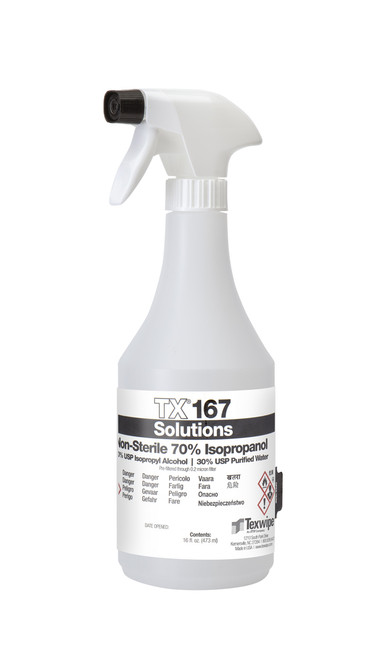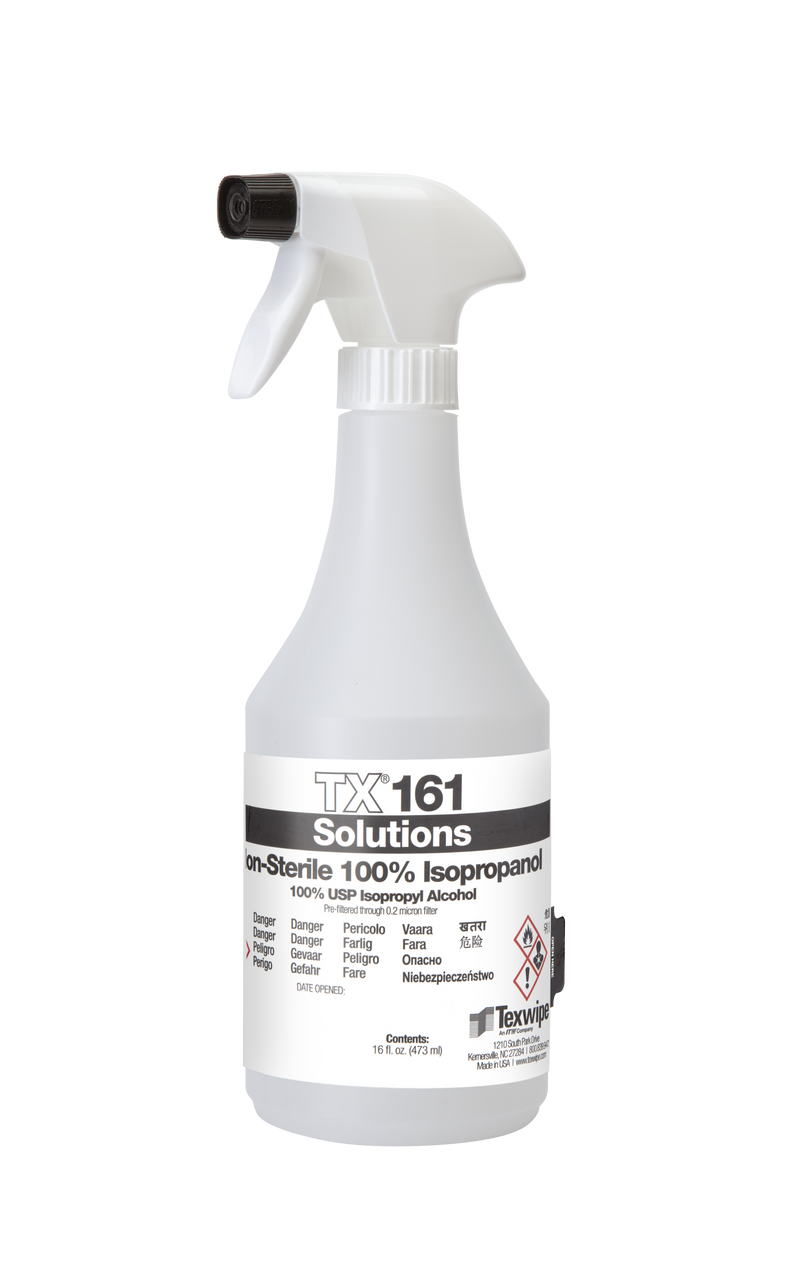
TX161 16 oz trigger spray bottle image (for receiving identification).
1) Practical solutions in a critical environment
In real cleanroom operations, the biggest risk with “routine” solvent wiping is not the chemistry—it is the handling. The moment a bulk pail gets opened on a bench,
you create opportunities for particulate ingress, cross-contact, and inconsistent wetting (too dry to lift residue, or so wet it floods seams, fasteners, and crevices).
TX161 is designed to reduce those day-to-day process variables by combining a prefilled, filtered 100% IPA solution with a ready-to-use, non-atomizing adjustable sprayer and
double-bag packaging for controlled introduction into critical areas.
SOSCleanroom supports Texwipe programs because documentation discipline and lot traceability matter in audits and investigations. When your deviation record needs to answer,
“Which solvent lot touched this tool, this cart, or this enclosure?”, that is not a theoretical question—it is a common root-cause path.
2) What this product is used for
- Surface cleaning and residue removal where a fast-evaporating solvent is preferred.
- Wipe-down of items entering controlled spaces (e.g., pass-through staging, carts, bins, notebooks, phones, and tool cases).
- Critical cleaning workflows that benefit from controlled dispensing instead of pouring from pails or drums.
- Use with low-lint cleanroom wipers when you need consistent wetting and repeatable wipe technique.
3) Why customers consider this product
- 0.2 µm filtered solution for cleanliness-focused solvent use.
- Double-bag packaging to reduce handling contamination during gowning-room transfer and staging.
- Non-atomizing adjustable spray supports controlled application (stream for precision; coarse spray for broader coverage).
- Ready-to-use, fully assembled sprayer reduces assembly steps that can introduce particles or cross-contact.
- Lot-coded with expiration date to support traceability, receiving controls, and investigation timelines.
- Case configuration (12 × 16 oz trigger spray bottles) supports point-of-use stocking without decanting from bulk containers.
4) Materials, composition, and build
TX161 is a prefilled 16 oz (473 mL) trigger-spray bottle containing 100% isopropyl alcohol solution intended for critical cleaning and controlled dispensing.
The solution is described as being filtered through a 0.2 µm filter and filled into cleaned containers that are double-bagged for contamination control.
Each bottle is lot coded and marked with an expiration date for recordkeeping and receiving traceability.
Note on alcohol grade terminology: Texwipe’s IPA technical data sheet describes 100% isopropanol solutions as semiconductor-grade isopropanol and lists TX111/TX161 under that category.
The SOSCleanroom product description includes a “USP-grade isopropyl alcohol” feature bullet while also describing the contents as semiconductor-grade isopropanol. If grade is a release-critical requirement in your
facility (e.g., microelectronics vs. general controlled environment cleaning), confirm acceptance criteria in your internal material specification and verify against supplier documentation at time of receipt.
5) Specifications in context
The table below captures what matters at the bench: container format, packout, filtration, and traceability attributes that drive real-world consistency.
| Attribute |
TX161 |
| Product type |
Isopropyl alcohol (IPA) solution |
| Concentration |
100% isopropanol / isopropyl alcohol |
| Sterility |
Non-sterile |
| Container format |
16 oz (473 mL) trigger spray bottle |
| Case configuration |
12 poly bottles per case |
| Filtration |
0.2 µm filtered |
| Packaging |
Double-bagged in solvent-safe bags |
| Dispense behavior |
Non-atomizing adjustable spray; stream or coarse spray modes |
| Traceability |
Lot coded with expiration date |
| Shelf life |
Non-sterile: 3 years from date of manufacture (per Texwipe IPA TDS) |
| Country of origin |
Not published in source basis |
6) Performance and cleanliness considerations
100% IPA is typically selected when fast evaporation and low residue are critical for visual finish, optical clarity, and tight process timing.
The practical tradeoff is that it can flash off quickly, so wipe technique (maintaining a wet edge and controlling re-deposition) matters more than many teams expect.
Typical published solution characteristics (Texwipe IPA TDS)
- % IPA content (non-sterile 100%): ≥ 99.8%
- Specific gravity (non-sterile 100%): 0.783–0.787
- NVR (non-sterile 100%): ≤ 0.0014 g per 100 mL
- Chloride (non-sterile 100%): ≤ 0.2 ppm
- Sodium (non-sterile 100%): ≤ 0.1 ppm
Cleanroom environment guidance in the Texwipe IPA technical data sheet lists non-sterile IPA solutions for ISO Class 5–8 use cases, supporting controlled environments where sterility is not required but
cleanliness and documentation still matter. If your process is aseptic, sterile fill, or requires sterile disinfectant intent, use a sterile solution validated for that purpose and aligned to your environmental monitoring and cleaning validation program.
7) Packaging, sterility, traceability, and country of origin
- Packaging: Double-bagged for extra contamination control; case unit is 12 poly bottles (16 oz trigger spray bottles).
- Sterility: Non-sterile. (If you need sterile, Texwipe’s sterile 70% IPA family is separately designated.)
- Traceability: Lot coded; expiration date marked on each package for QA tracking and receiving controls.
- Shipping controls: The SOSCleanroom listing flags this as a Consumer Commodity ORM-D shipment with ground shipping only; plan replenishment lead times accordingly.
- Country of origin: Not stated in the SOSCleanroom product page, Texwipe product page, or the linked TDS/SDS in the source basis.
8) Best-practice use
A high-performing solvent can still produce poor outcomes if it is applied inconsistently. The most repeatable approach is to control three variables: (1) where the IPA goes, (2) how the wipe contacts the surface,
and (3) what happens at edges, seams, and “last passes” where residue re-deposition is most common.
Technique module: controlled IPA wipe-down (practical field sequence)
- Stage correctly: Bring the double-bagged bottle through your normal transfer practice. Do not stage opened bottles near particle-generating activities (cardboard, abrasives, unpacking).
- Use “apply-to-wipe” for precision: For critical surfaces, spray the IPA onto a low-lint cleanroom wiper first, then wipe. This reduces overspray into vents, seams, fasteners, and connectors.
- Control wetness: The wipe should be uniformly damp, not dripping. Too wet causes pooling and streaking; too dry lifts less residue and increases re-deposition.
- Wipe pattern: Wipe in one direction with overlapping strokes (think “snowplow” overlap). Rotate or refold the wipe to a clean face before you return to a previously cleaned area.
- Edge control: At edges and corners, slow down and reduce spray. These are the zones where dissolved residue concentrates as IPA flashes off.
- Nozzle hygiene: Do not set the nozzle on benches or let it contact the surface. If the nozzle touches a surface, treat it as a contamination event and replace the bottle or isolate it per your QA practice.
- EHS basics: Use appropriate ventilation and ignition control. IPA is flammable; keep away from sparks, open flames, and hot surfaces. Use eye protection and gloves per your chemical hygiene program.
- Compatibility check: IPA can stress-crack certain plastics and soften some inks, adhesives, and coatings. If the surface is new or high value, test in an inconspicuous area and document the result.
If you are using IPA as part of a regulated cleaning program, align your acceptance criteria to your validation logic (surface type, residue risk, inspection method, and allowable NVR/ionic load).
The “right” IPA is the one that supports your documented process controls, not the one that merely evaporates quickly.
9) Common failure modes
- Streaking or haze: Often caused by wiping with a contaminated or overloaded wipe face, or by letting dissolved residue dry at the wipe boundary.
- Overspray into crevices: Spraying directly onto complex assemblies can drive solvent (and dissolved residue) into seams and under fasteners where it reappears later.
- Nozzle cross-contact: Touching the nozzle to a surface transfers contaminants to the dispenser path and can spread them across future wipe-downs.
- Flash-off before cleaning: 100% IPA can evaporate quickly, especially under high airflow. If the wipe is too dry on contact, cleaning effectiveness drops.
- Safety noncompliance: Using IPA near ignition sources, without ventilation, or without appropriate PPE can create preventable incidents and documentation findings.
10) Closest competitors
Competitors for non-sterile 100% IPA typically differentiate on filtration, packaging discipline (double-bagging), traceability, and whether the product is purpose-built for cleanroom introduction versus general lab solvent use.
When comparing alternatives, focus on how the product is filled, how it is packaged, and whether lot/expiration traceability is standard—not optional.
- Cleanroom-packaged 100% IPA trigger sprays from other contamination-control suppliers: Often comparable in format, but verify double-bag packaging and the supplier’s lot documentation package.
- General laboratory 100% IPA in spray bottles: Typically lacks cleanroom-specific packaging and may not include the same contamination-control handling or documentation expectations.
- Bulk pails/drums of IPA with in-house decanting: Can be cost-attractive, but frequently increases contamination risk and introduces variability in filtration, transfer, and dispenser cleanliness.
11) Critical environment fit for this product
TX161 aligns well with controlled environments where cleanliness and traceability are required but sterility is not. The Texwipe IPA TDS lists non-sterile IPA solutions for ISO Class 5–8 use, supporting common workflows in microelectronics,
optics, aerospace assembly, and controlled manufacturing where residue removal and fast dry-down are process-critical.
If your environment or procedure requires sterile application, validated sporicidal performance, or disinfectant intent, a non-sterile 100% IPA trigger spray is not the right control.
In those cases, match the solution to your classification, cleaning validation strategy, and audit expectations, then standardize receiving criteria (lot, expiration, packaging integrity, and documentation completeness).
12) SOSCleanroom note about SOP's
The Technical Vault is written to help customers make informed contamination-control decisions and improve day-to-day handling technique.
It is not your facility’s Standard Operating Procedure (SOP), batch record, or validation protocol.
Customers are responsible for establishing, training, and enforcing SOPs that fit their specific risks, products, equipment, cleanroom classification, and regulatory obligations.
Always confirm material compatibility, cleanliness suitability, sterility requirements, and acceptance criteria using your internal quality system and documented methods.
If you adapt any technique guidance from this entry, treat it as a starting template. Your team should review and approve the final method, then qualify it for your specific surfaces,
solvents, cleanliness limits, inspection methods, and risk profile. In short: use these best-practice suggestions to strengthen your SOPs—not to replace them.
13) Source basis
- SOSCleanroom product page (TX161): https://www.soscleanroom.com/product/solutions/texwipe-tx161-non-sterile-100-isopropyl-alcohol-solution-16-oz/
- Manufacturer product page (Texwipe TX161): https://www.texwipe.com/non-sterile-ipa-tx161
- SOS-hosted PDF copy (Texwipe non-sterile 100% IPA sheet for TX111/TX161): https://www.soscleanroom.com/content/texwipe_pdf/111%20161.pdf
- Manufacturer Technical Data Sheet (IPA TDS; TEX-LIT-TDS-036 Rev 06/23): https://www.texwipe.com/images/uploaded/documents/Cleaners/Texwipe-SolutionsIPA-TDS.pdf
- Manufacturer Safety Data Sheet (TX161_US_CA_SDS_ENG; date of issue 09/15/2018 per PDF): https://www.texwipe.com/images/uploaded/documents/Safety%20Data%20Sheets/TX161_US_CA_SDS_ENG.pdf
- ISO (International Organization for Standardization): https://www.iso.org/standard/53394.html
- FDA (Food and Drug Administration): https://www.fda.gov/
- ASTM (American Society for Testing and Materials): https://www.astm.org/
- IEST (Institute of Environmental Sciences and Technology): https://www.iest.org/
SOSCleanroom is the source for this Technical Vault entry.
Briefed and approved by the SOSCleanroom (SOS) staff.
If you have any questions please email us at Sales@SOSsupply.com
Last reviewed: Jan. 7, 2026
© 2026 SOSCleanroom