The Technical Vault
Sterile 70% Denatured Ethanol · ISO Class 5 Fill · SAL 10−6 Irradiation · Transfer & Wipe-Technique Discipline for ISO/USP/Annex 1 Programs
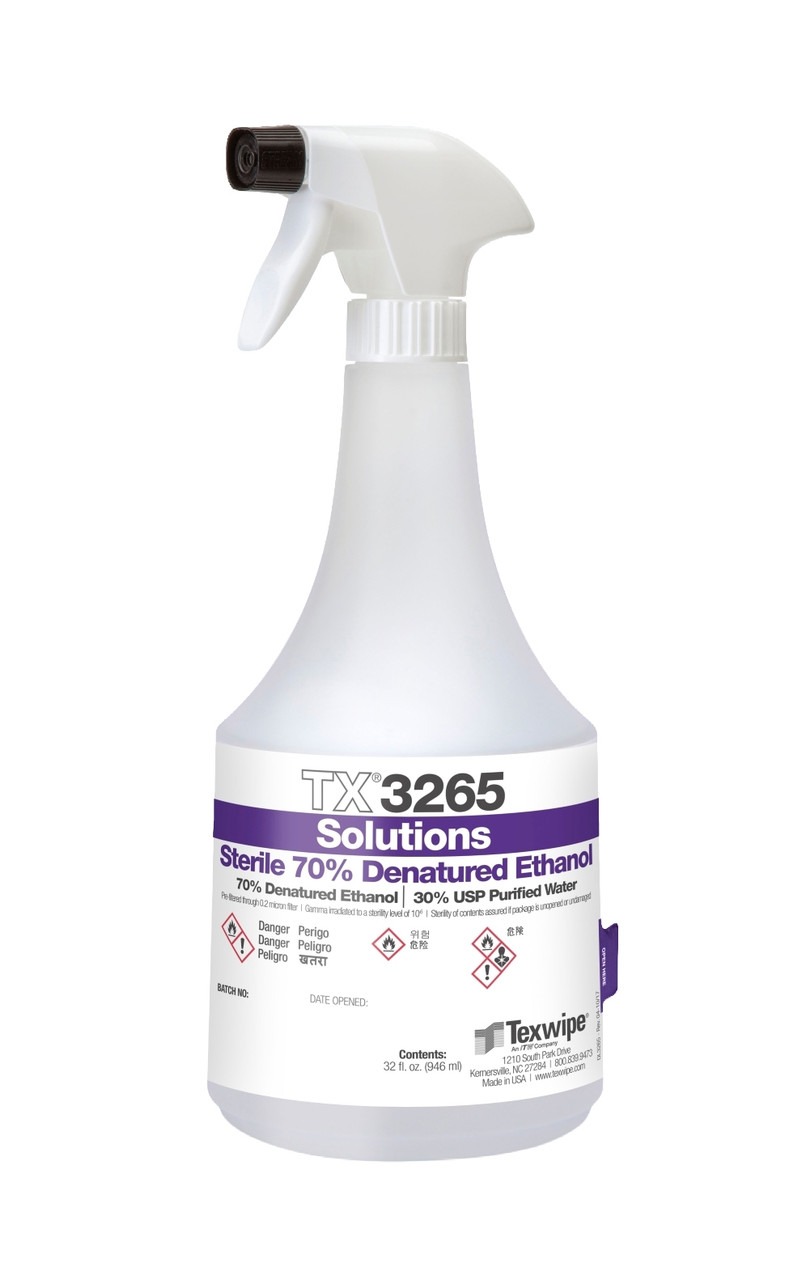
Texwipe TX3265 Sterile 70% Denatured Ethanol (EtOH) Solution — 32 fl. oz. Adjustable Trigger Spray (12/Case)
Texwipe TX3265 is a sterile, ready-to-use 70% denatured ethanol (EtOH) solution designed for controlled environments where
transfer discipline, lot traceability, and repeatable wipe-down technique matter. The solution is 0.2 µm filtered,
filled in an ISO Class 5 environment, individually double-bagged, and gamma irradiated to a sterility assurance level (SAL) of 10−6
(with independent QC audits noted by the manufacturer). Packaged in a 32 fl. oz. (946 mL) adjustable trigger sprayer (jet or spray),
TX3265 supports routine wipe-downs, pass-through decontamination steps, and sterile-suite workflows when a sterile alcohol is required by SOP.
At-a-glance (key published attributes)
- Part number: TX3265
- Solution: Sterile 70% denatured ethanol (EtOH), ready-to-use
- Filtration / fill environment: 0.2 µm filtered; filled in an ISO Class 5 environment
- Sterility assurance: Individually double-bagged and gamma irradiated to SAL 10−6 (independent QC audits noted)
- Residue profile: Evaporates leaving extremely low residue (surface- and process-dependent)
- Dispensing: Adjustable trigger spray — dispense as either a jet or spray
- Traceability: Fully lot traceable; each lot tested for endotoxins
- Shipment documentation: Certificate of Irradiation, Certificate of Compliance, and Certificate of Analysis
- Size: 32 fl. oz. (946 mL) trigger spray bottle
- Case pack: 12 bottles per case
- Published recommended environments: ISO Class 3–8; Class 1–100,000; EU Grade A–D
- Shipping controls (as listed): Hazmat; Ground only; $35 Hazmat fee per case; commercial address only
1) Where sterile 70% ethanol fits (and where it does not)
Sterile alcohol is commonly used as a routine/intermediate disinfectant step and as a practical wipe-down solvent on hard, non-porous surfaces in
controlled environments. TX3265 is typically selected when you need a sterile-packaged alcohol for use inside higher grade areas and
documentation-ready controls (sterility processing, bagging discipline, lot traceability) that support investigations and audit expectations.
Important scope note (accuracy-first)
70% alcohol is not a sporicide. Many validated programs use sterile alcohol for routine steps and implement a separate
sporicidal agent on a defined schedule (rotation) based on risk assessment and contamination control strategy (CCS).
2) Standards alignment (USP, ISO, Annex 1) — educational reference
In regulated cleanrooms, compliance is evaluated as process control: written procedures, trained operator behavior, documentation, and repeatable execution.
USP <797> and USP <800> expect cleaning/disinfection activities to be SOP-driven (agents, methods, frequencies, and PPE).
EU GMP Annex 1 emphasizes contamination control strategy (CCS), validated disinfection, and disciplined operator practices in Grade A/B.
ISO cleanroom operations guidance supports an operations control program covering personnel practices, cleaning, and material movement.
Key compliance reality: standards do not mandate a specific alcohol brand. Facilities must select, qualify, validate, document, and train
on the exact product, wipe method, and any wet-contact expectations used in their rooms.
3) Application technique that holds up in critical environments
A. Prefer “spray-to-wipe” in ISO-critical zones
In higher grade areas, many facilities apply sterile alcohol onto a sterile, low-linting wiper and then wipe the surface.
This improves saturation control and reduces overspray/aerosolization near airflow paths and open components (align with label and SOP).
B. Unidirectional wipe discipline
Use straight-line, overlapping strokes; rotate to a clean wipe face frequently. Avoid re-depositing soils by dragging a loaded wipe across a large area.
Replace wipes when they become visibly soiled, over-saturated, or contact a non-controlled surface.
C. Wet-contact time must be defined by SOP
If your SOP uses alcohol as a disinfection/sanitation step, keep the surface visibly wet for the required contact time (re-wet as needed).
In high airflow environments, alcohol can flash off quickly—technique and wiper selection determine whether you meet validated conditions.
4) Double-bag transfer control (make it real, not symbolic)
TX3265 is individually double-bagged to support staged de-bagging and cleaner-area introduction. The value of this packaging is only realized when your facility
removes outer bags in the correct transition zones (per SOP), maintains bag seal integrity, and prevents “shortcut” staging on non-controlled surfaces.
5) Suggested system pairings (validated-program logic)
Sterile alcohol performance is inseparable from the wiper and PPE system. Final selection must match your ISO class, residue limits,
and SOP validation.
6) Common failure modes (what to watch in audits)
- Wet-time failure: spraying and wiping dry immediately when SOP expects a disinfectant contact time.
- Cross-contamination wiping: using one loaded wipe face across large areas (re-deposition).
- Packaging drift: bypassing staged de-bagging, or introducing bottles with compromised bag seals.
- Touch events: adjusting hood/mask/eyewear with gloved hands without defined recovery steps.
7) Safety and handling (non-negotiables)
Flammability + SDS control
Denatured ethanol solutions are highly flammable. Control ignition sources, ensure appropriate ventilation, and follow your facility’s EHS program.
Always refer to the current SDS and your internal SOP for storage, spill response, and disposal guidance.
Disclaimer: This Technical Vault content is provided for educational and reference purposes only. It does not constitute regulatory, quality,
engineering, environmental health & safety, or legal advice. Alcohol use as a cleaner/disinfectant, any required wet-contact time, wiping technique,
transfer/handling controls, PPE requirements, and disinfectant rotation strategy must be defined, validated, and documented by the end user in accordance
with internal SOPs, risk assessments, and applicable standards and regulations. Always follow manufacturer instructions and the current SDS/TDS/label.
© 2026 SOS Supply. All rights reserved.