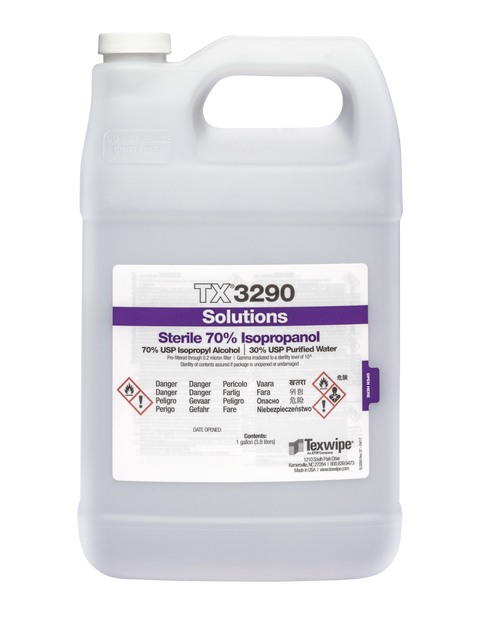
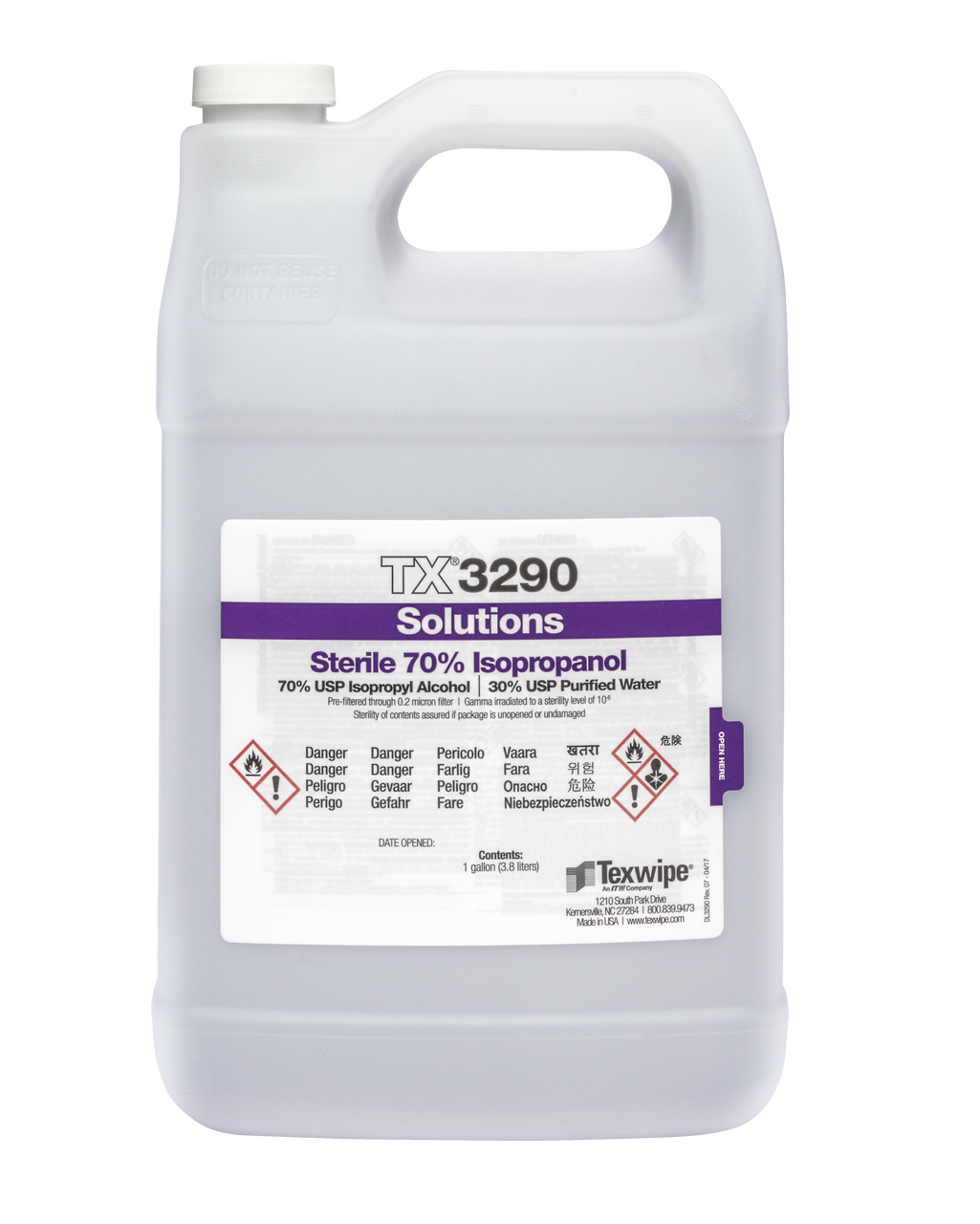
TX3290 bulk 1-gallon poly bottle format for higher-throughput alcohol use (4 bottles per case).
Practical solutions in a critical environment
Alcohol programs rarely fail because “the alcohol was wrong.” They fail because execution drifts: a decant bottle gets reused across zones,
caps are left loose, surfaces are “wiped dry” instead of wiped clean, and lot/expiration details never make it into the log when an audit question lands.
TX3290 is built to reduce that variability with sterile processing, consistent filtration/fill controls, and lot-coded traceability that supports
investigation-ready recordkeeping.
The 1-gallon format also changes behavior. It supports steady throughput (fewer mid-shift bottle swaps), helps standardize lots over a work period,
and reduces last-minute substitutions. SOSCleanroom’s long-standing relationship with ITW Texwipe supports continuity of supply and documentation discipline
(certificates by lot, stable technical references, predictable packaging) so cleaning programs stay consistent across shifts and over time.
What this product is used for
- Surface cleaning and residue removal on hard, non-porous surfaces and equipment exteriors (method-dependent).
- Wipe-down of items entering a controlled environment (gloves, notebooks, phones, tools), when allowed by facility policy and compatibility.
- Pass-through wipe-down steps where teams want a pre-made sterile 70/30 IPA/water blend rather than mixing in-house.
- Bulk staging for higher consumption areas using controlled dispensing into qualified secondary containers.
Why customers consider this product
- Sterile, ready-to-use blend: 70% by volume USP-grade isopropanol with 30% USP-purified water; avoids in-house blending variability.
- Filtration and fill controls: manufacturer guidance describes 0.2 µm filtration and filling in an ISO Class 5 environment; SOS listing notes filtration through a 0.22 µm filter.
- Sterility assurance: gamma-irradiated to a sterility assurance level of 10-6, with sterile documentation available per lot (manufacturer guidance).
- Packaging discipline: double-bagged in solvent-safe bags and packaged in a sealed poly bag case liner for controlled transfer and storage.
- Audit-ready traceability: lot coded with expiration marking; shipments supported by lot-specific certificates (processing/compliance) as described on the SOS listing.
- Bulk efficiency: 1-gallon bottles support higher throughput and reduce bottle change-outs in routine wipe-downs.
Materials, composition, and build
TX3290 is a sterile 70% isopropanol solution described as 70% by volume USP-grade isopropanol (isopropyl alcohol) and 30% USP-purified water.
The manufacturer technical data sheet lists typical IPA content for 70% solutions as 68%–72% and confirms USP-grade IPA and USP-purified water requirements.
Packaging is a 1-gallon (3.8 L) poly bottle. The product is described as filtered (0.2 µm, and also referenced as 0.22 µm on the SOS listing),
filled into cleaned containers, double-bagged in solvent-safe bags, and gamma-irradiated for sterility assurance.
Specifications in context
This table consolidates the SKU-level details teams typically verify for receiving inspection, change control, and day-to-day handling consistency.
If a value is not shown, it was not published in the sources listed in the Source basis section.
| Attribute |
TX3290 |
| Product type |
Sterile 70% isopropanol solution |
| Blend composition |
70% by volume USP-grade isopropanol + 30% USP-purified water |
| Typical IPA content |
68%–72% (typical) |
| Filtration / fill environment |
0.2 µm filtered; filled in an ISO Class 5 environment (manufacturer TDS). SOS listing states filtration through 0.22 µm filter. |
| Sterility method / assurance |
Gamma irradiated to SAL 10-6 (sterile product guidance) |
| Container format |
1 gallon (3.8 L) poly bottle |
| Case pack |
4 poly bottles per case |
| Packaging controls |
Filled into cleaned containers; double-bagged in solvent-safe bags; sealed poly bag case liner |
| Traceability documentation |
Lot coded; expiration date marked; lot-specific certificates described (processing/compliance; manufacturer certificate center referenced in TDS) |
| Appearance / odor (typical) |
Clear, colorless liquid; characteristic alcohol odor |
| Specific gravity (20°C, typical) |
0.872–0.883 |
| NVR (typical) |
Does not exceed 5 mg in 50 mL (0.01%) |
| Shelf life |
Sterile: 2 years from date of manufacture (manufacturer TDS) |
| Country of origin |
Not stated in source basis |
Performance and cleanliness considerations
The practical “performance” of 70% IPA is about residue control and consistency. The manufacturer guidance emphasizes low-residue evaporation
(no rinse required) and contamination-control processing (ISO Class 5 fill, 0.2 µm filtration, cleaned containers, double-bagging). In real workflows,
outcomes still depend on technique: one-direction strokes, frequent wipe-face rotation, and working clean-to-less-clean to prevent re-deposition.
Sterile processing helps when the alcohol is used in critical areas and pass-through steps, but sterile does not automatically mean “risk-free.”
The failure mode to watch is handling: uncontrolled decanting, unlabeled secondary containers, and “shared bottles” drifting across zones.
Treat alcohol control like any other controlled material: defined storage, defined issue, defined discard rules.
Safety is part of performance. The SDS classifies the solution as a highly flammable liquid and vapor, with eye irritation and single-exposure narcotic effects hazards.
Ventilation, ignition control, and closed-container discipline should be embedded in the method—not left to informal habit.
Packaging, sterility, traceability, and country of origin
- Pack size: Four 1-gallon (3.8 L) poly bottles per case.
- Sterility approach: described as gamma irradiated to SAL 10-6, with sterile documentation available per lot (manufacturer guidance).
- Transfer-friendly packaging: double-bagged in solvent-safe bags and packaged with a sealed poly bag case liner to support cleaner staging and movement.
- Traceability: lot coded and expiration dated; SOS listing describes lot-specific Certificate of Processing and Certificate of Compliance accompanying shipments.
- Shipping constraints: described as not shippable by air freight; SOS listing indicates hazmat ground shipping only, commercial address only, and a per-case hazmat fee.
- Country of origin: not stated in source basis.
Best-practice use
Bulk sterile alcohol handling that prevents cross-zone drift
- Treat dispensing as a controlled step: if you pour/dispense into smaller bottles, qualify the secondary container (material compatibility, closure integrity) and label it with lot, expiration, date opened, and designated zone.
- Minimize open time: open only long enough to dispense; close immediately to reduce evaporation variability and vapor load.
- Use a disciplined wipe method: wet a low-linting cleanroom wiper per your SOP, wipe one direction with overlap, rotate to a fresh face frequently, and never “buff” a surface with a contaminated wipe face.
- Control the sequence: work clean-to-less-clean (and top-to-bottom where applicable) to reduce cross-contamination.
- Compatibility matters: validate on your actual surface set (plastics, coatings, labels, adhesives) before broad deployment.
- Build safety into the method: control ignition sources, ensure ventilation, and follow SDS precautions as operational requirements.
Receiving/QA tip: verify case count (4 bottles), confirm double-bag integrity, check for legible lot and expiration markings, and file the current TDS/SDS revisions
in your chemical documentation set. For hazmat materials, inspect caps and handles for leakage, then quarantine any compromised unit before it enters the gowning flow.
Common failure modes
- Uncontrolled decanting: secondary bottles are unlabeled or reused across zones, breaking traceability and increasing contamination risk.
- Re-deposition during wiping: the same wipe face is used too long, spreading oils/particles rather than removing them.
- Evaporation variability: caps left loose or containers left open change wetting behavior and increase vapor exposure.
- Compatibility surprises: hazing, whitening, label lift, or stress cracking occurs because surfaces were not qualified.
- Safety noncompliance: ignition control and ventilation are not enforced as part of the method, increasing incident risk.
Closest competitors
Meaningful comparisons for sterile 70% IPA bulk typically center on filtration/fill controls, sterility method and documentation, packaging discipline,
traceability (lot/expiration), and how well the supplier supports consistent repeat ordering without documentation drift.
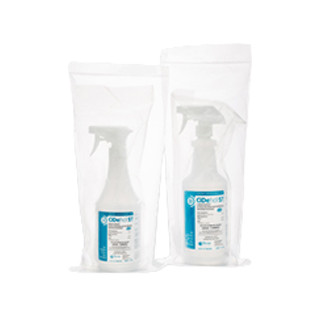
- Decon Labs CiDehol ST 8301 (sterile 70% IPA, 1 gallon, 4/case): compare sterility documentation, packaging controls, and lot traceability against your receiving criteria.
- Avantor/VWR sterile 70% IPA bulk offerings: compare published filtration/fill claims, certificate availability, and labeling discipline for audit readiness.
- Other sterile IPA suppliers: compare double-bagging, case-liner controls, and shelf-life/expiration labeling consistency across lots.
Critical environment fit for this product
Manufacturer guidance positions sterile IPA solutions for ISO Class 3–8 environments (and corresponding EU Grade A–D contexts), with use cases spanning
microelectronics, medical device, pharmaceutical/biologics, compounding pharmacies, and cleanroom maintenance. The same guidance states the solutions meet
USP <797> and USP <800> requirements; facilities should still confirm how that aligns with their SOPs, acceptance criteria, and quality system expectations.
TX3290 is a strong fit when teams want a sterile, bulk alcohol option for pass-through and routine wipe-downs with predictable traceability and certificates by lot.
For high-sensitivity work, the method matters as much as the material: control dispensing, control zone assignment, and train consistent wipe technique.
SOSCleanroom note about SOP's
The Technical Vault is written to help customers make informed contamination-control decisions and improve day-to-day handling technique.
It is not your facility’s Standard Operating Procedure (SOP), batch record, or validation protocol.
Customers are responsible for establishing, training, and enforcing SOPs that fit their specific risks, products, equipment, cleanroom classification, and regulatory obligations.
Always confirm material compatibility, cleanliness suitability, sterility requirements, and acceptance criteria using your internal quality system and documented methods.
If you adapt any technique guidance from this entry, treat it as a starting template. Your team should review and approve the final method, then qualify it for your specific surfaces,
solvents, cleanliness limits, inspection methods, and risk profile. In short: use these best-practice suggestions to strengthen your SOPs—not to replace them.
Source basis
- SOSCleanroom product page: https://www.soscleanroom.com/product/solutions/texwipe-tx3290-sterile-70-isopropanol-alcohol-solution-1-gallon-bottle-4-case/
- Manufacturer product page (TX3290): https://www.texwipe.com/sterile-70-isoproply-alcohol-tx3290
- Manufacturer Technical Data Sheet (Isopropanol Solutions; TEX-LIT-TDS-036 Rev 06/23): https://www.texwipe.com/images/uploaded/documents/Cleaners/Texwipe-SolutionsIPA-TDS.pdf
- Manufacturer Safety Data Sheet (TX3290/TX117, US/CA): https://www.texwipe.com/images/uploaded/documents/Safety%20Data%20Sheets/TX3290_TX117_US_CA_SDS_ENG.pdf
- SOS-hosted reference PDF (TX3290 datasheet; effective Aug. 2012): https://www.soscleanroom.com/content/texwipe_pdf/3290.pdf
- ISO (cleanroom context): https://www.iso.org/standard/53394.html
- FDA (regulated environment expectations): https://www.fda.gov/
- ASTM (methods and materials standards): https://www.astm.org/
- IEST (contamination control guidance): https://www.iest.org/
SOSCleanroom is the source for this Technical Vault entry.
Briefed and approved by the SOSCleanroom (SOS) staff.
If you have any questions please email us at Sales@SOSsupply.com
Last reviewed: Jan. 7, 2026
© 2026 SOSCleanroom