The Technical Vault
Sterile 70% IPA · Routine/Intermediate Disinfection Support · Clean Entry Packaging
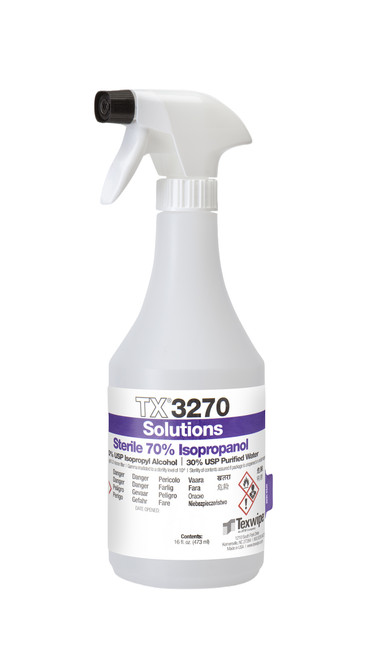
Texwipe TX3270 Sterile 70% IPA Isopropanol Alcohol Solution (16 oz. Trigger Spray)
Texwipe TX3270 is a sterile, ready-to-use solution of 70% isopropanol (IPA) and 30% USP-purified water,
packaged in fully assembled 16 fl oz (473 mL) trigger-spray bottles. It is commonly used for contamination-sensitive wipe-downs,
pass-through prep, and routine controlled-environment cleaning where consistent wetting, low residue, and lot-level traceability matter.
At-a-glance (published attributes)
- Solution type: 70% Isopropyl Alcohol (IPA) / 30% USP-purified water
- Format: Fully assembled trigger-spray bottle, 16 fl oz (473 mL)
- Case pack: 12 poly bottles per case
- Sterility: Yes (sterile product)
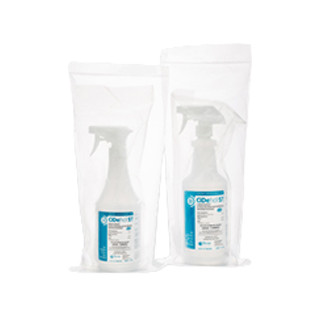
- Filtration / packaging notes: 0.2 µm filtered; double-bagged for clean entry (as listed on the product page)
- Shipping constraint: Ground shipping only (flammable / ORM-D acknowledgement on checkout workflow)
1) Where TX3270 fits in a contamination control program
Sterile 70% IPA is widely used as a routine or intermediate disinfectant step in ISO-classified environments. In practice, it is used to:
(a) support frequent wipe-down of cleanroom contact surfaces, (b) prep items for controlled entry (e.g., pass-through staging), and
(c) sanitize gloved hands during operations, when defined in the facility SOP.
Important scope note (accuracy-first)
70% IPA is not a sporicide. Many validated programs use IPA for routine/intermediate disinfection and implement a
separate sporicidal agent on a defined schedule as part of a rotation. Always follow your site’s contamination control strategy
and validation protocol.
2) Standards alignment (USP, ISO, Annex 1) — educational reference
In critical environments, standards and guidance consistently emphasize: (1) the need for clean and disinfected surfaces,
(2) trained personnel using appropriate garb/PPE, and (3) documented, validated procedures. USP <797> and USP <800>
expect cleaning/disinfection activities to be controlled through SOPs using suitable agents and appropriate PPE for the task.
EU GMP Annex 1 reinforces the need for a robust contamination control strategy, including validated disinfection processes and
disciplined operator behavior. ISO cleanroom operations guidance (e.g., ISO 14644-5) supports establishing an operations control program
covering personnel practices, cleaning, and material movement.
Key compliance reality: these frameworks do not “approve” a specific brand or bottle style. Facilities are responsible to
select, validate, document, and train on the exact products and methods used in their rooms.
3) Application technique (what auditors look for)
A. Prefer “spray-to-wipe,” not “spray-to-surface” (when feasible)
For many critical surfaces, applying IPA onto the wiper (then wiping) improves control of saturation and reduces
aerosolization and overspray. Where your SOP allows direct spray on a surface, define the target area, spray distance, and maximum wetting
to prevent pooling or drip transfer.
B. Single-pass, unidirectional wiping with overlap
Use single-pass strokes (do not “scrub back and forth” with the same face of the wiper). Overlap strokes to avoid missed lanes.
Change to a clean wiper face (or a new wiper) as soon as it becomes loaded, dries out, or contacts a non-controlled surface.
C. Contact time is defined by your SOP and validation
Maintain the surface visibly wet for the contact time specified in your procedure. Contact time and technique should be validated
for the way your team actually uses the product (surface type, wiping method, and environmental conditions).
4) Donning discipline and PPE interface control
Cleaning and disinfection should be performed by trained, appropriately garbed personnel. A common failure mode in audits is not the
chemical—it’s touch events (adjusting eyewear, re-touching non-controlled objects, poor glove-sleeve overlap) that reintroduce contamination.
Practical, SOP-aligned reminders
- Be fully gowned before introducing sterile solutions into ISO-classified areas.
- Don sterile gloves last (typical practice), then sanitize gloves with sterile IPA per SOP.
- If you must adjust goggles/hood/mask, follow your SOP (e.g., re-sanitize gloves, replace PPE, or step out).
- Confirm PPE needs for splash risk (eye protection) and chemical exposure (e.g., USP <800> hazardous drug handling).
5) System pairings (to standardize performance)
TX3270 is typically most effective when paired with cleanroom consumables engineered for low residue transfer and controlled wiping.
Below are common pairings used in validated programs (final selection must match your ISO class, room behavior, and SOP validation):
6) Selection notes (why this 16 oz sterile trigger format)
- Repeatable dosing: trigger format supports consistent surface wetting when the spray pattern and distance are standardized in SOP.
- Clean entry readiness: double-bagging supports staged de-bagging for controlled introduction.
- Operational efficiency: assembled bottles reduce setup steps and variability across shifts.
- Traceability: sterile solutions are commonly managed with lot-level traceability in validated programs.
7) Safety and handling (non-negotiables)
Flammability & SDS
70% IPA is a highly flammable liquid and vapor. Use in a well-ventilated area, keep away from ignition sources, and follow your site’s
PPE and EHS program. Always refer to the current SDS for full hazard, handling, storage, and disposal guidance.
Revision control
Technical Vault entry (SOSCleanroom): This content should be reviewed whenever manufacturer documentation, USP chapters, ISO standards,
or Annex 1 guidance is revised, or whenever your site changes cleaning SOPs or validation parameters.
Disclaimer: This Technical Vault content is provided for educational and reference purposes only. It does not constitute regulatory,
quality, engineering, environmental health & safety, or legal advice. Cleaning agents, contact times, wiping techniques, PPE requirements,
disinfectant rotation, and all related procedures must be defined, validated, and documented by the end user in accordance with internal SOPs,
risk assessments, and applicable standards and regulations. Always follow manufacturer instructions and the current SDS.
© 2026 SOS Supply. All rights reserved.