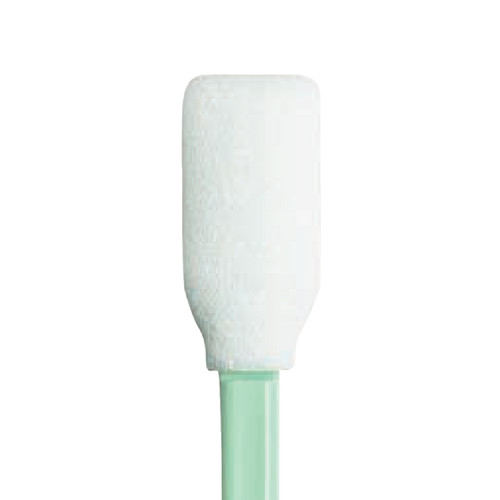
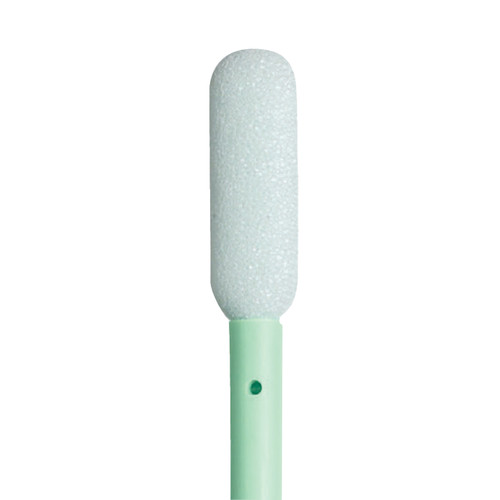
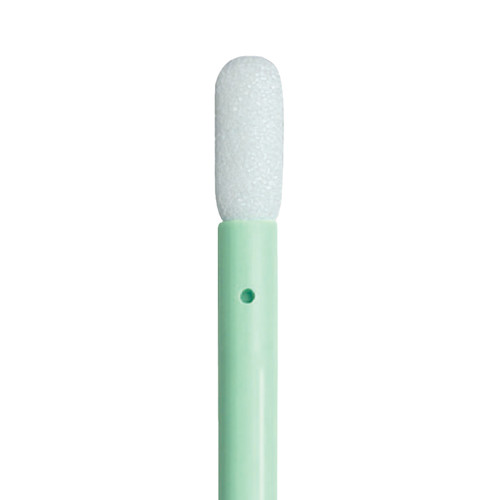
Texwipe STX708A Sterile CleanFoam Swab with Circular Head

$443.55
(No reviews yet)
SKU:
STX708A
Availability:
7 - 10 Business Days
Shipping:
Calculated at Checkout
Quantity Option (Case):
10 Boxes of 50 Swabs Per Case
Type:
Dry Swab
Swab Family:
CleanFoam
Swab Material:
Foam
Sterile:
Yes

STX708A Sterile CleanFoam® Circular-Head Cleanroom Swab (100 PPI Polyurethane Foam, Individually Wrapped, Gamma Irradiated SAL 10-6)

Texwipe STX708A is a sterile circular-head foam cleanroom swab designed for environmental monitoring, diagnostic sampling, and controlled cleaning on curved or irregular surfaces where a rectangular head can skip edges or miss contact on radii. The head is constructed from high-quality 100 PPI polyurethane CleanFoam® and joined to a long, easy-grip polypropylene handle using complete thermal bond construction to eliminate adhesive contamination at the bond line. Each swab is individually wrapped for point-of-use sterility and is gamma irradiated to a 10-6 Sterility Assurance Level (SAL) in accordance with ANSI/AAMI/ISO 11137. In practical cleanroom use, foam swabs are selected for low-linting performance (no swab is truly ‘lint-free’ in every process condition), solvent pickup/control, and consistent contact on complex geometries—while sterile packaging, lot traceability, and expiration dating help keep sampling workflows defensible and audit-ready.

Sterile-program note: STX708A is widely selected when teams need a sterile, ready-to-use circular foam swab with package-level lot coding and expiration dating for cleanroom sampling and controlled cleaning steps where chain-of-custody, repeatability, and seal-integrity checks matter at the point of use.

Specifications:
  • SKU: STX708A
  • Type: Dry Swab (sterile)
  • Swab family: CleanFoam® (Sterile CleanFoam® Series)
  • Swab material: Foam
  • Head material: 100 PPI polyurethane CleanFoam® foam
  • Head width: 19.7 mm (0.776")
  • Head thickness: 9.4 mm (0.370")
  • Head length: 26.4 mm (1.040")
  • Handle material: Polypropylene
  • Handle width: 6.6 mm (0.260")
  • Handle thickness: 3.2 mm (0.126")
  • Handle length: 105.8 mm (4.165")
  • Total swab length: 132.2 mm (5.205")
  • Head bond: Thermal (complete thermal bond; no adhesive)
  • Handle color: Light Green
  • Design notes: Rigid head paddle; long, easy-grip handle
  • Sterility: Gamma irradiated to 10-6 SAL (ANSI/AAMI/ISO 11137)
  • Traceability: Lot code and expiration date marked on each package and included in barcode for inventory control
  • Documentation: Certificates of Irradiation and Compliance attached to each case to confirm irradiation dose met specification
  • Packaging: 1 swab/sleeve (individually wrapped); 50 swabs/box; 10 boxes/case (500 sterile swabs/case)
  • Controlled introduction: Individually wrapped sleeves; packaged to support point-of-use seal integrity checks and controlled handling
  • Sterile shelf life: 3 years from date of manufacture (program/qualification dependent)
  • Country of origin: Made in the Philippines; gamma irradiation performed in the U.S. (capture in qualification documentation if required)
  • Use environments: Commonly used in ISO-class cleanrooms and controlled environments (final suitability depends on your process, sampling method, and qualification approach)
About the Manufacturer: 

Texwipe (an ITW company) engineers sterile swabs as controlled process tools: consistent foam pore structure (100 PPI), thermal-bond construction to remove adhesive contamination mechanisms, automated manufacturing for repeatable tolerances, and sterile packaging features designed to preserve point-of-use sterility while enabling practical seal-integrity checks. For sterile foam swab programs, documentation discipline (irradiation and compliance certificates) and package-level traceability support audit readiness in regulated and validation-sensitive environments.


SOSCleanroom (SOS) supports that manufacturing discipline with a close working relationship with Texwipe focused on continuity of supply, documentation-forward order handling (lot traceability support), and practical application guidance—so customers can standardize sterile sampling and cleaning steps without uncontrolled substitutions.

STX708A Features:
  • Gamma irradiated to a Sterility Assurance Level (SAL) of 10-6 in accordance with ANSI/AAMI/ISO 11137
  • Individually wrapped, easy-open sterile sleeves support point-of-use sterility
  • Clear packaging supports visual confirmation of seal integrity before introduction into critical zones
  • Lot code and expiration date clearly marked on each package and included in barcode for inventory control
  • Certificates of Irradiation and Compliance attached to each case confirm irradiation dose met specifications
  • 100 PPI polyurethane CleanFoam® circular head supports controlled contact on curved/irregular surfaces
  • Complete thermal bond construction eliminates adhesive contamination at the head/handle interface
  • Made to exacting and consistent tolerances using high-precision automated processes
  • Packaging labeled for global use (useful for multi-site programs)
STX708A Benefits:
  • Sterile sampling you can defend: Individually wrapped sterile presentation with lot/expiration markings supports chain-of-custody and investigation readiness
  • Curved-surface coverage: Circular foam geometry improves contact on radii, joints, and intersecting features where flat faces can miss edges
  • Adhesive-free bond line: Thermal bonding reduces a common residue/extractables risk when solvents are used or when pressure is applied at corners
  • Controlled solvent handling: Foam readily absorbs compatible solutions and solvents for damp (controlled) wipe passes and localized cleanup
  • Reduced method variability: Consistent dimensions and packaging discipline help reduce operator-to-operator drift in sampling and cleaning steps
  • Qualification-friendly approach: Typical background contamination values (ions and NVR) are used in many programs as starting baselines for method development (confirm fit to your acceptance criteria)
Common Applications:
  • Environmental monitoring surface sampling
  • Diagnostic sampling and general collection workflows in controlled environments
  • Cleaning with compatible solutions and solvents (verify compatibility to your chemistry and SOP)
  • Picking up fine powders and localized particulate pickup
  • Curved, radiused, or irregular geometries where circular contact improves consistency
Best-Practice Use:
  • Define the intent (sampling vs. cleaning): Sampling priorities are consistent recovery and controlled contact area; cleaning priorities are controlled removal without redeposition. Align technique and wetting to the objective.
  • Open-and-use discipline: Open the sterile sleeve only when ready to sample/clean; avoid staging opened swabs to reduce handling-driven contamination.
  • Wetness control: In many precision cleaning steps, damp is the control point. Over-wetting can flood features, spread dissolved residues, and create dry-down marks.
  • Stroke discipline: Use one-direction strokes with overlapping passes; avoid circular scrubbing unless a written procedure requires it.
  • Face rotation and change-outs: Foam loads quickly. Rotate the head surface aggressively and replace early to prevent streaking or redeposit.
  • No shared-reservoir re-dip: Do not re-dip a used swab into a shared solvent reservoir; dispense fresh solution or use controlled single-use aliquots.
  • Standards awareness: Align cleanroom classification language and documentation to ISO cleanroom conventions when applicable (ISO: https://www.iso.org/standard/53394.html). For regulated programs, maintain appropriate documentation posture (FDA: https://www.fda.gov; ASTM: https://www.astm.org; IEST: https://www.iest.org).
Selection Notes (STX708A vs. Other Options)
  • Sterile vs. non-sterile (TX708A): Choose STX708A when sterile handling, sterile documentation, and package-level traceability are required; choose a non-sterile equivalent when sterility is not required by the workflow.
  • Circular vs. rectangular head: Choose the circular head when radii and curved surfaces drive contact quality; use a rectangular head when edge definition and flat-face coverage are the priority.
  • Foam vs. fibrous heads: Foam is commonly selected for low-linting cleaning and controlled solvent handling; fibrous heads can be preferred for certain recovery or abrasion behaviors. Match head material to your method sensitivity and acceptance criteria.
  • Thermal bond matters in solvent steps: If your process uses solvents and pressure in corners, adhesive-free thermal bonding reduces a common failure mode (bond-line residue or softening).

Link to Texwipe Technical Datasheet (SOS PDF):
Click Here
Texwipe.com PDF (Sterile Swabs TDS): Click Here
Texwipe product page (STX708A): Click Here

Notes: Need help aligning STX708A sterile circular foam swabs to your environmental monitoring, sampling, or controlled-cleaning workflow? Open the SOSCleanroom Technical Vault tab above for operator-level technique (wetness control, stroke discipline, foam face rotation, early change-out triggers) and selection logic for when a sterile circular-head foam swab improves recovery consistency and reduces procedural noise.

SOSCleanroom.com supports contamination-control programs with best-in-class cleanroom consumables, responsive technical support, and continuity of supply—so teams can avoid uncontrolled substitutions that disrupt validated sampling and cleaning outcomes.

Briefed and approved by the SOSCleanroom (SOS) staff.

Product page updated: Jan. 5, 2026 (SOS Technical Staff)

© 2026 SOS Supply. All rights reserved.

The Technical Vault
By SOSCleanroom
Last reviewed: January 5, 2026
Texwipe STX708A sterile CleanFoam® circular-head cleanroom swab: controlled solvent delivery and curved-surface cleaning without adhesive risk
Practical solutions in a critical environment

Curved surfaces and tight radii are where good cleanroom technique either holds up or breaks down. A wipe bridges over edges, floods a bore, or leaves a streak line that turns into rework under angled inspection light. STX708A is built for those practical realities: a circular foam head that tracks curved geometry, a long, easy-grip handle that keeps gloves back, and a thermal bond that eliminates adhesive at the bond line.

Because STX708A is sterile and individually sleeved, it also supports aseptic transfer and point-of-use discipline in sterile areas where “open swab, use once, discard” needs to be audit-defensible and repeatable.

What is this swab used for
  • Targeted cleaning of curved surfaces, bores, ports, and radiused features where a flat wipe cannot maintain contact.
  • Controlled application and removal of small volumes of IPA and other compatible solutions (validate compatibility with plastics, paints, and coatings).
  • Removal of excess materials or debris at joints, intersecting surfaces, and recesses.
  • Picking up fine powders where the foam’s surface contact and solvent capacity help capture and transfer without spreading.
  • Sterile-area spot cleaning and diagnostic sampling workflows requiring a sterile, single-use swab at point-of-use.

Practical note: No swab is truly lint-free. “Low-linting” outcomes depend on technique and surface condition, including edge sharpness, surface roughness, and how aggressively the swab is worked into features.

Why should customers consider this swab
  • Adhesive risk removed at the bond: Thermal bond construction helps prevent adhesive-driven contamination at the head-to-handle interface.
  • Curved-surface control: Circular foam geometry maintains contact on radiused surfaces, ports, and bores where wipes tend to bridge or fold.
  • Sterile point-of-use discipline: Individually sleeved swabs support aseptic transfer and reduce “open container” exposure time.
  • Documented contamination data: Published ions and NVR support method development and investigations when residue limits matter.
  • Clean introduction packaging: Triple-bagging supports staged entry into sterile areas.
  • Program reliability: SOSCleanroom supports ITW Texwipe programs with continuity of supply, fast shipping, and responsive customer service when avoiding substitutions is part of your quality system.
Materials and construction
  • Head: 100 ppi CleanFoam® polyurethane foam.
  • Handle: 100% polypropylene handle for chemical resistance and lower extractables risk versus porous materials.
  • Head bond: Thermal bond (no adhesive at the bond line).
  • Handle color and ID cue: Trademarked light-green handles with “TEXWIPE” embossed on the handle, used in practice as an operational traceability and segregation cue.
  • Packaging controls: Packaged in silicone-free and amide-free bags (important when silicone transfer or amide slip agents can interfere with coatings, bonding, or sensitive analyses).
Specifications in context

The STX708A head is large enough to carry solvent and maintain contact, but still compact enough to control in ports and radiused features. The long, easy-grip handle supports stable approach angles, which is where most streaks and redeposit begin. If you need to reach deeper and keep hands farther back, gate to long-handle foam options; if your work is ESD-sensitive or validation-driven, select within the appropriate controlled variant family rather than improvising with field substitutions.

Attribute STX708A
Head material 100 ppi CleanFoam® polyurethane foam
Head width 19.7 mm (0.776")
Head thickness 9.4 mm (0.370")
Head length 26.4 mm (1.040")
Handle material Polypropylene
Handle width / thickness 6.6 mm / 3.2 mm (0.260" / 0.126")
Handle length 105.8 mm (4.154")
Total swab length 132.2 mm (5.205")
Head bond Thermal bond
Handle color Light green
Cleanliness metrics

The values below are representative laboratory analyses and are not specification limits. In practice, use them to set realistic process expectations (streak risk, residue risk), compare swab families during method selection, and support investigations where extractables can bias results. For sterile programs, note that the manufacturer also calls out testing for endotoxins.

Ion extractables (µg/swab)
Ion Value
Calcium0.18
Chloride1.01
Fluoride0.15
Magnesium0.05
Nitrate0.24
Phosphate0.67
Potassium0.04
Sodium0.29
Sulfate0.42
Nonvolatile residue (NVR) (mg/swab)
Extractant Value
DI water (DIW)0.24
Isopropyl alcohol (IPA)0.63

Operator takeaway: NVR is the number that most often shows up as visible streaking when wetness control is poor. If you see haze lines after drying, treat it as a process signal: reduce wetness, reduce dwell, and stop reworking the same area with a loaded head.

Packaging, sterility and traceability
  • Unit packaging: 1 swab per peel-apart sleeve for point-of-use sterility.
  • Inner packaging: 50 sleeves per inner bag; inner bags are triple-bagged for staged introduction into sterile areas.
  • Case quantity: 10 triple-bagged inner bags per case (500 swabs per case).
  • Lot and inventory controls: Each sleeve is lot coded and has an expiration date for inventory control; this matters during deviations and recall-style containment.
  • Sterility: Gamma-irradiated to a Sterility Assurance Level (SAL) of 10-6, with manufacturer validation references to AAMI guidance and ANSI/AAMI/ISO 11137.
  • Shelf life: Sterile products are listed as 3 years from date of manufacture.
  • Clean packaging controls: Packaged in silicone-free and amide-free bags.
  • Country-of-origin statement (manufacturer TDS): Sterile – Made in The Philippines, irradiated in the USA.

Practical staging tip: Treat the outer layers as “dirty” by default. Strip outer layers outside the critical zone, then introduce only the cleanest layer inside to reduce touch points and sleeve handling.

Best-practice use

For foam swabs, the difference between a clean result and a streaky result is almost always wetness control and stroke discipline. The swab should deliver solvent and lift residue, not flood the area and redeposit a drying ring.

Operator technique module (field-ready)
  • Open/close discipline: Open the sleeve only when you are ready to use the swab. Do not stage opened sleeves “for convenience.” If you pause, discard and restart.
  • Damp solvent technique: Wet the foam head until uniformly damp, then touch once to a clean, solvent-compatible surface to knock down excess. You want solvent capacity without dripping. Flooding creates streaks and tide marks as it dries.
  • No re-dipping: Do not re-dip a used swab into a solvent container. That practice contaminates the solvent and can cross-contaminate parts and lots.
  • Stroke count logic: Use single-direction strokes with overlap. For curved surfaces, use 3–5 controlled passes, rotating the swab slightly between passes to present a cleaner contact zone. Stop when drag increases, the head loads, or residue begins to smear.
  • Geometry control: Use the long handle to keep a stable angle into ports and radii. Keep gloves and sleeves out of the opening. Avoid “choking up” on the handle near the head.
  • Pressure guidance: Use enough pressure to maintain full contact, not enough to deform the foam and push solvent out as a bead. Excess pressure drives residue into corners and increases streak risk.
  • Solvent compatibility: IPA is common. Always validate compatibility with the surface or coating, especially on painted, printed, or polymeric parts. If your process is regulated, document the compatibility rationale in the method.
  • Handling discipline: Do not set a swab down once opened. If you must stage, stage unopened sleeves. Avoid contacting “clean” areas after swabbing a known dirty feature.
  • Disposal and documentation: Single-use means single-use. For QA-driven work, capture lot code and expiration date from the sleeve in the batch record or deviation note to support investigations.

If the endpoint is “no visible streaks,” verify under angled light after dry-down. If the endpoint is analytical (ions, TOC, or other residues), define acceptance criteria in the protocol and control wetness and stroke count to reduce variability.

Common failure modes
  • Streaks and tide marks: Over-wetting and stopping mid-stroke. Control wetness, keep strokes single-direction, and avoid dwell pools in corners.
  • Residue redeposit: Continuing to work with a loaded head. Rotate contact zones and discard early; rework is usually worse than a clean restart.
  • Cross-contamination: Re-dipping into solvent, setting the swab down, or touching the sleeve/bag opening with the foam head.
  • Geometry mismatch: Using a round head where a rectangular edge is needed (or vice versa). Match head geometry to the surface to reduce “wipe marks” and missed contact areas.
  • Process drift in sterile areas: Treating triple-bagging as a substitute for technique. Bag layers reduce risk, but the process still fails if staging and sleeve handling are sloppy.
Closest competitors

The closest alternatives are round-tip foam swabs intended for critical cleaning and solvent delivery. Focus your comparison on bond method (adhesive versus no-adhesive), published contamination data availability, sterile packaging architecture (single sleeve versus multi-layer), and traceability conventions (lot coding and expiration at the unit level).

  • Contec CONSTIX® SF-1 sealed foam swab (round tip): Polyurethane foam on a polypropylene handle with no adhesive or binder by design. Program differences often come down to published cleanliness data, packaging layers, and how you control introduction into sterile areas.
  • Puritan sterile foam-tipped applicator class (foam on plastic handle): Common in specimen collection workflows. Evaluate whether contamination characterization and clean introduction packaging match your controlled-environment expectations.
  • Berkshire Lab-Tips® rounded foam swab class: Rounded foam geometry is similar in use intent for curved features. Differences are typically in cleanliness characterization depth, sterile packaging options, and traceability conventions for investigations.
Critical environment fit for this swab

STX708A is a strong fit where sterile point-of-use control, solvent delivery, and curved-surface contact matter. It aligns well with ISO cleanroom discipline (classification and contamination control thinking), and it supports process consistency in environments influenced by FDA expectations for controlled operations, ASTM test-method rigor in validation programs, and IEST contamination-control practices.

SOSCleanroom’s relationship with ITW Texwipe is a practical advantage when you are trying to keep methods stable: fewer last-minute substitutions, consistent access to technical documentation, and reliable supply continuity. That reduces the real-world risk of “equivalent” swabs entering a process without the same bond construction, packaging controls, or cleanliness baseline.

If your cleaning is tied to a formal protocol, define the endpoint (visual, gravimetric, ionic, TOC, or other) and standardize wetness, stroke count, and discard criteria. STX708A performs best when technique is treated as a controlled variable, not operator preference.

Source basis
  • SOSCleanroom product page (STX708A): https://www.soscleanroom.com/product/swabs/texwipe-stx708a-sterile-cleanfoam-swab-with-circular-head/
  • ITW Texwipe product page (STX708A): https://www.texwipe.com/sterile-foam-stx708a
  • ITW Texwipe technical data sheet, “CleanFoam® Swab Series” (includes STX708A packaging, sterility claims, physical characteristics, contamination characteristics, shelf life, and COO statements): https://www.texwipe.com/images/uploaded/documents/Swabs/Texwipe-Cleanfoam-Swabs-TDS.pdf
  • ISO (International Organization for Standardization), ISO 14644-1:2015 page: https://www.iso.org/standard/53394.html
  • FDA (Food and Drug Administration): https://www.fda.gov/
  • ASTM (American Society for Testing and Materials): https://www.astm.org/
  • IEST (Institute of Environmental Sciences and Technology): https://www.iest.org/
  • Contec CONSTIX® SF-1 sealed foam swab product page (competitor class reference): https://cleanroom.contecinc.com/product/1779530354
  • Puritan sterile foam swab example (competitor class reference): https://www.puritanmedproducts.com/25-1506-1pf-100.html
  • Berkshire foam swabs category (competitor class reference): https://berkshire.com/product-category/cleanroom-cleaning-swabs/foam-swabs/
Source: SOSCleanroom. Briefed and approved by the SOSCleanroom (SOS) staff. Last reviewed: January 5, 2026. © 2026 SOSCleanroom.

Videos Hide Videos Show Videos