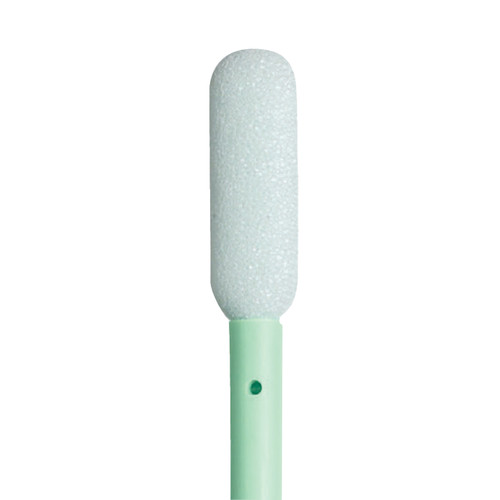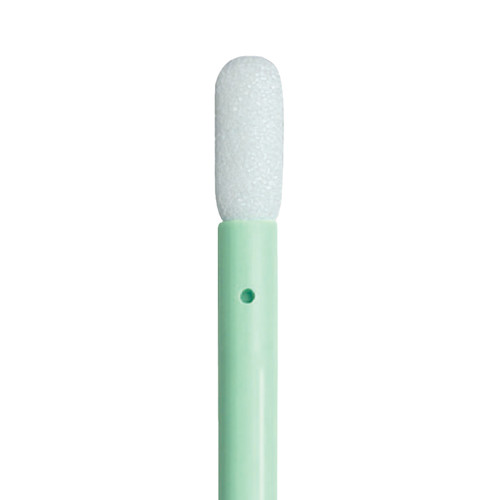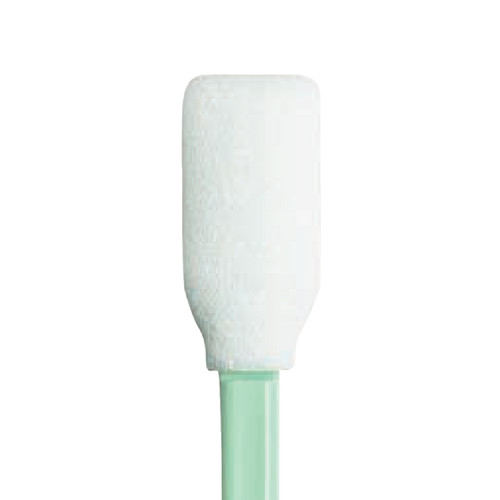
Texwipe STX712A Sterile CleanFoam Swab with Rectangular Head

$362.27
(No reviews yet)
SKU:
STX712A
Availability:
7 - 10 Business Days
Shipping:
Calculated at Checkout
Quantity Option (Case):
10 Boxes of 50 Swabs Per Case
Type:
Dry Swab
Swab Family:
CleanFoam
Swab Material:
Foam
Sterile:
Yes

STX712A Sterile CleanFoam® Rectangular Head Cleanroom Swab (100 PPI Closed-Cell Foam)

STX712A Sterile CleanFoam is a low-linting (no swab is truly ‘zero-lint’ in every process condition), sterile, rectangular-head foam cleanroom swab designed for controlled cleaning, solvent application and removal, fine powder pickup, and sampling in critical environments. The swab head is constructed from high-quality 100 PPI polyurethane CleanFoam (closed-cell behavior for wipe control) and bonded to a polypropylene handle using a thermal bond to reduce adhesive-related contamination risk at the bond line. Each swab is individually packaged in a peel-apart sleeve to support sterile-at-the-moment-of-use workflows, with lot coding and expiration dating to strengthen documentation, inventory control, and audit readiness. Sterilization is commonly specified as gamma irradiation to a 10-6 Sterility Assurance Level (SAL) for sterile cleanroom programs where transfer, handling discipline, and traceability matter as much as the swab tip itself.

Sterile-program note: STX712A is widely selected when teams need a sterile foam swab with broad, flat rectangular contact (mini-wiper behavior) plus point-of-use packaging, lot traceability, and expiration dating for environmental monitoring, aseptic cleaning, diagnostic sampling support, and controlled surface sampling in regulated or inspection-driven workflows.

Specifications:
  • Swab head material: 100 PPI polyurethane CleanFoam® (closed-cell foam behavior)
  • Head width: 12.7 mm (0.50")
  • Head thickness: 7.8 mm (0.307")
  • Head length: 25.7 mm (1.012")
  • Handle material: Polypropylene
  • Handle length: 101.8 mm (4.008")
  • Total swab length: 127.5 mm (5.020")
  • Head bond: Thermal (adhesive-free bond line intent)
  • Handle color: Light green (Texwipe authenticity and traceability cue)
  • Sterility: Gamma irradiated to 10-6 SAL (sterile); validated per sterile program expectations (process-dependent documentation)
  • Packaging: 1 swab/sleeve; 50 sleeves/inner bag (triple-bagged for introduction into sterile areas); 10 inner bags/case (500 swabs total/case)
  • Shelf life: Sterile — typically 3 years from date of manufacture (confirm against lot documentation)
  • Use environments: Commonly used across ISO-class cleanrooms and controlled areas, plus microbiology/diagnostic labs (final suitability depends on your process, solvent, and technique)
  • Country of origin: Sterile — made in the Philippines; irradiated in the USA (per manufacturer technical data sheet)
About the Manufacturer: 

Texwipe (an ITW company) differentiates itself in contamination control by treating cleanroom swabs as engineered tools, not commodity sticks. For CleanFoam swabs, that means controlled foam selection (100 PPI polyurethane), automated manufacturing for consistent tolerances, and process controls intended to support low residue/low ionic contribution performance relative to general-purpose swabs (process-dependent).


For sterile cleanroom swab programs, Texwipe also emphasizes sterile packaging architecture (individually sleeved units with multi-layer bag protection), gamma irradiation sterility assurance targets, and documentation discipline (lot traceability, expiration dating, and case-level certificates). SOSCleanroom (SOS) supports that documentation-forward approach with a close working relationship with Texwipe focused on continuity of supply, clean documentation handoff (certificates and lot traceability), and practical application support—so customers can standardize sterile swabbing tools with predictable performance while maintaining procurement reliability and inspection readiness.

STX712A Features:
  • High-quality 100 PPI polyurethane CleanFoam® head (rectangular rigid paddle geometry for broad, flat contact)
  • Thermal bond head-to-handle construction reduces adhesive-related contamination pathways at the bond line
  • Individually packaged in a peel-apart sleeve to support sterile-at-point-of-use handling
  • Each sleeve is lot coded and includes an expiration date to simplify inventory control and documentation
  • Fifty sleeves are triple-bagged to support controlled introduction into sterile areas; triple-bagged units are commonly packed with an additional case-liner layer for added protection
  • Gamma irradiated to a 10-6 Sterility Assurance Level (SAL) in alignment with sterile program expectations (e.g., ANSI/AAMI/ISO 11137 references in documentation)
  • Certificates of Irradiation and Compliance typically accompany case shipments to confirm sterilization dose met specifications
  • Commonly described as tested for endotoxins, ions, and non-volatile residue (NVR) to support critical-environment suitability (confirm against your acceptance criteria)
  • Polypropylene handle offers strong chemical resistance while minimizing added contaminants
  • Trademarked light-green handle with “TEXWIPE” name embossed on the handle supports authenticity verification and tool-crib traceability
STX712A Benefits:
  • Low-linting cleaning control: Foam swab construction helps reduce fiber contribution versus traditional fibrous swabs (process-dependent; technique still matters)
  • Sterile-at-the-surface execution: Individually sleeved packaging supports controlled transfer and point-of-use sterility maintenance
  • Rectangular head coverage: Broad, flat contact supports consistent pressure distribution for wipe-downs, film pickup, and controlled solvent laydown on flat surfaces
  • Reduced residue risk at the joint: Thermal bonding helps avoid adhesive softening or residue contribution under solvent exposure and pressure cycling
  • Traceability for inspections: Lot coding and expiration dating streamline record keeping, deviations, and audit response
  • Chemistry compatibility: Polyurethane foam and polypropylene handle are commonly used with many cleanroom-compatible solvents/cleaners (verify compatibility to your chemistry and SOP)
Common Applications:
  • Environmental monitoring swabbing and controlled surface sampling (sterile workflows)
  • Diagnostic sampling support where sterile handling and traceability are required
  • Controlled cleaning with compatible solutions and solvents (equipment touchpoints, fixtures, joints, intersecting surfaces)
  • Applying and removing lubricants, adhesives, coatings, or process solutions in critical clean environments
  • Picking up fine powders and particulate residues with controlled contact
  • Spot cleaning of flat features where a rectangular paddle provides stable contact and predictable stroke control
Best-Practice Use:
  • Peel-and-present technique: Open the peel-apart sleeve at point of use and present the swab without touching the head to preserve sterile intent.
  • Use straight-line strokes: On flat surfaces, maintain a square head-to-surface orientation and wipe in straight lines to avoid re-depositing contamination.
  • Control wetness: If wetting the swab, apply solvent intentionally (wet, not dripping) to prevent pooling in seams, threads, and electrical interfaces.
  • Protect the foam: Avoid dragging the head across burrs, sharp edges, or threads that can tear foam and increase shedding risk.
  • One swab, one critical task: For sterile sampling or critical wipe steps, treat each swab as single-use to prevent cross-contamination and documentation ambiguity.
  • Change-out triggers: Replace the swab if the head becomes visibly soiled, tacky, torn, or begins to leave streaks/residue.
Selection Notes (STX712A vs. Other Options)
  • Sterile vs. non-sterile (TX712A): Choose STX712A when sterile packaging, gamma irradiation, lot traceability, and expiration dating are required for the workflow; choose TX712A when sterile program controls are not required.
  • Rectangular paddle vs. point geometry: Use STX712A when you need broader, flat contact and stable pressure control; switch to smaller or different head shapes when access, pinpoint contact, or deep recess cleaning is the priority.
  • Packaging architecture matters: STX712A is built for controlled introduction into sterile areas (individually sleeved, multi-layer bag protection). If your risk is transfer and handling, prioritize packaging configuration as much as head dimensions.

Link to Texwipe Technical Datasheet:
Click Here
Texwipe.com PDF: Click Here

Notes: Looking for application guidance or qualification context for Texwipe STX712A Sterile CleanFoam rectangular head cleanroom swabs? Use STX712A when your priority is sterile-at-point-of-use handling, lot traceability, and broad, flat contact for controlled cleaning or sampling. For best results, align swab selection to your solvent system, surface type, and acceptance criteria, and validate the technique (wipe direction, pressure, wetness control, and change-out discipline) to reduce operator-to-operator variability.

SOSCleanroom.com supports contamination-control programs with cleanroom consumables, responsive technical support, and documentation-forward supply continuity—so teams can standardize critical tools without substitution pressure.

Product page updated: Jan. 5, 2026 (SOS Technical Staff)

© 2026 SOS Supply. All rights reserved.

The Technical Vault
By SOSCleanroom
Last reviewed: January 5, 2026
Texwipe STX712A Sterile CleanFoam® Rectangular Head Swab: Sterile transfer discipline with a controlled closed-cell foam paddle
Practical solutions in a critical environment

“Sterile” swabs are often selected because the risk is not the swab tip. The risk is how the tool moves from shipper to controlled space without importing bioburden, packaging debris, or trace residues that can compromise an aseptic process, an environmental monitoring result, or a cleaned-and-ready surface.

Texwipe’s STX712A addresses that transfer problem with sterile point-of-use packaging, lot traceability, and a rectangular closed-cell CleanFoam® head that gives you predictable, flat contact. When the swab is part of a documented method, SOSCleanroom’s long-standing relationship with ITW Texwipe supports continuity of supply and documentation discipline, reducing the chance of last-minute substitutions that break validation logic.

What is this swab used for
  • Sterile-area cleaning with compatible solutions and solvents where a broad, flat contact face helps control film and pressure.
  • Environmental monitoring and surface sampling workflows that require documented sterility at the moment of use.
  • Applying and removing lubricants, adhesives, and small-volume solutions in controlled environments.
  • Scrubbing recessed areas, joints, and intersecting surfaces without snagging on edges.
  • Picking up fine powders and localized debris where wipes cannot maintain stable contact.
Selection gate

Choose STX712A when sterile transfer and a controlled, flat foam face are the primary requirements. If the application requires higher mechanical scrubbing, higher solvent loading, or deeper crevice reach, consider a geometry-specific sterile foam tip or a different head profile that matches the feature.

Why should customers consider this swab
  • Sterile point-of-use packaging: Each swab is individually packaged in a peel-apart sleeve; sleeves are lot coded and expiration dated for inventory control.
  • Clean transfer packaging architecture: Fifty sleeves are triple-bagged for introduction into sterile areas; triple-bagged units are packaged in a case liner as a fourth layer of bag protection.
  • Thermal bond construction: Complete thermal bond construction eliminates the risk of adhesive contamination at the head-to-handle interface.
  • Closed-cell 100 ppi foam behavior: Readily absorbs solvents and solutions and grabs particulates while supporting uniform solvent laydown on flat surfaces.
  • Audit-friendly traceability: Lot coded for traceability and quality control; gamma-irradiated to a Sterility Assurance Level of 10-6 and sterile validated according to AAMI guidelines.
  • Operational segregation cue: Trademarked light-green handles with “TEXWIPE” name embossed on the handle support visual segregation and reduce mix-ups in shared tool areas.
Materials and construction

STX712A uses a 100 ppi polyurethane CleanFoam® head on a rigid rectangular paddle geometry with a 100% polypropylene handle. In practice, the rectangular head functions like a mini-wiper: a flat face that can be kept square to the surface so you can control contact pressure, stroke direction, and solvent film thickness.

The head-to-handle interface is thermally bonded, not glued. On swabs, the bond line is often the most contamination-sensitive location because adhesives can soften with solvent exposure, trap residues, or contribute nonvolatile residue. A thermal bond reduces that pathway and tends to be more consistent from lot to lot.

A cleanroom reality check: no swab is truly lint-free. Even foam and polyester designs can shed under the wrong solvent, excessive pressure, abrasion on sharp edges, or repeated passes on a loaded face. The objective is low-linting behavior supported by technique and a surface condition that does not abrade the head.

Specifications in context

STX712A’s rectangular head is sized for broad contact in joints and intersecting surfaces while keeping the tool compact enough for controlled hand positioning. The rigid paddle geometry helps you maintain a consistent angle and avoid “edge loading,” which is where many operators unintentionally gouge residue lines into a soft coating. The polypropylene handle supports chemical resistance and reduces the chance of introducing contaminants from the shaft.

  • Head material: 100 ppi polyurethane CleanFoam® (closed cell)
  • Head width: 12.7 mm (0.500")
  • Head thickness: 7.8 mm (0.307")
  • Head length: 25.7 mm (1.012")
  • Handle material: 100% polypropylene
  • Handle width: 5.2 mm (0.205")
  • Handle thickness: 3.0 mm (0.118")
  • Handle length: 101.8 mm (4.008")
  • Total swab length: 127.5 mm (5.020")
  • Head bond: Thermal
  • Handle color: Light green
  • Design notes: Rigid head paddle; long, easy-grip handle
Cleanliness metrics

The values below are manufacturer-reported contamination characterization data for the TX712A / STX712A family. Treat them as background indicators, not acceptance limits. This matters in practice because operator variables often dominate outcomes: solvent grade, wetness control, stroke discipline, and the discard threshold when the foam face loads.

Ion extractables for STX712A (µg/swab)
Ion Value
Calcium0.12
Chloride0.84
Fluoride0.18
Magnesium0.03
Nitrate0.22
Phosphate0.57
Potassium0.08
Sodium0.34
Sulfate0.61
Nonvolatile residue (NVR) for STX712A (mg/swab)
Extractant Value
DI water (DIW)0.27
Isopropyl alcohol (IPA)0.61

Practical interpretation: for flat cleaning, the rectangular paddle helps you maintain uniform contact and avoid “striping” from uneven pressure. When residues are solvent-soluble, wetness control and early discard usually matter more than raw absorbency. If you see haze after evaporation, review solvent purity, the number of passes per face, and whether the foam is being reused after it loads.

Packaging, sterility and traceability
  • Unit packaging: Each swab is individually packaged in a peel-apart sleeve.
  • Transfer packaging: Fifty sleeves are triple-bagged for easy introduction into sterile areas; the triple-bagged unit is packaged in a case liner forming the fourth layer of bag protection.
  • Case quantity (SOSCleanroom case): 10 boxes of 50 swabs per case (500 swabs per case).
  • Bag controls: Packaged in silicone-free and amide-free bags.
  • Traceability: Lot coded for traceability and quality control; each sleeve is lot coded and has an expiration date.
  • Sterility: Gamma-irradiated to a Sterility Assurance Level of 10-6 and sterile validated according to AAMI guidelines; tested for endotoxins, ions, and NVR.
  • Shelf life: Sterile – 3 years from date of manufacture (manufacturer statement for the series).
  • Country of origin (manufacturer statement): Sterile – Made in The Philippines, Irradiated in the USA.
Best-practice use

The rectangular foam face rewards discipline. If you control wetness, keep strokes single-direction, and rotate faces before the foam loads, you will reduce streaking and avoid redepositing what you just removed.

Operator technique module (sterile foam paddle control)
  • “Damp” solvent technique: Wet the foam until uniformly damp, not glossy-wet and not dripping. A good check is to lightly touch the foam to a clean, inert surface: you want a controlled film transfer, not pooling. Over-wetting creates flood lines and tide marks after evaporation.
  • Stroke count logic: Use single-direction strokes with overlap (think 30% overlap like a wipe pattern). Start with 3–6 strokes per face, then rotate or flip the head. Stop when the face loads, changes color, or begins to drag.
  • Geometry control: Keep the paddle square to the surface. For slots, tracks, and channels, use the long handle to maintain a stable angle and keep gloves and sleeves out of the contact plane.
  • Pressure guidance: Use enough pressure to maintain full contact, not enough to compress the foam into edges. Excess pressure increases abrasion on burrs and can leave residue lines from drag.
  • Solvent compatibility framing: IPA is common; other solvents may be used per the surface and coating compatibility. Validate solvent compatibility with the substrate, adhesive systems nearby, and any printed markings before standardizing the method.
  • Sterile handling discipline: Stage only what you will use immediately. Open the peel-apart sleeve with a clean, deliberate motion to avoid sleeve fibers and packaging snap-back. Do not set the exposed swab on the bench. Do not re-dip a used swab into a shared solvent container.
  • Disposal and documentation cues: Discard after localized use. When supporting investigations or EM trending, capture lot, expiration date, solvent, location, and number of passes used.

Standards context: cleanroom housekeeping and contamination-control methods commonly align to ISO cleanroom classification frameworks and IEST recommended practices. In regulated workflows, ensure your sterile transfer steps, documentation, and deviation handling align with your site’s quality system and FDA expectations. ASTM standards are frequently used across industry to structure test methods and residue evaluation; use them as reference points when defining internal qualification logic.

Common failure modes
  • Over-wetting and flooding: Creates evaporation lines and spreads residues. Control with a damp standard and avoid saturating the foam.
  • Reusing a loaded face: Leads to smearing and redeposition. Control with a rotation rule and early discard triggers.
  • Two-direction scrubbing on a flat surface: Can grind residues into coatings and leave drag lines. Control with single-direction strokes and overlap.
  • Edge abrasion on burrs: Foam can snag or tear on sharp edges. Control by reducing pressure, changing approach angle, or switching to a geometry-matched head profile.
  • Breaking sterile chain at point of use: The swab may remain sterile in the sleeve, but the process fails if the exposed swab touches non-sterile surfaces or gloves. Control with a defined opening and staging sequence.
Closest competitors

In the same functional class (sterile rectangular foam swabs), the meaningful differentiators are foam quality and cell structure, bond method at the head interface, sterile packaging architecture, and the depth of published contamination characterization and traceability controls.

  • Puritan sterile foam-tipped applicators (rectangular or paddle formats): Evaluate whether the head is thermally bonded or adhesive-bonded, whether packaging supports clean transfer into sterile areas, and whether ion and NVR characterization is published for your residue sensitivity.
  • Berkshire sterile foam swabs (paddle or rectangular profiles): Compare foam density/ppi disclosure, traceability (lot coding and expiration labeling), and whether sterility documentation is case-attached and audit-ready.
  • HUBY-340 sterile foam swabs (electronics and controlled environments): Compare head geometry rigidity, packaging layers for sterile introduction, and availability of contamination characterization data suitable for your process controls.
Critical environment fit for this swab

STX712A is a strong fit when the process requires sterile transfer discipline and a controlled, flat foam face for cleaning, sampling, or solvent application. The thermally bonded closed-cell foam paddle supports uniform contact on joints, edges, and intersecting surfaces, while the packaging architecture supports routine introduction into sterile areas with traceability.

SOSCleanroom reinforces that fit with continuity of supply through our established ITW Texwipe relationship, fast shipping to prevent unqualified “workarounds,” and customer support that understands sterile introduction and documentation requirements. When an investigation requires lot correlation, stable sourcing and consistent documentation reduce the chance that the consumable becomes the uncontrolled variable.

Source basis
  • SOSCleanroom product page (STX712A): https://www.soscleanroom.com/product/swabs/texwipe-stx712a-sterile-cleanfoam-swab-with-rectangular-head/
  • ITW Texwipe manufacturer product page (STX712A): https://www.texwipe.com/sterile-foam-stx712a
  • ITW Texwipe Technical Data Sheet: CleanFoam® Swab Series, US-TDS-051 Rev. 09/21 (construction, sterile packaging features, physical characteristics, ion extractables and NVR data, shelf life, country of origin statements): https://www.texwipe.com/images/uploaded/documents/Swabs/Texwipe-Cleanfoam-Swabs-TDS.pdf
  • SOS-hosted PDF copy (primary stable reference): Technical data sheet (TX706A, TX707A, TX708A, TX709A, TX710A, TX712A family): https://www.soscleanroom.com/content/texwipe_pdf/706a%20707a%20708a%20709a%20710a%20712a.pdf
  • International Organization for Standardization (ISO): https://www.iso.org/standard/53394.html
  • FDA (Food and Drug Administration): https://www.fda.gov/
  • ASTM (American Society for Testing and Materials): https://www.astm.org/
  • IEST (Institute of Environmental Sciences and Technology): https://www.iest.org/
Source: SOSCleanroom
© 2026 SOSCleanroom

Videos Hide Videos Show Videos