Practical solutions in a critical environment
Many “small-area” cleaning failures in controlled environments are not caused by inaccessible geometry. They come from inconsistency: too much solvent, too many repeat passes, or a swab face that shifts from a controlled contact patch into a smear tool. In sterile work, the failure mode is often compounded by handling drift — opening too many units at once, touching sleeves with non-sterile gloves, or re-dipping a used swab into a shared solvent reservoir.
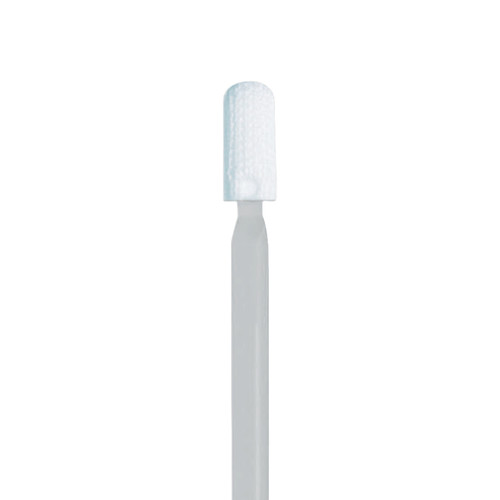
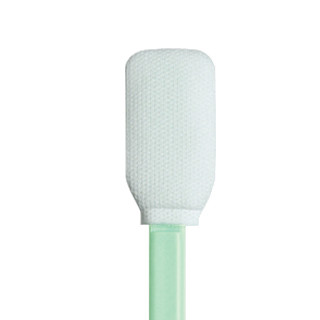
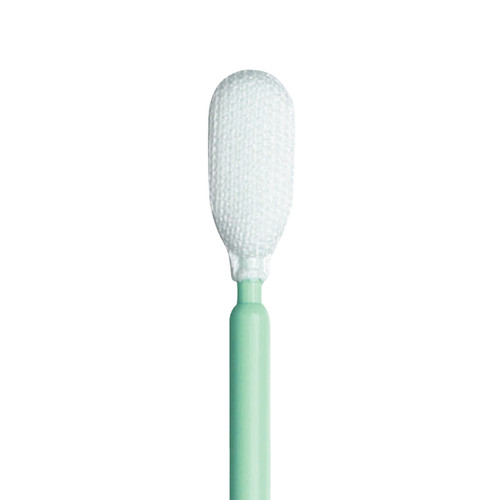
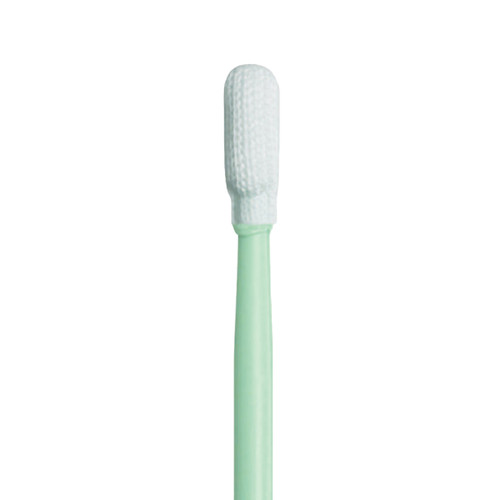
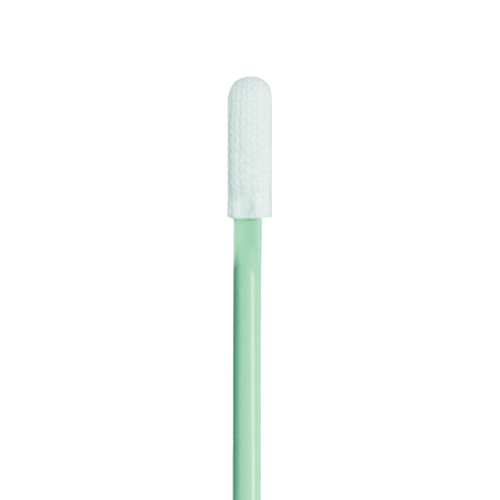
STX758B is built to reduce those variables. It uses a double layer of Alpha® polyester knit on a compact micro head and a fully thermal-bond construction that eliminates adhesive contamination at the head/handle interface. It is cleanroom manufactured for low levels of ions and nonvolatile residues (NVR), and it is lot coded for traceability and quality control. Each swab is individually packaged in a peel-apart sleeve with an expiration date to support inventory control and sterile-area introduction discipline.
Low-linting outcomes depend on technique and surface condition. No swab is truly lint-free; edge sharpness, surface roughness, solvent load, contact pressure, and stroke discipline govern what you see on the part.
What is this swab used for
Texwipe STX758B is used for precision spot cleaning in grooves, tracks, slots, and other small spaces where a standard head is too large to control contact and overlap. The micro head and compact handle geometry are practical for tight clearances, small tooling details, and residue-sensitive areas where “one clean pass” needs to be a defined, repeatable action rather than a scrub.
Common uses include applying and removing lubricants, adhesives, and process solutions, and solvent use such as IPA (validate compatibility with your surface, coatings, inks, and assembly materials). In sterile operations, the individually sleeved format supports single-unit opening at the point of use, reducing exposure time and helping maintain aseptic handling discipline.
Why should customers consider this swab
- Micro head geometry supports controlled contact in small spaces without forcing “edge wiping” that can streak or miss residue lines.
- Alpha® polyester knit, double-layer head improves controlled solution pickup and mechanical pickup on smear-prone films.
- Complete thermal-bond construction eliminates adhesive contamination at the bond line, reducing a residue variable in solvent-wet work.
- Individually packaged peel-apart sleeves with expiration dating support sterile handling discipline and inventory control.
- Triple-bagged configuration and case-liner fourth layer are designed for cleaner transfer into sterile areas.
- Published typical ions and NVR data help set realistic background expectations in residue-sensitive troubleshooting (values are typical analyses, not per-unit specifications).
- Trademarked light-green handle with “TEXWIPE” embossed on the handle is a practical line-level traceability and segregation cue.
Materials and construction
Head: Alpha® polyester knit (double layer)
Head bond: thermal bond (no adhesive at the bond)
Handle: polypropylene; compact handle format; handle color: light green; “TEXWIPE” embossed
Practical implication: micro heads amplify technique effects. Treat burrs and sharp edges as a process risk; reduce pressure near edges, avoid dragging the knit across sharp corners, and do not “power through” snag points that can create local fiber or particle release. Because the swab is small, over-wetting happens fast — keep solvent load controlled and intentional.
Specifications in context
STX758B is a compact, micro-head sterile swab intended for small-space control. Use head width to set overlap rules in tight tracks (avoid “random angle” wiping). Use head thickness and length to manage wetness and pressure distribution: small heads can flood quickly, so solvent control and early rotation matter more than with larger paddles. Handle dimensions matter for stability and for keeping gloved fingers out of the contact zone during aseptic technique.
| Attribute |
STX758B |
| Head material |
Alpha® polyester knit (double layer) |
| Head width |
3.2 mm (0.126") |
| Head thickness |
2.5 mm (0.098") |
| Head length |
11.0 mm (0.433") |
| Handle material |
polypropylene |
| Handle width |
2.2 mm (0.087") |
| Handle thickness |
2.2 mm (0.087") |
| Handle length |
60.0 mm (2.362") |
| Total swab length |
70.0 mm (2.756") |
| Head bond |
thermal |
| Handle color |
light green |
| Design notes |
flexible head paddle; compact handle |
Cleanliness metrics
The values below represent published typical analyses and are not per-unit specifications. Use them as a baseline for risk assessment, method development, and troubleshooting. If you run film-sensitive work (optics, polished metals, coated parts) or you validate cleaning (TOC, HPLC/UV-Vis, ion chromatography), qualify the swab with your solvent, your surfaces, your stroke count, and your inspection method so the swab does not become the dominant background signal.
Ion extractables (µg/swab)
| Ion |
STX758B (typical) |
| Calcium | 0.03 |
| Chloride | 0.12 |
| Fluoride | 0.01 |
| Magnesium | 0.01 |
| Nitrate | 0.02 |
| Phosphate | 0.01 |
| Potassium | 0.01 |
| Sodium | 0.02 |
| Sulfate | 0.06 |
Nonvolatile residue (NVR) (mg/swab)
| Extractant |
STX758B (typical) |
| DIW extractant | 0.01 |
| IPA extractant | 0.03 |
Operator takeaway: micro heads can hide a wetness problem until the end of stroke. Keep the head damp, rotate early, and stop when drag increases. If you see a drying ring, reduce solvent load, shorten stroke length, and avoid a “pause” at the end of travel where solvent can pool.
Packaging, sterility and traceability
- Packaging (STX758B): 1 swab/sleeve; 50 sleeves/inner bag (triple bagged); 10 bags/case; 500 swabs total/case
- Bag packaging controls: silicone-free and amide-free bag packaging
- Sterility processing: gamma-irradiated to a Sterility Assurance Level (SAL) of 10-6; sterile validated according to AAMI guidelines
- Unit controls: each swab individually packaged in a peel-apart sleeve; each sleeve lot coded and expiration dated
- Shelf life (series statement): sterile 3 years from date of manufacture
- Storage conditions (sterile swabs TDS): store at ambient conditions, 59°F (15°C) to 86°F (30°C)
- Traceability cues: lot coded packaging supports investigations; “TEXWIPE” embossed handle and light-green handle color support practical line segregation
- Country-of-origin (manufacturer statement): made in The Philippines; sterile versions irradiated in the U.S.
Best-practice use
Treat STX758B as a micro-scale “controlled wipe,” not a scrubber. Define stroke count, define overlap (even in small slots), and define discard triggers so operators do not chase a residue line by reworking it with a loaded face. In sterile work, define point-of-use opening and limit the number of sleeves opened at once.
Operator-level swabbing technique module
- “Damp” solvent technique: Apply solvent to the head, then reduce to damp, not dripping. With a micro head, one extra drop matters. A practical check is one touch to a controlled blot surface to remove excess. You want a light, even wet track, not a bead.
- Stroke count logic: Use single-direction strokes with intentional overlap. Start with 2–4 passes on a defined small area, then stop and inspect. Rotate to a fresh face early. Discard when drag increases, the face shows visible loading, or the work starts to streak.
- Geometry control: Keep the head square to the surface. In slots and tracks, avoid twisting the wrist — twist turns the knit edge into a squeegee and can leave a line at the end of stroke.
- Pressure guidance: Apply enough pressure to maintain contact, then reduce slightly. Excess pressure can squeegee dissolved residue into a line and can abrade soft coatings.
- Solvent compatibility framing: IPA is common. Validate compatibility with the surface, coating, ink, and adhesive systems. If residue does not dissolve, change chemistry or dwell strategy rather than increasing pressure or stroke count.
- Aseptic handling discipline: Open one sleeve at the point of use. Keep the sleeve peel path away from critical surfaces. Do not place a removed swab onto a bench surface. If the swab contacts a non-sterile surface, discard.
- Solvent reservoir discipline: Do not re-dip a used swab into a shared container. Decant to a small working vessel, refresh frequently, and capture solvent grade and lot in investigation notes when required.
Common failure modes
- Over-wetting the micro head and flooding a slot or pocket, leading to pooling and visible drying rings.
- Reworking the same area with a loaded face, causing streaks and redeposition.
- Twisting the wrist in a track/slot, turning the swab edge into a squeegee and leaving a residue line.
- Snagging the knit on burrs or sharp edges, increasing local fiber/particle risk.
- Sterile handling drift: opening multiple sleeves early, touching sleeves with non-sterile gloves, or staging opened swabs on a bench.
Closest competitors
The closest alternatives are sterile polyester knit or sealed-edge polyester swabs designed for micro-scale contact cleaning, where the selection hinges on head construction (knit vs sealed), bond method (thermal vs adhesive), data availability (ions/NVR/endotoxin), and packaging/traceability controls. Compare wetting behavior (flooding risk), snag resistance near edges, and whether lot coding and expiration dating support investigations and inventory discipline.
- Contec sterile polyester swab classes (sealed or knit): Evaluate construction approach and how the swab behaves under your solvent and inspection method, including background residue risk and snag behavior in slots.
- Berkshire sterile polyester swab classes: Compare published cleanliness support, lot/expiration controls, and packaging layers for sterile-area transfer.
- Puritan sterile polyester swab formats (micro head class): Confirm bond mechanism, documentation depth, and whether the packaging system supports your point-of-use opening discipline.
Critical environment fit for this swab
STX758B fits residue-sensitive and sterile workflows where micro-scale contact control matters: tight slots, grooves, small tooling details, and small-surface cleaning where a larger head forces poor overlap or unintended edge contact. It is a strong choice when you want controlled technique that remains auditable, with each swab treated as a single-use unit.
SOSCleanroom’s relationship with ITW Texwipe supports continuity of supply and documentation discipline, reducing the risk of unplanned substitutions that change wetting behavior, background extractables, or sterile handling assumptions. That matters in ISO-aligned cleanroom programs and in regulated environments where documentation expectations often track FDA quality systems and standards-driven methods associated with ASTM and IEST.
Operational support matters, too. Fast shipping and responsive customer service help keep validated work instructions intact by preventing “make-do” material swaps when production schedules tighten.
Source basis
- SOSCleanroom product page (STX758B): https://www.soscleanroom.com/product/swabs/texwipe-stx758b-sterile-micro-alpha-polyester-cleanroom-swab/
- Texwipe manufacturer product page (STX758B): https://www.texwipe.com/sterile-alpha-polyester-swab-stx758b
- Texwipe technical data sheet: “Cleanroom Swabs — Sterile” (US-TDS-060 Rev. 09/21): https://www.texwipe.com/images/uploaded/documents/Swabs/Texwipe-SterileSwabs-TDS.pdf
- Texwipe technical data sheet: “Cleanroom Swabs — Alpha® Polyester Knit Series” (US-TDS-062 Rev. 09/21): https://www.texwipe.com/images/uploaded/documents/Swabs/Texwipe-AlphaPolyesterKnit-Swabs-TDS.pdf
- International Organization for Standardization (ISO) reference (ISO 14644-1:2015): https://www.iso.org/standard/53394.html
- FDA (Food and Drug Administration): https://www.fda.gov/
- ASTM (American Society for Testing and Materials): https://www.astm.org/
- IEST (Institute of Environmental Sciences and Technology): https://www.iest.org/
SOSCleanroom is the source for this Technical Vault entry.
Briefed and approved by the SOSCleanroom (SOS) staff.
Last reviewed: January 6, 2026
© 2026 SOSCleanroom