Practical solutions in a critical environment
In sterile and residue-sensitive work, the failure is often not “we missed the corner.” It is contact control and handling control: a swab that cannot reach cleanly forces operators to over-extend, bend wrists, or drag the head at an angle, which increases snag risk, streaking, and inconsistent wetting. In aseptic processing and ISO-aligned cleanrooms, that becomes a repeatability problem, not a one-off technique issue.
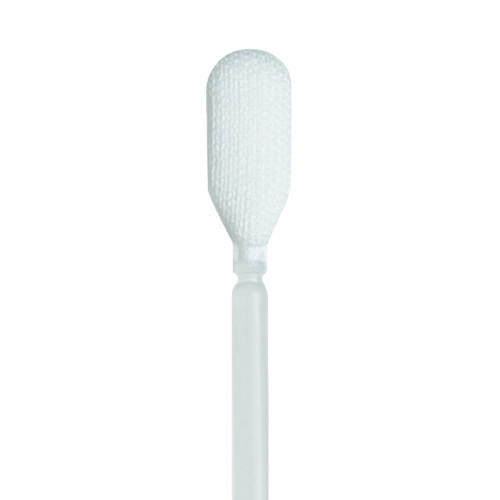
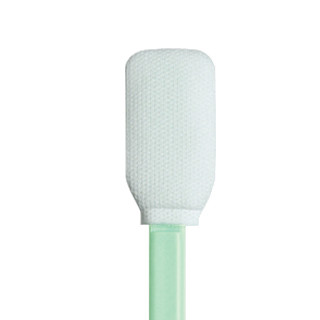
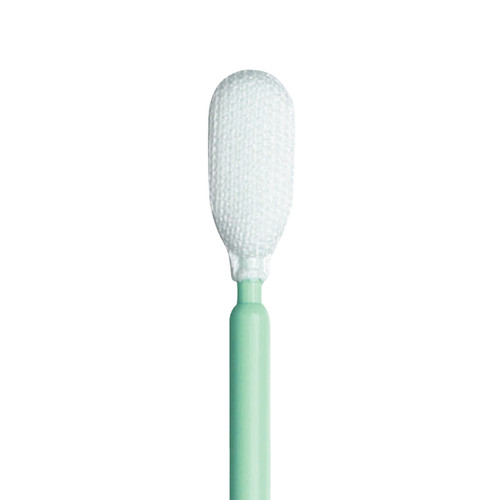
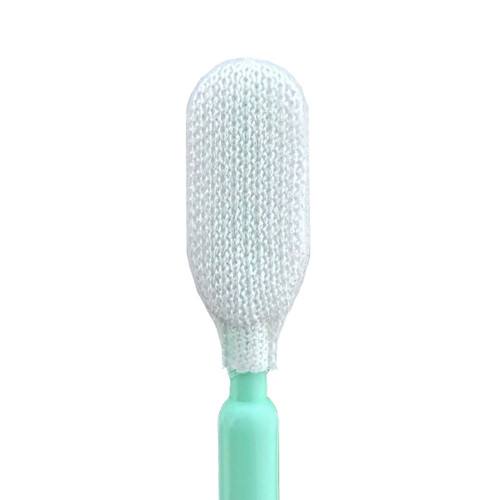
STX761 is built to reduce those variables. It pairs a double-layer Alpha® polyester knit head with a long polypropylene handle, and it uses thermal bond construction to eliminate adhesive at the head/handle interface. In solvent-wet cleaning and controlled sampling, removing adhesive from the bond line can help reduce a common hidden contributor to smear-prone background residue. The sterile configuration adds individually packaged sleeves with lot coding and expiration dating to support point-of-use sterility discipline.
Low-linting outcomes still depend on technique and surface condition. No swab is truly lint-free; edge sharpness, surface roughness, solvent load, contact pressure, and stroke discipline govern what you see on the part.
What is this swab used for
Texwipe STX761 is used for sterile, controlled cleaning and controlled sampling where reach matters: grooves, tracks, wide slots, rails, isolator access points, and work zones that are physically accessible but difficult to service with a standard-length swab without compromising contact angle. The long handle helps keep gloved fingers and sleeves out of the work envelope while maintaining a stable, flat head presentation.
Common uses include applying and removing lubricants, adhesives, and processing solutions; lifting particulate and smear-prone films; and solvent use such as IPA (validate compatibility with your surface, coatings, inks, and assembly materials). STX761 is also commonly selected where sterile packaging, lot traceability, and expiration dating support documentation expectations and audit-ready handling in controlled environments.
Why should customers consider this swab
- Sterile, individually sleeved configuration supports point-of-use sterility discipline, with lot coding and expiration dating at the sleeve level.
- Long handle improves reach and helps keep hands out of sensitive zones, reducing accidental contact and improving technique repeatability.
- Alpha® polyester knit (double layer) supports controlled solution pickup and mechanical pickup on smear-prone films without turning the swab into a “brush.”
- Thermal bond construction eliminates adhesive at the bond line, reducing a residue variable in solvent-wet work.
- Published typical ion extractables and typical NVR data help set realistic background expectations in residue-sensitive cleaning, sampling, and investigations.
- Silicone-free and amide-free bag packaging supports processes sensitive to slip additives and silicone transfer.
- Trademarked light-green handle with “TEXWIPE” embossed on the handle is a practical line-level traceability and segregation cue.
Materials and construction
Head: Alpha® polyester knit (double layer)
Head bond: thermal bond (no adhesive at the bond)
Handle: polypropylene; long-handle format; handle color: light green
Practical implication: the knit head is intended to resist snagging and abrading under normal use, but sharp edges and burrs are still process risks. Reduce pressure near edges, avoid dragging the knit across sharp corners, and do not “power through” snag points that can create localized fiber or particle release and compromise sterile handling discipline.
Specifications in context
STX761 is a long-handle swab intended to improve access while keeping head control. Use the head width and head length to standardize overlap and stroke count so the process does not drift into scrubbing. The long handle length supports reach, but it also increases leverage: define pressure guidance so operators do not unintentionally increase force at the head when working at full reach. If your work is film-sensitive (optics, polished metals, coated parts), pair the swab geometry with “damp” technique to prevent pooling and drying rings.
| Attribute |
STX761 |
| Head material |
Alpha® polyester knit (double layer) |
| Head width |
6.8 mm (0.268") |
| Head thickness |
2.8 mm (0.110") |
| Head length |
16.8 mm (0.661") |
| Handle material |
polypropylene |
| Handle width |
3.2 mm (0.126") |
| Handle thickness |
3.2 mm (0.126") |
| Handle length |
145.5 mm (5.728") |
| Total swab length |
162.3 mm (6.390") |
| Head bond |
thermal |
| Handle color |
light green |
| Design notes |
long handle for reach; knit head for controlled contact; sterile sleeve packaging |
Cleanliness metrics
The values below represent published typical analyses and are not per-unit specifications. Use them as a baseline for risk assessment, method development, and troubleshooting. If you validate cleaning (TOC, HPLC/UV-Vis, ion chromatography) or you run film-sensitive work, qualify the swab with your solvent, surfaces, stroke count, and inspection method so the swab does not become the dominant background signal.
Typical ion extractables (µg/swab)
| Ion |
STX761 |
| Calcium | 0.01 |
| Chloride | 0.01 |
| Fluoride | 0.01 |
| Magnesium | 0.01 |
| Nitrate | 0.01 |
| Phosphate | 0.01 |
| Potassium | 0.01 |
| Sodium | 0.01 |
| Sulfate | 0.01 |
Typical nonvolatile residue (NVR) (mg/swab)
| Extractant |
STX761 |
| DIW extractant | 0.01 |
| IPA extractant | 0.03 |
Operator takeaway: long-handle reach can hide a wetness problem because the operator is focused on access. Keep the head damp, rotate faces early, and stop when drag increases. If you see streaking or a drying ring, reduce solvent load and shorten the “finish” stroke length so the end-of-stroke does not pool.
Packaging, sterility and traceability
- Packaging (STX761): 1 swab/sleeve; 50 sleeves/inner bag, triple bagged; 10 bags/case; 500 swabs/case
- Bag packaging controls: silicone-free and amide-free bag packaging (manufacturer statement)
- Sterility method (series statement): gamma irradiated to a Sterility Assurance Level (SAL) of 10-6; sterile validated per manufacturer statement; sleeves are peel-apart and intended to support point-of-use sterility
- Endotoxin testing (series statement): manufacturer states sterile Alpha® swabs are tested for endotoxins, ions, and NVR
- Shelf life (series statement): sterile 3 years from date of manufacture (expiration date appears on sleeves)
- Traceability cues: lot coded packaging supports investigations; “TEXWIPE” embossed handle and light-green handle color support practical line segregation
- Country-of-origin (manufacturer statement): Sterile – Made in The Philippines, irradiated in the U.S.
Best-practice use
Treat STX761 as a control tool: controlled contact, controlled wetness, controlled discard timing, and controlled sterile introduction. The long handle improves access, but only if you define the technique so operators do not compensate with pressure or repeated rework that redeposits residue.
Suggested qualification checklist (SOP-ready fields)
- Record STX761 lot code and expiration date from the sleeve; record case lot if your program requires it.
- Define solvent grade, decant method, and maximum open time for the working vessel.
- Define wetness control (“damp” standard), stroke count per area, overlap, and discard triggers.
- Define inspection method (visual, UV, gravimetric, TOC, HPLC/UV-Vis, IC) and acceptance criteria tied to the surface risk.
Operator-level swabbing technique module
- Sterile introduction discipline: Use the triple-bag layers as intended for your gowning and area classification. Do not stage open sleeves at the bench. Open the peel-apart sleeve only at point-of-use and avoid touching the head or the portion of the handle that will enter the critical zone.
- “Damp” solvent technique: Apply solvent to the head (or use a controlled wetting method), then reduce to damp, not dripping. A practical check is one controlled blot touch to remove excess. You want a light, even wet track, not a bead. Over-wetting increases pooling and creates tide marks as solvent evaporates.
- Stroke count logic: Use single-direction strokes with overlap. Start with 2–4 passes on a defined area, then stop and inspect. Rotate to a fresh face early. Discard when drag increases, the face shows visible loading, or the work starts to streak.
- Reach without leverage: When working at full reach, reduce pressure. The long handle increases leverage and can unintentionally increase head force. Keep the head flat and avoid wrist twist that turns the head into an edge.
- Solvent compatibility framing: IPA is common. Validate compatibility with the surface, coatings, inks, and adhesive systems. If residue does not dissolve, change chemistry or dwell strategy rather than increasing pressure or stroke count.
- Handling discipline: Stage only what you need. Do not re-dip a used swab into a shared solvent reservoir. Decant to a small working vessel and refresh it frequently to prevent cross-contamination and concentration drift.
- Disposal and documentation cues: Discard after the defined stroke count or at first loading. For investigations, capture lot/expiry, solvent grade, wetness-control approach, stroke count, and inspection outcome so trends can be separated from process drift.
Common failure modes
- Breaking sterile discipline by staging opened sleeves or touching the head/critical handle zone during introduction.
- Over-wetting the head and flooding the surface, leading to pooling, drying rings, or solvent-driven redeposition.
- Reworking the same area with a loaded face, causing streaks and redeposition.
- Using leverage at full reach (too much pressure), which can squeegee dissolved residue into a line at the end of the stroke.
- Cross-contaminating solvent by re-dipping or using a shared reservoir without decant-and-refresh discipline.
Closest competitors
The closest alternatives are sterile, long-handle polyester swabs intended for controlled cleaning and sampling, where selection hinges on head construction, bond method (thermal vs adhesive), sterile packaging layers, data availability (typical extractables/NVR), and lot/expiry traceability. Compare wetting behavior (flooding risk), snag resistance near edges, and whether supplier documentation supports investigations.
- Contec CONSTIX® sealed polyester swab class (sterile variants): Often positioned for controlled surface contact with sealed construction approaches. Compare head durability under solvent-wet wiping and documentation depth (lot traceability, packaging discipline, extractables data).
- Berkshire Lab-Tips® polyester swab class (sterile variants): Similar polyester intent for critical cleaning and sampling. Evaluate how the head behaves under your solvent and inspection method and whether the supplier provides adequate contamination data and lot control.
- Puritan sterile polyester swab formats (long-handle class): Comparable reach-oriented options may be available. Confirm bond mechanism, packaging layers, and published cleanliness information that supports repeatable qualification.
Critical environment fit for this swab
STX761 is a strong fit for sterile and residue-sensitive cleaning and sampling where reach must not compromise contact control: isolators, hoods, wide slots, rails, fixtures, and difficult-access faces that still require flat, repeatable swabbing. It is most valuable when you need an auditable technique that avoids “creative” workarounds that add pressure, rework, and contamination risk.
SOSCleanroom’s relationship with ITW Texwipe supports continuity of supply and documentation discipline, which reduces the risk of unplanned substitutions that change wetting behavior and background extractables. That matters in ISO-aligned cleanroom programs and in regulated environments where documentation expectations often track FDA quality systems and standards-driven methods associated with ASTM and IEST.
Operational support matters, too. Fast shipping and responsive customer service help keep validated work instructions intact by preventing “make-do” material swaps when production schedules tighten.
Source basis
- SOSCleanroom product page (STX761): https://www.soscleanroom.com/product/swabs/texwipe-stx761-sterile-alpha-polyester-cleanroom-swab-with-long-handle/
- Texwipe manufacturer product page (STX761): https://www.texwipe.com/sterile-alpha-polyester-long-handle-swab-stx761
- Texwipe technical data sheet (SOS-hosted copy): “Cleanroom Swabs — Alpha® Series (TX714A/TX743B/TX754B/TX758B/TX761)” (PDF): https://www.soscleanroom.com/content/texwipe_pdf/714a%20743b%20754b%20758b%20761.pdf
- Texwipe technical data sheet: “ALPHA® SWAB SERIES — Polyester Knit” (US-TDS-062 Rev.09/21): https://www.texwipe.com/images/uploaded/documents/Swabs/Texwipe-AlphaPolyesterKnit-Swabs-TDS.pdf
- International Organization for Standardization (ISO) reference (ISO 14644-1:2015): https://www.iso.org/standard/53394.html
- FDA (Food and Drug Administration): https://www.fda.gov/
- ASTM (American Society for Testing and Materials): https://www.astm.org/
- IEST (Institute of Environmental Sciences and Technology): https://www.iest.org/
SOSCleanroom is the source for this Technical Vault entry.
Briefed and approved by the SOSCleanroom (SOS) staff.
Last reviewed: January 6, 2026
© 2026 SOSCleanroom