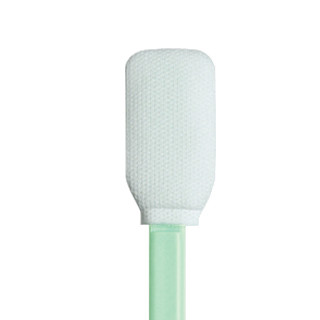
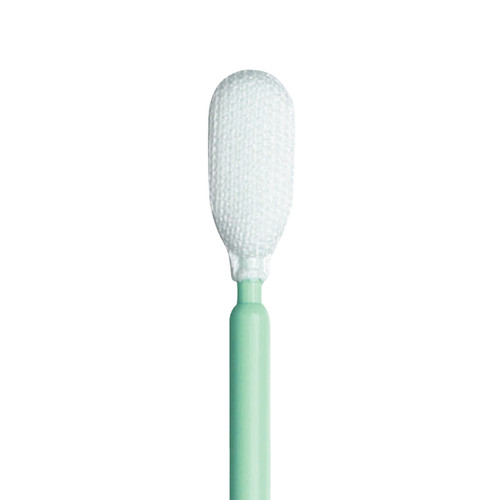
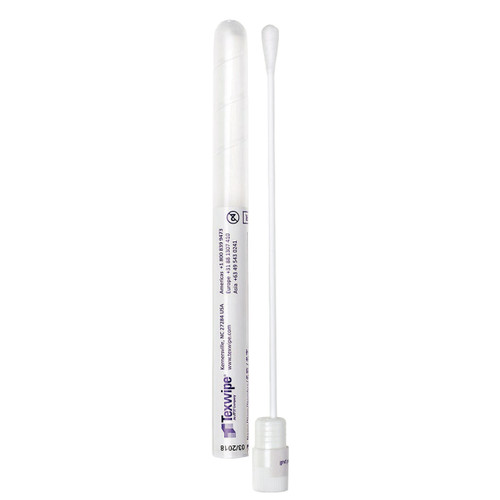
Texwipe STX763 Sterile Gamma Irradiated Polyester Swab

$384.18
(No reviews yet)
SKU:
STX763
Availability:
8 - 10 Weeks
Shipping:
Calculated at Checkout
Quantity Option (Case):
10 Boxes of 50 Swabs Per Case
Type:
Dry Swab
Swab Family:
Spun Polyester
Swab Material:
Polyester
Sterile:
Yes

Texwipe STX763 Sterile Gamma Irradiated Polyester Swab (Individually Wrapped, Lot/Expiration Marked)

Texwipe STX763 is a sterile, gamma irradiated spun polyester swab designed for diagnostic sampling, environmental monitoring, and controlled solvent-assisted swabbing in regulated and contamination-sensitive workflows. Each swab uses a 100% medical-grade spun polyester head securely bonded to a long polystyrene shaft with an aqueous (water-based) adhesive to deliver consistent geometry and repeatable sampling contact on seams, ports, touchpoints, recessed features, and irregular surfaces. STX763 is supplied individually wrapped in easy-open, clear packaging that supports point-of-use sterile presentation while providing visibility of seal integrity. Low-linting performance is process-dependent (no swab is truly ‘lint-free’ under every surface condition and operator technique), but STX763 is engineered to support clean, defensible swabbing where traceability and sterility controls are part of the method—not an afterthought.

Sterile-program note: STX763 is gamma irradiated to a Sterility Assurance Level (SAL) of 10-6 in accordance with ANSI/AAMI/ISO 11137. Each unit package is marked with lot code and expiration date (also embedded in barcode) to support inventory control, chain-of-custody discipline, and audit readiness.

Specifications:
  • SKU: STX763
  • Type: Dry swab (sterile)
  • Swab family: Spun Polyester (Sterile Polyester Series)
  • Swab material: Polyester
  • Head material: 100% medical-grade spun polyester
  • Handle material: Polystyrene
  • Head bond: Adhesive (aqueous/water-based adhesive)
  • Handle color: White
  • Design notes: 100% spun polyester head; long polystyrene handle
  • Dimensions:
    • Head width: 5.8 mm (0.228")
    • Head thickness: 5.8 mm (0.228")
    • Head length: 18.0 mm (0.709")
    • Handle width: 2.5 mm (0.098")
    • Handle thickness: 2.5 mm (0.098")
    • Handle length: 134.0 mm (3.276")
    • Total swab length: 155.0 mm (6.102")
  • Sterility: Gamma irradiated to 10-6 SAL (ANSI/AAMI/ISO 11137); individually wrapped for sterile presentation
  • Packaging (unit): 1 swab per peel-apart sleeve (clear packaging supports seal-integrity visibility)
  • Packaging (inner): 50 swabs/box
  • Packaging (case): 10 boxes/case (500 swabs total per case)
  • Documentation: Certificates of Irradiation and Compliance attached to each case; lot code + expiration date marked on each package and included in barcode
  • Availability: 8–10 weeks (confirm current lead time at order placement)
  • Country of origin: Made in the Philippines; gamma irradiated in the USA
  • Typical use environments: Pharmaceuticals, biologics, medical devices, microbiological and diagnostic testing laboratories, controlled environments
About the Manufacturer: 

Texwipe (an ITW company) is a global leader in contamination-control consumables, including sterile swabs engineered around repeatable geometry, controlled packaging, and documentation discipline. In sterile spun-swab programs like STX763, Texwipe emphasizes point-of-use sterile presentation (individually wrapped units), lot/expiration marking for traceability, and case-level certificates that support regulated workflows and inspection-ready records.


SOSCleanroom (SOS) supports sterile sampling and monitoring programs with continuity of supply, clean documentation handoff, and practical selection guidance so teams can standardize swabbing methods without uncontrolled substitutions that increase variability.

STX763 Features:
  • Gamma irradiated to a Sterility Assurance Level of 10-6 (SAL) in accordance with ANSI/AAMI/ISO 11137
  • Individually wrapped, easy-open peel-apart sleeve supports sterile presentation at point of use
  • Clear unit packaging allows visibility of seal integrity
  • Lot code and expiration date clearly marked on each package and included in barcode for inventory control
  • Certificates of Irradiation and Compliance attached to each case confirm irradiation dose met specifications
  • Pre-sterilized swabs help eliminate repackaging, documentation burden, and validation work tied to in-house sterilization steps
  • Packaging labeled for global use
  • 100% medical-grade spun polyester head bonded to long polystyrene shaft for consistent, repeatable sampling geometry
STX763 Benefits:
  • Audit-ready sterility claim: Defined SAL + standard-aligned irradiation helps support regulated sampling and monitoring programs
  • Traceability you can actually use: Unit-level lot and expiration marks make chain-of-custody and investigation work faster and cleaner
  • Reliable access for real sampling: Large spun-polyester head on a long polystyrene shaft improves reach and consistent approach angle across operators
  • Controlled swabbing with common solvents: Frequently used with IPA for solvent-assisted swabbing (verify compatibility and dwell-time limits for your chemistry)
  • Reduced handling variability: Individually wrapped sterile units help prevent compromise caused by repeated bag opening and rehandling at the bench
Common Applications:
  • Diagnostic sampling and specimen/surface collection workflows (as defined by your program)
  • Environmental monitoring swabbing (surface sampling in controlled areas)
  • Controlled cleaning with solvents such as IPA (spot cleaning and wipe-point swabbing)
  • Surface sampling of seams, ports, recessed features, irregular geometries, and touch surfaces
  • Picking up fine powders and particulate in small or hard-to-reach areas
Best-Practice Use:
  • Open-and-use discipline: Open the sleeve only at point of use and present the swab without contacting the head to preserve sterile integrity.
  • Define the method: For trending or investigation work, standardize the swabbed area, stroke count, stroke direction, and pressure expectations so results are comparable.
  • Control wetness: Damp lifts and captures; over-wet spreads and can drive material toward edges, seams, and the bond line. Avoid flooding the head.
  • Stroke strategy: Use single-direction, parallel, overlapping strokes. Avoid circular scrubbing unless your written method requires it.
  • No re-dipping: Do not return a used swab to a shared solvent reservoir. Use controlled aliquots/dispense to reduce cross-contamination.
  • Chemistry awareness: Polyester is broadly compatible with many common solutions, but polystyrene shafts may be challenged by aggressive chemistries (qualify your solvent, dwell time, and temperature to your SOP).
  • Standards awareness: Align sampling, documentation, and controlled-environment expectations to your program (ISO: https://www.iso.org/standard/53394.html; FDA: https://www.fda.gov; ASTM: https://www.astm.org; IEST: https://www.iest.org).
Selection Notes (STX763 vs. Other Options)
  • Sampling swab vs. ultra-critical residue control: STX763 is a sterile spun polyester swab with an adhesive bond. For ultra-low residue cleaning or validation-sensitive work, confirm whether your method requires a different swab construction (e.g., knit/foam with thermal bonding or method-specific low-background variants).
  • Geometry fit matters: STX763 is a large-head sterile polyester swab for broad contact and recoverability in real sampling. If your target features are narrower channels, micro-ports, or very tight recesses, a smaller head geometry may improve stroke control and access.
  • Solvent strength and shaft compatibility: If your SOP calls for stronger solvents than IPA, qualify the polystyrene shaft under real dwell time and temperature, or specify a handle material better suited to that chemistry.
  • Documentation expectations: Unit-level lot/expiration marking is a major operational advantage when sampling results drive investigations, batch decisions, or regulatory reporting.

Link to Texwipe Technical Datasheet (SOS PDF):
Click Here
Texwipe.com PDF (Spun Swab Series TDS): Click Here
Texwipe.com Product Page: Click Here

Notes: Looking for practical technique guidance for Texwipe STX763 sterile gamma irradiated polyester swabs—including wetting control for IPA swabbing, stroke-count consistency for trending, and documentation checkpoints (lot code, expiration, certificates)? Open the SOSCleanroom Technical Vault tab above for operator-level guidance that supports repeatable sterile sampling and monitoring in controlled environments.

SOSCleanroom.com supports contamination-control programs with best-in-class cleanroom consumables, responsive technical support, and continuity of supply—so sterile sampling methods stay stable and audit-ready over time.

Product page updated: Jan. 6, 2026 (SOS Technical Staff)
Briefed and approved by the SOSCleanroom (SOS) staff.

© 2026 SOS Supply. All rights reserved.

The Technical Vault
By SOSCleanroom
Last reviewed: January 6, 2026
Texwipe STX763 sterile gamma-irradiated spun polyester cleanroom swab: audit-ready surface and diagnostic swabbing when the sample has to stand up in review
Practical solutions in a critical environment

In controlled environments, the “swab” is not just a consumable — it becomes part of the measurement system. When sampling results are trended, audited, or tied to a deviation investigation, the questions quickly shift from “Did we sample?” to “Can we prove what we used, that it was sterile, and that it was in date?” That is where individually packaged, lot-coded sterile swabs reduce risk: they keep the sampling event anchored to documentation, not memory.

STX763 is positioned for sterile point-of-use control: a spun polyester head on a polystyrene handle, packaged as one swab per sleeve with lot coding and an expiration date on each unit. Gamma irradiation is used to support a defined sterility assurance claim, and the layered bagging configuration is designed to help reduce handling compromise during introduction into cleaner areas.

Low-linting outcomes still depend on technique and surface condition. No swab is truly lint-free; edge sharpness, surface roughness, wetness level, contact pressure, and stroke discipline govern what you see on the part and what you recover in the sample.

What is this swab used for

Texwipe STX763 is used for sterile surface sampling and controlled swabbing where you need unit-level traceability and predictable handling. It is commonly selected for seams, ports, touch surfaces, recessed features, and irregular geometries where wipes, contact plates, or larger sampling devices are impractical.

Typical applications include diagnostic sampling, environmental monitoring, and cleaning with compatible solvents such as IPA (and, in some manufacturer guidance for the spun swab series, solvents such as acetone — validate shaft compatibility and dwell time before adopting aggressive chemistries). The swab is also referenced for surface sampling and picking up fine powders when a defined, disposable contact tip is operationally useful.

Customer trust note (how to keep results defensible)
  • Record the swab lot code, expiration date, wetting agent/solvent, and sampling pattern in the same log entry as the sample ID.
  • Run a field blank (opened, handled, and wetted the same way, but not applied to the surface) to separate method background from surface contamination.
  • If your lab result is near an action limit, repeat with a second swab from the same lot and a second lot to rule out handling drift or atypical background.
Why should customers consider this swab
  • Sterile, unit-packed design supports point-of-use control: 1 swab per peel-apart sleeve helps reduce head contact during presentation.
  • Lot coding and expiration dating on each sleeve supports chain-of-custody discipline and speeds investigations.
  • Spun polyester head provides practical pickup for particles and light residues while maintaining a controlled, consistent geometry for repeatable technique.
  • Layered packaging configuration (50 sleeves per inner bag, triple-bagged; multiple bags per case) supports staged introduction into cleaner areas and reduces exterior-bag contamination risk.
  • Gamma irradiation supports a defined sterility assurance claim and aligns the product with sterile-program expectations where documentation is non-negotiable.
  • Polystyrene handle offers durability and operator control during sampling strokes.
  • Program reliability: SOSCleanroom’s long-running relationship with ITW Texwipe helps reduce unplanned substitutions that can change sampling recovery, background signals, and audit documentation flow.
Materials and construction

Head: 100% spun polyester (USP-grade positioning in manufacturer literature)

Head bond: water-based/aqueous adhesive (adhesive-bonded interface)

Handle: polystyrene; long, slender format; handle color: white

Practical implication: adhesive-bonded spun swabs can be a strong fit for sampling and general-purpose sterile swabbing, but they reward wetness control. Avoid flooding the head (especially near the bond line). For ultra-critical residue control (where adhesive variables are unacceptable), a fully thermal-bonded knit polyester or thermally bonded foam swab family is often the more conservative process choice.

Specifications in context

STX763’s dimensions map directly to access, contact control, and repeatability. The ~5.8 mm head width and thickness provide a compact contact patch that can reach seams and small features while still maintaining enough structure for consistent stroke geometry. The long handle supports reach and helps operators hold a stable angle without “choking up” close to the sampling plane — a common cause of inconsistent pressure and accidental head contact.

Note on handle length: published values can differ by measurement convention (e.g., whether the portion embedded in the head is counted as handle). The manufacturer lists a 134.0 mm handle length, while some catalog listings show ~137.0 mm. Treat total length and head dimensions as the most comparable cross-source controls, then qualify technique with a simple bench mockup of your target geometry.

Attribute STX763
Head material spun polyester
Head width 5.8 mm (0.228")
Head thickness 5.8 mm (0.228")
Head length 18.0 mm (0.709")
Handle material polystyrene
Handle width 2.5 mm (0.098")
Handle thickness 2.5 mm (0.098")
Handle length 134.0 mm (5.276") manufacturer listing; some catalog listings show ~137.0 mm (5.394")
Total swab length 155.0 mm (6.102")
Head bond adhesive (water-based/aqueous)
Handle color white
Design notes large head; long polystyrene handle; sterile unit sleeve
Cleanliness metrics

For sterile sampling, the practical goal is not just “clean” — it is known background. Manufacturer literature for this sterile spun swab family notes testing for endotoxins, ions, and nonvolatile residue (NVR), but published numeric extractables are not always presented at the single-SKU level in publicly posted summaries. In residue-sensitive work (TOC, HPLC/UV-Vis, ion chromatography) or regulated sampling, qualify the complete method (swab + wetting agent + container + hold time + lab recovery) and use blanks so the swab does not become the dominant background signal.

Ion extractables (typical data availability)
Metric STX763
Typical ion extractables table Request lot-level documentation when needed (CoA/CoC/irradiation documentation) and validate with method blanks.
Nonvolatile residue (NVR) (typical data availability)
Metric STX763
Typical NVR table Use blanks + qualification with your solvent/surface; avoid over-wetting that can increase smear risk and background.

Operator takeaway: when results are close to a limit, “clean technique” must become visible technique. Use the same stroke count, the same overlap, and the same wetness control every time — and log it.

Packaging, sterility and traceability
  • Packaging (unit): 1 swab per peel-apart sleeve; each sleeve is lot coded and carries an expiration date.
  • Packaging (case): 50 sleeves per inner bag (triple-bagged); 10 outer bags per case; 500 swabs per case total. (Often described commercially as 10 “boxes” of 50 per case.)
  • Sterility: gamma irradiated; sterility assurance level (SAL) 10-6 is stated in manufacturer literature for this sterile spun swab family.
  • Documentation cues: lot/expiration on each unit sleeve; case-level documentation may include irradiation/compliance documentation (program dependent).
  • Shelf life (series statement): sterile – 3 years from date of manufacture (verify the expiration date on the sleeve and your receiving log).
  • Country-of-origin (series statement): sterile – made in the Philippines; gamma-irradiated in the USA.
Best-practice use

Treat STX763 primarily as a sterile sampling tool: prioritize repeatability and traceability over “scrub power.” Define a sampling pattern (area, stroke count, overlap), define wetness control, and define how swabs are staged and discarded so results are comparable across operators and across time.

Operator-level swabbing technique module
  • Open and present without contaminating the head: Tear the sleeve deliberately and present the swab by the handle. Avoid glove contact with the head. If the sleeve tears poorly or the head touches the sleeve edge, treat it as compromised and discard.
  • Wetness control (sampling vs. cleaning): If your method uses a wetting agent (e.g., IPA), keep the head damp — not dripping. Over-wetting can spread residue, pool in crevices, and pull fluid toward the adhesive bond line.
  • Stroke discipline: Use single-direction, overlapping strokes. Avoid circular scrubbing unless your written method requires it. Rotate the swab as it loads; stop once streaking, drag increase, or visible loading appears.
  • Seams, threads, and ports: Use controlled, light pressure and avoid twisting at the wrist. Twisting increases fiber release risk on sharp edges and can smear residues into a line rather than lifting them.
  • Compatibility framing: Polyester is broadly compatible with many solvents. Polystyrene handles can be challenged by aggressive chemistries and long dwell times. If your SOP uses ketones or strong solvents, qualify handle integrity in your real dwell/temperature window before standardizing.
  • Chain-of-custody habits: Capture lot code + expiration date + sample ID together. When trending, add the sampling area estimate and stroke count so results remain comparable even when staffing changes.
Common failure modes
  • Compromising sterility by touching the head, dragging the head across the sleeve edge, or staging opened sleeves on uncontrolled surfaces.
  • Over-wetting and flooding features, leading to pooling, smear transfer, and a higher background signal in blanks.
  • Twisting/scrubbing on threads or sharp edges, increasing fiber release and reducing recovery consistency.
  • Reworking the same area with a loaded head, creating streaks and redeposition that confuses both cleaning outcomes and sample interpretation.
  • Incomplete documentation (missing lot/expiration), turning a valid sampling event into a weak sampling record during review.
Closest competitors

The closest alternatives are sterile, individually packaged polyester sampling swabs with comparable head size and documentation controls. When comparing, focus on (1) unit-level lot/expiration marking, (2) sterility claim documentation, (3) handle polymer compatibility with your wetting chemistry, and (4) consistency of supply (substitutions can change recovery and background).

  • Puritan sterile polyester swab families (diagnostic/surface sampling class): Often selected for specimen collection and surface sampling. Compare unit packaging, lot/expiration marking, and published quality documentation supporting your program.
  • Copan sterile polyester swab families (sampling-focused formats): Strong presence in sampling workflows. Compare head geometry, handle compatibility, and chain-of-custody documentation features.
  • Berkshire sterile polyester swab classes (cleanroom-oriented sampling): Evaluate data availability, packaging discipline, and whether the supplier supports consistent lot-level documentation and stable lead times for your validated method.
Critical environment fit for this swab

STX763 fits sterile sampling and controlled swabbing in pharmaceutical, biologics, medical device, and diagnostic environments where the sampling record must remain defensible. It is also a practical tool for cleanroom maintenance and environmental monitoring when a defined, disposable, sterile contact tip is preferred for consistency.

SOSCleanroom’s relationship with ITW Texwipe supports continuity of supply and documentation discipline. That reduces the risk of unplanned substitutions that can change recovery behavior, background extractables, and audit readiness — a meaningful advantage for ISO-aligned programs and regulated environments where documentation expectations often track FDA quality systems and standards-driven methods associated with ASTM and IEST.

Operational support matters, too. Fast shipping and responsive customer service help keep validated work instructions intact by preventing “make-do” material swaps when production schedules tighten.

Source basis
  • SOSCleanroom product page (STX763): https://www.soscleanroom.com/product/swabs/texwipe-stx763-sterile-gamma-irradiated-polyester-swab/
  • Texwipe manufacturer product page (STX763): https://www.texwipe.com/sterile-polyester-stx763
  • Texwipe technical data sheet: “SPUN SWAB SERIES” (US-TDS-053 Rev.09/21): https://www.texwipe.com/images/uploaded/documents/Swabs/Texwipe-Spun-Swabs-TDS.pdf
  • Texwipe technical data sheet: “STERILE SWABS” (product family overview): https://www.texwipe.com/images/uploaded/documents/Swabs/Texwipe-SterileSwabs-TDS.pdf
  • International Organization for Standardization (ISO) reference (ISO 14644-1:2015): https://www.iso.org/standard/53394.html
  • FDA (Food and Drug Administration): https://www.fda.gov/
  • ASTM (American Society for Testing and Materials): https://www.astm.org/
  • IEST (Institute of Environmental Sciences and Technology): https://www.iest.org/
SOSCleanroom is the source for this Technical Vault entry.
Briefed and approved by the SOSCleanroom (SOS) staff.
Last reviewed: January 6, 2026
© 2026 SOSCleanroom

Videos Hide Videos Show Videos